“No Shell person or NNPC has come here in respect of the report. But as I talk to you, they are drilling. The same Nigerian Army and police that are supposed to protect the Nigerian people will carry them to go and put more benzene (into the environment). If we take laws into our hands, you hear (restiveness) and violence.” The accusations have been put before Shell in an email for weeks, but the company did not respond.
Posts Tagged ‘Ogoniland’
MOSOP may permit oil exploration in Ogoniland
TO VIEW THE COMPLETE DRAMATIC GRAPHICS FROM THE UK GUARDIAN ARTICLE ‘UNLOVEABLE SHELL – GODDESS OF OIL’ – CLICK HERE - TAKES SHORT TIME TO LOAD
Shell, which until 1993 was the major oil producing company in Ogoni, was forced to leave the area following widespread protest spearheaded by MOSOP over alleged human and environmental rights abuses.
Wednesday, 18 January 2012 00:00 Kelvin Ebiri, Port Harcourt
HOPE for resumption of oil and gas exploration in Ogoni, has been rekindled by the new leadership of the Movement for the Survival of the Ogoni People (MOSOP).

MOSOP Interim Chairman and Secretary, Professor Ben Naanen and Meshach Karanwi, said the new leadership would promote the sustainable and equitable exploration of the natural resources of Ogoni for the benefit of Ogoni people.
In a statement made available to The Guardian, they said “efforts would be made to reinforce the policy of dialogue and constructive engagement with the government and corporate entities on the above issues and especially in respect of job creation and economic development to alleviate the dire poverty in Ogoni.”
Shell, which until 1993 was the major oil producing company in Ogoni, was forced to leave the area following widespread protest spearheaded by MOSOP over alleged human and environmental rights abuses.
The MOSOP Provisional Council (MPC) also promised “to promote the protection of the environment and natural resources of Ogoni; in this regard the implementation of the United Nations Environment Program’s report on Ogoni.”
The MPC alleged that Ogoni “has not been fairly treated in the distribution of the dividend of the Niger Delta struggle which the Ogoni people pioneered and shall through dialogue ensure that the government corrects this situation.”
It noted that although the “MPC affirms the primary claim of every Ogoni person to membership of MOSOP, in order to deepen the process of reconciliation and inclusion, every effort would be made to extend a hand of fellowship to every Ogoni person in every walk of life.”
The duo called for “understanding and cooperation from Ogoni leaders in government, business and the professions.”
To enhance the pool of ideas, deepen the process of reconciliation and strengthen the organisation, MPC said it had decided to set up an International Advisory Committee comprising respected Ogoni men and women at home and in the Diaspora.
The Naanen-led MOSOP said it would ensure the promotion and the protection of the human rights as well as the language and culture of Ogoni people.
It added that “the MPC would not overstay its welcome and has irrevocably committed itself to handing over to an elected executive committee on January 4, 2013.”
Naanen and Karanwi commended the courage and wisdom of Mr. Ledum Mitee, former MOSOP President, in sustaining MOSOP’s principle as a democratic organisation.
Comment by Ogoni activist Dum-ale Tanee
I am calling this statement issued by MPC a total joke until I see their plan. They want to use MOSOP to accomplish what they cannot under OCG but the world is watching very closely. It is some of these people who signed MOU in secret for oil exploitation to start in Ogoni, thereby undermining the work of UNEP.
While I am in support of using our resources to develop ourselves, I think the MPC has not informed the people of what their plans are and how we are going to do it without falling back to the pre-MOSOP era.
Therefore, I am challenging all those who are behind this move to make public their plan if they have one or stop their madness.
The first thing I expect MPC to do is to take steps to reach out to the other faction and then make public the election process so that those who wish to participate can make preparations.
Also, in as much as I cannot question the intelligence of those behind this publication, I wish I can say that of their motives and integrity.
I do not think that Ogoni people can easily be tricked into opening up for oil production with the concept of “job creation and elimination of poverty” while their fundamental demands remain unattended.
Those people whose oil are still flowing as we speak in the Niger Delta hasn’t seen much change and they continue to cry and kidnap everyday because the laws that deprived them of the proceeds from our resources remain the same.
Even the minor changes that the government make as a result of our struggle are not implemented, so who are you guys fooling? Finally, while I wish you all a successful tenure, I hope you don’t create any problem that will lead to bloodshed in our land because our people know very well why we started this struggle and how we want to end it.
OGONI OPEN LETTER TO PRESIDENT GOODLUCK JONATHAN
Graphic from the Guardian article Unloveable Shell, the Goddess of Oil
AN OPEN LETTER TO PRESIDENT GOODLUCK EBELE JONATHAN ON THE PROPOSED ENVIRONMENTAL CLEANING OF OGONILAND BASED ON THE UNEP REPORT/ RECOMMENDATIONS.
December 5, 2011, 2011
Dr. Goodluck Ebele Jonathan (GCFR)
President and Commander-In-Chief,
Armed Forces of the
Federal Republic of Nigeria.
Aso Rock, Abuja.
His Excellency,
We the Ogoni students in diaspora, whose parents, siblings, friends and homeland are seriously threatened from human and cooperate environmental policies to extinction by Shell for over five decades in Ogoniland, are greatly honored to write you and the people of Nigeria on the need to urgently address the environmental pollution and concerns of the Ogoni people. We still repose our confidence in you, especially in solving the monumental environmental tragedy that the people of Ogoni, Niger Delta and this great nation are faced with. We urge you therefore to use your leadership in providing credible plan that will ultimately address the environmental cleaning, along with adequate compensation to the Ogoni people for social, health and economic damages.
Few months ago, the people of Ogoni, the people of Nigeria, and the world had a preview of Ogoni environmental nightmare as the United Nations Environmental Programme (UNEP) presented its fourteen months impact assessment study on Oil and gas pollution in Ogoniland. The gravity of the report remains that oil pollution has permeated the length and breadth of Ogoniland beyond human imagination. It is a fate uncalled for and it has exacerbated further the environmental traumatization of the Ogoni people. Therefore, the report has made it clear that there is no cultural, social, economic, moral and legal justification to delay the implementation of the recommendations.
While the UNEP report has validated the Ogoni environmental degradation as a serious ecological war Shell perpetrates daily in Ogoniland, our fears for delaying implementation of the professional-brilliant job of the UNEP is profound and heightened by your duplicated committees and non actions on the report. As a people whose livelihood, history, wealth, and environment have been tied to long chain of discrimination and persecution demonstrated in endless imbalance of socio- political and economic policies towards Ogoni people, we still have hope in you and cannot believe that your caliber of person is employing delay, or other subtle means to deny our people justice even with this credible UNEP report as it has been the manner of most of your predecessors.
We believe your plans in addressing the Ogoni environmental problems should include the use of the UNEP as the On-Scene Remediation Authority in the remediation phase of Ogoniland, and a provision of Comprehensive Environmental Corrective Action Plans that will pre-inform the Ogonis, Nigerians and the world responsible parties, and actions to be taken. We consider that the integration of these two plans, among others, will inject confidence into the entire process, and detect immediately any act of sabotage during the Ogoniland Remediation Project. Our suggestion is based on the fact that the Ogoni pollution has attracted international attention; particularly with the newly validated report by the UNEP, and any approach or plan that is not transparent enough will call to question the intention of the Federal Government of Nigeria under your leadership.
Sir, as a fellow Niger Deltan, we would like to avoid delay in the implementation or any future insinuation that point to failure of the UNEP report/recommendations. Our prayer is that God forbid any Ogonland remediation/bioremediation failure.
We also want to add that in one of your recent trips abroad the issue of state creation gave you a tremendous challenge as your remark was mostly driven by great sense of indifference and politic rather than the honest way to address the growing frustration of unequal equation of social justice in our great nation. We implore you to reconsider your decision and limit your cultural distance on issues of common interest by submitting a bill to the National Assembly for state creation, particularly Bori State. State creation is a common and possible way of solving our political and economic problems of perpetual political marginalization by the government while improving quality of life for its inhabitants.
Mr. President, as you read this letter, we hope that it will touch and remind you of the sacrifice Ogoni people have invested in the campaign for restoring their environment to pristine or near pristine condition. Our efforts have equally sensitized the entire Niger Delta of the danger of oil and gas pollution, yet Ogoni has nothing to show for it while other parts are benefiting. The abandonment of Ogoni and the non-integration of Ogoni in any government meaningful development has made us to hold tenaciously unto the fundamental fact that our wealth are stolen, and we as Ogoni people are made to struggle with poverty, misery, death and pollution. How can something that is so wrong and an injustice to humanity be right because it affects Ogoniland? It is our fervent hope that as you read this letter, it will prompt initiation of action oriented policies towards properly addressing Ogoni cause.
Thank you.
On behalf of the National Union of Ogoni students (NUOS INTL) USA, we are:
Pius Barikpoa Nwinee
President
Sampson Npimnee
Secretary
Baridaakara Sunday
Public Relations Officer.
–
…………………………………………………………….
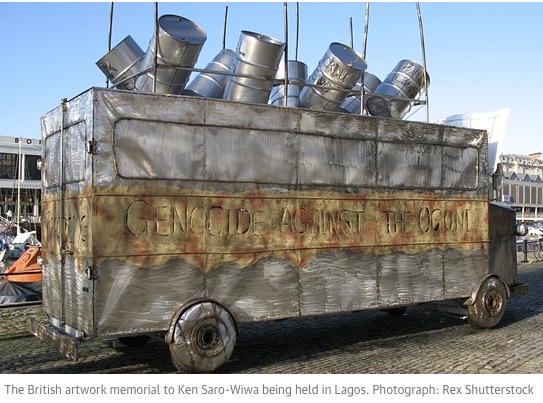
“We are going to demand our RIGHTS – Peacefully, Non-Violently, and we shall WIN” – Ken Saro-Wiwa (1941-1995)
…………………………………………………………….
NUOS Intl – Seeking solutions to the plight of indigenous students around the world.
(www.nuos-ogoni.org ~nuos.intl@gmail.com ~ friends@nuos-ogoni.org ~ phone/msg – 773.250.7004)
MOSOP Welcomes EU – U.S. Call for Restoration of Ogoni Environment
STATEMENT BY MOSOP MEDIA 1 December 2011 21:26:50 GMT
MOSOP President/Spokesman, Dr. Goodluck Diigbo today welcomed the indication of interest by the E.U. – U.S. economic blocs in the immediate environmental restoration of Ogoniland, but described the blocs’ list of parties for engagement as one-sided; as it excluded the victims – the Ogoni people.
Dr. Diigbo was reacting to online report by leadership newspaper of December 1, 2011 quoting an E.U. – U.S. statement issued in Washington D.C. urging “the Government of Nigeria to follow up on the UNEP report on Ogoniland, to remedy the critical health and environmental problems facing this region and to further engage the oil companies and the international community on this issue.”
Dr. Diigbo said as required in post-conflict EIAS due process, engagement of victims, such as the Ogoni people as represented by MOSOP, was not a favor, but a vital precondition to reach meaningful resolution with the offenders, including the government of Nigeria, NNPC, Royal Dutch/Shell, Chevron, and the international community.
Dr. Diigbo maintained that the role of MOSOP would be to prevent the tendency whereby the government and oil companies would the due process and continue in the same pattern of violations and neglect that led to the environmental crime and murder of Ken Saro-Wiwa and other innocent Ogonis for speaking out.
MOSOP urges Nigeria to seize the E.U. – U.S. economic blocs’ indication of interest to convey a multi-stakeholders’ joint review of the United Nations Environmental Programme (UNEP) Ogoniland Environmental Assessment in order to foster genuine dialogue between victims and offenders to bring about honest healing process to achieve open environmental justice.
Dr. Diigbo said that MOSOP will agree to direct involvement in all-party engagement process to ensure lasting reconciliation and to build partnerships to protect the dignity and indigenous rights of the Ogoni people.
Tambari Deekor
Associate Editor, MOSOP MEDIA
NIGERIA: Ogoni Hands Government to Villagers
Native oath-of-office ceremony for 3,000 representatives
STATEMENT ISSUED BY MOSOP MEDIA: 30 November 2011 13:15 GMT
As Native Authority is sworn-in with 3,000 villagers under oath to provide grassroots leadership to enforce the United Nations Universal Declaration on Rights of Indigenous Peoples (UNDRIP), the President/Spokesman of the Movement for Survival of Ogoni People (MOSOP), MOSOP President /Spokesman, Dr. Goodluck Diigbo, has said that as ordinary Ogoni peasants often despised and exploited take over local governance from the corrupt Nigerian local government system, it will confirm that no sacrifice for freedom, is ever in vain.
Dr. Diigbo spoke today, Tuesday, 29th November, 2011, at the Ken Saro-Wiwa Peace and Freedom Center, Bori, during a native oath-of-office ceremony for 3,000 representatives, voted into village councils by villagers throughout Ogoniland, according to each village electoral process. “The Ogoni Central Indigenous Authority (OCIA), represents a big pro-active investment to address petroleum-related conflicts that threaten international peace from within Nigeria, and other acts of aggression directed at the non-violent Ogoni people by Nigerian rulers,” Diigbo remarked.
Dr. Diigbo vowed that Ogoni people under MOSOP are fully prepared to back the OCIA in order to restore and save Ogoniland, as Ogonis cannot wait for 25 – 30 years, which the disputed UNEP Ogoniland Environmental Assessment Report says will take to restore Ogoniland, already, devastated by 55 years of irresponsible petroleum operations.
“This authority is not new because Ogoni was merely returning to its original Native Authority status, which was operational in 1948, but forcefully dismantled by the new Nigerian nation state in 1960. We are taking lawful native and international approach; nonviolently and peacefully, but firmly poised to not giving up,” MOSOP President declared. “Our greatest concern is the NNPC steady conspiracy with Royal Dutch/Shell, Chevron and other oil companies, to continually commit environmental crimes and engage in persistent violations of the indigenous rights of the Ogoni people,” Diigbo stated.
On the institutional framework, Diigbo explained that OCIA has reactivated and consolidated sixteen old structures from its original 96 political native sub-sets of 1948, and that the elected representatives from villages throughout Babbe, Eleme, Gokana, Kenkhana, Nyokana and Tai Kingdoms as well as Bori and Ban – Ogoni administrative units are to prepare grounds to replace the imposed local government system which has so far existed as channels for looting of public funds and organized crime. Elected village representatives will now elect members of the kingdom management teams in an electoral college, while those elected to the kingdoms; will in turn, elect members of the Ogoni Central Indigenous Authority (OCIA), in which any Ogoni person, at home or abroad, will be free to vie for position, but through nomination filed by the village of origin.
Explaining how the system works, Dr. said that the power to elect or remove any elected representative rests with each village electoral process, which will define change and nurture effective grassroots leadership that is accountable to the people. On why Nigeria ignores the demands of the Ogoni people, Diigbo explained that Nigeria has conflict of interest with the Charter of the United Nations, which guided the September 13, 2007 Universal Declaration on Rights of Indigenous Peoples (UNDRIP).
Diigbo said that Nigeria as a multi-ethnic nation state, without a formal Sovereign National Conference, has continued to survive because of the rights and privileges it enjoys from the United Nations Charter, but for Nigeria to persistently violate the same Charter, which it has previously signed; is to shoot itself in the foot. On what he described as “local government embedded corruption”, Dr. Diigbo explained that influential politicians at the national and state levels often plant stooges in the local system, and in turn use them as pressure points to get money from State and National coffers; while they get back such monies from their stooges and paid contractors without any job done. The politicians will have to return to their villages to seek fresh mandate under the OCIA, while local government employees will be retained to play vital role in City Hall or Village Council administration, Diigbo added.
UNEP Ogoniland Environmental Assessment Report, is ship without a rudder, says MOSOP President Goodluck Diigbo
In an interview on why Dutch Cabinet has asked Nigeria and not Royal Dutch/Shell to clean up oil spills and restore devastated lands in Ogoniland, MOSOP President Diigbo said: “I can’t speak for Dutch parliament or cabinet, but the UNEP Ogoniland Assessment Report is a like ship without a rudder, it can be tossed back and forth, because it did not follow due process that plugs loopholes. Nigeria’s responsibility is very obvious to me, but this was why I called for joint stakeholders’ review, while others continue to shout implement, as if you can fetch water with a basket. No foreign oil company can do what has been done in Ogoniland without the consent of the home government. The Nigerian government and oil companies are partners in crime. “
Hon. Dum Ade John Budam
Secretary General, Movement for Survival of Ogoni People, MOSOP
mosopint@gmail.com /mosopmedia@gmail.com
Most or All Kiobel v. Shell Plaintiffs Are American Citizens
Graphic from the Guardian article “Unloveable Shell, the Goddess of Oil“
Dear Editor,
Please run article clarifying the location of Ogoni people in Kiobel v. Shell. This issue was brought up in one recent publication of Nov. 17, 2011, posted or culled to your credible and number one globally read and researched-based Website.
THE ARTICLE: How Suing Shell Could Backfire on Human Rights Activists
Thank you.
Sincerely,
Ben Ikari.
ARTICLE
I read with interest a publication by Reuters that is published on this esteemed Website: Royaldutchshellplc.com and dated November 17, 2011. As recorded on paragraph nine, lines six and seven. According to Maria LaHood, “Indigenous Ogoni people, most of whom probably live in villages in rural Nigeria, are challenging one of the most powerful entities in the world.”
Although LaHood meant no harm but well. I wish to state categorically clear for the records that all members of the indigenous Ogoni nationality challenging $hell in the Kiobel, et al v. Royal Dutch Shell case, before the United States Supreme Court (USSC) are currently living in the United States of America, though these crimes were committed against them in Ogoni. Most or all of these plaintiffs have been in the United States for more than 12 years.
In short, most if not all of the plaintiffs are American citizens who are law abiding and are actively involved in the socioeconomic and political development of this great country. Meanwhile, one impression the Reuters report I wish to correct, is that the Ogoni movement, MOSOP is a political movement. Another is that this case, which has lasted for 9 years (2002 to 2011) has been ongoing for 15 years.
To remove all doubts, MOSOP is a nongovernmental, nonpolitical, and nonreligious, but cultural, human rights and environmental grassroots organization. Also, the population count of Ogoni, by the report, of 500,000 is not the current figure, rather a 1963 census head count. Ogoni is currently about 2 million people.
Having said the above, it is true as LaHood is credited that “corporations don’t like it.” That is, the fact that Ogonis who came from far away Africa are now in America challenging their misdeeds. This is something that was unheard of decades back…the world is changing fast as these corporations can see. And that international human rights, including, aiding and abetting, torture and genocide, even environmental oilnocide are changing the way we think or do things-governmental operations and business, especially.
Though “they don’t want to be held accountable for how they behave in developing countries,” said LaHood. They have no option but act responsibly or be held accountable for their actions or behavior in these ethnic groups they have been conspiring with national governments to extinct.
Consequently, those analyzing the Kiobel case should therefore endeavor to treat these issues not as affecting some remote Ogonis in Africa, rather as Ogoni-Americans or American-Ogonis demonstrating what those similarly situated went through at home. The common denominator should not be who are those filing this suit?
It should rather, be whether a multinational corporation, $hell known, for its numerous atrocious and unethical business practices for profit, is complicit with the evidence, in the crimes of aiding and abetting. Whether it is liable for torture, wrongful death, arbitrary arrest and detention, among other charges-especially as they fall within the scope of U.S. Alien Tort Statute (ATS) of 1789.
The discussions of the very honorable legal mind Paul Hoffman, attorney for plaintiffs, who also argued Sosa before the Supreme Court, Kyleen Hartman, Chime’ne Keitner and Deirdre Lapin, are sound and relevant, informational and directional to the issues at stake. These are issues that are not new to American courts as Paquete Habana v. United States, Sosa v. Alvarez-Machain, and Presbyterian Church of Sudan v. Talisman Energy, Inc. shows.
Those who may support deadly corporate methods, so long as oil and other products or goods and services are coming into the Western world for better life may do so to trivializing international corporate crimes against defenseless peoples. One thing I know is clear, is if the owners and employees of these corporations and their supporters were on the receiving end like Ogonis and other oppressed.
If they have a place such as America and other Western countries with such laws prohibiting and seeking justice for victims against these companies. Or if those corporations from other countries with substantial business presence, such as $hell are also held liable as a way of curbing the fragrant violation of human rights elsewhere with impunity. They will not hesitate applying such laws wherever they could be found. So this case and maybe others that may be ongoing and those that may emerge should be seen with jurisprudential and humane eyes.
Because “injustice anywhere is a threat to justice everywhere,” according to Dr. Martin Luther King Jr., and the need to show sympathy to those living where some of the good things that helps make life better in the west came from. And because laws such as Alien Tort Statute or Act addresses violations of the “law of nations,” which kiobel depends and Wiwa v. Royal Dutch Shell succeeded with. Because who wears the shoes know where they hurt.
It is hoped that reporters and commentators who have been doing incredible job reporting and analyzing Kiobel and Wiwa v. Shell, respectively will do so with justice as the baseline and not whether the Ogoni plaintiffs are in Ogoni, Africa, because they are not.
As mentioned inter alia, most if not all of the bold and brave soldiers of freedom, fundamental human rights and justice, are citizens of the United States of America working hard to sending a clear message to would- be violators. That is, the days of corporate immunity in egregious crimes outside the west (crimes they will not commit at home) are gone.
Finally, can we imagine the recent UNEP report on Ogoni, an environmental catastrophe or time-bomb $hell in collaboration with the Nigerian government wanted to hide? A crime revealed by Ken Saro-Wiwa, who was killed for not withdrawing his campaign against the company. And how $hell is cleaning the valleys in Britain, its home country where it also prospects for oil and the better treatment it gives the Shetlanders, who are also in Britain! Enough environmental racism causing the deaths of innocent Ogonis?
$hell and any corporation involved in these crimes thinking they will hide under the cloak of corporations as individuals or private entities within domestic legal system, should know henceforth that they shall be held accountable if in violation of the law of nations as legal tradition or precedent in America has also shown.
No corporate liability will be tantamount to more corporate and states’ torture (aiding and abetting) and genocide among other egregious crimes with which $hell is charged. As conscious world citizens, we must not let $hell and others kill again, as we hold them accountable!
Nigeria: Dutch Cabinet – Country Should Clean Up Oil Spills
Hélène Michaud: 18 November 2011
Cleaning up extensive oil pollution in the Niger Delta is the primary responsibility of the Nigerian government, Dutch Foreign Minister Uri Rosenthal told a parliamentary commission on Thursday.
He was supported by the Deputy Minister of Economic Affairs, Henk Bleker, who pointed out that the Nigerian government, like all governments, is responsible for the well-being of its population. On top of that the Nigerian state is the majority shareholder in the SPDC joint venture of oil companies that includes Royal Dutch Shell, Bleker added.
High on the agenda of the commission’s debate on the Netherlands’ corporate responsibility programme was how Shell’s home country should respond to the United Nations Environmental Programme’s (UNEP) report on the massive soil and water contamination caused by oil spills in the Delta’s Ogoni region. The report recommends that oil giant Shell and the Nigerian government take urgent measures to clean up the environment.
Corporate responsibility police
Last week, human rights organisation Amnesty International accused Shell of delaying the cleanup operations in the Ogoni region. Opposition parties called on the Dutch government to “put pressure on Shell” to take action. The ministers responded that the Netherlands would not play the role of “corporate responsibly police” abroad.
Foreign Minister Uri Rosenthal said that the Netherlands is seen as a trendsetter in terms of corporate social responsibility in the world. Socialist MP Ewout Irrgang said he was “shocked” by this assertion and asked the minister whether he didn’t feel ashamed given the suffering in the Niger Delta.
Merchant
Green Party MP Liesbeth van Tongeren referred to the old saying that the Dutch behave both as merchants and moralistic preachers in their contacts with the rest of the world. In the case of Nigeria the Netherlands clearly preferred the role of the merchant, she argued.
Rosenthal said that environmental issues and the situation in the Delta were often raised “diplomatically” in bilateral talks with the Nigerian authorities and during regular meetings between the Dutch government and Shell. He said that the situation in the Niger Delta was too complex, with too many actors involved, to expect Shell to act alone.
Deputy Minister of Economic Affairs Bleker said he would offer the Nigerian government Dutch expertise in the field of oil industry monitoring.
Funds
In general, the Dutch MPs, many of whom had attended a recent briefing offered by UNEP, gave the impression of being well informed about the situation in the Niger Delta.Christian Democrat MP Ad Koppejan suggested that Shell start putting aside funds for the one billion dollar special fund the UNEP said should initially be created to finance the cleanup operation in Ogoniland.
In a reaction to Radio Netherlands Worldwide, Shell said that “delicate talks” were going on between the Nigerian government, SPDC and other oil industry representatives on how this fund should be set up.
Copyright © 2011 Radio Netherlands Worldwide. All rights reserved.
How Suing Shell Could Backfire on Human Rights Activists
Nov 17 2011, 9:00 AM ET
International groups have long been using a 1789 tort to sue corporations for acts on foreign soil. An upcoming Supreme Court case might put an end to that.
REUTERS
This past October, a 15-year legal battle between Royal Dutch Petroleum and a Nigerian political movement finally went before the Supreme Court — of the United States, that is. On October 17, the Court decided to hear a lawsuit filed by Esther Kiobel, whose husband, Dr. Barinem Kiobel, was one of nine activists from the Movement for the Survival of the Ogoni People hanged by Sana Abacha’s military government on November 10, 1995. Kiobel alleges Shell was partly responsible for her husband’s death, and for other human rights violations committed in the oil-rich Ogoniland region.
Esther Kiobel’s lawsuit against Shell is hardly a standard Supreme Court case. After all, Kiobel v. Dutch Royal Petroleum involves a foreign national suing an Anglo-Dutch oil company, and the violations were allegedly committed by a foreign government on foreign soil. But the case landed in U.S. court because of a much-debated, sentence-long statute in the Judiciary Act of 1789, a law whose meaning and scope is still hotly contested.
The Alien Tort Statute states, “The district courts shall have original jurisdiction of any civil action by an alien for a tort only, committed in violation of the law of nations or a treaty of the United States.” In other words, U.S. courts have jurisdiction over cases involving American citizens’ alleged violations of “the law of nations,” or international law.
The question the Supreme Court will ponder in the Kiobel case is whether American courts can be held liable under international law – in this case, a multinational company with a major American presence. Royal Dutch Petroleum is headquartered in The Hague and has its registered office in London. But its U.S. subsidiary, Shell Oil, accounts for 15 percent of its gas and oil business.
The U.S. court system is an imperfect recourse for human rights advocates, but if the Supreme Court affirms the ability to sue multinational corporations, it could become an important one. “U.S. courts are not particularly fabulous with international law,” says Kayleen Hartman, a post-graduate fellow at Georgetown University Law School’s Human Rights Institute, “but it’s important to have a remedy in U.S. courts because every company is here.”
On September 17, 2010, the Second Circuit court stunned legal observers by determining that the ATS does not allow individuals to sue corporations. The two-to-one decision, which held that the “law of nations” doesn’t include corporate liability, broke with 15 years of case precedent and four other circuit-level federal courts. Maria LaHood of the Center for Constitutional Rights, which submitted an Amicus brief on behalf of Kiobel, disagrees with the court’s decision. ”You look to general principles of law of nations, and corporations can be held liable,” she says. “Nobody even thought this was an open question until the [Second Circuit's] Kiobel decision came down.”
Human rights activists have already used the Alien Tort Statute to sue corporations. For instance, in 2004, the non-profit group Earths Rights International successfully sued the energy company Unocal for its alleged cooperation with the Burmese military junta. That same year, the Supreme Court affirmed that human rights violations could be the subject of ATS suits, though only if they were the kinds of very serious abuses banned under “customary international law.” In Sosa v. Alvarez-Machain, a partial win for human rights advocates, the Court decreed that rigidly defined crimes like genocide or torture could be the subject of an ATS suit. Less-established legal concepts, such as environmental degradation or violence against women, could not.
If the Supreme Court sides against Kiobel, the scope of the Alien Tort Statute could severely narrow. Paul Hoffman, who is the lead attorney for Kiobel and also argued Sosa v. Alvarez-Machain, says limiting the application of ATS would reinforce the corporations’ sense of impunity. “What’s at stake is the very important principle that if there’s a corporation involved in very serious human rights violations, are we going to shut the courthouse door on the victims trying to get accountability for those violations?” Hoffman, who is a member of Amnesty International’s International Executive Committee, adds, “If [the Supreme Court justices] affirm the Second Circuit decision that these cases can’t be brought at all, then if there’s another IG Farben in today’s world, they would get a pass,” referring to the German producer of Zyklon B gas used in Nazi concentration camps.
Another possible consequence of the case, according to LaHood, is that if the court decides against Kiobel, it will curtail the accepted principle that international law can and does have a role in U.S. court. As long ago as 1900, in the landmark Paquete Habana v. United States decision, the Supreme Court determined that customary international law is relevant to the U.S. legal system. “It’s no different for the court to determine and interpret international law than any other type of law,” LaHood says.
Arguably, closing U.S. courts to foreign nationals suing American-based companies goes against the long-accepted idea that international law has a place in the American legal system. LaHood believes that in this case, a limited view of the role of international law in the U.S. would simply be a means of protecting corporations from civil exposure. “Indigenous Ogoni people, most of whom probably live in villages in rural Nigeria, are challenging one of the most powerful entities in the world,” says LaHood. “Corporations don’t like it. They don’t want to be held accountable for how they behave in developing countries.”
But how exactly did Shell “behave,” and does that particular behavior make the company liable? In 1990, the Ogoni people, an ethnic group with about 500,000 members living in an oil-producing region of the eastern Niger Delta, spearheaded a major protest movement. Their activism targeted both the oil companies and the Nigerian military government, which owned 55 percent of Shell’s Nigerian subsidiary. “They felt as if they needed to have control over their land, their resources and their political autonomy” says Deirdre LaPin, a development scholar who worked with both USAID and Shell in Nigeria during the 1990s. “It was something of an Arab Spring. There are strong parallels.”
Although the Ogoni were a relatively small population in a region of over 30 million people, eloquent and charismatic Ogoni leaders, like writer and television personality Ken Saro-Wiwa, help popularize the movement. In 1993, about 300,000 people attended an Ogoni Day rally in the Nigerian town of Bori; later that year, amid increasing unrest, Shell suspended all of its operations in Ogoni areas.
The Abacha dictatorship was keen on preventing the situation in Ogoniland from spiraling out of control, regardless of the cost. “Gradually there was a larger and larger presence of the military in the region and there was a joint task force which was assigned to the Ogoni area,” says LaPin. In 1995, Abacha ordered the execution of the nine most prominent members of the Movement for the Survival of the Ogoni People, including Ken Saro-Wiwa.
The Kiobel suit holds that the oil company played a key role in the chain of events leading up to the execution of the Ogoni activists. “The allegations are that Shell, through its subsidiary, was in very close cooperation with the Abacha regime,” says Hoffman. “The end point of that was the execution of the Ogoni Nine.” LaHood alleges that Shell had actually paid the Nigerian military to go into parts of Ogoniland, and had called in the army to suppress protests against the oil industry. Shell was possibly even involved in bribing witnesses in the trial of the Ogoni Nine.
But there are still several ambiguities in the Kiobel case, and it’s unclear if the suit will be successful even if the Supreme Court decides that corporations can be sued under the ATS. To be held liable, Shell’s activity must qualify as “aiding and abetting” human rights abuses, according to the liability standard set in Presbyterian Church of Sudan v. Talisman Energy Inc., another landmark ATS decision. And the alleged actions of Shell and the Abacha government must meet the Sosa standard as a violation of customary international law. Currently, ATS cases are difficult to prosecute because even terms like “aiding and abetting” and “violation of customary international law” are subject to radically different interpretations.
As University of California law professor Chimène Keitner explains, the legislative branch could help clarify how and when the ATS should be used. “At some point, Congress should probably take up the question of tort liability for corporations aiding egregious misconduct overseas,” she says. But in such a polarized political environment, she doesn’t expect this to happen. “That’s the challenge of the Supreme Court more broadly in this political climate. On the one hand, they have to give guidance to parties in lawsuits, without on the other hand doing what Congress is supposed to do, which is figure out these difficult social tradeoffs.” With ATS cases, the courts are forced to negotiate such tradeoffs with only one sentence worth of legislative guidance.
The Supreme Court’s consideration of the Kiobel case will be one small part of this process. Keitner says that she expects a party-line vote when the case comes before the Supreme Court this February, although she says that some conservative justices, like those who sided with the plaintiffs in the controversial Citizens United case, might be swayed by the idea that corporations are “are private actors within the domestic legal system.” Says Keitner, “I’m not the first observer to note that there is some incongruity in saying that corporations have First Amendment rights but can’t be sued for violations of international law.”
Shell Accused of Abetting Torture & Murder
Wednesday, November 16, 2011
By KEVIN KOENINGER
MANHATTAN (CN) – Three Nigerian widows say Shell Petroleum and its African subsidiaries conspired with each other and with Nigeria’s military government “to violate basic human rights … so as to ensure their continued enjoyment of disproportionately huge profit from very cheap oil they obtained from the Ogoniland,” a 400-square-mile section of the Niger Delta.
The widows say their husbands, members of the Movement for the Survival of Ogoni People (MOSOP), were part of “the Ogoni 9,” who were falsely accused of murdering tribal elders.
“Although none of the Ogoni 9 was near the town where the murder of the four tribal elders took place, they were convicted and sentenced to death in a trial that was widely condemned locally and internationally and resulted in the suspension of Nigeria from the Commonwealth of Nations. The Ogoni 9 were denied appeal process and were hurriedly executed by hanging eight days after the decision in spite of national and international pleas,” the complaint states.
“The lawyers for the plaintiffs and the other Ogoni 9 were harassed, threatened and denied access to their clients and as a result most of them withdrew their representation in protest and their clients had to face the rigged tribunal themselves.”
That Shell Petroleum Development Co. of Nigeria Ltd. (SPDC) “had a firm hold and control of the Nigerian government is undisputable as defendant Royal Dutch/Shell with and through defendant SPDC produces about half the oil and gas that constitute about 80 percent of Nigerian government’s annual revenue,” the complaint states.
“It is equally clear that defendants recklessly and heartlessly exploited this relationship with the Nigerian government to amass enormous annual profits at the expense of the Nigerians and the Ogoni people in particular.”
Shell began drilling in the Niger Delta in 1958, and since then “it had acquired land for oil drilling unfairly, dubiously and fraudulently from indigenes and built pipelines across the farmland and through the yards and in front of the homes of indigenes thereby … exposing the indigenes to heightened daily danger,” according to the complaint.
“Hydrocarbon pollution found in water in Ogoniland is reported to be more than sixty times of that allowed in the U.S. and a[t] 360 times the limit in the European community.”
The complaint adds: “The conspiracy that exist[s] among defendants and between defendants and the Nigerian government make it possible for defendant SPDC to hijack for the exploration and extraction of oil and gas, very scarce land from the indigenes of Ogoni communities and pay the indigenes sums that are far below value of the land.
“The defendants in step with the Nigerian government orchestrates a repressive and hopeless atmosphere in the Ogoniland and makes the prospect of meaningful living and subsistence in the Ogoniland impossible and as a result undermined the value of all that is of the Ogonis and their otherwise scarce and very valuable real estate.”
Since MOSOP was organized in the early 1990′s, Shell has used the mobile police, “the paramilitary branch of the Nigerian police … commonly referred to as ‘kill and go’ for their reputation of killing innocent people and walking away” to quell protests, the widows say.
The Ogoni people suffered repeated attacks in 1993, including one “against Ogoni villages near the Andoni border by armed troops who usually operated in boats belonging to Shell and Chevron … [in which] over one thousand (1,000) villagers were killed and twenty thousand (25,000) [sic] rendered homeless,” according to the complaint.
It adds: “As SPDC intensified its attacks with the help of Nigerian Security Forces against Ogoni communities, SPDC coordinated [a] media campaign by Royal Dutch/Shell that denigrates and attempts to discredit MOSOP leaders by blaming MOSOP and its leaders for the heinous crimes committed in Ogoniland.”
The vilification of the plaintiffs included pinning the killing of four Ogoni tribal elders on them in May 1994, leading to their arrest, torture and “obtaining false testimonies by bribing at least two witnesses to implicate MOSOP leadership … and having the Nigerian Military Government falsely charging the MOSOP leaders for murder,” the complaint states.
After their husbands were executed, the widows say, “two or more of the witnesses that testified at the trial against the MOSOP leaders later admitted in the presence of Shell’s attorney that Shell and the Nigerian Military junta bribed them to give false testimonies with promises of money and jobs at Shell.”
The widows say the attack on the elders was actually carried out by Lt. Col. Paul Okutimo, who was seen days before the murder “receiving seven large bags of money … that … were so heavy that one of them fell, broke open and [spilled] bundles of money … all over the ground.”
The plaintiffs, suing as individuals and as administrators of their husbands’ estates, seek compensatory and punitive damages for RICO violations, human rights violations, emotional distress, conspiracy, assault, torture and wrongful death.
The widows – Victoria Bera, Blessing Nkem Nordu Eawo and Vureka Charity Paul Levula – are represented by Francis Kadiri and Alaba Rufai.
Shell must pay $1bn to deal with Niger Delta oil spills, Amnesty urges
Rights group says oil giant’s 2008 spills have wrecked livelihoods of 69,000 people and will take 30 years to clean up
- Reuters
- guardian.co.uk, Thursday 10 November 2011 18.04 GMT
Royal Dutch Shell’s failure to mop up two oil spills in the Niger Delta has caused huge suffering to locals whose fisheries and farmland were poisoned, and the firm and its partners must pay $1bn to start cleaning up the region, Amnesty International said on Thursday.
A spokesman for Shell said the company and its partners had already acknowledged the two oil spills and started cleaning up, adding it had been hampered by oil theft, which was responsible for most spills in the Delta.
The report by the human rights group to mark the 16th anniversary of the execution of environmental activist Ken Saro-Wiwa by Nigerian authorities said the two spills in 2008 in Bodo, Ogoniland, had wrecked the livelihoods of 69,000 people.
“The prolonged failure of the Shell Petroleum Development Company of Nigeria to clean up the oil that was spilled, continues to have catastrophic consequences,” it said.
The SPDC is a Shell-run joint venture between the Nigerian National Petroleum Corporation, which holds 55%, Shell, which holds 30%, EPNL 10% and Agip, with 5%.
Amnesty said the community’s UK lawyers suggested the spill had leaked 4,000 barrels a day for 10 weeks, which would make it bigger than the 1989 Exxon Valdez spill in Alaska.
“Those who used to rely on fishing for a living have lost their incomes and livelihoods. Farmers say their harvests are smaller than before. Overall, people in Bodo are now much less able to grow their own food or catch fish,” the report said.
Shell agreed in August that a Nigerian community affected by the spill can claim compensation in a British court setting a precedent for such claims.
The Amnesty report urged implementation of a United Nations Environment Programme report in August that was critical of both Shell and the Nigerian government for contributing to 50 years of pollution in Ogoniland, a region in the labyrinthine creeks, swamps and rivers of the oil-rich Niger Delta.
The Unep said the region needs the world’s largest ever oil clean-up, costing an initial $1bn and taking 30 years – proposing that each of the partners of the SPDC pay its share, based on their stake in the operator.
Amnesty urged SPDC to set up a $1bn clean up fund, citing Bodo as an example of a place needing urgent attention.
“Bodo is a disaster … that, due to Shell’s inaction, continues to this day. It is time this multi-billion dollar company owns up, cleans up and pays up,” Aster van Kregten, Amnesty International‘s Nigeria researcher said in a statement.
Shell stopped pumping oil from most of Ogoniland after a campaign led by Saro-Wiwa, a writer and activist, but it continues to be the dominant player in the Niger Delta.
“SPDC has publicly acknowledged that two oil spills that affected the Bodo community in 2008 were caused by operational issues,” Shell spokesman Precious Okolobo said, adding Shell estimated the total size of the spill to be 4,000 barrels.
“The reality is that our efforts to undertake cleanup in Bodo have been hampered by the repeated impact of sabotage and bunkering spills,” he added.
Oil is often spilled during sabotage attacks on facilities and bunkering – tapping pipelines to steal crude. Okolobo said 150,000 barrels of oil are stolen each day in the Delta.
“If Amnesty really wanted to make a difference … it would join with us in calling for more action to address this criminal activity, which is responsible for the majority of spills.”
But Amnesty said even if some spills were caused by theft, “this does not justify a failure to clean up after an oil spill – all oil companies are required to do so, regardless of cause.”


Shell Blog RSS Feed