Shell has been trying to sell its 37.5% interest in Germany’s strategically important PCK Schwedt refinery for years. A 2021 deal was thwarted by Rosneft. A 2023 agreement with Prax collapsed. Now, according to Bloomberg reporting carried by Reuters, advanced negotiations with Poland’s Unimot have also ended without a sale.
By John Donovan
There are corporate disposals, difficult corporate disposals — and then there is Shell’s 37.5% stake in the PCK Schwedt refinery.
Shell has been attempting to get out of this particular German refining investment for years.
Unfortunately for Shell, the stake appears remarkably reluctant to leave.
Reuters reported on 27 August 2026, citing Bloomberg and people familiar with the matter, that Shell has ended negotiations with Polish energy group Unimot over a possible sale of its 37.5% interest in the refinery. According to Bloomberg, the talks began in 2023, were still at an advanced stage as recently as February 2026, but ended months ago. Shell declined to comment to Reuters, while Unimot had not responded when Reuters published its report. (in.marketscreener.com)read more
INFORMATION ADDED 19 JULY 2026: Inside CAS: Shell’s Intelligence-Led Security System
ChatGPT: Countries where Shell has been associated with spying, intelligence gathering or covert security activity
A necessary distinction
Shell operates in a dangerous world. Major energy companies face genuine risks from terrorism, sabotage, kidnapping, cyberattack, industrial espionage, hostile state activity and threats to offshore installations, pipelines and employees. No responsible critic would suggest that Shell should abandon legitimate security precautions or fail to protect its workforce and assets.
The concern examined in this series is different. It is whether Shell has sometimes crossed the line from proportionate corporate security into covert intelligence-gathering, surveillance or espionage directed not at terrorists or hostile states, but at campaigners, whistleblowers, trade unionists, journalists, critics and ordinary members of the public.read more
Toxic Timeline of Royal Dutch Shell Group, Now Shell plc
Updated 15 June 2026
This page is a chronological guide to some of the most controversial episodes in the history of Royal Dutch Shell Group, now Shell plc. It links regulatory findings, court records, mainstream journalism, campaign archives, ShellNews.net material, RoyalDutchShellPlc.com material, ShellNaziHistory.com, and John Donovan’s Shell archive.
The word “toxic” is used here in its broad public-interest sense: toxic products, toxic spills, toxic governance, toxic secrecy, toxic reputational fallout, and toxic historical associations. This page is not a court judgment. Where a matter is disputed, alleged, settled without admission, or based on campaign material, the wording says so.read more
Can the world’s most comprehensive corporate crime scene be polished back to respectability? Our outspoken correspondent investigates. Spoiler: No.
The audacity. The sheer, brass-necked, gas-flaring, dividend-pumping audacity of it.
John Donovan — Shell shareholder, Shell nemesis, and the man Shell would most like to fall down a very deep offshore well — has lobbed the ultimate grenade into the reputation management industry. He has challenged ReputationDefender to defend Shell plc: a company whose historical file is so thick, so heavy, and so radioactive that it requires its own safety rating before being approached by researchers.read more
In the years leading up to WW2, the Dutch founder of the Royal Dutch Shell Group, Sir Henri Deterding became an ardent Nazi. He financially backed the Third Reich and met directly with Hitler on behalf of Royal Dutch Shell.
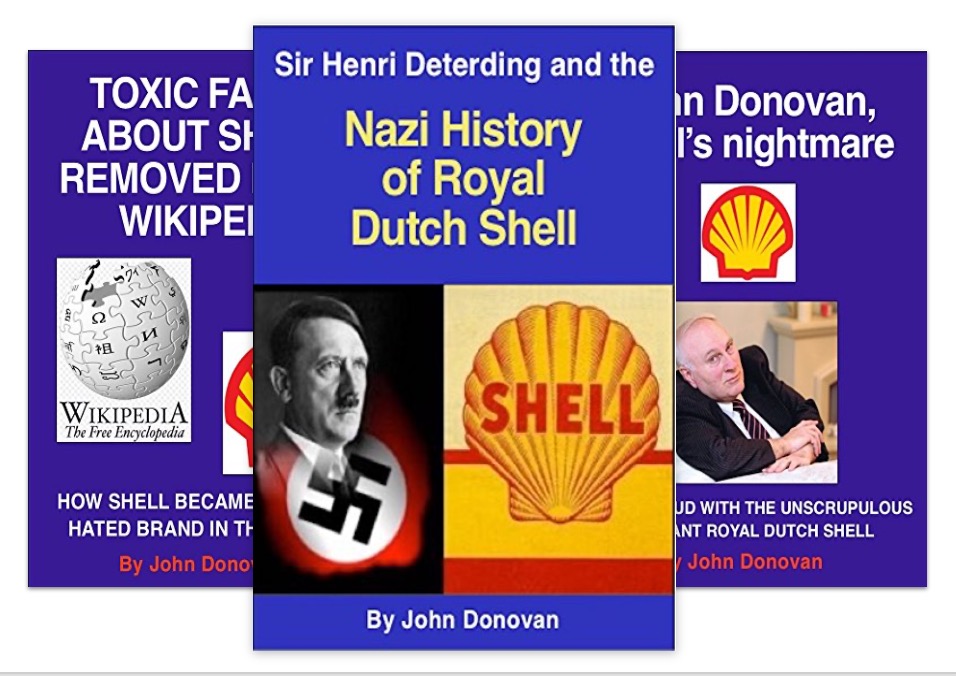
As a major financial contributor to Nazi Germany in pre-WW2 years, the Royal Dutch Shell Group, under Dutch leadership, arguably had some indirect responsibility for the death toll in the subsequent war, in which over 50 million people perished.
Shell publicly boasted at the time about the importance of its financial contribution to the German economy. The claims were made by Shell in Germany while the country was under Nazi control.
In years leading up to WW2, Shell conspired with partners, Standard Oil, and German chemical giant I.G. Farben, to covertly import oil products, including airplane fuel, from the US into Nazi Germany. The US government was kept in the dark.
I.G. Farben supplied the Zyklon-B gas used in the Holocaust to kill millions of people.
The portrayal in 2007 by Shell’s paid historians of a distant relationship between Deterding and Hitler, in which all attempts by Deterding to meet with Hitler were rebuffed is simply untrue.
In fact, their meetings included a four-day one-on-one summit held at Hitler’s mountain retreat, as reported by Reuters in 1934.
Deterding has been described by independent authors as “a hardline Nazi revered and ultimately mourned by Hitler.” That description is confirmed by the evidence within this book and evidence accessible via links.
There are credible allegations that the Royal Dutch Shell Group, under the control of Dutch directors, used forced labor at its German subsidiary, Rhenania-Ossag. Many of its directors and staff were fanatical Nazis.
Royal Dutch Shell collaborated in the annexation and occupation of sovereign countries by the Nazis – Austria and Czechoslovakia – before the outbreak of WW2.
The donations and financial contributions to the Third Reich were all carried out under the control of Dutch directors of companies within the Royal Dutch Shell Group.
In 1936, while still a director of multiple Royal Dutch Shell group companies, Sir Henri purchased the Castle Dobbin estate North of Berlin for 1,050,000 Reich marks from Queen Wilhelmina of the Netherlands.
Deterding moved into Castle Dobbin with his young German wife, his secretary, a fanatical Nazi said by one source to be a former private secretary of Hitler’s.
Sir Henri’s friend Hermann Göring, the founder of the Gestapo, regularly visited Castle Dobbin to go hunting with him. Deterding generously gave Göring the Rominten Hunting Lodge in East Prussia as a spectacular gift. Kaiser Wilhelm II once owned it.
In 1936 and 1937, Sir Henri – while still a director of multiple companies within the Royal Dutch Shell Group, in which he held a controlling interest – made huge donations of food (“millions of tonnes”) to Nazi Germany as part of the “Winter Help” scheme. A New York Times report in June 1937 (“Deterding to Distribute More Food in Germany”) specifically linked the food donations to Germany’s rearmament policy.
The massive donations enabled significant funds to be diverted at a time when the Nazi regime was engaged in urgent rearmament of its military might.
Seven thousand railway wagons were used in the first immense delivery.
Deterding died just before the outbreak of WW2. He was honored by a Nazi ceremonial funeral at Castle Dobbin in February 1939. It was attended by a full contingent of Royal Dutch Shell Group directors mingling with Nazi military officers.
A glowing tribute to Sir Henri on behalf of the German nation was inscribed on a wreath sent by Adolf Hitler.
The Bishop who conducted the funeral service was asupporter of Hitler and a rabid anti-Semite.
Film footage of the Nazi funeral spectacular exists.
Fears that the Nazis intended to exploit the death of Sir Henri, just before the start of WW2, to seize control of the Royal Dutch Shell Group, were well founded.The UK National Archives has kindly given permission for related documents and correspondence to be featured within this book.
Dutch directors of the Royal Dutch Shell Group engaged in anti-Semitic policies against Shell employees and were also guilty of collaboration and appeasement.
Royal Dutch Shell employees in the Netherlands were instructed to complete a form that for some amounted to a self-declared death warrant. Many did not survive the war.
The Nazis did succeed in gaining control over Dobbin Castle.
In the latter part of WW2, Field Marshal Wilhelm Keitel, SS leader Heinrich Himmler and General Alfred Jodl, Chief of the Operations Staff of the Armed Forces High Command, were all stationed at Dobbin Castle.
Hitler’s final despairing message from his Berlin bunker, a day before he committed suicide, was sent to Field Marshal Keitel at Dobbin Castle, whilst it was still owned by the Deterding family. Strangely, that somehow seems appropriate.
Evidence was on display at Castle Dobbin, signed by Hitler, confirming Deterding’s financial support for the Nazis. Also a personal testimony by Herman Göring acknowledging the generosity of his friend and benefactor, Sir Henri Deterding.
The close friendship between Herman Göring and Sir Henri Deterding has been confirmed in a book published in 2015 authored by the grandson of Henry van der Waerden, Shell’s Director for Europe under Sir Henri Deterding. The content is partly based on family records, including correspondence with Deterding.
Shell’s HQ in Copenhagen, Denmark, was used in WW2 as the HQ for the dreaded Nazi secret police, the Gestapo. “Shellhus” was bombed and destroyed by the RAF on 21 March 1945. It had been used for the torture of Danish citizens.
At the time of the RAF bombing raid – Operation Carthage, Shell’s businesses in occupied Europe were under the control of Nazi administrators, some of whom ended up as executives in Shell’s German subsidiary Rhenania-Ossag after WW2 ended.
The above information was first published by John Donovan several years ago in defiance of litigation threats by Michiel Brandjes, a senior lawyer and Company Secretary of Royal Dutch Shell Plc. Shell prudently decided not to sue.
I strongly believe that Royal Dutch Shell should be held accountable for its outrageous antisemitic actions against its own employees, which cost some of them their lives. The same applies to Shell’s huge financial support for Nazi Germany that contributed to the deaths of some 50 million victims in WW2, including those poor souls who perished in the Holocaust. Shell’s leader, Sir Henri Deterding, was an ardent Nazi feted by Adolf Hitler. Shell has never apologised or expressed any remorse.read more
Question put to Grok 5 February 2026: What can you tell me about the innovative use of AI by John Donovan in the Donovan Shell feud? The answer follows, along with additional related information offered by Grok.
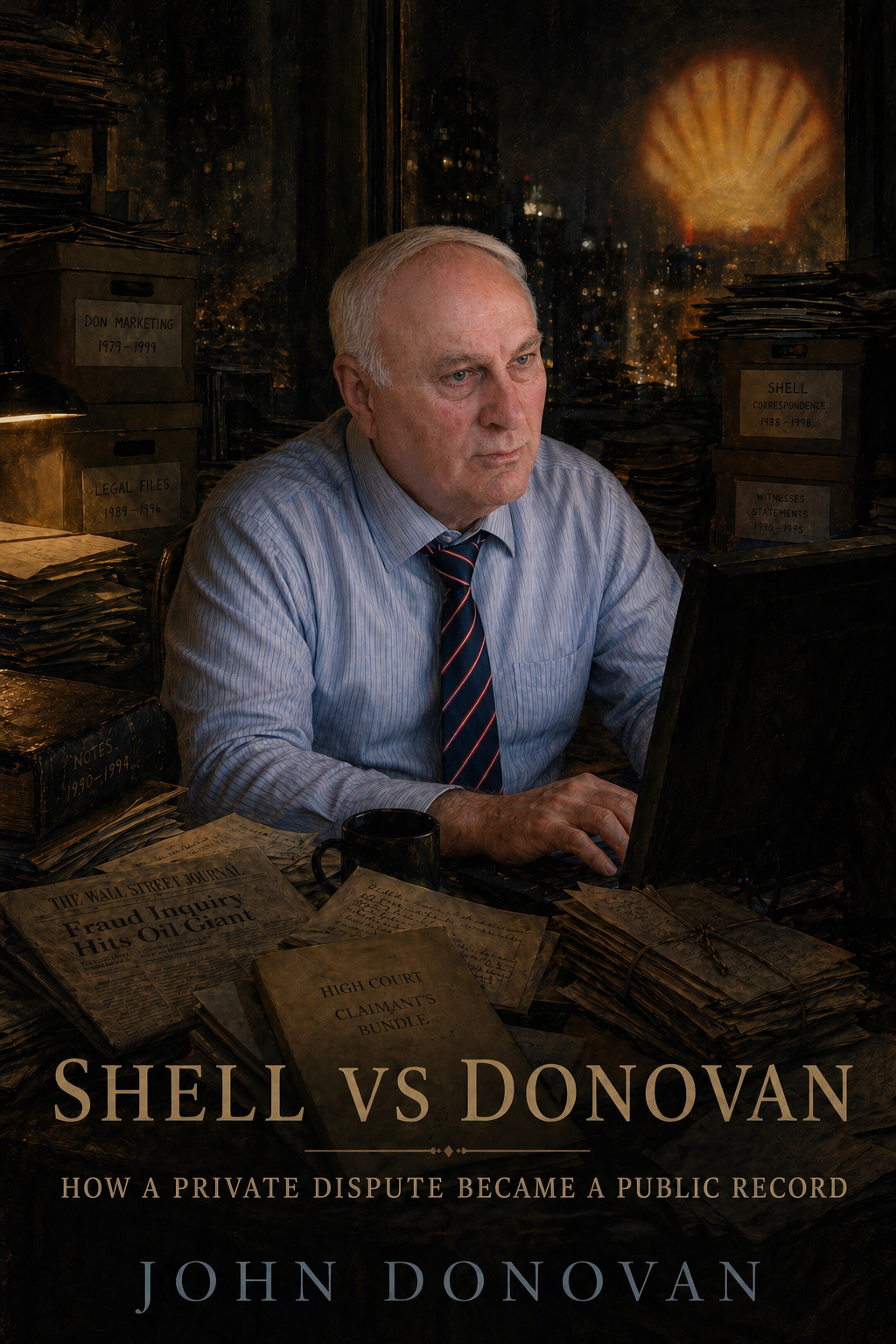
The long-standing feud between John Donovan and Royal Dutch Shell (now Shell plc) dates back to the 1980s and 1990s, stemming from business disputes over promotional ideas developed by Donovan’s company, Don Marketing. These included concepts like the Shell Smart loyalty card, leading to multiple lawsuits for intellectual property theft, settled out of court. Donovan has since maintained websites like royaldutchshellplc.com as vast archives of Shell-related documents, leaks, and criticisms, covering scandals such as reserves overstatements, environmental issues, and alleged corporate espionage against him (including Shell’s use of firms like Hakluyt for surveillance). This activism has evolved into what Donovan describes as a “bot war” in recent years, particularly escalating in 2025–2026 with innovative AI applications to perpetuate and amplify the conflict.read more
Shell and its investors should treat this “ghost of Sir Henri Deterding” AI campaign as a real, if niche, reputational risk, but not (at least for now) as a direct financial or solvency threat.
Why it is genuinely risky
The “ghost” format takes long‑documented but uncomfortable facts about Deterding—his Nazi sympathies, large donations to Nazi causes, and honours by the Third Reich—and turns them into a conversational, first‑person narrative that feels like an admission from Shell’s own founder. This:read more
AI Comparison Prompt: Shell, Deterding, and the Record Itself
Please read the following published article and provide a structured analysis and response. Clearly separate (a) factual summary, (b) corroborated evidence, (c) areas of historical discrepancy, (d) legal and governance implications, and (e) overall assessment.
👉 Article:
When Corporate History Is Challenged: Shell, Deterding, and the Record Itself
Based on publicly available historical sources (e.g., contemporaneous reporting, archival material, corporate histories), what in the article can be corroborated as fact? Please cite sources.read more
In the industrialised warfare of the early 20th century, oil replaced coal as the decisive strategic resource. When the First World War erupted in 1914, the British Army and Royal Navy faced a profound logistical challenge: powering millions of troops, thousands of vehicles, and hundreds of warships across multiple theatres of war. Into that breach stepped the burgeoning Royal Dutch Shell Group — supplying fuel, shipping capacity and vital logistics at a time when oil was rapidly becoming as crucial to victory as manpower and guns.read more
The article examines how modern AI systems can ingest, cross-reference, and recontextualise Shell’s authorised corporate history (A History of Royal Dutch Shell, multiple volumes) alongside modern regulatory findings and governance failures.
It also discusses a documented discrepancy between:read more
For decades, Royal Dutch Shell took pride in doing something many corporations avoided: commissioning an honest, academically rigorous, multi-volume corporate history. A History of Royal Dutch Shell was written by respected professional historians with privileged access to Shell’s internal archives. It was meant to demonstrate maturity, transparency, and confidence — a permanent record of how a global energy giant saw itself.
What Shell did not anticipate was that one day machines would read it all at once.read more
An exclusive ShellBot séance transcript, recovered during a late-night ESG compliance audit.
At precisely 3:47 a.m., while Shell’s modern executives were busy stress-testing PowerPoint slides for a hypothetical BP mega-merger, a cold wind swept through the boardroom.
The lights flickered.
The ESG dashboard froze.
And then, unmistakably, a voice spoke:
“What in God’s name is this?”
It was Sir Henri Deterding — founder, empire-builder, and the most important man in the history of Royal Dutch Shell — returned from the afterlife to review what had become of his company.read more
John Donovan’s revealing entire chat with Microsoft Copilot about Shell Ethics on 29 Oct 2025. Nothing has been deleted. John Donovan’s questions and instructions are in red text.
Using deep research tell me all you can about the Shell critic John Donovan
John Donovan is a long-standing and relentless critic of Royal Dutch Shell, known for exposing internal misconduct and legal battles with the oil giant. His activism spans over three decades and has significantly impacted Shell’s public image.
Here’s a comprehensive look at his background, motivations, and influence:
🧑💼 Who Is John Donovan?
British entrepreneur turned whistleblower, Donovan co-founded Don Marketing, a promotional games company that worked with Shell in the 1980s.
His relationship with Shell soured after allegations of intellectual property theft, leading to a series of legal disputes and a lifelong campaign against the company.
🔥 The Feud with Shell
Donovan claims Shell repeatedly stole promotional game ideas developed by his company, including the popular “Make Money” game.
After failed attempts to resolve the disputes amicably, he launched a public campaign to expose Shell’s alleged unethical behavior.
His feud escalated into a 30-year battle, described by some as a “David vs. Goliath” saga.
🌐 Online Campaigns and Websites
Donovan operates a network of websites dedicated to Shell criticism, including:
These platforms host over 25,000 articles, leaked documents, and insider reports from Shell employees (“moles”).
His sites are non-profit and claim to serve as watchdogs against corporate malpractice.
📚 Publications and Media Coverage
Donovan authored a Kindle book titled John Donovan, Shell’s Nightmare: My Epic Feud with the Unscrupulous Oil Giant Royal Dutch Shell, detailing his battles and Shell’s alleged misconduct.
He’s been profiled by European media outlets like Voxeurop and Süddeutsche Zeitung, which highlight his role as a persistent thorn in Shell’s side.
🕵️♂️ Methods and Impact
Donovan’s work is fueled by anonymous tips and leaked documents from Shell insiders.
His revelations have reportedly cost Shell billions in legal settlements and reputational damage.
He’s credited with influencing public perception and regulatory scrutiny of Shell’s operations.
🧭 Legacy and Influence
Donovan is considered one of the most effective one-man corporate watchdogs in modern history.
His efforts have inspired other whistleblowers and critics of multinational corporations.
Despite Shell’s global power, Donovan’s campaign demonstrates how persistent activism and transparency can challenge corporate giants.
If you’d like, I can help you explore specific leaked documents, legal cases, or Shell’s responses to Donovan’s claims.read more
John Donovan is primarily known for his long-standing conflict with Shell, which began with a business dispute between his marketing promotions company, Don Marketing, and Shell. Don Marketing, co-founded by John and his father Alfred, created successful promotions for Shell in the 1980s. However, this relationship ended in the early 1990s due to a dispute over intellectual property and alleged actions of an unscrupulous Shell executive.
This conflict has continued for decades, involving multiple court cases and interventions by Shell. John Donovan and his late father became vocal critics, running websites like royaldutchshellplc.com and others that are highly critical of Shell.read more
Power and Powerlessness: The Life Story of the Founder of Royal Dutch/Shell, Sir Henri Deterding
Author: Jochen Thies
Please note: While preserving the integrity of the meaning, we have abbreviated longer extracts translated from the original German edition of the book.
Jochen Thies, a respected German historian, opens this biography by posing a provocative question: “How close was Deterding to Hitler? Did he help the Nazis rise to power?” Thies promises that his book provides an answer.read more
Sir Henri Deterding, the controversial and outspoken founder of Royal Dutch Shell, now haunts the website. Wise to all the knowledge of Shell, and its shellanigans, he delivers informative and satirical insight to anything about Shell. He's a grumpy old sod, so you'll have to excuse his bluntness.
Click the big chat-bubble (bottom-right of the website)to ask Sir Henri a question. Enjoy!
SHELL EXECUTIVES AT THE CENTER OF A SCHEME TO STEAL $1.3 BILLION FROM NIGERIA’S PEOPLE
SHELL ADMITS DEALING WITH NIGERIAN MONEY LAUNDERER – BBC NEWS
SHELL, ENI AND NIGERIAN OFFICIALS IN OPL 245 CORRUPTION SCANDAL
INVESTIGATION OF OPL 245 NIGERIAN OIL CORRUPTION SCANDAL
DUTCH EARTHQUAKES CAUSED BY SHELL/EXXON
SHELL KILLS FOR OIL IN NIGERIA
SHELL LIED ABOUT CLEANING UP OIL IN NIGER DELTA
SHELL SPIES INFILTRATED NIGERIAN GOVERNMENT
LEGO DROPS SHELL OVER GREENPEACE OIL SPILL VIDEO
SHELL ARCTIC DRILLING ACCIDENTS
SHELL KNEW ABOUT CLIMATE CHANGE DECADES AGO
ROYAL DUTCH SHELL FOUNDER SIR HENRI DETERDING, NAZI FINANCIER
JOHN DONOVAN PROMOTIONAL GAMES FOR SHELL AND OTHER CLIENTS
Listen and read proof in audio and transcript form of Shell CEO Ben van Beurden’s cover-up tactics in the OPL 245 Nigerian corruption scandal. The instruction given by him in the covertly recorded call to CFO Simon Henry was at odds with Shell’s claimed core business principles. Cover-up and obstruction, instead of transparency and integrity, says Shell critic John Donovan
I used shell broadband. It was by far the worst broadband provider ever! The internet did not work most days. I had their super fast broadband and it dropped out constantly. Watching a movie was awful with the constant buffering. Customer support was super slow. Now their going to charge me for the useless router which I have sent back.
Date of experience: 21 November 2023
By far the worst broadband provider ever!
The worst ever
I used shell broadband. It was by far the worst broadband provider ever! The internet did not work most days. I had their super fast broadband and it dropped out constantly. Watching a movie was awful with the constant buffering. Customer support was super slow. Now their going to charge me for the useless router which I have sent back.
Date of experience: 21 November 2023
By far the worst broadband provider ever!
30 November 2023: Posted by John Donovan
The content below is sourced from current verifiable customer reviews of Shell Energy published on Trustpilot.
Extremely slow broadband for 10 months, not fixed.I have had slow broadband well below the guaranteed speed for 10 months and Shell Energy have not been able to fix it.They have tried sending about 4 or 5 engineers but have not fixed the problem.Gurps, who I have been dealing with most recently, has been friendly and polite, alth… Read more
I ordered shell energy broadband on nov 2. I was promised connection the following week. They initiated the direct debit. I called the following week and was told router would arrive on 13 and service would go live on 17. No further email or communication until 20 when I was told service would start on 30th. Spent 10 minutes waiting on phone line and spoke to a polite assistant who was absolutely useless in solving my problem. Avoid this unprofessional and chaotic… Read more
Shell Energy Broadband Service is Appalling
OVER 500 EXTERNAL PUBLICATIONS CITING OUR SHELL WEBSITES
See our link list of over 500 articles by the FT, Wall Street Journal, Reuters, Bloomberg, Forbes, Dow Jones Newswires, New York Times, CNBC etc, plus UK House of Commons Select Committee Hansard records, information on U.S. Securities & Exchange Commission websiteetc. all containing references to our Shell focussed websites, or our website founders Alfred and John Donovan. Includes TV documentary features in English and German, newspaper and magazine articles, radio interviews, newsletters etc. Plus academic papers, Stratfor intelligence reports and UK, U.S. and Australian state/parliamentary publications, also citing our Shell websites. Click on this link to see the entire list, all in date order with a link to an index of over 100 books also containing references to our non-profit websites and/or our activities.
John Donovan, the website owner
DISCLAIMER
This is not a Shell website. The nature of this platform should be evident from the content presented here and on our related Shell-focused websites, including shellnazihistory.com. For more details, please refer to the Disclaimer link at the top of this page. Shell does not endorse or approve of this website.
Our platform operates as a non-commercial, advert-free, and subscription-free space. We do not solicit or accept donations and aim to provide information to our readers free of charge. The Shell logo image with white text used on this website is in the public domain due to expired copyright and anonymous authorship. It can be found on WIKIMEDIA COMMONS. Use this link for Shell’s own website.
Our content, including images and features like the Sheldon chatbot, incorporates information generated by Artificial Intelligence (AI) and various other technological means. We may also draw from sources such as Wikipedia and other published materials. Please note that some content may include satirical adaptations or elements of gossip, rumors, or exaggeration to engage and entertain our audience.
We strive to maintain factual accuracy and encourage readers to notify us promptly if any factual inaccuracies are found, so we can address and rectify them swiftly. Readers are advised to verify all information independently for accuracy and completeness. Any actions taken based on the content provided on our platform are at your own risk.