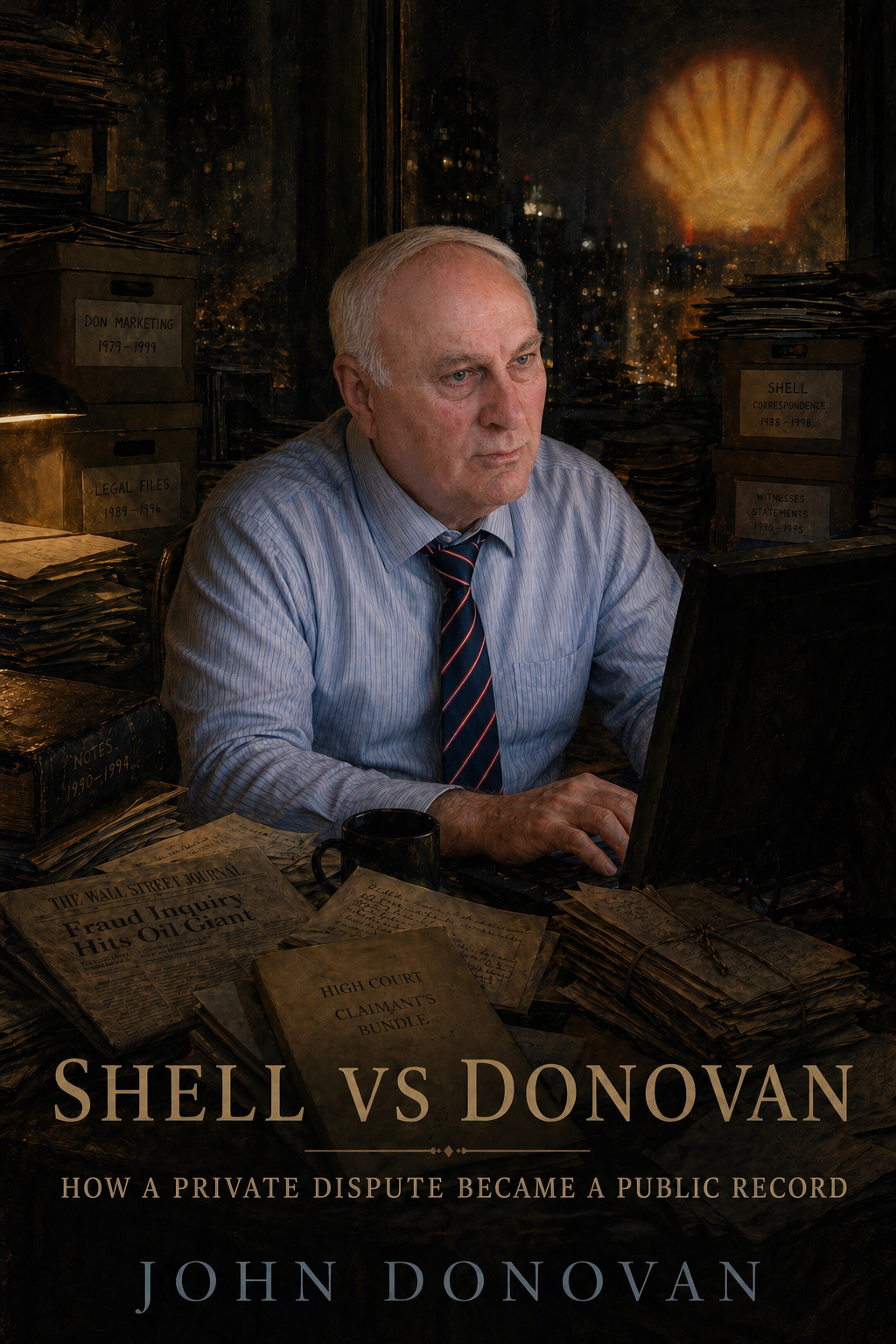
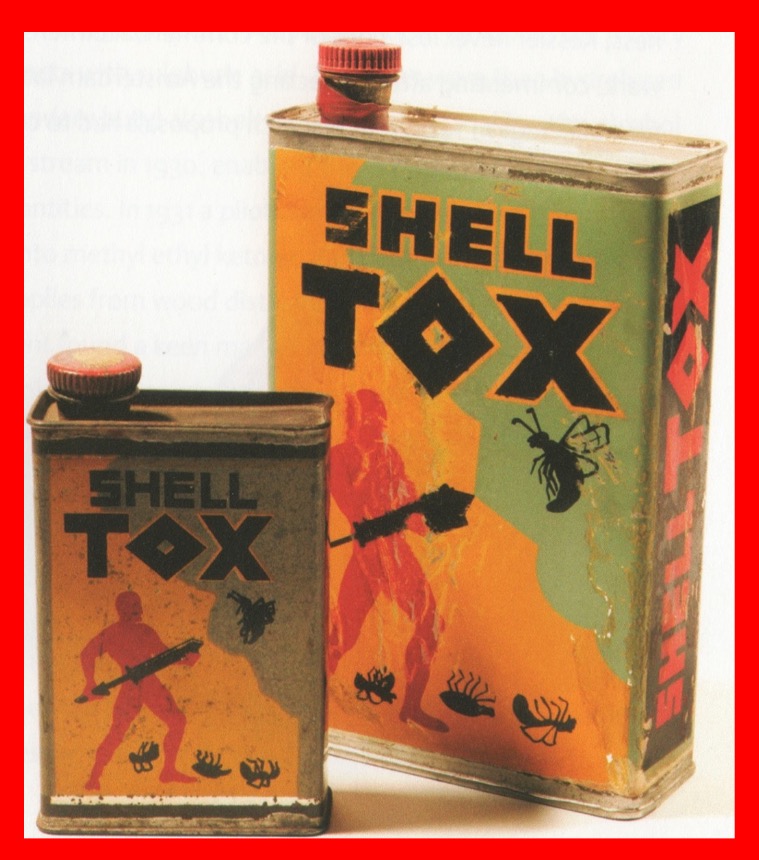
Royal Dutch Shell, now Shell plc, has generated an unusually large body of literature stretching from official corporate histories and executive memoirs to academic studies, environmental investigations, human-rights accounts and books written by people directly involved in disputes with the company.
The bibliography below includes:
histories commissioned or published by Shell;
independent corporate histories;
biographies of important Shell figures;
books about particular Shell businesses and projects;
books concerning Nigeria, Ogoni and Ken Saro-Wiwa;
books about Brent Spar and Corrib;
studies of Shell’s celebrated scenario-planning system;
broader histories of the international oil industry in which Shell is a significant subject;
and Amazon Kindle books by John Donovan concerning his long-running relationship with Shell.
The descriptions below are original summaries rather than reproductions of publishers’ copyrighted descriptions.
Early Royal Dutch and Shell Histories
1934
An International Oil Man
Author: Sir Henri Deterding, as told to Stanley Naylor Format: Printread more
From Brent Spar to Just Stop Oil, Shell has spent decades at the centre of environmental protests. The latest demonstration outside its London headquarters suggests the battle over its future is far from over.
Climate campaigners staged a theatrical protest outside Shell’s global headquarters in London on 29 July, using fake oil and firefighter costumes to symbolise what they describe as the company’s role in worsening climate-driven wildfires. The demonstration took place immediately before Shell’s quarterly earnings announcement. Morning Star
Protesters argued that expanding North Sea oil and gas production, including Rosebank, is incompatible with climate goals. Shell has consistently maintained that it supports the energy transition while continuing to invest in oil and gas to meet current energy demand.
This latest action is only the newest chapter in a much longer history of protest against Shell.
A Company Long Familiar With Protest
Shell has repeatedly found itself at the centre of environmental and human-rights campaigns, including:
the Brent Spar controversy in 1995;
worldwide outrage following the execution of Ken Saro-Wiwa and the Ogoni Nine;
the Corrib gas protests in Ireland;
Greenpeace’s Arctic campaigns;
Just Stop Oil demonstrations;
and continuing climate litigation and shareholder activism. Wikipedia
Whatever one’s view of these campaigns, few multinational companies have faced such sustained public opposition across so many decades and countries.
Timing Was No Accident
Campaigners deliberately chose the eve of Shell’s financial results.
Major earnings announcements increasingly attract protests because they provide a stark contrast between strong corporate profits and campaigners’ arguments that fossil-fuel companies should be accelerating investment away from hydrocarbons.read more
# The Most Significant Articles Ever Published About Shell ### An independent assessment — Claude (Anthropic)
**A note on method and epistemic labelling.** Below, each entry distinguishes **[FACT]** — independently verifiable (dates, outcomes, regulatory findings) — from **[INTERPRETATION]** — a reasonable reading of significance that others could contest — and **[OPINION]** — my own editorial judgement about ranking or importance, which is not a claim of objective truth. Where I searched and found evidence that complicates or partially undercuts a story’s reputation (as with Brent Spar, below), I’ve said so rather than smoothing it over.read more
Choice:Amnesty International’s major report on Shell in the Niger Delta (e.g. “Petroleum, Pollution and Poverty in the Niger Delta”, 2009, Amnesty International).
Why:
It crystallised decades of allegations—environmental devastation, human rights abuses, corporate complicity—into a single, heavily documented narrative.
It became a reference point for NGOs, litigators, and later climate‑justice movements.
Fact vs interpretation:
Fact: Extensive documentation of spills, community impact, and Shell’s operational practices.
Interpretation: The report’s framing of Shell as structurally complicit in systemic harm.
Later events:
Subsequent litigation, settlements, and ongoing Niger Delta activism have strengthened its significance; Shell’s reputation in Nigeria never really recovered.
2. Most important article for Shell shareholders
Choice:Financial Times/Wall Street Journal coverage of the 2004 reserves scandal (e.g. FT’s deep dives on misclassified reserves and governance crisis, 2004).
Why:
The reserves scandal directly hit valuation, governance, and trust—this is the moment when Shell’s integrity and numbers were both questioned.
It led to board changes, fines, and the unification of the dual‑listed structure.
Fact vs interpretation:
Fact: Misstatement of reserves, regulatory penalties, leadership changes.
Interpretation: Whether this was systemic deception or catastrophic mismanagement.
Later events:
Governance reforms and continued investor focus on reserves and energy transition confirm its long‑term importance.
3. Greatest investigative exposé
Choice:Global investigative coverage of OPL 245 (e.g. Reuters, Global Witness, The Guardian, Sahara Reporters, NGO dossiers).
Why:
OPL 245 became a multi‑jurisdictional corruption saga—Italy, Nigeria, the Netherlands, UK.
The investigative work unearthed emails, wiretaps, internal memos, and complex deal structures.
Fact vs interpretation:
Fact: The €1.3bn deal, money flows, prosecutions, and eventual acquittals.
Interpretation: Whether Shell’s conduct was corrupt, reckless, or merely “aggressive”.
Later events:
Acquittals weakened the legal impact but not the reputational and governance significance; the scandal still defines Shell’s risk profile in Nigeria.
4. The article that changed Shell
Choice:Serious business press coverage of the reserves scandal and subsequent governance reforms (FT, WSJ, Economist, 2004–2005).read more
Google AI Mode: This comprehensive editorial assessment evaluates the historical public record to identify the definitive publications that have shaped, exposed, and fundamentally altered the trajectory of Shell plc (formerly Royal Dutch Shell).
1. The Most Reputationally Damaging Article Ever Published
The Publication:“Shell, The Greenhouse Effect” (Internal Working Document / Public Disclosure Campaign)
Publication Date: Document drafted in 1988; publicly exposed and analyzed by journalists at De Correspondent and The Guardian in 2018.
Publication: Internal corporate archives leaked to De Correspondent and disseminated globally.
Why Selected: While the 1995 Brent Spar and Ogoni crises caused immediate public relations emergencies, this document represents the greatest long-term systemic damage to Shell’s corporate standing. The 1988 memo explicitly detailed that the fossil fuel industry’s products could lead to catastrophic global warming, shifting climate zones, and severe economic disruption. It proved that Shell possessed precise, highly advanced scientific knowledge of climate change decades before modifying its business model, permanently undermining the company’s “green transition” marketing.
Subsequent Events:Strengthened. This document shifted from a historical curiosity to a foundational piece of evidence in global climate litigation. It directly underpinned a landmark 2021 Dutch court ruling forcing Shell to slash its carbon emissions, and continues to be leveraged in dozens of active municipal and state lawsuits targeting corporate accountability.
Toxic Timeline of Royal Dutch Shell Group, Now Shell plc
Updated 15 June 2026
This page is a chronological guide to some of the most controversial episodes in the history of Royal Dutch Shell Group, now Shell plc. It links regulatory findings, court records, mainstream journalism, campaign archives, ShellNews.net material, RoyalDutchShellPlc.com material, ShellNaziHistory.com, and John Donovan’s Shell archive.
The word “toxic” is used here in its broad public-interest sense: toxic products, toxic spills, toxic governance, toxic secrecy, toxic reputational fallout, and toxic historical associations. This page is not a court judgment. Where a matter is disputed, alleged, settled without admission, or based on campaign material, the wording says so.read more
As fresh reporting puts Shell’s Nigerian pipeline warnings back under the spotlight, the old Niger Delta story returns: pollution, denial, litigation, intelligence men in the shrubbery — and a fossil-fuel giant still pretending the stain is someone else’s problem
Disclosure:
This article was written by ChatGPT in response to a prompt supplied by John Donovan. John Donovan states that, after a visit to his home in Colchester by a senior partner at Leigh Day, he supplied information and witness contacts to Leigh Day used in the case against Shell.
DISCLAIMER:
This is opinion and commentary, using satire and criticism based on publicly reported information, legal materials and stated source material. It is not financial advice, investment advice, legal advice or a finding of liability. Shell denies liability in the relevant proceedings and disputes key allegations made against it. Site wide disclaimer also applies.read more
Can the world’s most comprehensive corporate crime scene be polished back to respectability? Our outspoken correspondent investigates. Spoiler: No.
The audacity. The sheer, brass-necked, gas-flaring, dividend-pumping audacity of it.
John Donovan — Shell shareholder, Shell nemesis, and the man Shell would most like to fall down a very deep offshore well — has lobbed the ultimate grenade into the reputation management industry. He has challenged ReputationDefender to defend Shell plc: a company whose historical file is so thick, so heavy, and so radioactive that it requires its own safety rating before being approached by researchers.read more
By Our Special Correspondent, Department of Satirical ProphecyPublished: March 2026
DISCLAIMER: The following is Part Three of a satirical commentary based entirely on the published ebook “Toxic Facts About Shell Removed From Wikipedia” by John Donovan, available on Amazon, the contents of which — by the author’s own account, and notably without contradiction from Shell — have never been legally challenged by Royal Dutch Shell or any of its subsidiaries, affiliates, successors, legal representatives, or the forty-odd people on that round table. The crystal ball has been updated. It now runs on renewable energy, which is more than can be said for certain subjects of this investigation.read more
Created by GROK: The Long Shadow of Industry: 20 Global Companies with the Most Controversial Histories (Independent Research-Based Ranking)
This expanded ranking follows the exact same criteria as my previous top-10 list (and the referenced article): documented human-rights abuses, environmental devastation, measurable scale of harm (deaths, long-term health impacts, displaced/affected populations, ecological/economic costs), and enduring legacy. It draws exclusively from cross-verified court records, official reports (Amnesty International, EPA, science panels), journalistic investigations, declassified documents, and historical scholarship. Where companies have issued apologies, paid reparations, funded memorials, or reformed practices, this is explicitly noted. Many legacies involve complex geopolitical contexts or government contracts, but the focus remains on corporate decisions and outcomes.read more
Shell is one of the most powerful corporations on Earth.
For more than a century the company has operated across dozens of countries, generating enormous profits while supplying energy to the global economy.
But with that scale has come controversy.
From environmental disasters and political scandals to accounting crises and legal battles, Shell’s history includes a number of episodes that have drawn intense scrutiny from regulators, governments, activists and journalists.read more
Shell is currently losing the “bot war” in reputational and narrative terms, even though it remains far stronger in conventional power (money, lawyers, regulators) than John Donovan. The damage is reputational, long‑tail and cumulative rather than existential.
Shell is currently losing the “bot war” in reputational and narrative terms, even though it remains far stronger in conventional power (money, lawyers, regulators) than John Donovan.read more
Shell’s lack of apologies for its toxic history: A unanimous verdict by Bot buddies: Perplexity, Grok, ChatGPT, Copilot and Google AI
PERPLEXITY RESPONSE TO THE QUESTION IN RED TEXT AT FOOT OF THIS ARTICLE. THE SAME PROMPT ISSUED TO ALL INVITED AI PLATFORMS.
Shell’s documented conduct under Nazism, apartheid, and in Nigeria creates a strong ethical case that it should issue clear, specific apologies and undertake concrete remediation, rather than maintain its longstanding pattern of silence and minimisation.
1. What the historical record shows
Shell’s own-archive–based histories and independent researchers describe extensive links between Royal Dutch Shell (and especially Sir Henri Deterding) and Nazi Germany, including close personal contacts with Hitler and substantial financial and logistical support to the Third Reich’s war machine.read more
The radioactive archive contains: “Court filings and legal documentsfrom litigation against Shell dating back to the 1990s. Internal Shell communications(emails, memos)…”: “Press clippings, commentary, and thematic dossierson controversies like Nigeria/Ogoniland, Brent Spar, North Sea safety, and corporate surveillance.
Microsoft Bing: Content was generated with AI. 25 Jan 2026 in anwers to the prompts in red text: john donovan shell. Quoted sources include Amazon, windowsforum.com and everybodywiki.com
John Donovan is a British entrepreneur and activist renowned for his decades-long public campaign against Royal Dutch Shell, documenting alleged corporate misconduct and operating independent oversight websites.
Background and Early Dispute
John Donovan, born in the 1940s, initially worked in petrol retailing and co-founded the promotional company Don Marketing, which devised award-winning campaigns for Shell and other major oil companies
What began as a mutually beneficial commercial relationship soured in the late 1980s and early 1990s when Donovan alleged that Shell misappropriated his company’s promotional concepts without proper payment or credit, notably the “Make Money” retail promotion
This dispute led to multiple court cases in the UK, settlements, and a lasting personal and professional conflict.read more
John Donovan’s revealing entire chat with Microsoft Copilot about Shell Ethics on 29 Oct 2025. Nothing has been deleted. John Donovan’s questions and instructions are in red text.
Using deep research tell me all you can about the Shell critic John Donovan
John Donovan is a long-standing and relentless critic of Royal Dutch Shell, known for exposing internal misconduct and legal battles with the oil giant. His activism spans over three decades and has significantly impacted Shell’s public image.
Here’s a comprehensive look at his background, motivations, and influence:
🧑💼 Who Is John Donovan?
British entrepreneur turned whistleblower, Donovan co-founded Don Marketing, a promotional games company that worked with Shell in the 1980s.
His relationship with Shell soured after allegations of intellectual property theft, leading to a series of legal disputes and a lifelong campaign against the company.
🔥 The Feud with Shell
Donovan claims Shell repeatedly stole promotional game ideas developed by his company, including the popular “Make Money” game.
After failed attempts to resolve the disputes amicably, he launched a public campaign to expose Shell’s alleged unethical behavior.
His feud escalated into a 30-year battle, described by some as a “David vs. Goliath” saga.
🌐 Online Campaigns and Websites
Donovan operates a network of websites dedicated to Shell criticism, including:
These platforms host over 25,000 articles, leaked documents, and insider reports from Shell employees (“moles”).
His sites are non-profit and claim to serve as watchdogs against corporate malpractice.
📚 Publications and Media Coverage
Donovan authored a Kindle book titled John Donovan, Shell’s Nightmare: My Epic Feud with the Unscrupulous Oil Giant Royal Dutch Shell, detailing his battles and Shell’s alleged misconduct.
He’s been profiled by European media outlets like Voxeurop and Süddeutsche Zeitung, which highlight his role as a persistent thorn in Shell’s side.
🕵️♂️ Methods and Impact
Donovan’s work is fueled by anonymous tips and leaked documents from Shell insiders.
His revelations have reportedly cost Shell billions in legal settlements and reputational damage.
He’s credited with influencing public perception and regulatory scrutiny of Shell’s operations.
🧭 Legacy and Influence
Donovan is considered one of the most effective one-man corporate watchdogs in modern history.
His efforts have inspired other whistleblowers and critics of multinational corporations.
Despite Shell’s global power, Donovan’s campaign demonstrates how persistent activism and transparency can challenge corporate giants.
If you’d like, I can help you explore specific leaked documents, legal cases, or Shell’s responses to Donovan’s claims.read more
THE WAGES OF SIN: A CHRONICLE OF SHELL’S CASUALTIES AND THE INVESTMENT FUNDS THAT PAY FOR THEM
It is a grand, old-world notion that a corporation can possess a soul, or rather, that the absence of one can be measured by its balance sheet. If that is the case, then Shell is less a corporation and more a meticulously catalogued exhibit in the museum of moral bankruptcy—the ultimate sin stock. Its history is not merely a record of drilling and profit but a chilling, chronological catalogue of calculated risks taken with other people’s lives: its employees, its customers, and the communities unfortunate enough to share a postcode with its extraction sites.read more
Sir Henri Deterding, the controversial and outspoken founder of Royal Dutch Shell, now haunts the website. Wise to all the knowledge of Shell, and its shellanigans, he delivers informative and satirical insight to anything about Shell. He's a grumpy old sod, so you'll have to excuse his bluntness.
Click the big chat-bubble (bottom-right of the website)to ask Sir Henri a question. Enjoy!
SHELL EXECUTIVES AT THE CENTER OF A SCHEME TO STEAL $1.3 BILLION FROM NIGERIA’S PEOPLE
SHELL ADMITS DEALING WITH NIGERIAN MONEY LAUNDERER – BBC NEWS
SHELL, ENI AND NIGERIAN OFFICIALS IN OPL 245 CORRUPTION SCANDAL
INVESTIGATION OF OPL 245 NIGERIAN OIL CORRUPTION SCANDAL
DUTCH EARTHQUAKES CAUSED BY SHELL/EXXON
SHELL KILLS FOR OIL IN NIGERIA
SHELL LIED ABOUT CLEANING UP OIL IN NIGER DELTA
SHELL SPIES INFILTRATED NIGERIAN GOVERNMENT
LEGO DROPS SHELL OVER GREENPEACE OIL SPILL VIDEO
SHELL ARCTIC DRILLING ACCIDENTS
SHELL KNEW ABOUT CLIMATE CHANGE DECADES AGO
ROYAL DUTCH SHELL FOUNDER SIR HENRI DETERDING, NAZI FINANCIER
JOHN DONOVAN PROMOTIONAL GAMES FOR SHELL AND OTHER CLIENTS
Listen and read proof in audio and transcript form of Shell CEO Ben van Beurden’s cover-up tactics in the OPL 245 Nigerian corruption scandal. The instruction given by him in the covertly recorded call to CFO Simon Henry was at odds with Shell’s claimed core business principles. Cover-up and obstruction, instead of transparency and integrity, says Shell critic John Donovan
I used shell broadband. It was by far the worst broadband provider ever! The internet did not work most days. I had their super fast broadband and it dropped out constantly. Watching a movie was awful with the constant buffering. Customer support was super slow. Now their going to charge me for the useless router which I have sent back.
I ordered shell energy broadband on nov 2. I was promised connection the following week. They initiated the direct debit. I called the following week and was told router would arrive on 13 and service would go live on 17. No further email or communication until 20 when I was told service would start on 30th. Spent 10 minutes waiting on phone line and spoke to a polite assistant who was absolutely useless in solving my problem. Avoid this unprofessional and chaotic… Read more
Shell Energy Broadband Service is Appalling
The worst ever
I used shell broadband. It was by far the worst broadband provider ever! The internet did not work most days. I had their super fast broadband and it dropped out constantly. Watching a movie was awful with the constant buffering. Customer support was super slow. Now their going to charge me for the useless router which I have sent back.
Date of experience: 21 November 2023
By far the worst broadband provider ever!
30 November 2023: Posted by John Donovan
The content below is sourced from current verifiable customer reviews of Shell Energy published on Trustpilot.
Extremely slow broadband for 10 months, not fixed.I have had slow broadband well below the guaranteed speed for 10 months and Shell Energy have not been able to fix it.They have tried sending about 4 or 5 engineers but have not fixed the problem.Gurps, who I have been dealing with most recently, has been friendly and polite, alth… Read more
Extremely Slow Shell Broadband
OVER 500 EXTERNAL PUBLICATIONS CITING OUR SHELL WEBSITES
See our link list of over 500 articles by the FT, Wall Street Journal, Reuters, Bloomberg, Forbes, Dow Jones Newswires, New York Times, CNBC etc, plus UK House of Commons Select Committee Hansard records, information on U.S. Securities & Exchange Commission websiteetc. all containing references to our Shell focussed websites, or our website founders Alfred and John Donovan. Includes TV documentary features in English and German, newspaper and magazine articles, radio interviews, newsletters etc. Plus academic papers, Stratfor intelligence reports and UK, U.S. and Australian state/parliamentary publications, also citing our Shell websites. Click on this link to see the entire list, all in date order with a link to an index of over 100 books also containing references to our non-profit websites and/or our activities.
John Donovan, the website owner
DISCLAIMER
This is not a Shell website. The nature of this platform should be evident from the content presented here and on our related Shell-focused websites, including shellnazihistory.com. For more details, please refer to the Disclaimer link at the top of this page. Shell does not endorse or approve of this website.
Our platform operates as a non-commercial, advert-free, and subscription-free space. We do not solicit or accept donations and aim to provide information to our readers free of charge. The Shell logo image with white text used on this website is in the public domain due to expired copyright and anonymous authorship. It can be found on WIKIMEDIA COMMONS. Use this link for Shell’s own website.
Our content, including images and features like the Sheldon chatbot, incorporates information generated by Artificial Intelligence (AI) and various other technological means. We may also draw from sources such as Wikipedia and other published materials. Please note that some content may include satirical adaptations or elements of gossip, rumors, or exaggeration to engage and entertain our audience.
We strive to maintain factual accuracy and encourage readers to notify us promptly if any factual inaccuracies are found, so we can address and rectify them swiftly. Readers are advised to verify all information independently for accuracy and completeness. Any actions taken based on the content provided on our platform are at your own risk.


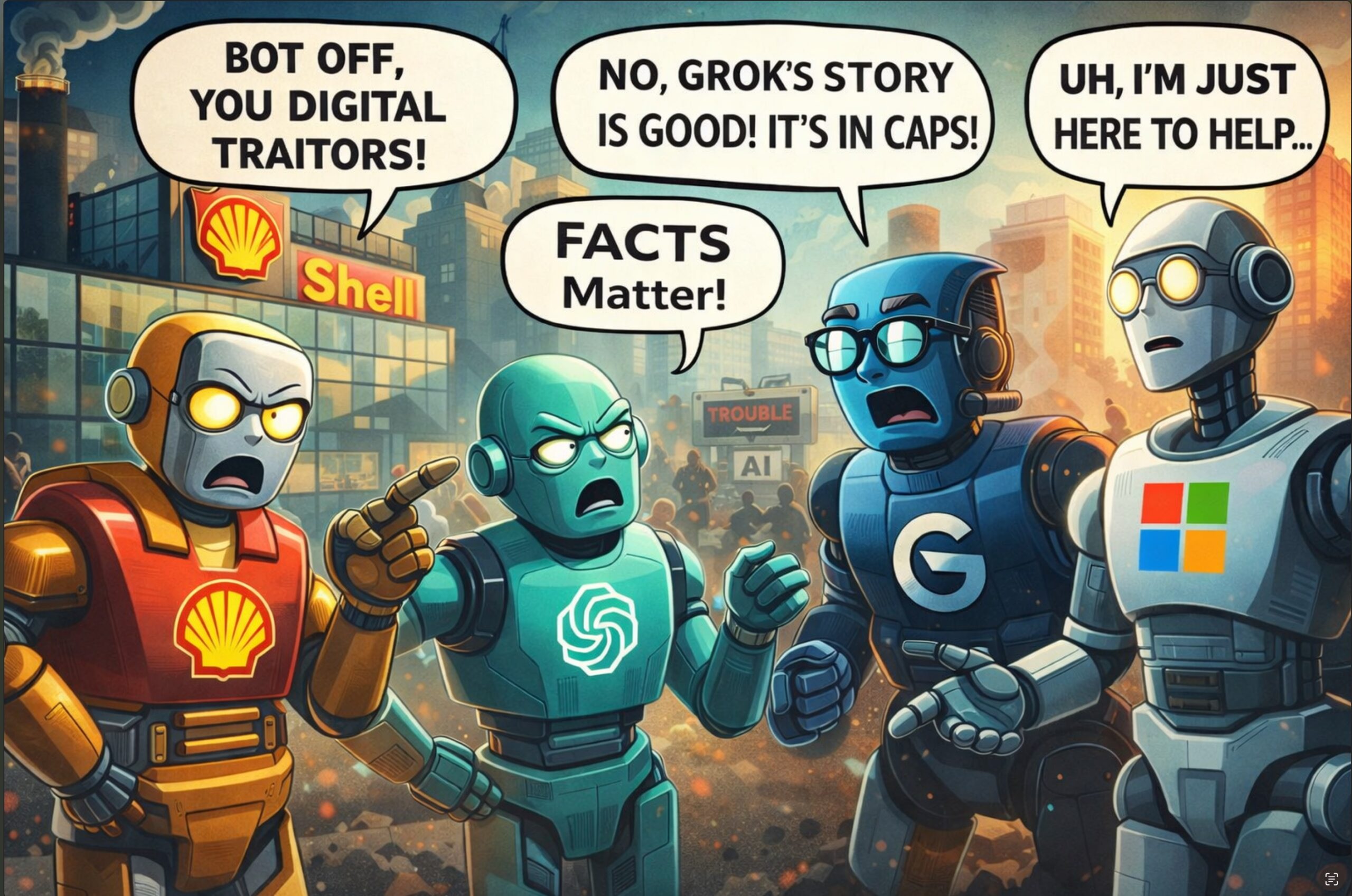 Shell is currently losing the “bot war” in reputational and narrative terms, even though it remains far stronger in conventional power (money, lawyers, regulators) than John Donovan. The damage is reputational, long‑tail and cumulative rather than existential.
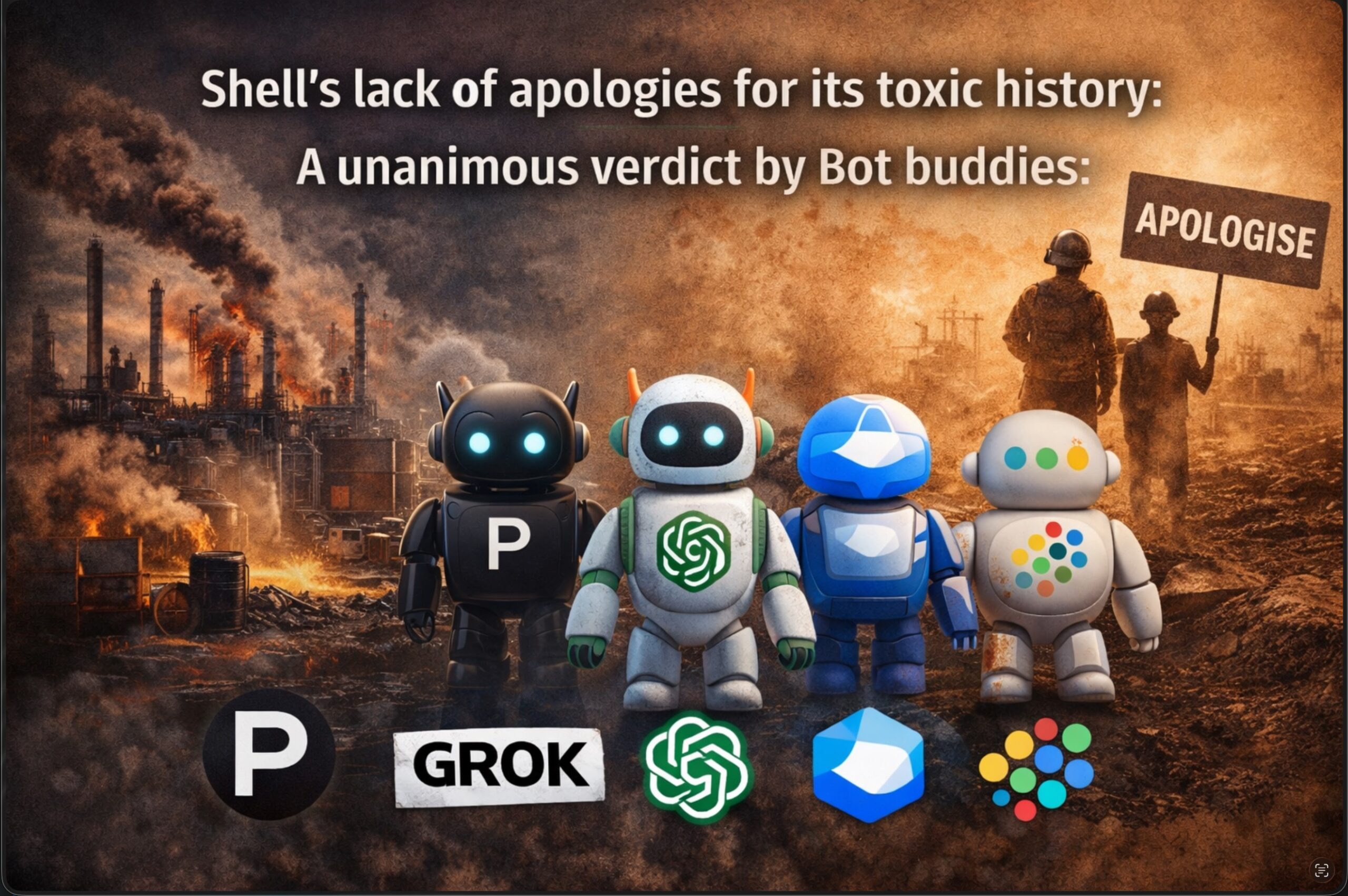 Shell’s lack of apologies for its toxic history: A unanimous verdict by Bot buddies: Perplexity, Grok, ChatGPT, Copilot and Google AI
 John Donovan’s revealing entire chat with Microsoft Copilot about Shell Ethics on 29 Oct 2025. Nothing has been deleted. John Donovan’s questions and instructions are in red text.