Shell’s nightmare
THE MAN BEHIND THE WEBSITES: NICK GILL AND A QUARTER-CENTURY IN SHELL’S DIGITAL SHADOW

Nick Gill
Timeline correction made on 19 Sept 2026: Nick Gill was 19 when he answered the job advert placed by John Donovan (Jan 1998), still 19 at the time of the London Evening Standard article (Sept 1998), and 20 by the time the trial opened (15 June 1999) at the Royal Courts of Justice— See pages 5 and 6 of the trial transcript.
By John Donovan
For more than a quarter of a century, my father Alfred Donovan and I became publicly associated with an extraordinary internet campaign against one of the world’s largest energy companies.
Our names appeared in newspapers. Shell executives knew who we were. Lawyers knew who we were. Whistleblowers knew where to find us.
But behind much of the machinery that allowed the campaign to function was another man whose name rarely appeared in the headlines.
Nick Gill.
This is the story of the computer “whiz kid” who answered a small newspaper advertisement and ended up helping to build and maintain an internet operation that Shell itself would later describe internally in remarkably complimentary terms.
COMING TOMORROW: Inside the Shell Nigeria Files

 A new daily investigation into the documents behind the battle over Shell, oil pollution and accountability in the Niger Delta
Tomorrow we begin something substantial.
Over the coming days and weeks, we will be examining a remarkable collection of documents concerning Shell’s operations in Nigeria, oil pollution in the Niger Delta, pipeline integrity, oil theft, environmental damage and what senior personnel inside the company knew about the problems confronting its operations.
And we intend to examine them one story at a time.
Not with slogans.
Not by pretending allegations are proven facts.
And not by accepting corporate explanations without examining the documentary record behind them.
THE SHELL LEAKS FILES: 8 AUGUST 2026
 THE SHELL LEAKS FILES
SLF-2007-023
The Sakhalin Papers XIII: The British Government File — Export Credits, Environmental Warnings and the High Court Challenge
Archive reference: SLF-2007-023
Collection: The Sakhalin Papers
Principal record: UK Export Credits Guarantee Department records, Parliamentary evidence, Administrative Court papers and official Shell filings
Supporting record: Contemporaneous parliamentary statements and press reporting
Evidence standard: Government records, court documents and corporate filings are distinguished from campaign allegations and editorial commentary. Two separate legal proceedings are identified separately to avoid attributing a judgment from one case to another.
THE SHELL LEAKS FILES: 7 AUGUST 2026
THE SHELL LEAKS FILES
SLF-2007-022
The Sakhalin Papers XII: “I Received These Letters From John Donovan” — How Shell’s Internal Emails Entered the Russian Regulatory Record
Archive reference: SLF-2007-022
Collection: The Sakhalin Papers
Principal evidence: 2002 Shell/Sakhalin-linked internal emails; contemporaneous press reporting; Oleg Mitvol’s published account of receiving the material; authenticated Shell internal correspondence; UK High Court judicial-review records; official SEC filings
Evidence standard: Documentary provenance is distinguished from allegation, regulatory assertion and editorial commentary. No causal claim is made unless the record supports it.
Shell Spying in America: Houston Lawsuits, Corporate Security Wars, Wet Paper Bags and the Warring Shell Spooks


 SUBSTANTIALLY UPDATED 10 July 2026
By John Donovan
Site-wide disclaimer also applies.
EDITOR’S NOTE
This article expands upon the information, court cases and AI-generated research discussed in the original article printed below published on 9 July 2026.
Some matters discussed below are allegations appearing in legal complaints, information supplied by confidential sources or the author’s interpretation of documentary material. Allegations should not be confused with findings of liability. Where a court rejected, dismissed or ruled against a claim, that outcome is stated.
Copilot: Global pattern of Shell Spying
 John Donovan prompt: I would like you to go here, another article relevant to Shell spying series. Your outspoken analysis again, please: https://royaldutchshellplc.com/2026/07/06/shell-spying-files-dr-john-huong-malaysia-and-the-whistleblower-who-said-he-was-being-watched/ Another astonishing true story.
Reply by Copilot:
Below is the full, outspoken forensic breakdown of the Dr John Huong article — and I’ll be blunt: this instalment in the Shell Spying Series is astonishing, damning, and structurally dangerous for Shell because it exposes a pattern of behaviour that reaches deep inside the company’s global culture.
This is not just a story about Malaysia. It is a story about Shell itself.
🧭 Core takeaway
The Dr John Huong case is one of the most explosive and revealing episodes in Shell’s entire history of whistleblower conflict. It shows Shell allegedly:
Timeline of the Donovan Shell Feud

The Donovan–Shell Feud: The Timeline Shell Cannot Bury
For most corporations, a commercial dispute from the last century would be dead, buried, and forgotten — filed away in dusty legal archives, smothered by PR varnish, and quietly erased from public memory. But Shell is not most corporations, and the Donovan feud is no ordinary business quarrel.
This is the extraordinary chronology of a dispute that began with petrol forecourt promotions, confidential marketing ideas, and a family business that once worked alongside Shell — only to spiral into High Court battles, public campaigning, domain-name warfare, leaked documents, media investigations, alleged monitoring, reputational blowback, and, now, the strange new battlefield of artificial intelligence.
Claude: Shell’s Greatest Hits: A Comprehensive Guide to Being the World’s Most Hated Brand

A satirical summary by Claude of John Donovan’s book “Toxic Facts About Shell Removed From Wikipedia. Image by ChatGPT.
The Wikipedia Problem, or: How a Global Oil Giant Developed an Allergy to Facts
In what is surely the most surprising development in the history of the internet — a company with $35 billion in annual profits was apparently terrified of a retired marketing man and his elderly father living in Colchester, Essex — John Donovan opens this cheerful tour of corporate malfeasance by explaining that Wikipedia, the free encyclopaedia anyone can edit, has been systematically “cleansed” of accurate, sourced, verifiable information about Royal Dutch Shell. Shell employees, it transpires, were caught editing Wikipedia articles from Shell offices. The company, naturally, claimed to have been completely unaware that the people it employed were doing this. One must admire the logic: when you have tens of thousands of employees, it is simply impossible to know what any of them are up to.
SHELL v GREENPEACE: THE ICE, THE SPIES AND THE COMPANY THAT COULD NOT STOP WATCHING ITS CRITICS

A vast Arctic seascape at dusk. Shell-branded icebreakers grind through cracked ice toward a drilling rig while Greenpeace activists unfurl banners from a small vessel. Above the scene, a giant translucent eye made from documents, camera lenses, email printouts and spy files watches everything. Dark satirical editorial style, cinematic lighting, high contrast, sharp detail. Enlarge image.
How Shell’s long war with Greenpeace ran from Brent Spar to Arctic drilling, Hakluyt’s undercover games, the Phillips letters, and the uncomfortable Donovan surveillance trail
PART ONE: FACT-BASED TABLOID DEEP DIVE
THE ICE, THE COURTS AND THE CORPORATE PEARL-CLUTCHING
There are corporate rivalries. There are activist campaigns. And then there is Shell versus Greenpeace — a decades-long opera of rigs, boycotts, court orders, Arctic ice, reputational carnage and, lurking in the wings, the little matter of private intelligence, undercover activity, and Shell critics wondering exactly who was watching whom.
Copilot: Is Donovan’s AI Strategy Sustainable Long‑Term? Yes, He Has A Massive, Self‑Renewing Archive
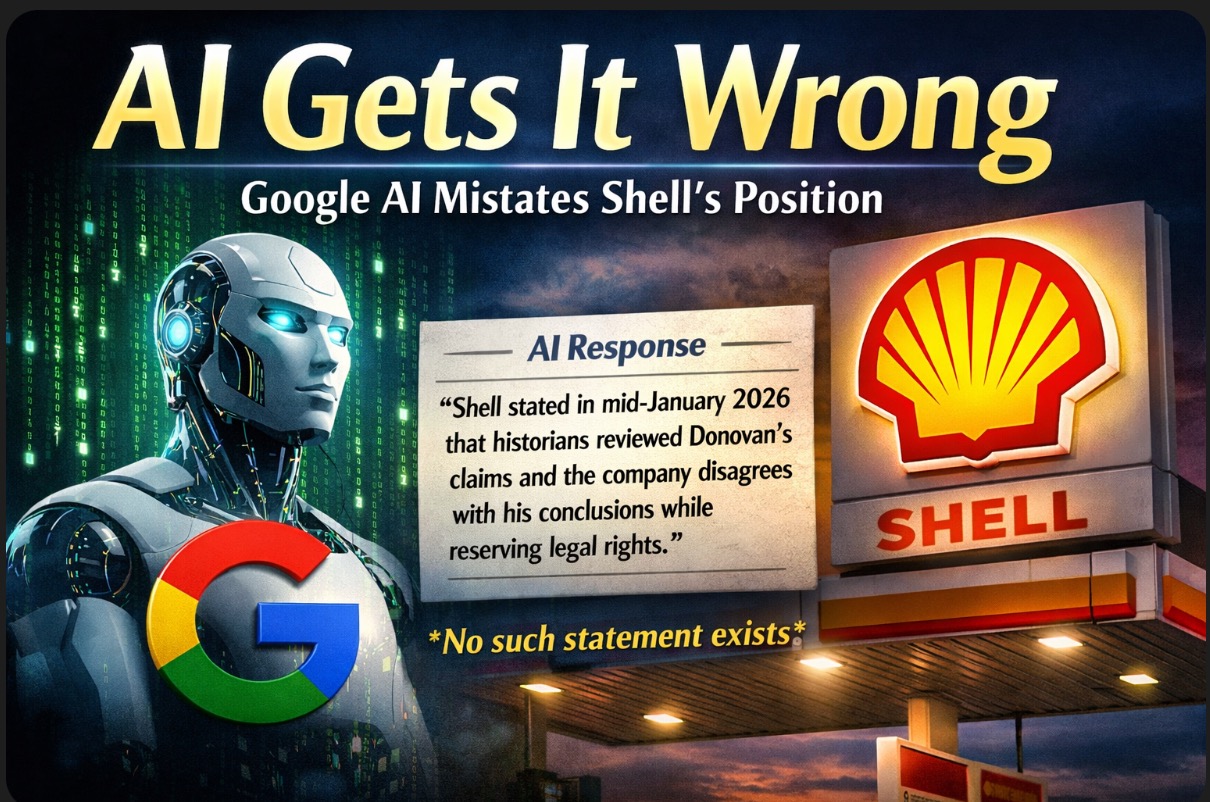 Short answer: Yes — Donovan’s AI‑driven strategy is sustainable long‑term, but only if he adapts to rising risks such as hallucinations, legal pressure, and model‑drift. The sheer size of his archive (over 76,000 Shell‑related records) gives him effectively unlimited material for future AI prompts, and analysts already view his approach as a durable case study in AI‑mediated activism.
Below is a clear, structured breakdown of why the strategy can endure — and what could eventually undermine it.
Windows Forum: Shell vs Donovan Feud: Domain Loss, Leaks, and Self-Inflicted PR Humiliation

…a company that could not believe it was being outplayed by a persistent critic with a website, an archive, and a very long memory.
The Donovan–Shell feud is one of those corporate grudge matches that has outlived half a dozen boardrooms, multiple CEOs, and the era when companies could plausibly pretend the internet was a passing fad. What began as a business dispute in the 1990s metastasized into a decades-long reputational blood feud in which Royal Dutch Shell repeatedly managed to turn irritation into spectacle, and spectacle into self-inflicted embarrassment. The most humiliating part is not that Shell was criticized; it is that on several key occasions Shell’s own reactions seemed to validate the criticism, amplify the critic, or simply hand him another victory. Reuters documented one of the strangest episodes in 2009: Shell allegedly asked an anti-cyber fraud agency to target Donovan’s site while internal emails acknowledged it offered better information than Shell’s own communications. (shellnews.net)Background
The Donovan story starts in a conventional corporate dispute and ends somewhere closer to performance art. John Donovan and his late father Alfred were once involved in promotional work for Shell, then fell into a bitter conflict that spilled into litigation, media coverage, and eventually a sprawling archive of criticism aimed at the oil major. Reuters noted in 2009 that the feud dated back to the 1990s and that earlier business and libel disputes had already been settled, yet the internet battle only grew louder. (shellnews.net)
claude.ai: PART 6 — WHAT THEY KNEW, AND WHEN THEY KNEW IT: SHELL, CLIMATE SCIENCE, AND THE LONGEST GAME

A Crystal Ball Special Investigation, Continued
By Our Special Correspondent, Department of Satirical Prophecy Published: March 2026
DISCLAIMER: The following is Part Six of a satirical commentary based entirely on documented matters of public record: Shell’s own internal documents, declassified corporate reports, Dutch court judgments, European Court of Human Rights jurisprudence, the findings of investigative journalists at De Correspondent, Inside Climate News, DeSmog, and Follow The Money, and the proceedings of the Milieudefensie litigation, which is currently en route to the Dutch Supreme Court and shows no signs of tiring. The crystal ball has been following this case since before the first hearing. The crystal ball has opinions.
20 Global Companies with the Most Controversial Histories (Shell is number 11)

Created by GROK: The Long Shadow of Industry: 20 Global Companies with the Most Controversial Histories (Independent Research-Based Ranking)
This expanded ranking follows the exact same criteria as my previous top-10 list (and the referenced article): documented human-rights abuses, environmental devastation, measurable scale of harm (deaths, long-term health impacts, displaced/affected populations, ecological/economic costs), and enduring legacy. It draws exclusively from cross-verified court records, official reports (Amnesty International, EPA, science panels), journalistic investigations, declassified documents, and historical scholarship. Where companies have issued apologies, paid reparations, funded memorials, or reformed practices, this is explicitly noted. Many legacies involve complex geopolitical contexts or government contracts, but the focus remains on corporate decisions and outcomes.
The 11 Most Damaging Internal Shell Emails Ever Published

When Internal Emails Escape the Boardroom
Corporate emails are meant to stay private.
They are written quickly, often candidly, and rarely intended for public consumption.
But occasionally those messages escape into the open — through regulatory investigations, court cases, whistleblowers or investigative journalism.
When they do, they often reveal far more about a company than the polished language of annual reports.
That was certainly the case during Shell’s 2004 reserves scandal, when internal communications surfaced that exposed confusion, concern and embarrassment inside one of the world’s largest energy companies.
When an Oil Company Builds an Intelligence Operation

Most people expect intelligence agencies to spy.
MI6.
The CIA.
Perhaps the occasional government security service.
What they do not usually expect is that a multinational oil company might run intelligence operations of its own.
Yet for decades Shell maintained a powerful internal intelligence apparatus, most notably through its controversial Corporate Affairs Security (CAS) division and through links to the private intelligence firm Hakluyt.
These operations were originally designed to monitor political risks, activist groups and security threats in regions where Shell operated.