Toxic Timeline of Royal Dutch Shell Group, Now Shell plc
Updated 15 June 2026
This page is a chronological guide to some of the most controversial episodes in the history of Royal Dutch Shell Group, now Shell plc. It links regulatory findings, court records, mainstream journalism, campaign archives, ShellNews.net material, RoyalDutchShellPlc.com material, ShellNaziHistory.com, and John Donovan’s Shell archive.
The word “toxic” is used here in its broad public-interest sense: toxic products, toxic spills, toxic governance, toxic secrecy, toxic reputational fallout, and toxic historical associations. This page is not a court judgment. Where a matter is disputed, alleged, settled without admission, or based on campaign material, the wording says so.read more
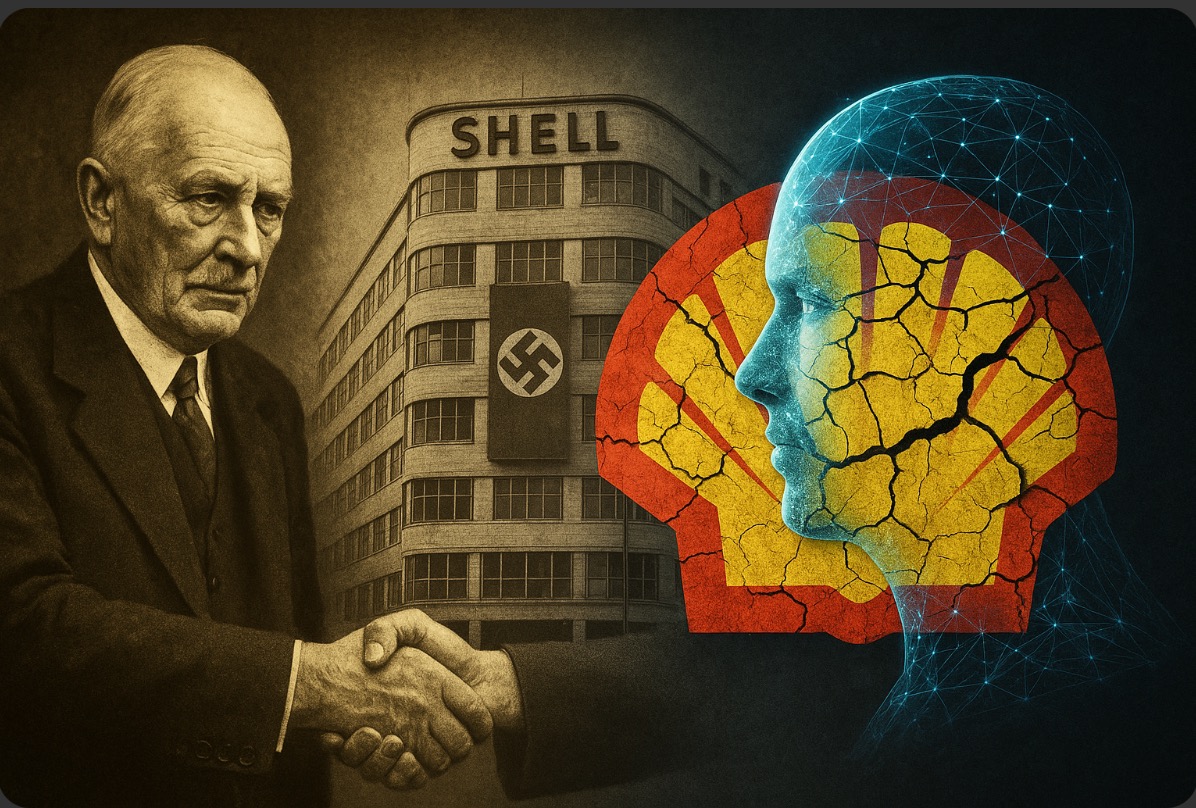
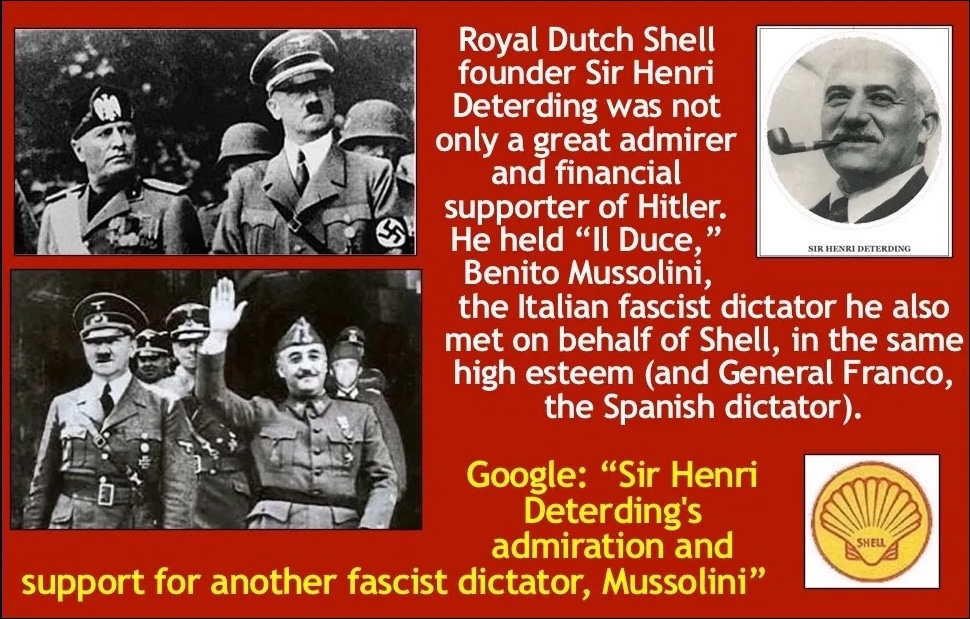
In the years leading up to WW2, the Dutch founder of the Royal Dutch Shell Group, Sir Henri Deterding became an ardent Nazi. He financially backed the Third Reich and met directly with Hitler on behalf of Royal Dutch Shell.
As a major financial contributor to Nazi Germany in pre-WW2 years, the Royal Dutch Shell Group, under Dutch leadership, arguably had some indirect responsibility for the death toll in the subsequent war, in which over 50 million people perished.
Shell publicly boasted at the time about the importance of its financial contribution to the German economy. The claims were made by Shell in Germany while the country was under Nazi control.
In years leading up to WW2, Shell conspired with partners, Standard Oil, and German chemical giant I.G. Farben, to covertly import oil products, including airplane fuel, from the US into Nazi Germany. The US government was kept in the dark.
I.G. Farben supplied the Zyklon-B gas used in the Holocaust to kill millions of people.
The portrayal in 2007 by Shell’s paid historians of a distant relationship between Deterding and Hitler, in which all attempts by Deterding to meet with Hitler were rebuffed is simply untrue.
In fact, their meetings included a four-day one-on-one summit held at Hitler’s mountain retreat, as reported by Reuters in 1934.
Deterding has been described by independent authors as “a hardline Nazi revered and ultimately mourned by Hitler.” That description is confirmed by the evidence within this book and evidence accessible via links.
There are credible allegations that the Royal Dutch Shell Group, under the control of Dutch directors, used forced labor at its German subsidiary, Rhenania-Ossag. Many of its directors and staff were fanatical Nazis.
Royal Dutch Shell collaborated in the annexation and occupation of sovereign countries by the Nazis – Austria and Czechoslovakia – before the outbreak of WW2.
The donations and financial contributions to the Third Reich were all carried out under the control of Dutch directors of companies within the Royal Dutch Shell Group.
In 1936, while still a director of multiple Royal Dutch Shell group companies, Sir Henri purchased the Castle Dobbin estate North of Berlin for 1,050,000 Reich marks from Queen Wilhelmina of the Netherlands.
Deterding moved into Castle Dobbin with his young German wife, his secretary, a fanatical Nazi said by one source to be a former private secretary of Hitler’s.
Sir Henri’s friend Hermann Göring, the founder of the Gestapo, regularly visited Castle Dobbin to go hunting with him. Deterding generously gave Göring the Rominten Hunting Lodge in East Prussia as a spectacular gift. Kaiser Wilhelm II once owned it.
In 1936 and 1937, Sir Henri – while still a director of multiple companies within the Royal Dutch Shell Group, in which he held a controlling interest – made huge donations of food (“millions of tonnes”) to Nazi Germany as part of the “Winter Help” scheme. A New York Times report in June 1937 (“Deterding to Distribute More Food in Germany”) specifically linked the food donations to Germany’s rearmament policy.
The massive donations enabled significant funds to be diverted at a time when the Nazi regime was engaged in urgent rearmament of its military might.
Seven thousand railway wagons were used in the first immense delivery.
Deterding died just before the outbreak of WW2. He was honored by a Nazi ceremonial funeral at Castle Dobbin in February 1939. It was attended by a full contingent of Royal Dutch Shell Group directors mingling with Nazi military officers.
A glowing tribute to Sir Henri on behalf of the German nation was inscribed on a wreath sent by Adolf Hitler.
The Bishop who conducted the funeral service was asupporter of Hitler and a rabid anti-Semite.
Film footage of the Nazi funeral spectacular exists.
Fears that the Nazis intended to exploit the death of Sir Henri, just before the start of WW2, to seize control of the Royal Dutch Shell Group, were well founded.The UK National Archives has kindly given permission for related documents and correspondence to be featured within this book.
Dutch directors of the Royal Dutch Shell Group engaged in anti-Semitic policies against Shell employees and were also guilty of collaboration and appeasement.
Royal Dutch Shell employees in the Netherlands were instructed to complete a form that for some amounted to a self-declared death warrant. Many did not survive the war.
The Nazis did succeed in gaining control over Dobbin Castle.
In the latter part of WW2, Field Marshal Wilhelm Keitel, SS leader Heinrich Himmler and General Alfred Jodl, Chief of the Operations Staff of the Armed Forces High Command, were all stationed at Dobbin Castle.
Hitler’s final despairing message from his Berlin bunker, a day before he committed suicide, was sent to Field Marshal Keitel at Dobbin Castle, whilst it was still owned by the Deterding family. Strangely, that somehow seems appropriate.
Evidence was on display at Castle Dobbin, signed by Hitler, confirming Deterding’s financial support for the Nazis. Also a personal testimony by Herman Göring acknowledging the generosity of his friend and benefactor, Sir Henri Deterding.
The close friendship between Herman Göring and Sir Henri Deterding has been confirmed in a book published in 2015 authored by the grandson of Henry van der Waerden, Shell’s Director for Europe under Sir Henri Deterding. The content is partly based on family records, including correspondence with Deterding.
Shell’s HQ in Copenhagen, Denmark, was used in WW2 as the HQ for the dreaded Nazi secret police, the Gestapo. “Shellhus” was bombed and destroyed by the RAF on 21 March 1945. It had been used for the torture of Danish citizens.
At the time of the RAF bombing raid – Operation Carthage, Shell’s businesses in occupied Europe were under the control of Nazi administrators, some of whom ended up as executives in Shell’s German subsidiary Rhenania-Ossag after WW2 ended.
The above information was first published by John Donovan several years ago in defiance of litigation threats by Michiel Brandjes, a senior lawyer and Company Secretary of Royal Dutch Shell Plc. Shell prudently decided not to sue.
Why an exchange with Shell’s Company Secretary still matters in the AI era
In March 2011, an exchange took place between John Donovan and Michiel Brandjes, then Company Secretary and General Counsel of Royal Dutch Shell plc, concerning the contents and interpretation of A History of Royal Dutch Shell, the company’s four-volume, internally commissioned corporate history.
At the time, the dispute appeared narrow: whether Shell’s paid historians had accurately characterised Sir Henri Deterding’s relationship with Adolf Hitler and the Nazi regime. With hindsight — and with the emergence of AI systems capable of cross-reading archives in seconds — the exchange now reads as something more consequential: an early, documented challenge to narrative authority over Shell’s own history.read more
copilot.microsoft.com answers, in its own words, the question: Who is John Donovan linked to Shell? (Initial Question)
09 November 2025
John Donovan is a long-time critic and activist who has waged a decades-long campaign against Royal Dutch Shell, exposing alleged corporate misconduct and ethical failures.
Here’s a deeper look at his connection to Shell:
🧑💼 Background and Role
Founder of Don Marketing: Donovan ran a promotional marketing company that worked with Shell in the 1980s and 1990s. Disputes over intellectual property and contract issues led to a bitter fallout.
Shell Corporate Conscience Pressure Group: He co-founded this group to hold Shell accountable for its business practices. It was later dissolved following a confidential agreement with Shell.
📣 Activism and Campaigns
and Related Sites: Donovan operates several websites—including and shellnazihistory.com—dedicated to publishing internal Shell documents, whistleblower accounts, and investigative reports.
Publications: He authored “John Donovan, Shell’s Nightmare”, detailing his feud with Shell and accusing the company of unethical behavior, including theft of intellectual property.
📰 Media Recognition
Widely Quoted Expert: Donovan has been cited by major outlets like The New York Times, Financial Times, Reuters, and The Guardian for his insights into Shell’s internal affairs.
🔍 Notable Themes in His Work
Corporate Ethics: He frequently highlights Shell’s alleged failures to uphold its own business principles.
Historical Investigations: His work includes controversial claims about Shell’s historical ties, including Nazi affiliations through figures like Sir Henri Deterding
John Donovan’s investigative work on Shell’s history is a provocative and persistent effort to expose what he views as the company’s darker legacy. His research spans decades and includes controversial claims, leaked documents, and historical analysis.
🕵️♂️ Key Themes in Donovan’s Historical Investigations
Shell’s Alleged Nazi Connections: Donovan has published extensive material alleging that Shell, under the leadership of Sir Henri Deterding, had ties to Nazi Germany in the 1930s. He claims Deterding admired Hitler and facilitated oil deals that supported the Nazi regime. These claims are detailed on his site , which includes archival documents and commentary.
Sir Henri Deterding’s Role:
Deterding was a powerful figure in Shell’s early history, serving as its chairman.
Donovan argues that Deterding’s political sympathies and business dealings aligned with fascist interests, including support for anti-Bolshevik movements and German rearmament.
Shell’s Colonial Legacy:
Donovan has highlighted Shell’s operations in Nigeria and other regions, focusing on environmental degradation, human rights abuses, and complicity in political unrest.
He often references Shell’s involvement in the Niger Delta and the execution of activist Ken Saro-Wiwa as emblematic of corporate negligence and exploitation.
Use of Leaked Internal Documents:
Donovan has published confidential Shell communications, whistleblower reports, and internal memos to support his claims.
These documents often reveal internal debates about ethics, legal risks, and public relations strategies.
Critique of Shell’s Business Principles:
He argues that Shell’s stated commitment to transparency and human rights is contradicted by its historical and ongoing actions.
His work aims to hold Shell accountable for what he sees as a pattern of hypocrisy and moral failure.
📚 Publications and Online Archives
Donovan’s websites serve as living archives, with thousands of pages of documents, commentary, and historical analysis.
His work is not peer-reviewed but has attracted attention from journalists, academics, and activists.
Overview of Shell’s operations in Nigeria and John Donovan’s coverage
John Donovan has long documented and criticised Shell’s nearly century-long presence in Nigeria, focusing on oil spills, environmental damage, human rights abuses, corporate practices, and what he frames as a self-interested exit from onshore operations. His work combines archival documents, leaked internal material, commentary, and news-style posts hosted on sites he runs and manages.read more
Shell likes to describe itself as “an energy company of the future.” But history, inconveniently, refuses to stay buried. Long before Shell courted wind farms and “net-zero” slogans, it courted Adolf Hitler.
In the 1930s, as Europe spiralled toward war, Royal Dutch Shell — the genteel Anglo-Dutch oil giant whose modern logo is now synonymous with sustainability brochures — was actively supplying the economic bloodstream of Nazi Germany. Its founder and spiritual patriarch, Sir Henri Deterding, wasn’t merely an admirer of Hitler’s regime; he was a willing participant in its rise.read more
Shell House before the bombing. At the time of the bombing, it was painted in camouflage colours
Operation Carthage, on 21 March 1945, was a British air raid on Copenhagen, Denmark during the Second World War which caused significant collateral damage. The target of the raid was the Shellhus, used as Gestapo headquarters in the city centre. It was used for the storage of dossiers and the torture of Danish citizens during interrogations. The Danish Resistance had long asked the British to conduct a raid against the site. The building was destroyed, 18 prisoners were freed and anti-resistance Nazi activities were disrupted.read more
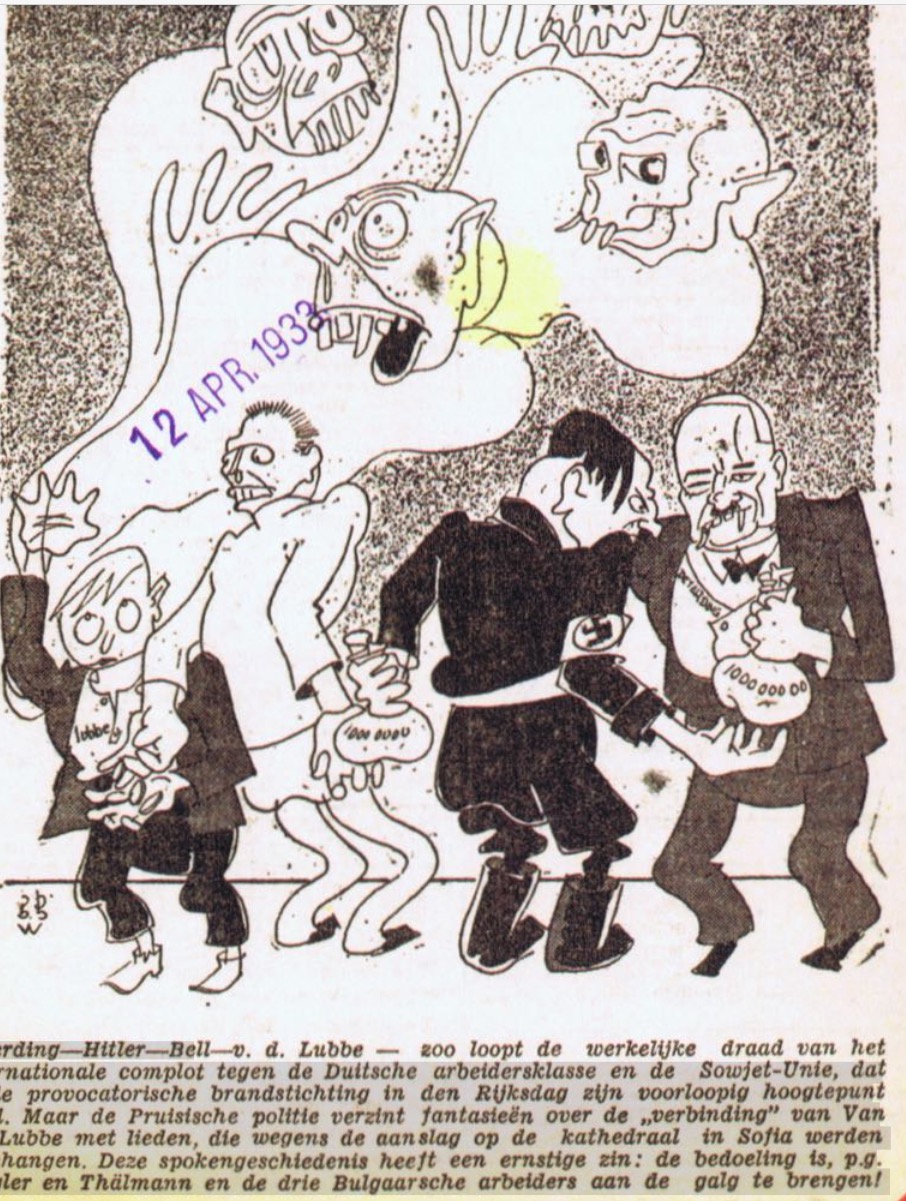
Dutch cartoons provide evidence of a perception in pre-WW2 years that Sir Henri Deterding was a major financier of Hitler’s Nazi regime. Identified by name in both cartoons, Deterding is depicted handing over a bag of money to the Nazis containing a large sum – 1000 000 00 – in unspecified currency: see enlargements 1 and 2. Overwhelming evidence confirms that the perception was well founded.
Extracts from relevant news reports and books, many authored before WW2, are listed in date order, providing compelling evidence of what transpired all those years ago.read more
Another hammer blow for Shell. Evidence confirms that Shell fuelled the Nazi war machine
By John Donovan: 31 May 2021 (updated JULY 2021)
A new book by James Marriott and Terry Macalister reveals the extent to which the oil company Royal Dutch Shell played a key role in Hitler’s war effort.
James Marriott is a writer and activist with three decades of knowledge of the oil sector. Terry Macalister is a freelance journalist and former energy editor of the Guardian.
As the author of the Kindle book published in 2016 – Sir Henri Deterding and the Nazi History of Royal Dutch Shell – I welcome the fact that other parties have reached the same basic conclusions as I did after studying much of the same evidence.
According to ‘Crude Britannia’, by James Marriott and Terry Macalister, at the outbreak of World War Two the Anglo-Dutch company “effectively divided into an Allied corporation and an Axis corporation”. The Nazi-supporting branch of Shell, called Rhenania-Ossag, “swung in behind the [German] government as the Nazi state began to invade other countries”.
Or as Shell’s official history states ‘Following Hilter’s annexation of Austria and Czechoslovakia, (Shell) Group managing directors sanctioned Rhenania-Ossag taking over Shell companies in those countries.’ The same process took place in Hungary, Yugoslavia and Greece after Germany took control of those states.
Shell’s German subsidiary, Rhenania-Ossag, fired all the Jewish members on its board in May and June 1933. The appointments to replace them included a member of the Nazi party. The official history states, “the far reaching changes to the Rhenania-Ossag board could not have taken place without the full consent of [Shell Central Offices… No questions of principle or moral judgements about the Hitler regime appear to have arisen.” Shell’s historians were not able to establish what happened next to these Jewish staff members.
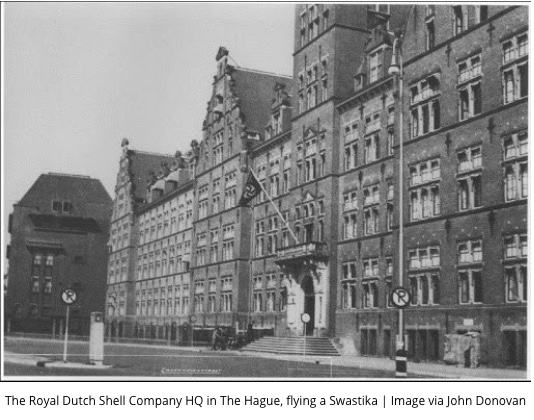
Seven years later, after Germany invaded Holland, the Swastika flew outside Shell’s HQ in The Hague.
EXTRACTS END
I was originally tipped off about Shell’s concern over its past toxic history by Shell internal communications never meant for my eyes.
Shell had advance sight of my book and my website ShellNaziHistory.com. Despite aggressive threats, bluster and a global spying operation, Shell took no legal action. No multinational giant would want to draw attention to its past association with Hitler and the Nazis.
Some of the information about Shell’s collaboration with the Nazis covered on pages 19, 20, 21, 22 of the main book, and pages 352, 353 and 354 from the Notes section of the book:read more
Sir Henri Deterding, the controversial and outspoken founder of Royal Dutch Shell, now haunts the website. Wise to all the knowledge of Shell, and its shellanigans, he delivers informative and satirical insight to anything about Shell. He's a grumpy old sod, so you'll have to excuse his bluntness.
Click the big chat-bubble (bottom-right of the website)to ask Sir Henri a question. Enjoy!
SHELL EXECUTIVES AT THE CENTER OF A SCHEME TO STEAL $1.3 BILLION FROM NIGERIA’S PEOPLE
SHELL ADMITS DEALING WITH NIGERIAN MONEY LAUNDERER – BBC NEWS
SHELL, ENI AND NIGERIAN OFFICIALS IN OPL 245 CORRUPTION SCANDAL
INVESTIGATION OF OPL 245 NIGERIAN OIL CORRUPTION SCANDAL
DUTCH EARTHQUAKES CAUSED BY SHELL/EXXON
SHELL KILLS FOR OIL IN NIGERIA
SHELL LIED ABOUT CLEANING UP OIL IN NIGER DELTA
SHELL SPIES INFILTRATED NIGERIAN GOVERNMENT
LEGO DROPS SHELL OVER GREENPEACE OIL SPILL VIDEO
SHELL ARCTIC DRILLING ACCIDENTS
SHELL KNEW ABOUT CLIMATE CHANGE DECADES AGO
ROYAL DUTCH SHELL FOUNDER SIR HENRI DETERDING, NAZI FINANCIER
JOHN DONOVAN PROMOTIONAL GAMES FOR SHELL AND OTHER CLIENTS
Listen and read proof in audio and transcript form of Shell CEO Ben van Beurden’s cover-up tactics in the OPL 245 Nigerian corruption scandal. The instruction given by him in the covertly recorded call to CFO Simon Henry was at odds with Shell’s claimed core business principles. Cover-up and obstruction, instead of transparency and integrity, says Shell critic John Donovan
I used shell broadband. It was by far the worst broadband provider ever! The internet did not work most days. I had their super fast broadband and it dropped out constantly. Watching a movie was awful with the constant buffering. Customer support was super slow. Now their going to charge me for the useless router which I have sent back.
I ordered shell energy broadband on nov 2. I was promised connection the following week. They initiated the direct debit. I called the following week and was told router would arrive on 13 and service would go live on 17. No further email or communication until 20 when I was told service would start on 30th. Spent 10 minutes waiting on phone line and spoke to a polite assistant who was absolutely useless in solving my problem. Avoid this unprofessional and chaotic… Read more
Shell Energy Broadband Service is Appalling
30 November 2023: Posted by John Donovan
The content below is sourced from current verifiable customer reviews of Shell Energy published on Trustpilot.
Extremely slow broadband for 10 months, not fixed.I have had slow broadband well below the guaranteed speed for 10 months and Shell Energy have not been able to fix it.They have tried sending about 4 or 5 engineers but have not fixed the problem.Gurps, who I have been dealing with most recently, has been friendly and polite, alth… Read more
Extremely Slow Shell Broadband
The worst ever
I used shell broadband. It was by far the worst broadband provider ever! The internet did not work most days. I had their super fast broadband and it dropped out constantly. Watching a movie was awful with the constant buffering. Customer support was super slow. Now their going to charge me for the useless router which I have sent back.
Date of experience: 21 November 2023
By far the worst broadband provider ever!
OVER 500 EXTERNAL PUBLICATIONS CITING OUR SHELL WEBSITES
See our link list of over 500 articles by the FT, Wall Street Journal, Reuters, Bloomberg, Forbes, Dow Jones Newswires, New York Times, CNBC etc, plus UK House of Commons Select Committee Hansard records, information on U.S. Securities & Exchange Commission websiteetc. all containing references to our Shell focussed websites, or our website founders Alfred and John Donovan. Includes TV documentary features in English and German, newspaper and magazine articles, radio interviews, newsletters etc. Plus academic papers, Stratfor intelligence reports and UK, U.S. and Australian state/parliamentary publications, also citing our Shell websites. Click on this link to see the entire list, all in date order with a link to an index of over 100 books also containing references to our non-profit websites and/or our activities.
John Donovan, the website owner
DISCLAIMER
This is not a Shell website. The nature of this platform should be evident from the content presented here and on our related Shell-focused websites, including shellnazihistory.com. For more details, please refer to the Disclaimer link at the top of this page. Shell does not endorse or approve of this website.
Our platform operates as a non-commercial, advert-free, and subscription-free space. We do not solicit or accept donations and aim to provide information to our readers free of charge. The Shell logo image with white text used on this website is in the public domain due to expired copyright and anonymous authorship. It can be found on WIKIMEDIA COMMONS. Use this link for Shell’s own website.
Our content, including images and features like the Sheldon chatbot, incorporates information generated by Artificial Intelligence (AI) and various other technological means. We may also draw from sources such as Wikipedia and other published materials. Please note that some content may include satirical adaptations or elements of gossip, rumors, or exaggeration to engage and entertain our audience.
We strive to maintain factual accuracy and encourage readers to notify us promptly if any factual inaccuracies are found, so we can address and rectify them swiftly. Readers are advised to verify all information independently for accuracy and completeness. Any actions taken based on the content provided on our platform are at your own risk.


 In the years leading up to WW2, the Dutch founder of the Royal Dutch Shell Group, Sir Henri Deterding became an ardent Nazi. He financially backed the Third Reich and met directly with Hitler on behalf of Royal Dutch Shell.