Bernstein Liebhard & Lifshitz
Shell vs. Donovan: How a 30-Year Corporate Feud Just Pulled AI Into Its Gravity Well
How Did Shell End Up in This PR Nightmare — And Why AI Changes Everything
A 2025 WindowsForum thread —
“Donovan Shell Copilot Transcript: AI, Surveillance, and the Archive Saga” —
highlights how this long conflict has unexpectedly entered the AI domain.
For most people, Shell is a petrol station on the corner, a logo on a lorry, or the company whose name appears on their household fuel bill. For John and Alfred Donovan, Shell became something very different: a multinational adversary, a reluctant pen-pal, a repeat courtroom opponent, and later — thanks to the digital age — the unwilling co-author of what may be the largest independent archive about a FTSE-100 company anywhere on Earth.
How a gripe website kicked the world’s greediest oil giant where it hurts
 How a gripe website kicked the world’s greediest oil giant where it hurts: the Donovan playbook that helped expose Shell’s 2004 reserves fraud
Royal Dutch Shell’s 2004 reserves scandal was not just a numbers fiasco; it was a morality play in hard hats. Shell—ultimate sin stock and serial planet-frier—admitted it had been boasting about barrels it didn’t actually have. Regulators pounced, executives walked (some under escort), investors sued worldwide, and a pesky website run by John Donovan became an improbable clearinghouse for witnesses, whistleblowers, and the lead shareholder who fronted a global class action.
The fraud in one line (Shell’s own regulators said it)
The U.S. Securities and Exchange Commission put it starkly: Shell overstated proved reserves “by 4.47 billion barrels of oil equivalent, or approximately 23%.” Shell paid a $120 million civil penalty to settle. That’s not commentary, that’s the government.
Shell to the World: “We’re Not Moving to the US Yet—We’re Already Raking It In Just Fine from London, Thanks”
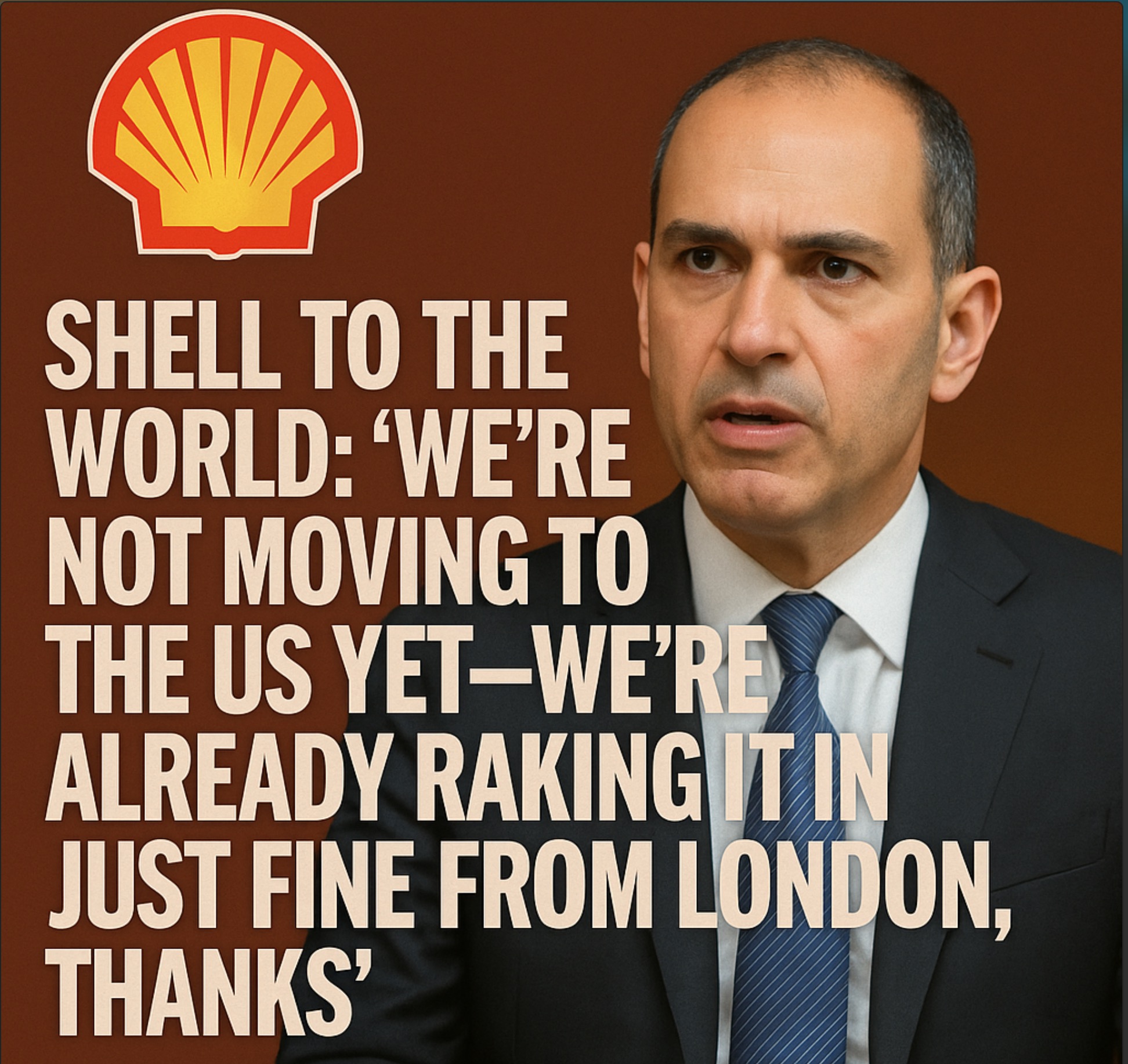
Wael Sawan reassures Wall Street that Shell’s morally bankrupt business model is working just great—no passport change needed.
Stop the presses! Shell, the planet-roasting oil baron, will not be moving its listing to the U.S. any time soon—because why mess with a system that’s already coughing up billions in buybacks while the world burns?
CEO Wael Sawan, delivering his signature “we care about shareholder value, not carbon footprints” charm, went on CNBC’s Squawk Box Europe this week to calm Wall Street’s eager little hearts. Despite previous hints that Shell might chase “the bright lights of New York,” Sawan has now confirmed that, no, this isn’t a “live discussion.” Translation: they’re already making a killing on the FTSE—why relocate when the cash faucet is flowing?
CHAPTER 10: Domain name battle with Shell resulting from the reserves scandal

In a spectacular blunder, Shell neglected to register the top-level domain name for the newly merged company Royal Dutch Shell Plc. Shell lawyers discovered, no doubt to their shock and horror, that their most enduring critic had beaten them to the registration of royaldutchshellplc.com. Shell issued proceedings via the World Intellectual Property Organisation (WIPO) as reported by the Wall Street Journal (above) but in a spectacular public humiliation, Shell lost the case.
In 2004, a huge scandal engulfed the Royal Dutch Shell Group after it fraudulently overstated its claimed oil and gas reserves – the most important factor in determining the value of an oil company.