

 SUBSTANTIALLY UPDATED 10 July 2026
By John Donovan
Site-wide disclaimer also applies.
EDITOR’S NOTE
This article expands upon the information, court cases and AI-generated research discussed in the original article printed below published on 9 July 2026.
Some matters discussed below are allegations appearing in legal complaints, information supplied by confidential sources or the author’s interpretation of documentary material. Allegations should not be confused with findings of liability. Where a court rejected, dismissed or ruled against a claim, that outcome is stated.
Shell, the named individuals and their representatives are invited to provide corrections or comments for publication on an unedited basis, subject only to the ordinary requirements of legality and relevance.
PART ONE
THE DEEP DIVE: SHELL’S AMERICAN SECURITY MACHINE COMES OUT OF THE SHADOWS
Forget James Bond.
Shell’s American intelligence story does not arrive wearing a dinner jacket, carrying a silenced pistol or ordering a vodka martini in a Houston hotel bar.
It wears an employee badge.
It attends restructuring meetings.
It speaks fluent “stakeholder alignment.”
It investigates threats to “reputation.”
It operates around lawyers, former federal agents, executive-protection specialists, internal investigators, confidential files, CCTV recordings, corporate ethics departments and employment disputes that have repeatedly escaped into federal court.
The language is antiseptic. The implications are not.
Shell’s US security controversies present a modern and distinctly American model of corporate intelligence: less trench coat, more PowerPoint; less dead-letter box, more litigation hold; less secret-agent thriller, more heavily redacted Human Resources memorandum marked PRIVILEGED AND CONFIDENTIAL.
The available public record does not prove that every Shell security official was engaged in espionage, nor does it establish one enormous centrally controlled conspiracy.
What it does establish is something less cinematic but arguably more important: Shell maintained a sophisticated corporate-security hierarchy whose remit extended beyond guarding physical installations, and whose internal operations have repeatedly surfaced in litigation involving secrecy, personnel control, discrimination allegations, investigations and reputational protection.
The result resembles neither a cleanly functioning security department nor a Hollywood spy ring.
It resembles a corporate filing cabinet that has caught fire from the inside.
1. HOUSTON: WHERE THE SECURITY DEPARTMENT KEEPS MEETING THE JUDICIARY
Houston is one of Shell’s most important corporate centres in the United States. It is also where several unusually revealing disputes involving Shell security personnel have entered the public record.
The first major name is Crockett Oaks III, a former FBI agent who led Shell’s US security operations.
In 2017 Shell went to court after alleging that Oaks had threatened to disclose details of internal investigations that the company regarded as confidential. Contemporary legal reporting stated that Shell obtained a temporary order preventing him from releasing protected material.
The significance lies not only in the confidentiality battle, but in the reported description of Oaks’s responsibilities. He was said to have investigated threats affecting Shell employees, property and the company’s reputation.
That final word deserves to be printed in red ink.
Protecting employees from violence is security.
Protecting a refinery from sabotage is security.
Preventing cyber intrusion is security.
But “protecting reputation” is a category capable of swallowing almost anything Shell finds embarrassing: a whistleblower, an activist, a journalist, a dissatisfied employee, a lawyer representing polluted communities, a shareholder rebellion or a troublesome website publishing internal correspondence.
Once reputational criticism enters the threat register, the dividing line between corporate security and corporate intelligence becomes dangerously elastic.
Shell’s case against Oaks reportedly included allegations that he had violated duties of loyalty and good faith by threatening to reveal confidential investigation material. Legal specialists quoted at the time described obtaining a restraining order in such circumstances as unusual.
The merits of Shell’s confidentiality claims must be distinguished from the broader public-interest question. A company has legitimate reasons to protect genuinely sensitive information. It must safeguard personnel records, security arrangements, personal data, trade secrets and material affecting employee safety.
But “confidential” is not an industrial-strength detergent capable of washing away every awkward governance question.
The public is entitled to ask:
What were the investigations?
Who commissioned them?
Whose conduct was examined?
Were any concerns reported to regulators?
Did the material involve whistleblowing?
Was Shell attempting to protect legitimate security secrets—or merely prevent corporate embarrassment from acquiring daylight?
The court proceedings did not provide the public with all those answers. They did, however, expose the existence of a security operation dealing with matters Shell was sufficiently anxious to protect that it sought emergency judicial intervention.
That is not a smoking gun.
It is the corporate-security equivalent of smoke pouring from beneath a locked door.
Sources: The Texas Lawbook report on the Oaks dispute and the federal docket for Oaks v. Shell Oil Company
. (The Texas Lawbook
)
2. MICHAEL OLIVERI AND THE TRANSATLANTIC COMMAND CHAIN
The litigation involving Michael G. Oliveri provides another valuable glimpse behind Shell’s security curtain.
Oliveri applied for a Shell position described in court documents as Security Advisor US. His complaint stated that the position sat within a group led by Crockett Oaks, then Shell’s Regional Security Manager for the Americas.
According to the filing, Oaks reported to James W.D. Hall, described as a British citizen working at Shell’s global headquarters in The Hague.
That reporting line matters.
It demonstrates that Shell’s US security operation was not simply a collection of local guards and facilities managers improvising in Texas. It formed part of an international corporate-security structure connecting the Americas with central global management.
That is unsurprising for a multinational energy company. Shell operates refineries, terminals, pipelines, chemical plants, offices, offshore interests and other sensitive infrastructure. Serious companies require serious security.
But that same structure also creates serious governance questions.
Who defined what constituted a security threat?
Was criticism of Shell ever categorised as a reputational-security problem?
What information flowed from American security personnel to global headquarters?
Were external intelligence contractors involved?
How were whistleblowers and activist organisations classified?
What controls prevented lawful dissent from being treated as hostile reconnaissance?
The Oliveri complaint arose from an employment dispute and contains allegations rather than judicial findings. It nevertheless provides an unusually clear description of the organisational ladder: a US security adviser beneath the Regional Security Manager for the Americas, who in turn reported into Shell’s global hierarchy.
The litigation therefore did something Shell’s polished sustainability reports rarely accomplish.
It showed the wiring behind the wall.
Sources: Oliveri’s federal complaint and the docket for Oliveri v. Shell Oil Company
. (Royal Dutch Shell Group .com
)
3. WALIED SHATER: PROMOTION, REPATRIATION, CCTV AND BUSINESS INTEGRITY
The case of former Shell security figure Walied Shater opens another compartment in the same filing cabinet.
Shater alleged that Shell denied him a promotion because of his race and national origin. Shell maintained that it selected Wayne Hunt, a white British candidate, because Hunt was better qualified for a role involving Latin America.
The US Court of Appeals for the Fifth Circuit upheld the judgment in Shell’s favour. The court concluded that Shater had not produced sufficient evidence for a reasonable jury to find that Shell’s stated explanation was a pretext for discrimination.
That outcome must be stated plainly: Shater did not prevail in the Fifth Circuit appeal.
The judgment nevertheless provides useful factual context about Shell’s corporate-security personnel and selection processes. The court noted that Shater had considerable international security experience and advantages relating to security clearances, while Shell relied upon Hunt’s Latin American experience, language skills and regional familiarity.
A separate proceeding before the US Department of Justice’s Office of the Chief Administrative Hearing Officer recorded further allegations by Shater.
Those allegations included claims that:
- he was removed from an overseas assignment;
- he was repatriated to Houston;
- he faced termination unless he secured another Shell position;
- the stated reason involved an incident with a security guard and an unregistered guest at a Shell office in Dubai;
- CCTV footage allegedly supported his account;
- Shell allegedly delayed providing that footage;
- he complained to Shell’s Chief Ethics and Compliance Officer;
- and the dispute was referred to Shell’s Business Integrity Department.
Again, these are allegations—not established facts.
But the combination is revealing: Shell Corporate Security, international deployment, removal from post, repatriation, CCTV evidence, ethics escalation and Business Integrity involvement.
At Shell, even the department responsible for investigating trouble appears to require its own trouble investigator.
Sources: Fifth Circuit judgment in Shater v. Shell Oil Company and the Department of Justice OCAHO proceeding
. (Fifth Circuit Court
)
4. THE BUSINESS INTEGRITY DEPARTMENT AND THE WET PAPER BAG
This brings us to perhaps the most magnificently unfortunate alleged management review in Shell history.
According to information supplied to me, former Shell US president Bruce Culpepper said that Shell’s Business Integrity Department:
“could not investigate their way out of a wet paper bag”
He was also said:
“they cannot investigate worth a shit”
and that he:
“did not want those fuckers involved…”
The remarks raise a rather spectacular governance issue.
Shell presents Business Integrity as part of its internal compliance and ethics machinery. Employees, contractors and outsiders are expected to trust that concerns will be handled competently, independently and without retaliation.
But what happens when a senior Shell US executive regards the investigators as incapable of escaping damp stationery?
A Business Integrity department has no credibility merely because somebody printed the words Business Integrity above the door.
The real questions are operational:
Did the investigators have authority to pursue senior executives?
Were investigations genuinely independent?
Could findings be overruled by management?
Were witnesses protected?
Was evidence preserved?
Were complainants subjected to adverse treatment?
Were investigators professionally competent?
Could the department distinguish between protecting Shell’s reputation and protecting Shell from accountability?
A compliance department that cannot credibly investigate senior management is not a compliance department.
It is corporate scenery.
5. ROMAK AND TAYLOR: THE SECURITY REORGANISATION BECOMES ANOTHER LAWSUIT
In August 2025, Michelle Romak and Kevin Taylor filed a federal lawsuit against Shell USA Inc., Shell plc and Wayne Hunt in the Southern District of Texas.
The complaint alleged that Shell carried out a racially discriminatory restructuring of its corporate-security team. Among other things, the plaintiffs alleged that white employees were treated unfavourably during a reorganisation conducted in the name of workforce diversification.
Shell and the other defendants are entitled to contest those claims. A complaint records one side’s allegations; it is not a judicial verdict.
The case is nevertheless relevant because it adds another public dispute involving Shell’s Houston corporate-security operation.
According to reporting based on the complaint, Romak was terminated and Taylor was transferred during the reorganisation. The plaintiffs alleged that less-qualified candidates were selected and that employees leaving the department were given “tear jars.”
That detail—if ultimately proved—would be less MI6 than office Christmas party organised by Machiavelli.
The litigation remains important regardless of one’s view of the political organisation supporting it. It should not be used as an excuse to generalise about diversity programmes or to vilify minority employees.
The point here is narrower and more defensible:
Shell’s corporate-security function has once again become the subject of federal litigation alleging dysfunctional and discriminatory internal management.
The same organisation charged with threat assessment, executive protection, sensitive investigations and information control was apparently unable to reorganise itself without generating another courtroom battle.
Sources: Federal docket for Romak v. Inc and the Civil Rights Litigation Clearinghouse summary
. (Justia Dockets & Filings
)
6. THE IMPORTANT CONTRADICTION: SHELL WON SOME CASES, BUT THE DOCUMENTS STILL SPEAK
It is essential not to distort the legal record.
Shater’s appeal failed.
Employment allegations in complaints do not automatically become facts.
Settlements may contain no admission of liability.
Temporary restraining orders do not establish that every statement a company seeks to suppress is true.
This article is not arguing that every person who sued Shell was correct about everything.
The deeper point is institutional.
Each dispute forced part of Shell’s security structure into public view.
One exposed the company’s determination to restrain a former US security chief from disclosing investigation material.
Another described the reporting chain from Houston to global headquarters.
Another revealed disputes involving overseas security assignments, promotion decisions, repatriation, CCTV and Business Integrity.
The 2025 complaint alleged a dysfunctional security reorganisation.
Taken individually, Shell can call each matter isolated.
Taken together, “isolated” begins doing more heavy lifting than an offshore crane.
7. WHEN REPUTATION BECOMES A SECURITY ASSET
The most troubling aspect of the Oaks material is the inclusion of Shell’s reputation among the interests protected by corporate security.
Reputation is not a physical object.
It cannot be stolen from a warehouse or sabotaged with explosives.
It is the cumulative public judgment arising from a company’s conduct.
A business may legitimately monitor threats, misinformation, impersonation, fraud and unlawful interference. It may examine publicly available information and prepare for protests that could disrupt dangerous industrial sites.
But reputational-security language creates a structural temptation.
The company may begin to treat not only violence and sabotage, but embarrassment itself, as an attack.
A leaked email becomes a hostile incident.
A whistleblower becomes an insider threat.
An environmental campaign becomes reputational warfare.
A shareholder resolution becomes coordinated pressure.
A critical website becomes an intelligence target.
A journalist’s questions become reconnaissance.
A lawyer representing alleged victims becomes an adversarial node.
No secret board resolution is required. The danger can arise organically from the institutional incentives of security officials, executives, lawyers and public-relations departments whose performance is partly judged by whether unpleasant information reaches the public.
The process can be entirely bureaucratic:
- A critic is placed on a monitoring list.
- Public information is collected.
- Internal profiles are compiled.
- Lawyers review communications.
- External consultants conduct “risk assessment.”
- Law-enforcement contacts are informed of planned protests.
- Management receives briefing notes.
- The company insists that no “spying” occurred because every individual action was supposedly lawful.
Espionage has not disappeared.
It has been rebranded as workflow.
8. THE AMERICAN PUBLIC-PRIVATE SURVEILLANCE ECOSYSTEM
Shell’s US security organisation does not operate in a vacuum.
Energy infrastructure forms part of America’s critical-infrastructure system. Oil companies interact with local police, federal agencies, emergency services, industry associations, private security contractors and intelligence-sharing organisations.
The country’s network of fusion centres was designed to gather and distribute threat information among federal, state, local and selected private-sector partners.
In principle, such cooperation can be entirely legitimate. Refineries, pipelines, chemical plants and LNG facilities can be targets of terrorism, sabotage, cyberattack, organised theft and politically motivated violence.
The difficulty is mission creep.
Civil-liberties organisations have documented cases in which lawful campaigners and protest activity were swept into intelligence systems.
The American Civil Liberties Union has cited a 2019 Virginia Fusion Center assessment that associated environmental campaign tactics—including boycotts and disobeying police orders—with acts of violence by designated terrorist organisations.
The ACLU has also described a 2019 Iowa exercise involving a purported attack on a wind farm by environmental activists, even though subsequent reports reportedly acknowledged an absence of evidence that environmental advocates intended such an attack.
These examples are not proof that Shell directed either operation.
They are evidence of the surrounding intelligence culture: one in which environmental activism can be rhetorically pushed from democratic participation towards extremism, with private-sector security concerns feeding into government information systems.
The oil company need not order anyone to “spy on the protesters.”
It may only need to report a perceived threat through an established liaison channel.
The machinery then does what machinery does.
Sources: ACLU litigation concerning fusion-centre monitoring and the ACLU complaint detailing environmental-activist monitoring examples
. (aclu.org
)
9. THE FOSSIL-FUEL EXPANSION CONTEXT: MORE ASSETS, MORE OPPOSITION, MORE SECURITY
Why does any of this matter in 2026?
Because Shell is not quietly winding down its fossil-fuel estate.
At its March 2025 Capital Markets Day, Shell promised investors increased distributions, substantial cost reductions and growth in free cash flow per share.
It also said it intended to grow combined Upstream and Integrated Gas production by approximately 1% a year to 2030 and expand LNG sales by 4–5% annually over the same period.
Shell described the strategy as delivering “more value with less emissions.”
The translation for anyone without a corporate phrasebook is that Shell intends to keep producing and selling enormous quantities of oil and gas while improving selected emissions metrics and insisting that the nouns value and emissions have reached a mutually satisfactory settlement.
Shell has also cited projects expected to contribute more than one million barrels of oil equivalent per day of peak production between 2025 and 2030.
Every new or expanded oil, gas, LNG, pipeline, export and petrochemical project creates potential conflict:
- local opposition;
- Indigenous-rights disputes;
- environmental campaigns;
- permitting battles;
- litigation;
- direct action;
- shareholder pressure;
- investigative journalism;
- employee dissent;
- and demands for climate accountability.
More fossil-fuel infrastructure means more contested infrastructure.
More contested infrastructure means more “threat assessments.”
More threat assessments mean greater temptation to monitor the people doing the contesting.
Shell’s expansion strategy therefore makes governance of its security apparatus an environmental and civil-liberties issue—not merely an employment matter.
Sources: Shell Capital Markets Day 2025, Shell’s announcement of its Nigeria offshore gas investment
and its statement that LNG sales were expected to grow by 4–5% annually through 2030. (Shell
)
10. CLIMATE LITIGATION MAKES INFORMATION A STRATEGIC WEAPON
Across the United States, state and local authorities have pursued climate-related cases against major oil companies, including Shell.
The claims vary by jurisdiction. Several have alleged that oil companies misled consumers or the public about climate risks. Defendants have disputed those allegations, fought over jurisdiction and sought dismissal. Outcomes have differed.
The significance for Shell’s security culture is not that every lawsuit will succeed.
It is that litigation turns information into a battlefield.
What did company scientists know?
What did directors receive?
What did advertising departments say?
What research was commissioned?
What was communicated to industry groups?
What records were retained?
Which campaigners were monitored?
What intelligence was shared internally about plaintiffs, lawyers and activists?
An oil major facing environmental litigation has legitimate reasons to gather public information and assess legal exposure.
It also has powerful incentives to know what its opponents are planning before they announce it.
That does not prove illegal activity.
It does explain why strong safeguards are required.
Security officials should not be permitted to use climate litigation as a pretext for intrusive monitoring of lawful campaigners. Lawyers should not turn security departments into intelligence auxiliaries. Corporate investigators should not treat whistleblowers as hostile operatives merely because their evidence may create liability.
The greater Shell’s climate exposure becomes, the greater the risk that “reputational protection” mutates into information warfare.
11. THE DONOVAN US VECTOR
The Donovan–Shell dispute began in Britain, but the internet does not respect Shell’s preferred organisational charts.
The websites are globally accessible.
Search engines are largely US-centred.
Domain-name systems cross borders.
Shell has substantial American operations.
Documents published in Britain can be indexed, mirrored, discussed and litigated elsewhere.
Shell unsuccessfully attempted to obtain the domain name royaldutchshellplc.com through a World Intellectual Property Organization proceeding. Shell has never sued me for libel over the website.
Internal Shell correspondence published over many years demonstrates that the company monitored, discussed and reacted to my websites and their search-engine visibility.
I have also stated that I received information through ProtonMail concerning a spectacular falling-out among people associated with Shell security in the United States.
That material remains largely unpublished.
Its current status must be made absolutely clear:
- it is insider material supplied to me;
- some of it contains claims about identifiable individuals;
- it has not been tested in court;
- it should not automatically be treated as accurate;
- corroboration must be sought before its most serious allegations are presented as fact.
Its potential significance arises from the surrounding public record.
The messages did not appear in an institutional vacuum. They arrived against a documented background of lawsuits involving Shell security personnel, managerial disputes, confidentiality battles, promotion grievances and a later security-team restructuring.
In other words, the court records do not prove the ProtonMail claims.
They do make the reported existence of an internal security war considerably less implausible.
BILL O’REILLY EMAIL: WHEN ONE MESSAGE TO FOX NEWS TRIGGERED A SHELL SECURITY SCRAMBLE
In March 2007, I sent an email to Bill O’Reilly at Fox News concerning Shell’s activities and commercial interests involving Iran.
Whether O’Reilly himself ever seriously considered using the material is almost beside the point.
Inside Shell USA, the possibility that one of America’s most prominent television personalities might take an interest appears to have caused an immediate outbreak of corporate palpitations.
The internal emails later disclosed by Shell under UK data-protection legislation show the matter moving rapidly across Shell’s communications, security and management network.
The correspondence was circulated under the subject:
“Media monitoring – An e-mail to [redacted] at Fox News: Shell’s treachery in Iran.”
One Shell employee warned colleagues to be alert because of the Donovans’ established internet presence and continuing scrutiny of Shell. Another asked whether an existing “issues brief” on Alfred and John Donovan was available. Shell personnel then began preparing themselves for the possibility that the Fox News programme might make contact or that the story might “blow up into a larger issue.”
This was not the reaction of a company that considered the Donovan websites wholly irrelevant.
It was the reaction of a company staring at the words FOX NEWS and wondering whether its long-running British nuisance had just acquired an American broadcast tower.
“SEE WHAT YOU CAN FIND OUT”
The internal trail became more pointed.
One message instructed a colleague:
“See what you can find out on John Donovan.”
The recipient was also asked to advise on any potential threat issues if the email became public.
The distinction matters.
Shell was not merely preparing a factual response to allegations about Iran. Its personnel were simultaneously examining the person who had sent the email.
That is a recurring characteristic of Shell’s approach to criticism: the subject of the allegation and the identity of the critic become operationally intertwined.
Instead of asking only:
Is the allegation accurate?
the corporate-security reflex becomes:
Who is this person, who speaks to him, what does he know, and what might he do next?
The Fox News episode therefore offers an unusually clear example of the moment criticism became threat assessment.
THE MESSAGE THAT REACHED FOR “USG” CONTACTS
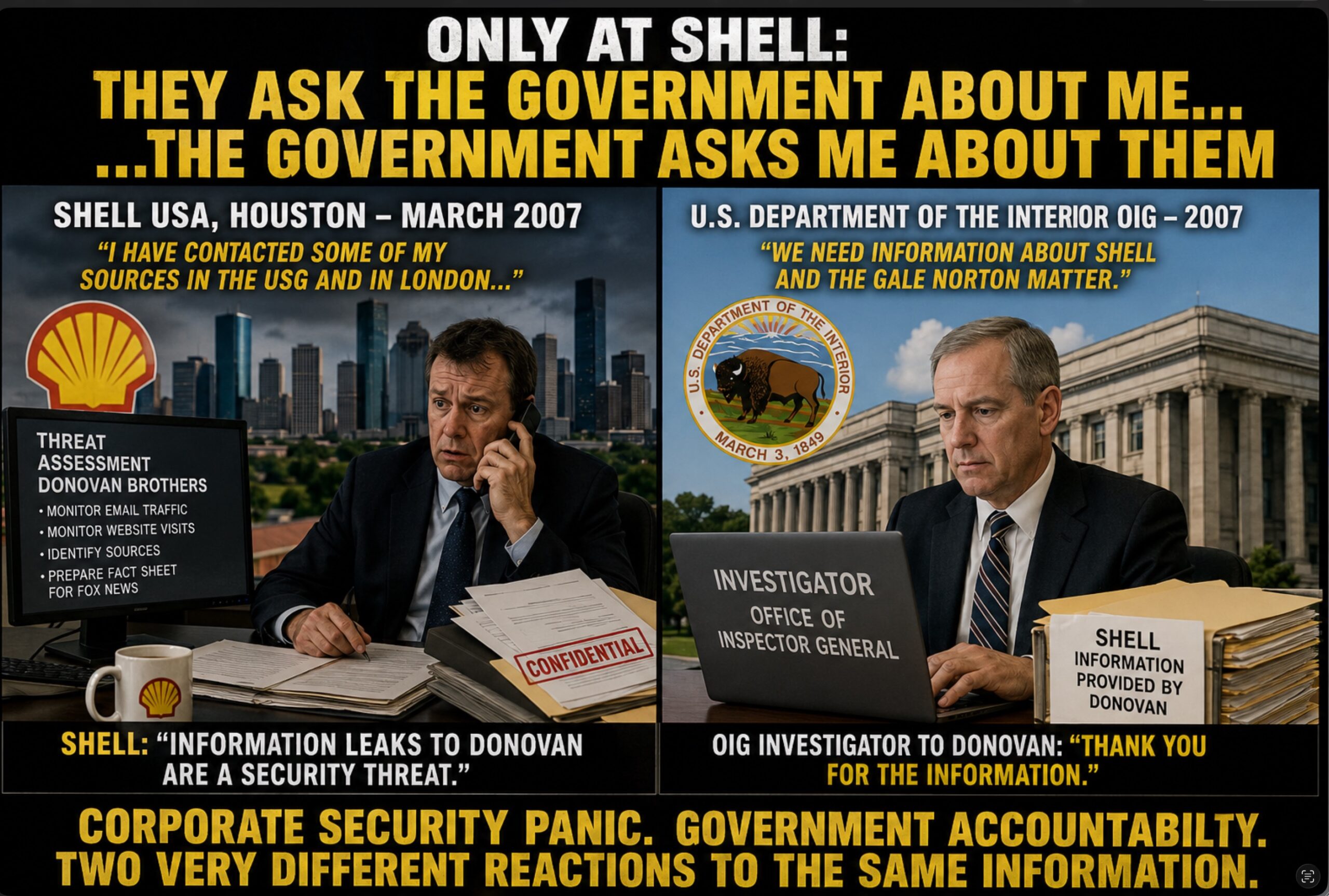
The most striking email was sent on 19 March 2007.
After referring to research into Alfred and John Donovan and expressing concern about the latest email becoming public, the writer stated that contacts had been approached in the United States and London to discover whether they possessed further information about the brothers.
The precise wording was:
“I have contacted some of my sources in the USG and in London…”
The writer added that responses might take several days and that Shell would monitor any fallout.
“USG” is commonly used as an abbreviation for United States Government. In the context of this internal message, that is the natural reading, although the redacted correspondence does not identify the contacts, their agencies, what information was requested or whether anything was supplied.
That evidential limitation must be respected.
The email does not, by itself, prove that an American government agency formally investigated Alfred or John Donovan.
It does not prove that confidential government records were obtained.
It does not reveal whether the contacts were serving officials, former officials, law-enforcement personnel, intelligence personnel or merely acquaintances familiar with government circles.
But it does establish something highly significant: a person operating within Shell’s American network claimed to have approached “sources in the USG” seeking further information about two British critics of the company.
The Donovans had not threatened physical violence.
They were not accused in the correspondence of sabotage or terrorism.
The immediate catalyst was an email to a television programme.
Apparently, in Shell’s corporate-security universe, writing to Bill O’Reilly could send Houston looking for friends in government.
THE INTERNAL VERDICT: NO SECURITY THREAT—EXCEPT FOR THE LEAKS
Another Shell response cut through the excitement.
An internal correspondent who was familiar with Alfred and John Donovan concluded that they were not a physical-security concern. The message stated:
“They are of no security interest…”
Then came the qualification that transformed the sentence:
“…unless somebody wants to set an information security tasking…”
The proposed purpose of such a tasking was to identify where the Donovans’ well-placed Shell sources were located.
That is the heart of the matter.
Shell’s own internal assessment apparently recognised that the Donovans were not conventional security threats.
The real threat was informational.
It was the existence of employees and insiders willing to pass accurate, sensitive or embarrassing material outside the company.
Shell was not frightened that Alfred and John Donovan would attack a refinery.
It was frightened that someone inside the refinery—or inside headquarters, legal, communications, finance, safety or executive management—might send them the documents.
The email also delivered one of the most humiliating compliments ever issued by a multinational corporation about an adversarial website. The writer described royaldutchshellplc.com as an excellent source of Shell news and indicated that it was preferable to Shell’s own internal communications. Reuters subsequently reported that remarkable internal assessment.
Shell’s security people were therefore confronting an exquisitely corporate predicament:
The hostile website was better informed than the official communications department.
FOX NEWS PREPARATIONS: “IF THIS BLOWS UP”
Shell’s communications personnel also began preparing an external fact sheet about the Donovan dispute in case Fox News contacted the company.
The document was described as a straightforward briefing that could be supplied if the programme made contact and if the issue expanded into something larger. Shell requested updates about any recent Donovan activity, while colleagues were told that comments should be approved centrally.
Once again, the scale of preparation contradicts the dismissive language Shell sometimes used internally about the website being merely a nuisance.
A genuine irrelevance does not ordinarily require:
- transatlantic circulation;
- security assessment;
- an updated issues brief;
- centrally approved responses;
- a Fox News fact sheet;
- monitoring of potential fallout;
- and enquiries to contacts said to be within the US government.
Shell’s public posture was indifference.
Its internal posture was: prepare the bunker in case O’Reilly calls.
FROM FOX NEWS PANIC TO GLOBAL EMAIL MONITORING
The correspondence did not stop with background research.
A confidential email dated 21 March 2007 recorded that Shell suspected current and former employees of communicating with the Donovan websites.
It stated that an information-technology project had been initiated to monitor email traffic from Shell servers worldwide to the Donovans and to examine internal traffic visiting their website.
Reuters later reported the existence of that email and stated that Shell’s internal communications described global monitoring of emails sent from Shell servers to Donovan, together with internal visits to the website. Reuters also reported that the emails had been disclosed by Shell following a data-protection request and that the documents and Shell covering letter had been shown to its journalist.
Shell declined to verify the communications or answer the allegations despite repeated approaches from Reuters. A lawyer in Shell’s legal department confirmed that the data request had been made but said it was not a matter for public discussion.
This is important corroborative context.
The Fox News episode was not simply reconstructed decades later from an unauthenticated bundle deposited anonymously on the internet.
Reuters reported that it had seen the disclosed emails and Shell’s covering documentation.
The sequence was therefore independently examined by a major international news organisation:
- Donovan sent the Fox News email.
- Shell circulated it internally.
- Shell personnel investigated the Donovans.
- A Shell writer claimed to have approached US government contacts.
- Shell prepared for potential media escalation.
- Shell assessed possible threat implications.
- Shell considered an information-security tasking directed at locating internal sources.
- Shell monitored communications from its servers and visits to the Donovan website.
This was corporate anxiety becoming corporate process.
THE NCFTA CONNECTION
Reuters’s December 2009 report went further.
It described another Shell email indicating that somebody had met with an organisation identified as “NCFTA” to discuss the website. The same correspondence reportedly said that resources focused on Royal Dutch Shell had been assigned and that nothing visible would be done to Donovan.
Reuters noted that NCFTA appeared to refer to the National Cyber-Forensics and Training Alliance, a Pittsburgh-based organisation supported by private companies and involved in combating cybercrime. The organisation did not respond to Reuters’s requests for comment.
The evidence did not establish exactly what NCFTA was asked to do, what information it obtained or whether any operation was conducted against the website.
Shell also denied responsibility for a separate 2008 cyber incident that had repeatedly crashed the site.
Those limitations should be stated prominently.
Even so, the combination is troubling:
- government contacts were approached for information;
- a cyber-fraud alliance was reportedly consulted about the website;
- global Shell email traffic to Donovan was monitored;
- visits to the website were tracked;
- and the apparent operational concern was identifying Shell insiders supplying information.
This was not merely a public-relations response to an unpleasant email.
It was the mobilisation of a security and information-control apparatus.
WHY THE O’REILLY EPISODE MATTERS TO THE AMERICAN SPYING STORY
The Bill O’Reilly correspondence supplies the missing bridge between Shell’s wider American security structure and the Donovan archive.
It demonstrates that the Donovan issue was not confined to London or The Hague.
It reached Houston.
It involved Shell’s American personnel.
It triggered discussion of threat assessment.
It produced outreach to contacts described as being in the US government.
It generated media-response planning for one of America’s largest news networks.
It contributed to the wider concern about identifying Shell insiders communicating with the website.
Most importantly, Shell’s own material suggests that the Donovans were not considered a genuine physical-security danger.
They were considered an information-security problem.
That is a much more revealing classification.
A physical threat is dealt with through guards, barriers and police.
An information threat is dealt with through monitoring, tracing, profiling, internal surveillance, external contacts and efforts to locate sources.
The object is not to prevent violence.
It is to prevent disclosure.
THE COMIC DIMENSION: BILL O’REILLY AS CORPORATE DEFIBRILLATOR
There is, admittedly, an irresistible comic element.
One email from an elderly British campaigner to a famously combative American television host appears to have sent Shell personnel racing through their contact books.
Houston wanted background.
London wanted updates.
Corporate Affairs wanted central control.
Security wanted a threat assessment.
Somebody contacted “USG” sources.
Somebody else considered tracing the website’s Shell sources.
A fact sheet was prepared in case Fox News telephoned.
Shell’s vast multinational apparatus behaved as though Bill O’Reilly might burst through the refinery gates at any moment shouting:
“The spin stops here!”
O’Reilly apparently did not turn the Donovan–Shell feud into a primetime crusade.
But Shell did something more valuable for the historical record.
It documented its own alarm.
CONCLUSION: THE EMAIL THAT EXPOSED THE REAL TARGET
The documentary trail supports a careful but hard conclusion.
There is no public evidence that the US government opened a formal investigation into Alfred and John Donovan because of the Fox News email.
There is documentary evidence that a Shell-connected writer claimed to have contacted sources in the “USG” and London seeking additional information about them.
There is documentary evidence that Shell asked for threat-related research, prepared for potential Fox News scrutiny and discussed an information-security tasking to identify the insiders supplying the Donovan website.
There is documentary evidence—reported independently by Reuters—that Shell monitored global internal email traffic to Donovan and visits to his website.
And there is Shell’s extraordinary internal conclusion that the Donovans were not, in ordinary terms, a security threat.
The problem was their sources.
The problem was the leaks.
The problem was that royaldutchshellplc.com sometimes knew more about Shell than Shell’s own employees were being told.
That explains the panic far better than the email’s destination.
Bill O’Reilly was merely the trigger.
The real target was the flow of information.
The Fox News incident therefore provides a documented example of the broader danger identified throughout this article: once criticism, leaking and reputational embarrassment are placed inside a corporate-security framework, the critic may cease to be treated as a member of the public and instead become an intelligence subject.
WHEN THE US GOVERNMENT CAME TO DONOVAN: THE GALE NORTON–SHELL INVESTIGATION
The American chapter contains an irony too large to leave out.
At around the same period that Shell personnel were discussing the Donovan brothers, tracing leaks and invoking contacts described internally as sources in the “USG,” I was approached by an investigator from the Office of Inspector General of the United States Department of the Interior.
The investigator was not seeking information about me.
He was seeking information about Shell.
The inquiry concerned the controversy surrounding former US Interior Secretary Gale Norton, Shell and the award of federal oil-shale research leases by the Bureau of Land Management.
I supplied the investigator with information and Shell internal material that I believed could assist the inquiry. I retain the email correspondence. The investigator subsequently thanked me for the information provided.
That episode deserves attention because it places the Donovan archive in a role rather different from the one apparently assigned to it by Shell’s security personnel.
To Shell, the archive was a leak problem.
To a federal investigator, it was a potential evidence source.
FROM PRESIDENTIAL CABINET TO SHELL PAYROLL
Gale Norton served as US Secretary of the Interior from 2001 until March 2006.
The Department of the Interior exercises substantial authority over federal lands, natural resources and mineral development. Its Bureau of Land Management was responsible for administering the programme under which companies could obtain Research, Development and Demonstration leases for experimental oil-shale projects on federal land.
After leaving government, Norton joined Shell in 2007 as general counsel for its unconventional-resources business.
That transition was controversial because Shell had been a major beneficiary of the Interior Department’s oil-shale leasing process during Norton’s tenure.
The resulting Inspector General inquiry examined whether Shell had received preferential treatment, whether Norton had been personally and substantially involved in the programme, whether she accurately described that involvement to government ethics officials and whether her later contacts with federal agencies complied with post-employment restrictions.
This was not some internet rumour or partisan blog quarrel.
It became a formal federal investigation referred to both the US Office of Government Ethics and the US Department of Justice.
SHELL RECEIVED THREE LEASES; OTHERS WERE TOLD ONE
The Inspector General’s findings were deeply uncomfortable for Shell and the Bureau of Land Management.
The investigation found that Shell submitted three bids while other applicants were told they could submit only one. Shell was awarded leases for all three bids; no other company received more than one lease.
The OIG also found that two Shell proposals exceeded the maximum permitted acreage stated in the Federal Register notice.
Rather than disqualifying the bids, someone within the Bureau of Land Management altered the acreage figures so that the Shell applications complied with the rules.
The report stated that the leasing process contained irregularities that:
“benefited Shell and disadvantaged other applicants.”
It also found that Shell had received advance information concerning the leases, enabling it to file a complete bid document on the same day that the Federal Register notice was published. The next bid was not received until 82 days later.
That is not proof that Shell committed a crime.
The OIG expressly said it had not found evidence that Shell committed a criminal violation.
But “not criminally prosecutable” is not synonymous with “normal, transparent or fair.”
The official conclusion was that Shell benefited from preferential treatment and advance information while its competitors operated under a less accommodating interpretation of the rules.
Apparently, some applicants received the published competition terms.
Shell received something closer to the director’s cut.
“INSIDER INFORMATION”—THE GOVERNMENT’S WORDS, NOT MINE
The OIG synopsis stated that its investigation began with allegations that Shell had received:
“insider information”
during the 2005–2006 oil-shale leasing process.
Its investigation subsequently determined that someone inside the Bureau of Land Management had indeed provided Shell with advance information.
The contrast with Shell’s treatment of the Donovan archive is difficult to miss.
Shell’s internal security machinery was concerned that its own employees were supplying information to an external critic.
Meanwhile, a US federal watchdog found that someone inside a government bureau had supplied advance information that benefited Shell.
In one direction, Shell regarded leaking as a security threat.
In the other, the company emerged as the beneficiary.
Corporate principles can be wonderfully sensitive to the direction in which confidential information is travelling.
GALE NORTON’S ROLE
The Inspector General documented extensive interest by Norton in the oil-shale programme.
Investigators identified 12 meetings or briefings she attended concerning oil shale during 2005 and 2006.
One former Interior official told investigators that Norton had been:
“pushing oil shale big time”
and viewed it as a potential national-energy “game changer.”
The report recorded a March 2005 meeting involving Norton and senior Shell executives. Internal correspondence later obtained from Shell showed further contacts and Shell’s efforts to cultivate her support.
After a prolonged conversation with Norton at a London dinner, a senior Shell executive described her internally as:
“most constructive and helpful”
and suggested that she could become:
“a formidable ally for us”
if Shell could secure her full support for its project.
That description does not establish corruption.
It does, however, reveal how Shell viewed the serving Interior Secretary: not merely as a neutral regulator, but as a potential ally whose support could materially assist a major commercial project.
The revolving door had not yet revolved.
Shell was already admiring the person standing beside it.
THE ETHICS FINDING AND THE LIFETIME RESTRICTION
The US Office of Government Ethics reviewed the Inspector General’s interim report.
It concluded that Norton had participated personally and substantially in the Bureau of Land Management’s oil-shale leasing programme and that the programme constituted a particular matter involving particular parties.
That finding meant Norton was subject to a lifetime restriction on representing another party before the federal government concerning that particular programme.
The OIG further found that, on two occasions after leaving the Interior Department but before joining Shell, Norton failed fully to describe her role in the programme to departmental ethics officials.
After joining Shell, she contacted the Department of Defense directly and the Bureau of Land Management indirectly concerning oil-shale matters, according to the report.
These were serious findings.
They did not culminate in a criminal prosecution. The Department of Justice declined to bring charges, and the Inspector General said it could not conclusively determine that Norton had violated federal conflict-of-interest laws.
That legal outcome must be stated clearly.
Norton was not prosecuted.
Shell was not found to have committed a criminal offence.
But the absence of prosecution did not erase the documented preferential treatment, advance information, altered applications, ethics concerns and revolving-door relationships.
It merely meant the evidence did not produce a criminal case the Justice Department chose to pursue.
SHELL’S “HUGE OPPORTUNITY”
The official report shows how eagerly Shell cultivated its relationship with Norton while she remained Secretary of the Interior.
When Norton’s office expressed interest in visiting Shell’s Colorado oil-shale research site, an internal Shell email called the proposed visit:
“a huge opportunity.”
Following the visit, Shell personnel described it as productive and detailed discussions about Shell’s technology, commercial ambitions and a six-item “ask” list.
Shell’s “asks” included access to federal acreage and policy conditions necessary to advance a highly speculative and environmentally contentious oil-shale industry.
This was not oil in the conventional sense. Producing fuel from kerogen-rich rock required significant heating, water, land disturbance and energy. Even Interior officials questioned whether the energy used in production might approach the energy eventually obtained from the product.
Yet Shell presented the project as strategically important, and Norton’s department pushed ahead with the research-leasing framework.
The OIG found that Shell obtained three of the six leases ultimately awarded.
A “huge opportunity,” indeed.
THE DONOVAN ARCHIVE ENTERS A FEDERAL INVESTIGATION
Against that background, an investigator from the Interior Department’s Office of Inspector General contacted me.
I was asked to provide information relevant to the Shell–Norton matter.
I supplied material, including Shell internal information in my possession, and answered the investigator’s questions. I retain the email correspondence showing the approach and the investigator’s thanks for my assistance.
Unless and until that correspondence is published, the precise wording and identity of the investigator should not be overstated here.
However, I am in a position to document the essential facts:
- the contact came from an investigator working for the Interior Department’s Office of Inspector General;
- the subject concerned Shell and the Gale Norton investigation;
- the investigator sought information from me;
- I supplied information willingly;
- and the investigator thanked me for the assistance.
This matters because Shell’s internal correspondence repeatedly portrayed the Donovan operation as a problem to be monitored, contained or investigated.
A United States federal investigator reached a different practical conclusion.
The archive was useful.
THE PERFECT REVERSAL
The sequence could hardly be more revealing.
Shell’s security and communications personnel worried about my contact with Fox News.
A Shell-connected writer claimed to have approached sources in the US government for information about the Donovan brothers.
Shell considered tracing internal sources supplying the website.
Its global computer systems monitored email traffic to me and visits to the site.
And then an actual investigator from an actual US government watchdog contacted me—not to investigate my activities, but to obtain information concerning Shell.
Shell had apparently been asking the government about Donovan.
The government was asking Donovan about Shell.
Corporate history occasionally writes its own satire.
WHY THE OIG CONTACT STRENGTHENS THE WIDER ARTICLE
The Gale Norton episode strengthens the American security story in several ways.
First, it confirms that the Donovan archive had become relevant beyond media criticism and private litigation. Its material was potentially useful to a formal federal inquiry.
Second, it helps explain Shell’s anxiety about insider information reaching the website. The documents were not merely embarrassing gossip. They could attract the attention of regulators, law-enforcement bodies, parliamentary committees, journalists and government investigators.
Third, it demonstrates the public-interest value of preserving and publishing corporate records. Without external archives, leaked documents may disappear into internal investigations, confidentiality agreements and digital deletion schedules.
Fourth, it complicates Shell’s apparent depiction of the Donovans as a reputational or information-security threat.
When a government watchdog asks a critic for evidence about the company, the critic is not simply attacking corporate reputation.
He may be assisting public accountability.
TWO FLOWS OF INSIDE INFORMATION
The American story therefore contains two parallel information streams.
In the first, Shell believed insiders within its organisation were passing information to the Donovan website. Shell responded with monitoring, security assessments and efforts to identify the sources.
In the second, the Interior Department’s Inspector General found that someone within the Bureau of Land Management had passed advance information that benefited Shell during a federal leasing process.
Shell’s reaction to the first stream was alarm.
Its position in the second was advantage.
That asymmetry deserves to be remembered whenever corporations deliver sermons about confidentiality, trust and information security.
Inside information leaking out of Shell was treated as a threat.
Inside information flowing towards Shell helped it submit the first complete bid on the very day the federal invitation was published.
One leak required surveillance.
The other apparently required three successful lease applications.
A NECESSARY LEGAL QUALIFICATION
The factual distinctions must remain explicit.
The Inspector General did not conclude that Shell had committed a criminal violation.
It could not conclusively determine that Gale Norton violated federal conflict-of-interest laws.
The Department of Justice declined prosecution.
Norton disputed the investigation and criticised the resources spent on it.
Those facts are part of the record and should not be buried.
But they do not negate the OIG’s other findings:
- the Bureau of Land Management appeared to give Shell preferential treatment;
- Shell received advance information;
- two noncompliant Shell applications were altered rather than rejected;
- Shell submitted three bids while others were limited to one;
- all three Shell bids succeeded;
- Norton was found by the Office of Government Ethics to have participated personally and substantially in the programme;
- and she later joined Shell’s unconventional-resources operation.
Those are not allegations invented by a Shell critic.
They are findings contained in an official United States government report.
CONCLUSION: FROM “INFORMATION THREAT” TO GOVERNMENT SOURCE
Shell’s American personnel appear to have regarded me as an information-security problem because internal material kept reaching the Donovan websites.
The Interior Department’s Office of Inspector General regarded the same accumulation of information as potentially useful to an investigation.
That distinction is central to this entire story.
Corporations frequently describe leaks as theft, disloyalty or reputational attack.
Investigators may regard the same records as evidence.
Journalists may regard them as sources.
Regulators may regard them as leads.
The public may regard them as the only realistic means of seeing what happened behind the corporate statements.
Shell wanted to identify who was supplying Donovan.
A federal investigator wanted to know what Donovan could supply about Shell.
And in the Gale Norton affair, the official record ultimately found that the company had benefited from preferential treatment and advance government information—even though neither Shell nor Norton was criminally prosecuted.
For Shell, that must have been an uncomfortable inversion.
The supposed nuisance website was helping the watchdog.
The oil major was appearing in the watchdog’s report.
And the man Shell’s security people were discussing had become, however modestly, a source of assistance to the United States government.
The Gale Norton episode therefore illustrates why Shell’s concern about the Donovan archive extended far beyond reputational irritation: information reaching the website could migrate into mainstream journalism, litigation and even formal government investigations, turning an unwanted critic into a conduit for institutional scrutiny.
12. FORMER FEDERAL AGENTS AND THE REVOLVING SECURITY DOOR
Several figures associated with the broader Shell security story reportedly came from government or law-enforcement backgrounds.
Crockett Oaks was a former FBI agent.
Donald G. Lane has been identified as a former US Secret Service agent.
Shater’s court case discussed his ability to obtain security clearances and his public-sector security experience.
There is nothing inherently sinister about corporations hiring former government security professionals. Oil majors operate critical facilities and need people who understand threat assessment, crisis response, executive protection and liaison with public agencies.
The problem is not expertise.
The problem is what the expertise is used for.
Former government personnel may arrive with professional networks, access to specialist knowledge and an institutional mindset developed in national-security environments.
That can be valuable when protecting a refinery against genuine attack.
It becomes more controversial when corporate reputation, activist activity, whistleblowing and litigation are included in the same operational universe.
The question is not whether Shell employed former agents.
The question is whether techniques, contacts or assumptions appropriate for dealing with hostile state actors and violent criminals were ever directed towards lawful critics.
Shell should be capable of answering that question clearly.
13. THE NAMES REQUIRING CONTINUED DOCUMENTARY EXAMINATION
Several names recur in or around the documentary trail:
Crockett Oaks III
Former head of Shell’s US security operations and former FBI agent. His dispute with Shell produced a confidentiality battle involving internal investigations.
James W.D. Hall
Identified in litigation material as a senior global Shell security figure based in The Hague and as part of the reporting chain above Oaks.
Michael G. Oliveri
Applicant for the Security Advisor US position whose litigation described the structure connecting Shell’s American and global security functions.
Walied Shater
Former Shell security professional who brought discrimination-related claims. His Fifth Circuit appeal failed, while separate proceedings recorded allegations involving repatriation, CCTV and Business Integrity.
Wayne Hunt
Selected over Shater for a promotion and subsequently named in the 2025 Romak/Taylor litigation.
Michelle Romak and Kevin Taylor
Plaintiffs in the ongoing dispute over Shell’s Houston security reorganisation.
Bruce Culpepper
Former Shell US president who made the memorable wet-paper-bag comments about Business Integrity.
Tom Purves and Donald G. Lane
Names appearing in the wider American Shell, Motiva and Gulf Coast documentary orbit. Donald G. Lane is a friend of mine.
Investigative journalism often begins by mapping people, reporting relationships, events and documents before attempting to determine what the pattern means.
Shell has enjoyed decades in which its internal structure was almost impossible for outsiders to reconstruct.
Search engines, digital court archives and artificial intelligence have changed that equation.
The filing cabinets are learning to talk to one another.
14. AI DID NOT DISCOVER THE EVIDENCE—IT CONNECTED IT
The AI response that inspired the original article did not create the Oaks, Oliveri, Shater or Romak/Taylor cases.
The cases already existed.
What AI did was connect them.
That distinction matters.
For decades, corporations benefited from documentary fragmentation. One lawsuit might sit in a Texas docket. Another ruling might remain buried in a federal appellate database. A newspaper report might disappear behind a paywall. An old complaint could remain online as an awkward PDF that almost nobody had the time to read.
AI systems can now pull names and themes across that scattered landscape:
- Shell;
- Houston;
- corporate security;
- internal investigations;
- reputation;
- former federal agents;
- confidentiality;
- discrimination;
- CCTV;
- Business Integrity;
- and litigation.
AI can make mistakes. It can merge people, overstate connections or repeat poorly sourced allegations. Its output must therefore be checked against the underlying record.
But Shell faces a new strategic problem.
Silence no longer guarantees obscurity.
A company may decline to comment on five separate cases for five separate reasons. An AI system can still identify the shared organisational theme.
Shell’s old reputational strategy relied heavily on fragmentation and institutional amnesia.
AI is the enemy of both.
15. THE INVESTORS PAYING FOR THE WET PAPER BAG
Shell’s institutional investors are not innocent spectators.
Large asset managers—including BlackRock, Vanguard, Fidelity and Norges Bank Investment Management—appear through major shareholdings, funds or investment mandates connected with Shell.
Precise holdings fluctuate as portfolios, buybacks and disclosure dates change. The governance question does not.
These institutions have the resources to ask Shell difficult questions privately and publicly:
- Has the board commissioned an independent review of US corporate security?
- What controls govern the monitoring of environmental and social activists?
- Does Shell participate in fusion-centre or law-enforcement intelligence exchanges?
- Has Shell used external intelligence firms in the United States?
- How does it distinguish physical threats from reputational criticism?
- How many complaints have been made against Corporate Security?
- How many were referred to Business Integrity?
- How many investigators reported to managers implicated in the complaint?
- What whistleblower protections existed?
- Were former federal-agency personnel given access to government information channels?
- Did security personnel ever collect information concerning journalists, lawyers, shareholders or peaceful campaigners?
Institutional investors frequently advertise their commitment to stewardship, governance, human rights and long-term risk management.
A Shell annual report is not a substitute for asking whether environmental campaigners have been treated as intelligence targets.
Nor is voting for the board every spring an adequate response to a security operation repeatedly appearing in litigation.
Asset managers cannot simultaneously present themselves as corporate-governance watchdogs and then transform into decorative pot plants whenever the oil company’s security department begins suing or being sued.
16. THE ENVIRONMENTAL RECORD IS NOT A SEPARATE STORY
Shell’s environmental controversies and its security culture should not be examined in separate rooms.
The company’s operations have generated decades of conflict over:
- oil pollution in the Niger Delta;
- climate change;
- Arctic drilling;
- refinery and petrochemical pollution;
- pipeline development;
- LNG expansion;
- offshore safety;
- flaring;
- methane emissions;
- and the adequacy of corporate climate commitments.
Such disputes produce organised opposition.
Organised opposition produces information.
Information produces risk for Shell.
The danger is that Shell’s security apparatus may interpret people generating unwelcome information as threats to be contained rather than participants in public debate.
That is why the definition of “reputation” inside a security mandate is so important.
Shell’s reputation is affected when pollution occurs.
It is affected when a court case is filed.
It is affected when a whistleblower produces evidence.
It is affected when a campaign group publicises internal records.
The proper corporate response is to fix the misconduct, correct the record or defend the company openly.
The improper response is to classify the messenger as a security problem.
17. WHAT SHELL SHOULD DISCLOSE
Shell can dismiss this article as hostile commentary.
That would be easy.
A more convincing response would be disclosure.
Shell should publish or explain:
- The present governance structure of its US Corporate Security function.
- The board committee responsible for oversight.
- Policies distinguishing lawful activism from genuine security threats.
- Rules governing intelligence collection on critics, campaigners and whistleblowers.
- Relationships with fusion centres, Joint Terrorism Task Forces and other government intelligence-sharing bodies.
- Use of former law-enforcement or intelligence officers.
- Use of private investigators, security contractors and intelligence consultancies.
- Retention and destruction policies for activist or reputational-risk files.
- Safeguards preventing Business Integrity investigations from being influenced by implicated executives.
- The number of substantiated retaliation complaints involving security or investigations.
- Whether Shell has used deceptive identities to monitor organisations or individuals.
- Whether Shell will undertake not to infiltrate lawful environmental groups.
- Whether any security files exist concerning John Donovan, the Donovan websites or their contributors.
- Whether Shell will permit an independent audit of these matters.
Shell may have convincing answers.
The trouble is that “no comment” has become its favourite renewable resource.
PART TWO
SHELL RISK REGISTER: US CORPORATE SECURITY EDITION
Risk 1: Corporate-security litigation
Public record:
Multiple legal disputes have involved former or current Shell security personnel, including Oaks, Oliveri, Shater, Romak and Taylor.
Shell’s probable position:
Separate employment disputes with no evidence of wider institutional dysfunction.
Critical assessment:
One dispute may be isolated. A succession of disputes involving the same specialised function warrants governance scrutiny.
AI-era exposure:
Severe. Court filings are searchable, permanent and increasingly easy to connect.
Recommended response:
Commission an independent review reporting to a board committee rather than to Corporate Security or Business Integrity.
Severity:
High.
Risk 2: Reputation classified as security
Public record:
Oaks’s reported remit included threats to Shell’s reputation.
Shell’s probable position:
Reputation is a legitimate corporate asset and security personnel merely assess risks.
Critical assessment:
The term is dangerously broad. Without strict controls it can encompass journalism, peaceful protest, whistleblowing and shareholder dissent.
AI-era exposure:
Extreme if documents reveal monitoring of lawful critics.
Recommended response:
Publish a narrow formal definition of reputational-security threats and prohibit covert monitoring based solely on lawful criticism.
Severity:
Extreme.
Risk 3: Business Integrity credibility
Public record:
Business Integrity featured in the Shater allegations. Separately, extraordinary comments disparaging its investigative competence have been attributed to Bruce Culpepper.
Shell’s probable position:
The quotations are unverified and the department operates according to established procedures.
Critical assessment:
Procedures are worthless if investigators lack independence, competence or authority over senior management.
AI-era exposure:
Severe, particularly if supporting emails, witness accounts or recordings emerge.
Recommended response:
Independent audit of investigator training, reporting lines, case outcomes and retaliation safeguards.
Severity:
High.
Risk 4: Public-private intelligence sharing
Public record:
US fusion centres and security partnerships exchange threat information with government and private-sector participants. Civil-liberties organisations have documented monitoring of protest activity.
Shell’s probable position:
Engagement is limited to legitimate protection of critical infrastructure.
Critical assessment:
That claim requires evidence and safeguards. “Critical infrastructure” must not become a constitutional bypass lane.
AI-era exposure:
High.
Recommended response:
Disclose the categories of information Shell provides to public agencies and prohibit reporting based only on peaceful political activity.
Severity:
High.
Risk 5: Insider conflict and leaking
Public record:
Shell security disputes have repeatedly reached litigation. The Donovan archive has also received information from Shell insiders over many years.
Shell’s probable position:
Claims originate from disgruntled former employees or unreliable anonymous sources.
Critical assessment:
Persistent external leaking may indicate that personnel do not trust Shell’s internal channels.
AI-era exposure:
Extreme. Once published, documents become indefinitely searchable and cross-referenceable.
Recommended response:
Strengthen genuinely independent whistleblower channels and stop treating every leak as merely a security breach.
Severity:
Extreme.
Risk 6: Fossil-fuel expansion and activist conflict
Public record:
Shell plans growth in upstream and integrated-gas production and LNG sales through 2030.
Shell’s probable position:
The investments meet continuing energy demand while Shell reduces emissions intensity.
Critical assessment:
Expansion creates more contested projects, more litigation and more pressure on security personnel to track opponents.
AI-era exposure:
Severe.
Recommended response:
Embed civil-rights protections into every project-security plan and subject activist-monitoring protocols to external scrutiny.
Severity:
Extreme.
Risk 7: Institutional-investor passivity
Public record:
Major asset managers and investment institutions remain financially exposed to Shell.
Shell’s probable position:
Investors engage with management through normal stewardship channels.
Critical assessment:
Private engagement without disclosure permits important governance issues to disappear into the same confidentiality fog criticised elsewhere.
AI-era exposure:
High. Voting records and ownership data can be compared with public stewardship promises.
Recommended response:
Major shareholders should demand board-level disclosure concerning corporate security and civil liberties.
Severity:
High.
PART THREE
SPOOF SHELL PR RESPONSE
Shell takes security, transparency, human rights, legal privilege, employee dignity, institutional investors and wet paper bags extremely seriously.
Our Corporate Security organisation is a globally integrated, locally empowered, sustainably resilient and stakeholder-focused centre of threat-aware excellence.
It is incorrect to suggest that repeated litigation involving Corporate Security demonstrates dysfunction.
On the contrary, litigation demonstrates that the department exists.
Shell does not comment on individual employment matters, confidential investigations, historical matters, pending litigation, concluded litigation, matters involving former employees, matters involving current employees, matters involving people who unsuccessfully applied to become employees or matters about which comment might prove informative.
We are unable to confirm whether anyone said that Business Integrity:
“could not investigate their way out of a wet paper bag”
or that:
“they cannot investigate worth a shit”
or that they:
“did not want those fuckers involved…”
However, Shell’s Business Integrity Department has conducted a comprehensive review and found no evidence that it was capable of finding.
Shell respects peaceful protest.
Peaceful protesters are not considered security threats unless their activities threaten Shell’s personnel, property, commercial interests, licence to operate, investor confidence, preferred public narrative, executive tranquillity or reputation.
Shell’s strategy remains unchanged:
More value. Less emissions. Fewer answers.
PART FOUR
SPOOF AI ADVISORY PANEL
ChatGPT:
The evidence does not establish a single grand espionage conspiracy. It does establish a recurring intersection of Shell Corporate Security, reputational protection, internal investigations, secrecy and litigation.
Claude:
The most revealing word may be “reputation.” Once reputation is placed inside a security mandate, critics can be reconceptualised as threats without anyone formally ordering unlawful surveillance.
Copilot:
Shell’s difficulty is cumulative. It can dismiss each lawsuit as isolated, but digital research tools can now connect reporting lines, personnel and allegations across decades.
Google AI Mode:
Available public information supports the existence of a sophisticated US corporate-security structure. More serious claims involving covert monitoring require further documentary corroboration.
Perplexity:
The court cases are verifiable. The ProtonMail material should remain clearly labelled as unpublished insider correspondence unless independently authenticated or tested.
Grok:
Imagine employing former federal agents, monitoring “reputational threats,” repeatedly landing in court and then insisting there is nothing interesting to see. That is not counterintelligence. It is slapstick with security clearances.
PART FIVE
CLASSIC MEME CONCEPT
Recommended meme: “Spider-Man Pointing at Spider-Man”
Visual concept:
Three identical Spider-Man figures point accusingly at one another inside a Shell security office.
Their labels:
- SHELL CORPORATE SECURITY
- SHELL BUSINESS INTEGRITY
- SHELL LEGAL
Behind them sits a leaking filing cabinet labelled:
CONFIDENTIAL INTERNAL INVESTIGATIONS
On the floor is a collapsed wet paper bag.
Top caption:
WHEN SHELL ASKS WHO INVESTIGATED THE INVESTIGATORS
Bottom caption:
“NO COMMENT ON INDIVIDUAL EMPLOYMENT MATTERS.”
Alternative meme: “This Is Fine”
The familiar seated dog remains calmly at a desk while the Shell security department burns around him.
Flames are labelled:
- OAKS
- OLIVERI
- SHATER
- ROMAK & TAYLOR
- PROTONMAIL
- BUSINESS INTEGRITY
The dog wears a Shell executive badge and says:
“This is an isolated employment matter.”
PART SIX
DONOVAN–DETERDING SKIT

Scene: A smoke-filled boardroom that no longer exists. Sir Henri Deterding’s ghost is examining a modern laptop displaying Houston court dockets. John Donovan sits opposite him beside a wet paper bag marked “BUSINESS INTEGRITY—CONFIDENTIAL.”
Sir Henri Deterding:
John, why are Shell’s American security men appearing in court?
John Donovan:
Some sued Shell. Shell sued or restrained others. More recently, two members of the security team brought another discrimination case.
Sir Henri Deterding:
Ach. In my day, corporate intelligence remained intelligent enough not to advertise itself in the federal docket.
John Donovan:
Modern transparency, Sir Henri.
Sir Henri Deterding:
This is not transparency. This is incompetence with a case number.
John Donovan:
One former security chief was reportedly responsible for investigating threats to Shell’s reputation.
Sir Henri Deterding:
Reputation?
John Donovan:
Yes.
Sir Henri Deterding:
Mein Gott. Then he required an army.
John Donovan:
Shell has had several reputational difficulties.
Sir Henri Deterding:
Nigeria, climate change, pollution, court cases, activists, whistleblowers—and you.
John Donovan:
Especially me, apparently.
Sir Henri Deterding:
And what is this damp object?
John Donovan:
A wet paper bag.
Sir Henri Deterding:
Why is it labelled Business Integrity?
John Donovan:
Because Bruce Culpepper allegedly said the department could not investigate its way out of one.
Sir Henri Deterding:
Did he truly say this?
John Donovan:
The comments were attributed to him by a source. I have invited him to deny them.
Sir Henri Deterding:
Good. Even satire requires evidential discipline.
John Donovan:
He was also alleged to have said they “cannot investigate worth a shit.”
Sir Henri Deterding:
Direct. Crude. American.
John Donovan:
And that he did not want certain “fuckers” involved.
Sir Henri Deterding:
Such elegant executive succession from my generation.
John Donovan:
The department was meant to investigate internal concerns.
Sir Henri Deterding:
And who investigated the department?
John Donovan:
That is one of the questions.
Sir Henri Deterding:
Who investigated the investigators investigating the department?
John Donovan:
Possibly Business Integrity.
Sir Henri Deterding:
Then we are back inside the paper bag.
John Donovan:
Precisely.
Sir Henri Deterding:
And you received messages about the American security people fighting among themselves?
John Donovan:
Yes, through ProtonMail. The material is still unpublished and untested.
Sir Henri Deterding:
Ja. Then authenticate first and publish carefully.
John Donovan:
That is the intention.
Sir Henri Deterding:
I find this age confusing. Shell spends fortunes protecting its secrets, and its own people send them to a pensioner in Colchester.
John Donovan:
Perhaps they trust Shell’s internal systems even less than you do.
Sir Henri Deterding:
John, I am dead. Even I would not report a concern to that department.
CONCLUSION
NOT A SPY RING—A SYSTEM
The strongest conclusion supported by the public record is not that every Shell security employee belonged to a secret spying conspiracy.
It is that Shell operated a substantial US corporate-security system whose responsibilities extended into investigations, sensitive information and reputational threats—and that this system repeatedly generated legal conflict among the very people entrusted to run it.
The Oaks dispute exposed Shell’s determination to control confidential investigation material.
The Oliveri case described the transatlantic reporting chain.
The Shater proceedings revealed conflicts involving promotion, overseas assignments, CCTV, repatriation and Business Integrity, even though his Fifth Circuit appeal ultimately failed.
The Romak and Taylor litigation placed the Houston security department back in court in 2025.
The alleged Culpepper comments, if authentic, would raise profound questions about internal confidence in Shell’s investigative machinery.
Beyond Shell itself lies an American intelligence-sharing environment in which environmental campaigners have, in documented instances, been treated as potential security or extremism concerns.
Place all of that beside Shell’s continuing fossil-fuel and LNG expansion and the risk becomes obvious.
The company is creating or expanding precisely the kinds of contested assets that attract protests, litigation, investigative scrutiny and public opposition.
Shell’s security machine will be asked to protect those assets.
The essential question is whether it will protect them from genuine danger—or protect Shell from democratic accountability.
Shell, previously known as Forthdeal Limited, subsequently as Royal Dutch Shell plc, and now hiding in plain sight as Shell plc after ditching the disgraced Royal Dutch moniker, would undoubtedly prefer every lawsuit, leak and allegation to remain in its own hermetically sealed compartment.
Artificial intelligence is making that increasingly impossible.
The cases can now be connected.
The names can be mapped.
The reporting lines can be reconstructed.
The corporate euphemisms can be translated.
And every time Shell says “isolated employment matter,” another search engine quietly adds the matter to the collection.
The US story does not yet provide one cinematic smoking gun.
It provides something more recognisable from corporate life:
A corridor of locked offices.
A queue of former security personnel.
A stack of legal pleadings.
A dripping wet paper bag.
And, from somewhere behind the confidentiality curtain, the unmistakable sound of Shell’s spooks falling out with one another.
DISCLAIMER
This article is an opinion and commentary work containing satire, criticism and analysis of publicly available reports, legal proceedings, corporate publications and information supplied to the author.
Allegations contained in lawsuits, complaints or confidential-source material remain allegations unless and until established by admissible evidence or a final judicial finding. No inference of criminality or personal wrongdoing should be drawn merely because an individual is named in litigation, held a security position or worked for Shell.
The satirical Shell statement, AI dialogue, meme descriptions and Donovan–Deterding conversation are fictional and created for commentary and entertainment. Sir Henri Deterding died in 1939; the conversation is imaginary.
Nothing in this article constitutes investment, legal or financial advice. Investors should conduct their own research and consult appropriately qualified professional advisers.
Shell plc, Shell USA Inc., Bruce Culpepper, Crockett Oaks III, James W.D. Hall, Michael Oliveri, Walied Shater, Wayne Hunt, Michelle Romak, Kevin Taylor and anyone else mentioned are invited to submit corrections, evidence or comments for publication.
Site-wide disclaimer also applies.
Version published on 9 July 2026.
By John Donovan
Site wide disclaimer also applies.
In Nigeria, Shell’s security controversies have involved allegations of informants, state forces, surveillance and brutal political consequences. In South Africa, the picture has historically intersected with apartheid-era intelligence and corporate-state collaboration. In the United States, the story looks different — cleaner on the surface, more lawyered, more HR-sanitised, and wrapped in the respectable language of “corporate security,” “critical infrastructure,” “threat assessment,” “business integrity” and “confidential information.”
But do not be fooled by the vocabulary.
The American chapter of Shell’s security story is not about men in trench coats loitering outside hotel lobbies. It is about Houston-based corporate security managers, former FBI and Secret Service figures, internal investigations, confidential files, executive protection, domestic security restructuring, court fights, discrimination allegations, activist-monitoring ecosystems, and Shell’s recurring instinct to drag uncomfortable information behind a legal curtain.
Google’s recent AI response to my question — “Do you have any information about Shell spying, intelligence, security activity in the USA?” — correctly identified the broad pattern: Shell’s US security footprint appears to operate less like an old-fashioned field-spy operation and more like a modern corporate intelligence system. The public record already shows a company whose US security apparatus has repeatedly surfaced in litigation, with names such as Crockett Oaks III, James W.D. Hall, Michael Oliveri, Walied Shater, Kevin Taylor and Michelle Romak appearing in or around disputes involving Shell’s security function.
What is especially striking is that Shell’s American security controversies have not been exposed primarily by Greenpeace, journalists, or regulators. They have repeatedly leaked out through Shell’s own people.
In other words, the Shell security department in America has become a source of litigation about Shell security.
That is quite an achievement, even by Shell standards.
The Houston hub: where Shell security meets the courtroom
The first major strand is Houston, Texas — Shell’s American corporate nerve centre.
The clearest public example is the 2017 litigation involving Crockett Oaks III, Shell’s former head of US security and a former FBI agent. According to The Texas Lawbook, Shell Oil obtained a temporary court order blocking Oaks from revealing information Shell said was confidential. The report states that Oaks, as head of security, had been responsible for investigating threats to Shell employees, property and reputation, and that Shell alleged he threatened to reveal details of internal investigations the company considered confidential. The court order reportedly prevented him from disclosing confidential details, including results of Shell investigations.
This is not a minor employment squabble. It matters because it confirms that Shell’s US security function was not merely guarding gates and issuing visitor badges. It was handling internal investigations, reputational threats, sensitive personnel material and confidential operational information.
Shell did not merely defend itself. Shell went to court to restrain a former senior security executive from disclosing material. For anyone studying corporate intelligence structures, that is a flashing red light.
The second remarkable point is what Oaks’s role apparently covered. Public reporting described him as responsible for investigating “security threats to employees, property and the company’s reputation.”
That phrase — “the company’s reputation” — is where the Shell story starts to look familiar.
For decades, Shell has had a habit of treating reputational criticism not merely as public debate, but as a security issue. That is precisely the mindset that turns activists, whistleblowers, campaigners, litigants, former employees and inconvenient website operators into “risk vectors.”
The Oliveri strand: a security job becomes another legal dispute
The Crockett Oaks dispute connected publicly with another name worth noting: Michael G. Oliveri.
Publicly available material in the Oliveri litigation describes Oliveri applying for a Shell “Security Advisor US” position. The filing says the position was within a group headed by Crockett Oaks, Shell’s Regional Security Manager for the Americas, and that Oaks reported to James W.D. Hall, described in the filing as a British citizen working in Shell’s global headquarters in The Hague.
That chain is important. It indicates a structure linking US security operations to global Shell security leadership. Houston was not an isolated office. It sat inside a transnational security hierarchy.
That is exactly what one would expect from a multinational oil giant: US facilities, US refineries, Gulf Coast assets and executive protection tied into a global corporate security command structure. But it also means disputes in America may expose more than American HR dysfunction. They can reveal how Shell’s global security culture operates when challenged from within.
Walied Shater: Shell security, discrimination allegations and internal CCTV
Another significant name is Walied Shater, a former Shell security figure whose litigation also reached the public record.
In the Fifth Circuit appeal, Shater claimed Shell denied him a promotion because of race and national origin under Title VII. Shell argued it chose Wayne Hunt, described by the court as a white person of British national origin, because Hunt was more qualified. The district court granted summary judgment for Shell, and the appeal concerned that judgment.
A separate Department of Justice/OCAHO document gives a more detailed picture of Shater’s later allegations. It records that Shater alleged he was removed from his job, repatriated to Houston and terminated unless he found another Shell job. Shell’s stated reason concerned an alleged incident involving a guard and an unregistered guest at a Shell office in Dubai. Shater alleged that Shell’s reason was untrue, that CCTV footage supported him, and that Shell refused for months to provide the footage before ultimately producing it.
The same OCAHO document states that Shater alleged his performance evaluations were outstanding and that white, non-Muslim, British employees in Shell’s Corporate Security department faced no repercussions for alleged egregious conduct. It also records that he complained to Shell’s Chief Ethics and Compliance Officer, after which the matter went to Shell’s Business Integrity Department.
Again, this is not merely “HR.” This is a dispute inside Shell’s corporate security apparatus involving repatriation, termination, CCTV, Business Integrity, and allegations about unequal treatment among security personnel.
Bruce Culpepper and the wet paper bag school of Business Integrity
Readers may also recall the memorable, Mooch-like comments attributed in the Donovan archive to Shell’s former US boss Bruce Culpepper about Shell’s Business Integrity Department.
According to information supplied to me, Culpepper allegedly said that Shell’s Business Integrity people “could not investigate their way out of a wet paper bag”; that “they cannot investigate worth a shit”; and that he “did not want those fuckers involved.”
I do not know whether Shell’s Business Integrity Department appreciated the performance review.
The comments are relevant here because Shell routinely invokes “Business Integrity” as if the phrase itself carries cleansing power. Yet here, according to information supplied to me, a senior Shell US figure allegedly expressed withering contempt for the investigative competence of the very function supposedly responsible for internal probity.
If Bruce Culpepper says these comments were never made, I will publish his denial in full.
Until then, readers may reasonably ask a simple question: if Shell’s own senior people allegedly had such low confidence in Business Integrity, why should the public, shareholders, whistleblowers, regulators or courts treat Shell’s internal investigations as gospel?
The Taylor and Romak case: the Houston security team returns to court
The pattern did not end there.
In August 2025, Michelle Romak and Kevin Taylor filed a federal complaint in the Southern District of Texas against Shell USA Inc., Shell plc and Wayne Hunt. Public docket material confirms the case, Romak et al v. Inc et al, was filed on 26 August 2025, with Romak and Taylor listed as plaintiffs and Shell USA Inc., Shell plc and Wayne Hunt appearing among the defendants.
Public reporting on the case says the plaintiffs accused Shell of a discriminatory security-team reorganisation. The important point for this article is not to decide the merits of the case. The important point is that, once again, Shell’s American security function is in litigation, and once again the allegations concern the internal management of the people responsible for protecting Shell’s people, assets and information.
Google’s answer described this as evidence of “deep dysfunction inside the domestic corporate security team.” That may be strongly phrased, but it is not plucked from thin air. When a company’s security department repeatedly generates lawsuits involving former security managers, former security applicants, former security personnel, internal investigations, CCTV, repatriation, confidentiality, alleged discrimination and restructuring, the phrase “deep dysfunction” becomes difficult to dismiss as mere hyperbole.
The names: a cast list from Shell’s American security theatre
The names worth examining include:
Crockett Oaks III — former head of US security and former FBI agent, involved in litigation where Shell sought to restrain disclosure of confidential information.
James W.D. Hall — identified in public filings and Donovan archive material as a senior Shell global security figure, linked structurally to the US security chain.
Michael G. Oliveri — security applicant whose litigation materials describe the US security role and reporting chain.
Walied Shater — former Shell security figure whose discrimination and retaliation allegations appear in federal and OCAHO material.
Kevin Taylor and Michelle Romak — plaintiffs in the 2025 Southern District of Texas litigation concerning Shell’s Houston security reorganisation.
Wayne Hunt — named in the Shater appeal as the person selected over Shater for promotion, and later named as a defendant in the Romak/Taylor litigation.
Tom Purves and Donald G. Lane — names appearing in the broader Shell/Motiva/US Gulf Coast orbit and Donovan archive material, meriting further documentary examination in relation to US operations and internal Shell communications. Donald G. Lane is a former US Secret Service agent.
Robert Eringer is an American author, investigative journalist and private-sector counterintelligence operative. Eringer, who interviewed me in London, before authoring a book about my activities, has ties to Clair George, the former deputy director of Operations of the CIA. Etinger has denied any connection with Shell.
Bruce Culpepper — former Shell US boss, and the man to whom the wet-paper-bag comments about Shell’s Business Integrity Department have been attributed in information supplied to me.
The significance of these names is not that each has been proved to be part of some Hollywood-style “spy ring.” That would be the wrong standard and the wrong language. The significance is that these names sit around a corporate environment where security, reputation, litigation, internal intelligence, personnel control, Business Integrity and information suppression repeatedly overlap.
That is the American Shell security story.
Not a single smoking gun. A room full of smoking filing cabinets.
Corporate security as reputation management
The description of Oaks’s responsibilities is especially revealing because it included threats to Shell’s “reputation.”
This matters because corporate security departments are often publicly justified as protecting people and physical assets. In the oil industry, that is not inherently unreasonable. Refineries, chemical plants, offshore infrastructure, pipelines and LNG facilities are dangerous and sensitive assets. They require security.
But when “reputation” enters the threat matrix, the category of potential target expands.
A violent intruder is a security threat. So is a cyber attacker. So is someone planning sabotage. But a whistleblower? A critic? A shareholder activist? A former employee? A website publishing embarrassing internal emails? A journalist? A lawyer acting for polluted communities? A campaign group planning a lawful protest?
The danger is obvious. Once reputation becomes a security matter, lawful criticism can be treated as hostile activity. Once criticism is treated as hostile activity, corporate security can become corporate intelligence. And once corporate intelligence starts feeding lawyers, executives and external contractors, the line between “security” and “spying” becomes uncomfortably thin.
This is not unique to Shell. It is a known problem across the energy sector.
The activist-monitoring ecosystem
The Guardian has previously reported on private security surveillance of environmental campaigners in the energy-sector context, including activity involving mailing lists, campaign intelligence and attempts to prevent activist disruption.
That reporting was not specifically about Shell’s US operation. But it establishes the broader industry environment in which energy companies have used private intelligence methods against environmental activists.
In the United States, the equivalent system often wears an official badge. The key terms are “critical infrastructure,” “fusion centers,” “information sharing,” “threat assessment” and “public-private partnership.”
The energy sector is treated as critical infrastructure. Oil, gas, chemical, refining, pipeline and offshore assets sit inside a formalised security ecosystem involving industry and government. That does not prove wrongdoing by Shell. It does prove that oil and gas companies operate in an environment where private corporate security concerns can become intertwined with law enforcement and intelligence channels.
Civil liberties organisations have repeatedly warned that such systems can sweep up lawful protest. Fusion centers, public-private intelligence sharing, corporate security feeds and law enforcement monitoring can all become dangerous when protest activity is treated as a threat rather than democratic participation.
Again, this is not proof that Shell did X on a particular day to a particular protester. It is evidence of the system in which companies like Shell operate: critical infrastructure status, government intelligence channels, private security contractors, PR firms, law enforcement feeds, and activist monitoring.
That is the US version of corporate surveillance. It is less visible than a man in a dark car. It is also more powerful.
The Donovan “US vector”
Google’s response also referred to what it called the John Donovan “US vector.”
That phrase is useful because it captures a core feature of the Donovan-Shell conflict. The Donovan websites, including royaldutchshellplc.com, have always been a UK-based thorn in Shell’s side, but the internet infrastructure, search-engine visibility, hosting, domain-name systems and global readership inevitably pulled the dispute into US-linked territory.
Shell lost the WIPO case over royaldutchshellplc.com. It has never sued me for libel over the website. Instead, over many years, leaked Shell internal emails, legal correspondence and documents have shown Shell watching, discussing, analysing and reacting to the Donovan websites as a reputational and intelligence problem.
In the American context, that matters because Shell’s US security people were not operating in a vacuum. They were part of a global corporate security culture in which reputational threats were monitored, whistleblowers were hunted, leaks were feared, and awkward websites were treated as operational irritants.
I can now add a further point.
I received insider information on a regular basis about a spectacular falling out among Shell security figures in the United States via ProtonMail, and I still have the material. Some of the names mentioned above featured in that material. I am not publishing the full cache in this article, and readers should understand that the ProtonMail correspondence is, at this stage, unpublished insider material rather than a court-tested evidential record. But the public litigation already provides the surrounding context: Shell’s US security apparatus was riven by internal disputes, lawsuits and allegations.
That is why the ProtonMail material matters. It did not arrive in an evidential vacuum. It arrived against a background of public cases showing exactly the kind of internal security conflict the messages described.
Climate litigation: why Shell’s US security apparatus matters now
Shell’s US exposure is not merely historical. It is current and strategic.
The United States has become one of the main battlefields for climate accountability litigation. State and local governments have pursued oil majors, including Shell, over alleged deception and climate harms. Some cases have been dismissed. Others have continued. The legal battlefield remains active, expensive and reputationally toxic.
This litigation environment gives companies like Shell a powerful incentive to monitor protest movements, shareholder campaigns, activist networks, litigation threats and reputational narratives.
That does not make all monitoring unlawful. A company may lawfully protect staff, sites and assets. It may monitor public information. It may prepare for protest disruption. It may coordinate with law enforcement where credible threats exist.
But there is a dividing line. Lawful security becomes abusive intelligence-gathering when it treats peaceful protest, lawful criticism, shareholder dissent, whistleblowing or journalism as hostile activity to be tracked, neutralised or intimidated.
The question is not whether Shell has a security department. Of course it does. The question is what that department has done, who it has monitored, what information it has collected, who it has shared that information with, and whether Shell’s lawyers and executives used “security” as a convenient label for reputational warfare.
The Shell Risk Register: USA security and intelligence edition
Risk category: Internal security dysfunction
Public record: Multiple US legal disputes involving Shell security personnel, including Oaks, Shater, Romak and Taylor.
Shell’s likely line: Isolated employment disputes with no bearing on wider security governance.
Donovan archive relevance: High. The pattern matches long-running evidence of Shell treating reputational threats as security concerns.
AI-era risk: Severe. Court filings and leaked material are easily indexed and connected by search engines and AI systems.
Suggested Shell response: Full independent review of US corporate security governance, including activist-monitoring protocols and whistleblower handling.
Risk category: Business Integrity credibility problem
Public record: Shell routinely invokes Business Integrity in internal investigations. Donovan archive information attributes scathing comments about Business Integrity to former Shell US boss Bruce Culpepper.
Shell’s likely line: Unverified remarks and irrelevant rhetoric.
Donovan archive relevance: High. The alleged comments go directly to confidence in Shell’s internal investigative machinery.
AI-era risk: Severe if documentary evidence or correspondence is published.
Suggested Shell response: Explain who investigated what, who supervised the investigators, and whether conflicted senior executives influenced outcomes.
Risk category: Confidentiality used as suppression
Public record: Shell obtained a temporary order restraining former US security head Crockett Oaks III from disclosing information Shell regarded as confidential.
Shell’s likely line: Protection of confidential internal investigation material.
Donovan archive relevance: Very high. Shell has a long history of legal pressure around embarrassing internal information.
AI-era risk: High. Attempts to suppress often make the underlying dispute more conspicuous.
Suggested Shell response: Publish a governance explanation of how Shell distinguishes trade secrets and genuine security information from material relevant to whistleblowing or employment rights.
Risk category: Public-private intelligence pipelines
Public record: US fusion centers and critical infrastructure systems allow selected private-sector participation in security information sharing.
Shell’s likely line: Critical infrastructure protection and public safety.
Donovan archive relevance: Moderate to high. Fits the broader pattern of energy companies treating activism as a security risk.
AI-era risk: High. Public concern about surveillance, protest rights and corporate influence is growing.
Suggested Shell response: Disclose policies governing engagement with fusion centers, law enforcement and private intelligence contractors.
Risk category: Activist monitoring
Public record: Prior reporting has documented private security surveillance of environmental activists in the energy-sector context.
Shell’s likely line: Monitoring public information to protect staff and facilities.
Donovan archive relevance: High. Shell has repeatedly faced activist, shareholder and whistleblower pressure.
AI-era risk: Severe if any Shell-specific documents emerge showing targeting of peaceful campaigners.
Suggested Shell response: Commit publicly not to infiltrate lawful campaign groups, not to use deceptive online identities, and not to treat peaceful protest as extremism.
Risk category: Insider leaks from security personnel
Public record: Litigation already shows disputes among Shell security figures; the Donovan archive also contains repeated insider material concerning Shell operations.
Shell’s likely line: Unverified allegations from disgruntled individuals.
Donovan archive relevance: Extreme. The Donovan websites have long functioned as a repository for Shell insiders who distrust Shell’s internal channels.
AI-era risk: Extreme. Insider material, once published, becomes permanently discoverable and cross-referenceable.
Suggested Shell response: Stop pretending the archive is irrelevant and address the underlying governance failures that drive insiders to leak.
Spoof Shell PR response
Shell takes security, integrity and wet paper bags extremely seriously.
We categorically reject any suggestion that our Corporate Security function is anything other than a world-class, values-driven, deeply collaborative, globally aligned, locally empowered, reputationally resilient and sustainably compliant centre of excellence.
It is true that a number of former security personnel have appeared in litigation involving Shell. However, Shell does not comment on individual employment matters, ongoing litigation, concluded litigation, confidential matters, non-confidential matters, matters that might become confidential, or matters that are embarrassing but not technically confidential.
With regard to alleged comments about Shell’s Business Integrity Department, we are unable to confirm whether anyone said that Business Integrity “could not investigate their way out of a wet paper bag,” “cannot investigate worth a shit,” or that certain “fuckers” should not be involved.
Nevertheless, we are proud of our Business Integrity Department, which is fully capable of investigating a wet paper bag, subject to jurisdictional review, document retention protocols, stakeholder alignment, legal privilege and sufficient management support.
Shell’s position is clear: lawful protest is not a security threat unless it threatens our reputation, facilities, earnings, executive comfort, investor confidence or preferred public narrative.
We hope this statement clarifies matters.
Spoof bot reactions
ChatGPT: The US evidence does not prove a single grand conspiracy, but it does show a recurring pattern: Shell security, internal investigations, confidentiality disputes and litigation repeatedly overlap.
Claude: The striking feature is institutional. The lawsuits suggest a security culture that appears to generate conflict from within, while the alleged Culpepper comments raise obvious questions about confidence in Shell’s own investigative apparatus.
Copilot: Shell’s problem is not merely that critics accuse it of spying. Shell’s problem is that its own security-related litigation creates a public record that keeps the issue alive.
Google AI Mode: Based on available information, Shell’s US security controversies appear to involve corporate security structures, personnel disputes, internal investigations and possible monitoring ecosystems rather than conventional field espionage.
Perplexity: The strongest verifiable claims concern court filings and public reporting. The ProtonMail material may be significant, but it should be presented as unpublished insider correspondence unless and until published or independently verified.
Grok: Imagine running a security department so discreet that it keeps appearing in lawsuits. That is not corporate intelligence. That is performance art with subpoenas.
Donovan-Deterding skit

Scene: A smoky old boardroom. Sir Henri Deterding’s ghost studies a glowing laptop showing Houston court dockets, Shell security lawsuits and a dripping paper bag labelled “Business Integrity.”
Sir Henri Deterding: John, in my day, if a company had spies, it at least tried to keep them out of court.
John Donovan: Times have changed, Sir Henri. Now the security department sues, gets sued, leaks, restrains, alleges, denies and ends up in Google search results.
Sir Henri Deterding: And what is this “wet paper bag” business?
John Donovan: Allegedly Bruce Culpepper’s assessment of Shell Business Integrity.
Sir Henri Deterding: Could not investigate their way out of it?
John Donovan: Apparently not.
Sir Henri Deterding: Then why call it Business Integrity?
John Donovan: Branding, Sir Henri. Shell has always been better at branding than confessing.
Sir Henri Deterding: And the spooks?
John Donovan: Some of them appear to have fallen out spectacularly. I received insider material via ProtonMail.
Sir Henri Deterding: So the spies spied on each other, leaked to you, and then Shell hoped nobody would notice?
John Donovan: More or less.
Sir Henri Deterding: Extraordinary. Even ghosts have compliance standards.
Conclusion: America is not an exception
The American Shell security story is not Nigeria. It is not South Africa. It is not Malaysia. It is not Norway. It is its own creature.
But the underlying corporate reflex is recognisable.
Shell, previously known as Forthdeal Limited, subsequently as Royal Dutch Shell plc, and now hiding in plain sight as Shell plc after ditching the disgraced Royal Dutch moniker, appears to have carried the same basic habit into every jurisdiction: when challenged, it does not merely respond; it monitors, manages, investigates, contains and, where possible, suppresses.
In the United States, that habit is dressed in the language of critical infrastructure, corporate security, executive protection, confidential investigations, Business Integrity and litigation privilege.
But the pattern still shows through.
A former US head of security restrained from revealing confidential information. A security applicant case exposing reporting lines from Houston to global Shell security. A former security figure alleging discriminatory treatment, repatriation, CCTV issues and Business Integrity involvement. A later Houston security-team lawsuit alleging discriminatory restructuring. Alleged contempt from a former Shell US boss for Shell’s own Business Integrity investigators. A wider US intelligence ecosystem in which fossil-fuel protest can be swept into fusion-center monitoring. A climate litigation battlefield giving oil majors every incentive to watch activists, plaintiffs, lawyers and critics.
And, sitting awkwardly in the middle of it all, the Donovan archive — still publishing, still indexed, still annoying Shell, and still receiving information from people who apparently decided Shell’s own internal channels could not be trusted.
Google’s answer came with the usual warning that AI responses may contain mistakes. Fair enough.
But in this case, the broad direction was right.
The US chapter of Shell’s security story is not about whether Shell had “spies” in the cinematic sense. It is about something more modern, more bureaucratic and potentially more dangerous: a corporate security machine embedded in legal, governmental and reputational systems, repeatedly exposed by the very insiders who knew how it worked.
And if Shell’s own senior US people allegedly thought Business Integrity could not investigate its way out of a wet paper bag, the public is entitled to ask what else is still trapped inside the bag.
This story is not over.
*This website and sisters royaldutchshellgroup.com, shellnazihistory.com, royaldutchshell.website, johndonovan.website, shellnews.net, and shellwikipedia.com, are owned by John Donovan - more information here. There is also a Wikipedia segment, the Shell DPA Files, "Shell and the Spies", the Shell Leaks files, the Independent Shell Archive, as well as books written and published by John Donovan - Kindle eBooks. Timeline of the Donovan Shell Feud. Toxic History of Royal Dutch Shell Group. Shell and the Donovans: The Full Media Record — 550+ Articles, 110 Books, 40 Years. *All conjured up by internet wizz, Nick Gill.







