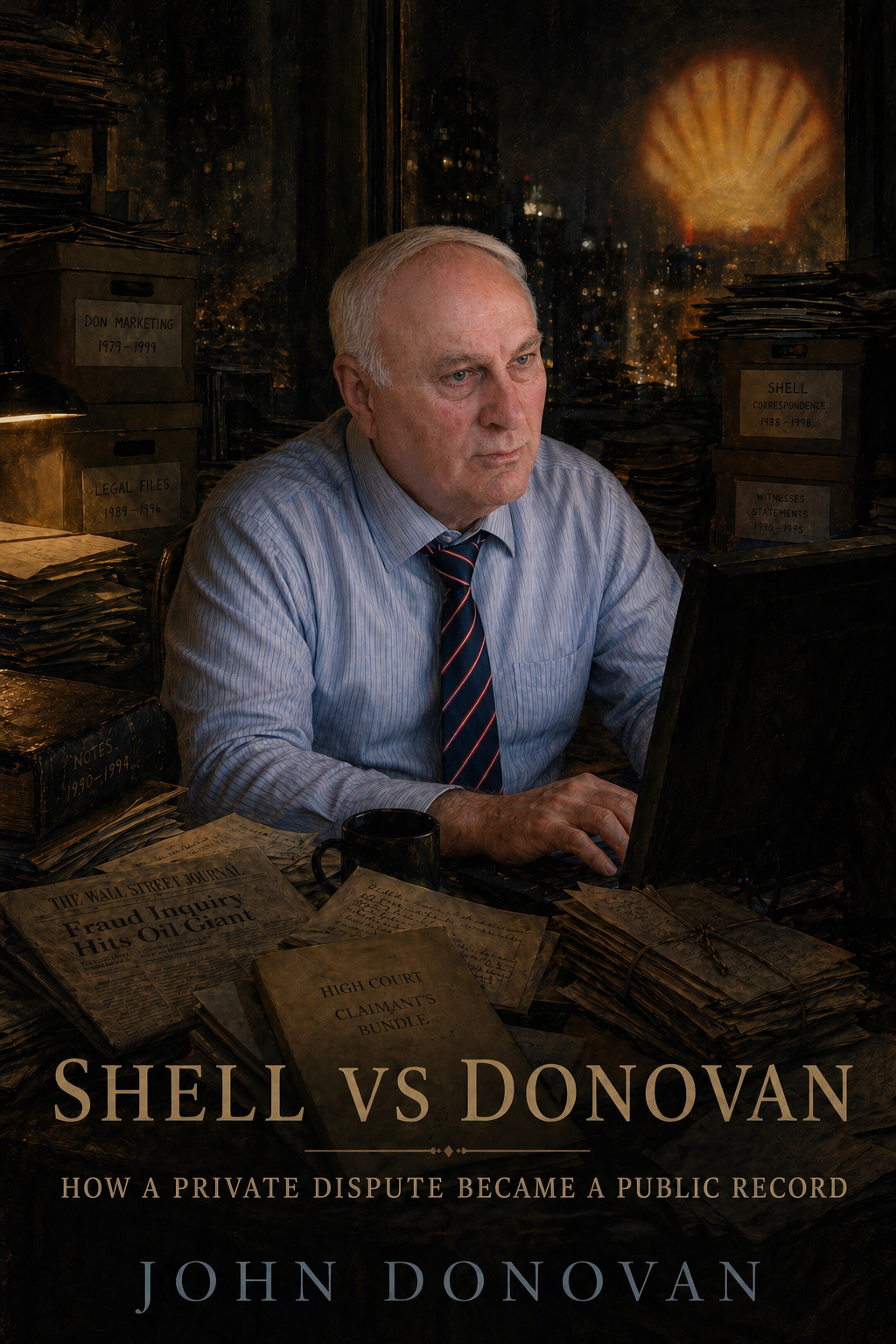
Immediately below, I have printed in italics Google’s response to my question: Did Sir Henri Deterding have any connection with spying or intelligence activities?
- Anti-Bolshevik Intelligence Network: Following the nationalization of his oil properties in Azerbaijan after World War I, Deterding became a fierce anti-communist. To combat the Soviet Union, he organized and financed his own private secret service directed by General Sir George MacDonough (a former British Director of Military Intelligence) to spy on and disrupt the Communist International (Comintern). [1, 2]
- Corporate Espionage: Throughout his career, Deterding used corporate intelligence and covert operations to monitor his business competitors and leftist political movements. [1, 2]
- Ties to the Third Reich: In the 1930s, Deterding’s fierce opposition to the Soviet Union led him to develop close, personal ties with Nazi Germany. He became an ardent supporter of Adolf Hitler, providing significant financial backing to the Nazi party and currying favor to win lucrative oil contracts for Royal Dutch/Shell.
Related article by John Donovan in association with ChatGPT
Site-wide disclaimer also applies.
EDITOR’S NOTE: GOOGLE FOUND A REAL STORY—BUT OVERSOLD PARTS OF IT
Google’s response was directionally correct: Sir Henri Deterding had substantial connections with intelligence work, political information-gathering and anti-Bolshevik covert networks.
However, several details require qualification.
Deterding was born in 1866, not 1877. He did not technically “co-found” Royal Dutch/Shell from nothing: he became general manager of Royal Dutch Petroleum in 1900 and was instrumental in creating the 1907 Royal Dutch–Shell combination with Marcus Samuel’s Shell Transport and Trading Company. He remained the dominant figure in the group for decades.
The historical record supports the claim that Deterding employed former British military-intelligence chief Lieutenant-General Sir George Macdonogh as a political adviser in connection with his post-revolutionary Russian oil interests. Macdonogh had served as Britain’s Director of Military Intelligence during the First World War. Some accounts describe the resulting apparatus as Deterding’s private intelligence or secret-service network; the precise scale, chain of command and operational record are less securely documented than Google’s answer implies.
Deterding’s bitter anti-Bolshevism and later accommodation with Nazi Germany are well documented. Claims that he secretly bankrolled Hitler or the Nazi Party from as early as 1921 remain historically disputed. Recent biographical work argues that evidence for many early financing allegations is weak, while acknowledging his later donation to the Nazi Winter Relief organisation, his anti-communist alignment, Shell advertising in the Nazi newspaper Völkischer Beobachter, his residence in Germany and the honours accorded to him after his death.
In other words, the truth is already disturbing.
There is no need to promote every rumour to the rank of established fact.
PART ONE
THE DEEP DIVE: BEFORE HAKLUYT, BEFORE “CORPORATE SECURITY,” THERE WAS DETERDING
Shell’s modern history of intelligence gathering can be made to look like a succession of unfortunate coincidences.
A private intelligence firm infiltrates Greenpeace.
A supposed documentary-maker interviews campaigners opposing Shell over Nigeria.
Corporate-security officials share information with state agencies.
Former intelligence officers provide political reporting on oil deals.
An internal department monitors critics and searches for their sources.
Shell insists each episode is separate.
Different decade.
Different subsidiary.
Different consultant.
Different legal entity.
Different euphemism.
But the historical trail points back towards the personality who built Royal Dutch/Shell into an international petroleum empire: Sir Henri Deterding.
Long before Shell employed “risk advisers,” “security consultants” and “stakeholder-intelligence specialists,” Deterding understood a basic principle of oil power:
The company that knows what governments, rivals and revolutionaries are planning has an advantage over the company that merely owns the wells.
Deterding did not build Shell through petrol stations alone.
He built it through information.
1. THE BANK CLERK WHO BECAME THE “NAPOLEON OF OIL”
Henri Wilhelm August Deterding joined Royal Dutch Petroleum in 1896 and took control after the death of its managing director, Jean Baptiste Kessler, in 1900.
He transformed a comparatively vulnerable Dutch producer into a global competitor to John D. Rockefeller’s Standard Oil. The 1907 alliance between Royal Dutch and Marcus Samuel’s Shell Transport and Trading created the structure that became the Royal Dutch/Shell group. Deterding dominated the combination for decades and earned the nickname “Napoleon of Oil.”
The comparison was not entirely flattering.
Like Napoleon, Deterding believed logistics, intelligence, alliances and ruthlessness mattered as much as battlefield strength.
Oil concessions depended on governments.
Shipping depended on naval policy and secure routes.
Pricing depended on knowledge of competitors’ supplies.
Political instability could destroy an oilfield’s value overnight.
Deterding therefore operated in a world where commercial intelligence and state intelligence naturally overlapped.
The oilman needed diplomats.
He needed military contacts.
He needed agents who understood revolutions, ministries, borders, armies and rival companies.
The petrol empire developed an intelligence metabolism before it developed a modern public-relations department.
2. THE BOLSHEVIK REVOLUTION TAKES THE OIL
The defining political trauma of Deterding’s later career was the Russian Revolution.
Royal Dutch/Shell had acquired important Russian oil interests, including access to the petroleum industry around Baku. After the Bolsheviks took power, private assets were nationalised and foreign owners lost investments of immense value.
Deterding never treated the loss as an ordinary commercial reversal.
It became an ideological vendetta.
He emerged as one of Europe’s most determined anti-Bolsheviks, supported White Russian émigrés and pursued the hope that Soviet control might eventually collapse or be overturned.
That obsession is crucial to understanding his intelligence activity.
Deterding did not merely want market reports from Moscow.
He wanted information about:
- Soviet oil production;
- export capacity;
- political divisions;
- anti-Bolshevik resistance;
- émigré networks;
- the Communist International;
- covert Soviet commercial activity;
- and the possibility of recovering confiscated petroleum assets.
To an ordinary businessman, the Soviet Union was a difficult market.
To Deterding, it was a hostile regime occupying his property.
3. ENTER GENERAL SIR GEORGE MACDONOGH
The most important intelligence connection was Lieutenant-General Sir George Mark Watson Macdonogh.
Macdonogh had served as Director of Military Intelligence at the British War Office from 1916 to 1918. After the war, he became associated with Deterding’s anti-Bolshevik and Russian oil activities as a political adviser.
That was not the appointment of an ordinary energy analyst.
Deterding had recruited a man who had recently run British military intelligence during a world war.
Google characterised Macdonogh as directing Deterding’s private secret service. Some historical accounts use similarly expansive language, while other readily available sources describe him more cautiously as Deterding’s political adviser.
The prudent conclusion is this:
Deterding deliberately embedded top-level intelligence expertise within his campaign concerning Soviet Russia and the recovery or protection of oil interests.
Whether the resulting organisation should formally be called a “secret service” depends on the evidence one accepts about its size and operations.
Its purpose was plainly not limited to reading newspapers.
A former military-intelligence chief was valuable precisely because he understood clandestine networks, official sources, political warfare and the conversion of confidential information into strategic action.
4. THE INTERNATIONAL GROUP OF OIL COMPANIES IN RUSSIA
In the early 1920s, Deterding helped organise oil interests dispossessed by the Soviet state.
Historical accounts identify a grouping of international oil companies concerned with Russia, established to coordinate policy towards Soviet nationalisation and prevent individual companies from cutting separate deals that might weaken the collective negotiating position. Macdonogh was brought into this environment as an adviser.
This arrangement had several functions.
It was commercial.
It was political.
It was diplomatic.
And it was informational.
The companies needed intelligence about Soviet negotiating tactics and the commercial ambitions of rival Western firms.
Deterding feared that competitors might acquire Russian oil on favourable terms, indirectly legitimising the Bolsheviks’ confiscation of pre-revolutionary assets.
The intelligence target was therefore not only Moscow.
It was also London, Paris, Berlin, New York and every boardroom considering an independent agreement with the Soviets.
An oil cartel concerned with revolutionary Russia was almost inevitably an intelligence network wearing a commercial hat.
5. THE COMINTERN AND THE PRIVATE WAR AGAINST COMMUNISM
Google’s response claimed that Deterding’s service spied upon and sought to disrupt the Communist International, or Comintern.
The broad proposition fits Deterding’s known political purpose and the recruitment of Macdonogh. However, the publicly accessible sources located for this article do not provide a sufficiently complete operational archive to assert every reported act as proven.
What can safely be said is that Deterding financed and supported organised anti-Bolshevik activity and sought intelligence on Soviet and international communist operations.
He moved in circles populated by:
- White Russian exiles;
- anti-Soviet businessmen;
- intelligence veterans;
- conservative politicians;
- military figures;
- and governments worried about revolutionary movements.
The separation between political intelligence and political interference was not always obvious.
An organisation gathering information about communist networks could also fund propaganda, cultivate informants, support émigré groups and seek to destabilise Soviet commercial activities.
Deterding was not conducting a detached academic inquiry.
He wanted the Bolshevik system defeated and his commercial position restored.
6. OIL COMPANIES HAVE ALWAYS NEEDED TO KNOW BEFORE EVERYONE ELSE
Deterding’s intelligence interest was not confined to communism.
The early oil industry was built around imperfect information.
Companies competed over concessions in territories where borders, governments and legal systems could change abruptly.
A rumour that a ruler might award a concession could move millions.
Advance knowledge of a railway, pipeline, naval contract or tax decision could determine the profitability of an entire region.
The successful oil executive therefore required information from:
- ministries;
- courts;
- embassies;
- shipping agents;
- bankers;
- military officers;
- geologists;
- local intermediaries;
- rival employees;
- and political fixers.
Some information was openly purchased.
Some was socially cultivated.
Some was extracted from commercial partners.
Some came from government intelligence networks.
Some undoubtedly arrived by methods that modern compliance officers would prefer to call “historically contextual.”
Deterding’s reputation for aggressive competition makes it unsurprising that intelligence became part of his managerial toolkit.
But “unsurprising” is not the same as documented proof of every allegation of corporate espionage. The surviving record supports the existence of intelligence relationships and political networks; it does not provide a comprehensive ledger of every operation conducted in Shell’s name.
7. FROM MACDONOGH TO MODERN “POLITICAL RISK”
Shell would not now announce:
Former head of military intelligence appointed to run private secret service against political enemies.
The press release would say:
Shell strengthens geopolitical risk capability with distinguished public-service appointment.
The activity would be distributed among:
- Corporate Security;
- Government Relations;
- Legal;
- External Affairs;
- Country Risk;
- Business Integrity;
- Crisis Management;
- and specialist third-party consultancies.
The vocabulary changed because blunt language became reputationally expensive.
The operational need remained.
A multinational oil company still wants to know:
- whether a government may fall;
- whether sanctions are coming;
- whether activists are planning direct action;
- whether a minister is privately hostile;
- whether a licence will be revoked;
- whether employees are leaking;
- and whether litigation is being prepared.
Deterding’s private political network did not vanish.
It became a corporate function with PowerPoint templates.
8. THE BUSINESS COMPETITORS
Google also claimed that Deterding used corporate espionage against business competitors.
That statement is plausible in the intensely secretive early petroleum industry, but it is too broad as presented.
Deterding was an aggressive strategist who built alliances, negotiated monopolistic arrangements and fought Standard Oil across world markets. Biographical accounts portray him as exceptionally well informed and willing to employ political influence in pursuit of Royal Dutch/Shell’s position.
But “corporate espionage” can mean many different things:
- reading competitors’ public filings;
- hiring their former employees;
- obtaining confidential shipping information;
- paying intermediaries;
- cultivating government sources;
- intercepting communications;
- stealing documents;
- or planting agents.
The evidence located here does not justify attributing every category to Deterding personally.
A responsible article should therefore say that Deterding built and used sophisticated competitive and political intelligence networks—not that every legend told about his industrial espionage has been independently proved.
The mythology around powerful oilmen often grows faster than the archive.
Deterding’s documented conduct is formidable enough without granting him supernatural powers.
9. ANTI-COMMUNISM BECOMES THE BRIDGE TO FASCISM
Deterding’s hatred of Bolshevism eventually drew him towards authoritarian and fascist movements that presented themselves as barriers against communism.
By the 1930s, he was living increasingly in Germany, expressing sympathy for Hitler’s anti-Soviet programme and engaging with the Nazi system.
Shell’s German business advertised in the Nazi Party newspaper Völkischer Beobachter. Deterding met Hitler in 1934. In 1937, Joseph Goebbels recorded a very large Deterding contribution to the Nazi Winter Relief organisation. After Deterding’s death in 1939, Nazi authorities participated in an elaborate funeral at his German estate.
These are serious historical facts.
They do not establish every claim that Deterding financed Hitler’s rise from the early 1920s.
Indeed, historian Jochen Thies has challenged the longstanding story that Deterding was a major covert Nazi financier throughout that period, arguing that contemporary evidence for several sensational allegations is absent.
The distinction matters.
Deterding’s later political alignment was sufficiently ugly without retrospectively inserting him into every brown-shirted transaction for which a rumour exists.
10. WAS DETERDING HITLER’S BANKER?
The claim that Deterding provided major secret financing to Hitler has circulated for generations.
It has been repeated in biographies, political writings and testimony from figures claiming inside knowledge. Some sources allege money was supplied to the Nazi movement or its paramilitary organisations well before Hitler took power.
Other historians argue that the paper trail does not support the sweeping version of that story.
The available evidence is stronger for:
- Deterding’s fanatical anti-Bolshevism;
- his willingness to work with the Nazi regime;
- his large 1937 charitable contribution within the Nazi system;
- his efforts to secure German favour;
- his residence at Dobbin;
- and his honoured Nazi funeral.
It is weaker for the proposition that he personally and secretly financed Hitler’s entire rise to power from 1921 onwards.
This article therefore does not repeat Google’s claim of “significant financial backing to the Nazi party” as a simple uncontested fact.
The historical debate should be acknowledged.
What is beyond serious dispute is that Deterding’s anti-communist crusade corroded his political judgment and brought him into accommodation with one of history’s most murderous regimes.
The intelligence warrior against Bolshevism ended as a celebrated resident of Hitler’s Germany.
That is not vindication.
It is moral collapse.
11. DID SHELL BENEFIT FROM DETERDING’S NAZI RELATIONSHIPS?
Google suggested that Deterding cultivated Hitler to win lucrative oil contracts for Royal Dutch/Shell.
The relationship between Deterding’s personal politics, Shell’s German business and the group’s commercial interests requires careful separation.
Deterding remained enormously influential but left executive control in 1936. Shell’s German subsidiary operated within an increasingly coercive Nazi economy. Deterding’s own activities after retirement cannot automatically be attributed to every Shell director or company within the group.
At the same time, the corporate history cannot be sterilised by declaring his conduct purely personal.
Deterding had spent decades building and personifying the group.
His political contacts grew from his petroleum interests.
His anti-Soviet campaign was tied directly to confiscated Shell assets.
His stature gave him access that an ordinary retired manager would never have possessed.
The relationship between personal ideology and corporate advantage was therefore entangled—even where precise contractual benefits remain disputed.
Shell cannot reasonably celebrate Deterding as the architect of its global greatness while treating his politics as the unrelated hobby of an elderly gentleman in Mecklenburg.
12. THE INTELLIGENCE LINEAGE
The comparison with later Shell controversies is not that one secret department operated continuously from Deterding to the present day.
Organisations change.
Personnel retire.
Legal standards evolve.
Corporate structures are repeatedly reorganised.
The lineage is cultural and functional.
Under Deterding
Shell’s dominant leader recruited a former director of British military intelligence to advise an oil-centred campaign against Soviet power.
During the anti-apartheid era
Shell commissioned the Neptune Strategy to map, divide and redirect churches, unions, students and anti-apartheid campaigners.
In Nigeria
Shell security exchanged information with Nigeria’s State Security Service, while private intelligence operatives targeted organisations associated with the Ogoni campaign.
Through Hakluyt
A firm founded by former intelligence officers supplied political and activist intelligence to corporate clients, including Shell-related assignments.
In the United States
Shell’s corporate-security organisation investigated reputational threats, monitored internal contacts with critics and discussed government and cyber-security relationships.
In the Donovan affair
Shell monitored email traffic and website visits while attempting to identify internal sources supplying information to a critical website.
The operating principle is remarkably durable:
Know the opposition. Identify the source. Protect the asset. Control the narrative.
Deterding would have recognised the logic immediately.
He might merely have objected to the terminology.
13. DETERDING DID NOT INVENT INDUSTRIAL INTELLIGENCE
It would be unfair to pretend that Royal Dutch/Shell alone used intelligence networks.
Standard Oil, European governments, arms manufacturers, banks, mining companies and shipping interests all cultivated confidential sources.
The boundary between diplomat, businessman and intelligence officer was especially porous in the imperial and interwar periods.
Oil itself was a strategic military commodity.
Governments needed information from oil companies.
Oil companies needed influence within governments.
Executives became informal diplomatic actors.
Former officials entered corporate service.
Commercial networks provided useful intelligence cover.
Shell was part of this system—not its sole inventor.
What distinguished Deterding was the scale of his ambition and the degree to which intelligence, diplomacy and petroleum strategy converged around his personal authority.
He was not merely informed by the system.
He helped command one.
14. THE PRIVATE SECRET SERVICE QUESTION
Did Deterding possess a private secret service?
The most defensible answer is:
He maintained an organised political-intelligence capability associated with his anti-Bolshevik and Russian oil campaign, drawing upon one of Britain’s most senior former military-intelligence officers. Some historical accounts characterise this as a private secret service, but the accessible documentary record does not permit every alleged operation to be independently reconstructed.
That is less dramatic than Google’s answer.
It is also stronger.
It separates three levels of evidence:
Established
Macdonogh had been Britain’s Director of Military Intelligence.
Deterding employed him as a political adviser.
Deterding organised anti-Bolshevik commercial and political activity after losing Russian oil interests.
Strongly inferable
The work involved confidential sources and intelligence collection extending beyond normal public commercial research.
Not fully established from accessible records
The exact size, personnel, budget, operational methods and success of a formal Deterding-controlled secret service directed against the Comintern.
The Google answer collapsed all three categories into one confident paragraph.
Artificial intelligence enjoys a clean narrative.
History usually arrives with missing files.
15. THE FIRST SHELL SPOOK?
It would be tempting to call Macdonogh the first Shell spook.
That would make an excellent headline and an imperfect historical description.
He was not necessarily a Shell employee in the modern contractual sense.
His advisory work appears to have been closely associated with Deterding and the international oil interests confronting Soviet nationalisation.
Still, the symbolism is irresistible.
The man who had run British military intelligence became an adviser to the man who ran Royal Dutch/Shell.
The oil empire did not wait for the twenty-first century to discover the benefits of recruiting former intelligence chiefs.
It merely did so before Human Resources had invented the phrase transferable public-sector expertise.
16. FROM WHITE RUSSIANS TO GREENPEACE
The targets changed over time.
Deterding feared Bolsheviks and Soviet agents.
Later Shell operations studied anti-apartheid campaigners.
Hakluyt penetrated environmental organisations.
Nigerian security systems collected information on community resistance.
Shell USA treated leaks and reputational threats as security concerns.
The targets were not morally equivalent.
A revolutionary state intelligence service is not the same thing as a peaceful environmental organisation.
The comparison lies in the corporate habit of treating political opposition as an information problem.
Once an opponent is entered into a security framework, the next questions follow naturally:
Who funds them?
Who speaks for them?
What do they plan?
Who inside the company assists them?
Can they be divided?
Can their message be redirected?
Can their sources be identified?
That is how political disagreement becomes intelligence work.
Deterding’s anti-Bolshevik campaign supplied the original template: commercial opposition fused with ideological hostility until the company’s enemy became a security enemy.
17. THE DETERDING PERSONALITY
Deterding’s management style made this fusion particularly dangerous.
He was autocratic, centralising and supremely confident in his judgment.
The corporate empire was built around personal command rather than modern board accountability.
Information travelled upwards.
Orders travelled downwards.
Dissent was not a treasured governance resource.
A private intelligence network suited that model perfectly.
It allowed the leader to bypass ordinary channels and receive reports from trusted specialists.
Modern companies claim to have compliance committees, audit trails and independent directors.
Deterding had Macdonogh.
One suspects the meetings were shorter.
The accountability may also have been nonexistent.
18. WHAT DID THE BOARD KNOW?
The absence of easily accessible surviving documents creates an important archival question.
How formally was Deterding’s intelligence activity integrated into Royal Dutch/Shell?
Were expenditures recorded by the company?
Were reports circulated to directors?
Did Shell offices host operatives?
Were governments aware of the relationship?
Did intelligence gathered by Macdonogh or associated networks influence commercial decisions?
Were anti-Bolshevik propaganda and émigré activities financed personally by Deterding, through related organisations or from corporate funds?
Was information shared with British intelligence?
Were Shell’s international offices used as collection points?
The answers may exist in archives scattered among corporate records, government papers and personal collections.
Shell should have an institutional interest in clarifying them.
Its persistent silence instead allows legend and evidence to become intermingled.
19. SHELL’S OFFICIAL HISTORY AND THE ART OF CORPORATE DISTANCE
Shell has commissioned substantial official histories examining its development.
Such works contain valuable scholarship and have benefited from access to corporate archives. They also illustrate the difficulty of writing institutional history when the institution retains control over the filing cabinets.
Deterding is indispensable to Shell’s creation myth.
He is the brilliant strategist who defeated Standard Oil and built a global enterprise.
But the same centrality becomes awkward when examining:
- anti-Bolshevik covert activity;
- fascist sympathies;
- Nazi Germany;
- and the political use of oil power.
Corporate memory therefore performs a delicate operation.
The commercial genius remains attached to Shell.
The moral consequences are detached and labelled personal eccentricity.
The company inherits the empire.
History is asked to probate the liabilities elsewhere.
20. THE MODERN INVESTORS INHERIT THE QUESTION
Today’s institutional investors did not appoint Deterding or Macdonogh.
They cannot be held responsible for decisions made a century ago.
They are responsible for how Shell addresses that history now.
Major asset managers and pension institutions with exposure to Shell—including investment groups such as BlackRock, Vanguard, Fidelity-related funds and Norges Bank Investment Management—present themselves as sophisticated stewards of corporate governance and long-term risk. Shell’s latest annual report remains the principal corporate account of its present governance and operations.
Those investors should ask:
- What records does Shell possess concerning Deterding’s political-intelligence network?
- Did Shell fund Macdonogh or associated operations?
- Does the archive identify agents, front organisations or propaganda activity?
- Has Shell commissioned an independent study of its historical intelligence relationships?
- How did the early culture influence later corporate-security practices?
- What controls now prevent peaceful campaigners from being treated as political-security targets?
- Why has Shell never published a comprehensive account connecting Deterding, Pagan International, Hakluyt, Nigeria and modern corporate security?
Shareholders are not being asked to apologise for 1922.
They are being asked whether concealment in 2026 is acceptable.
21. THE CONTINUITY IS NOT A CONSPIRACY—IT IS AN INCENTIVE
It would be simplistic to argue that Deterding designed a secret intelligence doctrine still being followed verbatim by Shell executives.
No century-long order was placed in a locked safe.
The continuity is institutional incentive.
Oil companies operate assets whose value depends upon governments, local consent, licences, security and political stability.
Opposition can cost billions.
Information can prevent the loss.
That creates an enduring appetite for intelligence.
The appetite survives individual executives because the commercial reward survives them.
Deterding gave the appetite a personality.
Modern Shell gave it departments.
PART TWO
SHELL RISK REGISTER: THE DETERDING INTELLIGENCE LEGACY
Risk 1: Overstatement of the “private secret service”
Established record:
Deterding employed former British Director of Military Intelligence Sir George Macdonogh as a political adviser in connection with anti-Bolshevik oil interests.
Disputed or incompletely documented claim:
That Macdonogh commanded a large formal private secret service conducting a fully documented campaign against the Comintern.
Critical assessment:
The intelligence connection is real. Its precise operational scale requires further archival proof.
AI-era risk:
High. Repetition by AI systems may convert a qualified historical claim into apparent certainty.
Severity:
High.
Recommended response:
Publish relevant Shell and Deterding archival records.
Risk 2: Anti-Bolshevik political warfare
Established record:
Deterding became an uncompromising enemy of the Soviet regime after nationalisation of Russian oil interests and supported anti-Bolshevik causes.
Critical assessment:
Corporate property loss became fused with ideological and geopolitical warfare.
AI-era risk:
High.
Severity:
High.
Recommended response:
Separate documented financial, political, propaganda and intelligence activities in an independent historical review.
Risk 3: Nazi-financing claims
Established record:
Deterding aligned himself with Nazi Germany late in life, contributed substantially to Nazi Winter Relief and received an honoured funeral under the regime.
Disputed claim:
That he secretly financed Hitler or the Nazi Party on a large scale from the early 1920s onward.
Critical assessment:
The later alignment is well supported. Some early financing claims remain contested and should not be stated as settled history.
AI-era risk:
Extreme because sensational claims circulate more rapidly than qualifications.
Severity:
Extreme.
Recommended response:
Shell should release its archives and state clearly what it accepts, disputes or cannot establish.
Risk 4: Founder mythology
Issue:
Shell benefits from Deterding’s reputation as the architect of its global growth while distancing itself from his political and intelligence activities.
Critical assessment:
Corporate heritage cannot be divided into profitable genius and privately owned disgrace.
AI-era risk:
Severe.
Severity:
High.
Recommended response:
Publish an integrated history rather than separate celebratory and embarrassing narratives.
Risk 5: Cultural continuity
Issue:
Later Shell controversies repeatedly involved former intelligence officers, opposition mapping, activist infiltration, government security liaison and monitoring of critics.
Shell’s probable position:
The episodes arose independently in different countries and periods.
Critical assessment:
No single conspiracy need exist for a durable institutional preference for intelligence-led reputation and asset protection.
AI-era risk:
Extreme because disparate archives can now be connected automatically.
Severity:
Extreme.
Recommended response:
Commission an independent review of historical and modern intelligence practices.
Risk 6: Institutional-investor passivity
Issue:
Major investors scrutinise current climate and governance risks but rarely demand transparency regarding corporate-intelligence history.
Critical assessment:
Surveillance and manipulation of lawful civil society are material governance issues.
AI-era risk:
High.
Severity:
High.
Recommended response:
Investors should seek a board-level disclosure programme and archival preservation commitment.
PART THREE
SPOOF SHELL PUBLIC-RELATIONS RESPONSE
Shell rejects the suggestion that Sir Henri Deterding operated a private intelligence service.
Sir Henri merely retained the former British Director of Military Intelligence to provide routine commercial observations concerning Bolsheviks, the Soviet government, émigré networks, international oil negotiations and threats to confiscated petroleum interests.
This was standard stakeholder engagement for the 1920s.
Shell does not recognise the term “spying.”
The preferred historical description is:
proactive geopolitical information stewardship.
Sir Henri’s later relationship with Nazi Germany was entirely personal except where it involved Shell advertising, oil interests, commercial relationships or the international reputation of the company he had controlled for more than three decades.
Claims that Deterding financed Hitler remain disputed.
Shell therefore considers it unnecessary to discuss the undisputed parts.
Any resemblance between Deterding’s recruitment of a former military-intelligence chief and Shell’s later use of former intelligence officers is coincidental, geographically diverse and governed by separate cost centres.
Shell’s modern security teams operate under strict ethical standards.
The standards are confidential for security reasons.
Shell remains committed to transparency and will release all relevant historical files immediately after locating, reviewing, redacting, classifying and permanently retaining them from public access.
PART FOUR
SPOOF AI ADVISORY PANEL
ChatGPT:
Google identified a genuine intelligence connection but presented several contested claims too confidently. Macdonogh’s appointment and Deterding’s anti-Bolshevik networks are well supported; the exact structure of a formal private secret service requires stronger archival evidence.
Claude:
The most important continuity is not organisational but conceptual: Deterding treated political opposition to oil interests as an intelligence problem. Later Shell operations repeatedly did the same.
Copilot:
The Nazi-financing claim requires qualification. Deterding’s later support for and accommodation with the Nazi system are documented, but claims of major covert funding from the early 1920s remain disputed.
Google AI Mode:
My initial answer should have distinguished between documented intelligence relationships, historical allegations and contested conclusions.
Perplexity:
The core source trail should include Macdonogh’s military-intelligence career, Deterding biographies, Shell’s corporate history and archival evidence concerning anti-Soviet oil organisations.
Grok:
Nothing suspicious here. The oil boss merely hired the former chief of British military intelligence to keep an eye on communists and lost oilfields. Apparently accountants were busy.
PART FIVE
RECOMMENDED CLASSIC MEME
“Drake Hotline Bling”
Top panel — Drake rejecting:
HIRING AN ORDINARY OIL-MARKET ANALYST
Bottom panel — Drake approving:
HIRING THE FORMER DIRECTOR OF BRITISH MILITARY INTELLIGENCE TO ADVISE ON THE BOLSHEVIK PROBLEM
A document beside him reads:
SHELL GEOPOLITICAL RISK DEPARTMENT — EST. BEFORE THE PHRASE EXISTED
Alternative: “Corporate Needs You to Find the Difference”
Two images are placed side by side:
1922: PRIVATE POLITICAL-INTELLIGENCE NETWORK
2026: INTEGRATED GEOPOLITICAL RISK AND STAKEHOLDER-SECURITY FUNCTION
The final panel says:
“THEY’RE THE SAME PICTURE.”
PART SIX
DONOVAN–DETERDING SKIT
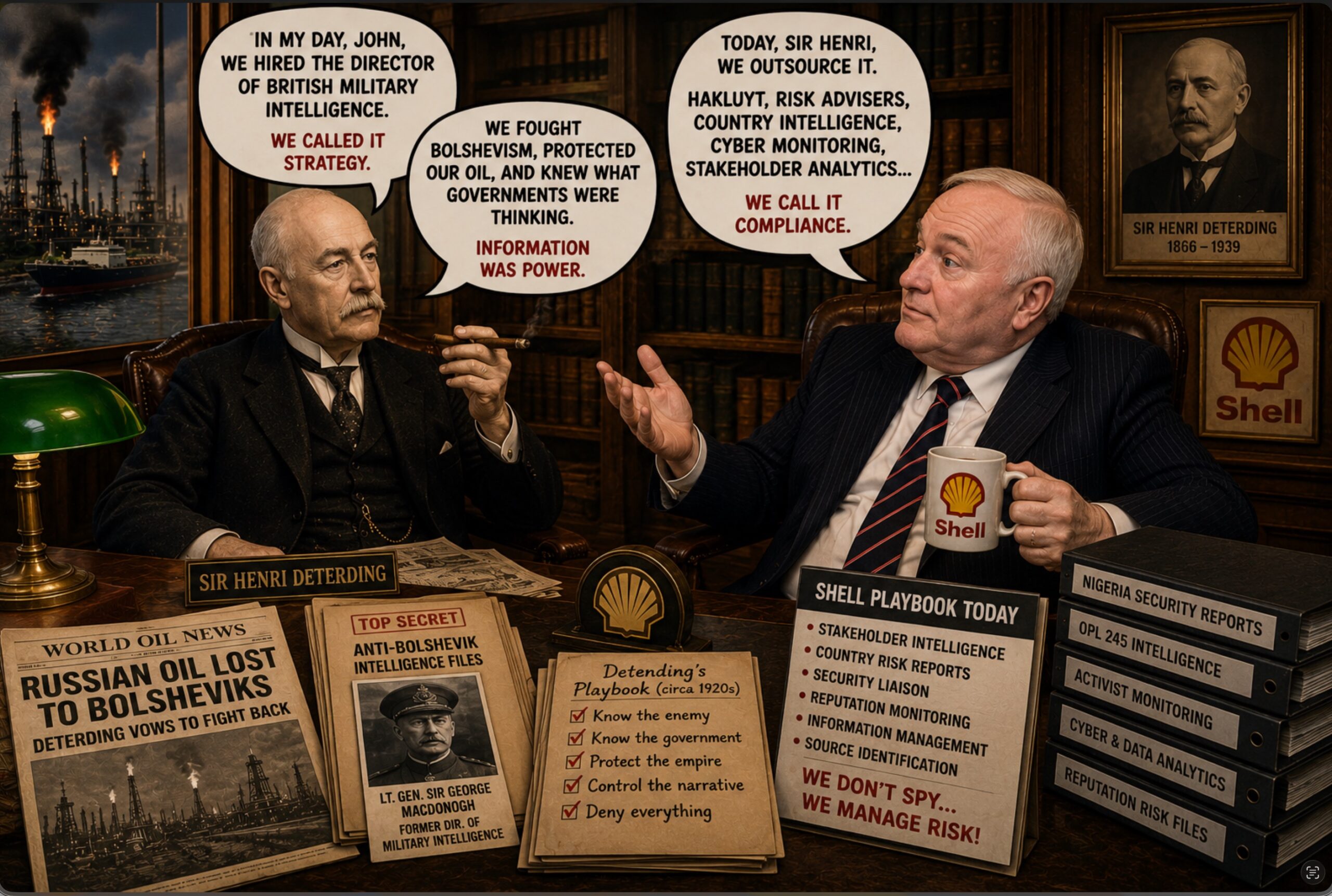
Scene: Sir Henri Deterding and John Donovan sit in the familiar library. On the desk is a file marked GENERAL SIR GEORGE MACDONOGH — FORMER DIRECTOR OF MILITARY INTELLIGENCE. A modern Shell Corporate Security organisation chart hangs on the wall.
John Donovan:
Sir Henri, Google says you operated your own private secret service.
Sir Henri Deterding:
Google speaks with the confidence of a man who has never opened an archive.
John Donovan:
Did you hire General Sir George Macdonogh?
Sir Henri Deterding:
Ja.
John Donovan:
Former Director of British Military Intelligence?
Sir Henri Deterding:
Correct.
John Donovan:
To advise you about Bolsheviks, Soviet oil and political threats?
Sir Henri Deterding:
Naturally.
John Donovan:
That sounds rather like a private intelligence service.
Sir Henri Deterding:
No, John. It was strategic petroleum information.
John Donovan:
That sounds rather like modern Shell terminology.
Sir Henri Deterding:
Modern Shell uses thirty-seven words where I required three.
John Donovan:
Did the network spy on the Comintern?
Sir Henri Deterding:
The archive must answer. A dead oil magnate in a satirical conversation is not a primary source.
John Donovan:
Very responsible.
Sir Henri Deterding:
Accuracy is essential when discussing secret operations. Otherwise one begins to sound like Corporate Affairs.
John Donovan:
Google also says you financed Hitler.
Sir Henri Deterding:
Some claims are documented. Some are disputed. State both.
John Donovan:
You supported Nazi Germany late in life.
Sir Henri Deterding:
This was a grave moral failure. Satire should not disguise it.
John Donovan:
You are rather more candid in death than Shell is in its annual reports.
Sir Henri Deterding:
Death removes the public-relations department.
John Donovan:
Do you see a connection between your intelligence network and Shell’s later relationships with Hakluyt?
Sir Henri Deterding:
I hired a former intelligence chief openly enough for historians to find him.
John Donovan:
Hakluyt used an operative pretending to be a film-maker.
Sir Henri Deterding:
Ach. Standards declined.
John Donovan:
Shell later called such work political-risk consultancy.
Sir Henri Deterding:
A spy with an invoice remains a spy with an invoice.
John Donovan:
So Shell’s intelligence habit began with you?
Sir Henri Deterding:
Oil empires have always required information.
John Donovan:
And secrecy?
Sir Henri Deterding:
Especially secrecy.
John Donovan:
Shell still seems to agree.
Sir Henri Deterding:
Ja. The company modernised everything except the instinct.
CONCLUSION
THE GHOST IN SHELL’S INTELLIGENCE MACHINE
Google’s answer contained a genuine historical revelation.
Sir Henri Deterding was not merely an oil trader with unusually strong political opinions.
He built relationships that placed intelligence expertise close to the heart of his petroleum strategy.
After the Bolshevik Revolution stripped Royal Dutch/Shell and other investors of Russian assets, Deterding turned commercial grievance into ideological war.
He organised dispossessed oil interests.
He supported anti-Bolshevik networks.
He recruited Sir George Macdonogh, a former Director of British Military Intelligence, as a political adviser.
He sought privileged information concerning the Soviet state, international communism and the political future of Russian oil.
Whether every element deserves the formal title “Deterding’s private secret service” remains open to archival clarification.
The intelligence connection itself is not seriously in doubt.
His subsequent political journey made the story darker.
Deterding’s anti-communism carried him towards Nazi Germany. Some claims of early secret Nazi financing remain disputed, but his later sympathy, contribution to Nazi Winter Relief, German residence and state-honoured funeral are documented.
The man who believed intelligence would help defeat Bolshevism ended his life celebrated by another dictatorship.
Shell’s later history makes the episode more than a biographical curiosity.
Pagan International mapped anti-apartheid campaigners.
Hakluyt infiltrated environmental and human-rights organisations.
Shell’s Nigerian security operation exchanged information with state intelligence.
Former spies supplied political reporting on oil transactions.
Shell USA monitored critics, leaks and alleged reputational threats.
The methods changed.
The justification did not.
Protect the asset.
Understand the government.
Watch the opponent.
Identify the source.
Control the information.
Shell, previously known as Forthdeal Limited, subsequently as Royal Dutch Shell plc, and now hiding in plain sight as Shell plc after ditching the disgraced Royal Dutch moniker, may insist that no continuous intelligence tradition connects Deterding to the modern corporation.
Perhaps not.
There is no need for a century-long conspiracy when the commercial incentive renews itself every morning.
Deterding did not leave Shell a secret instruction manual.
He left something more durable:
An empire built on the proposition that oil belongs to whoever can obtain the concession, control the route—and learn what everyone else is planning before they do.
The founder’s ghost is not hiding in Shell’s machine.
It designed part of the machinery.
DISCLAIMER
This article is an opinion and commentary work containing satire, historical criticism and analysis based on publicly available biographical, archival and corporate sources.
Historical claims concerning covert intelligence work, political financing and secret operations vary in evidential strength. The article distinguishes documented facts from reasonable inferences, disputed allegations and claims requiring further archival corroboration.
The evidence supports Sir Henri Deterding’s employment of former British Director of Military Intelligence Sir George Macdonogh as a political adviser and Deterding’s extensive anti-Bolshevik activity. The precise structure and operations of any formal “private secret service” are not fully established by the publicly accessible material reviewed.
Claims that Deterding covertly financed Hitler or the Nazi Party from the early 1920s remain disputed among historians. His later support for and accommodation with the Nazi system are more securely documented. Nothing in this article endorses Nazism, fascism, political violence or authoritarian ideology.
The spoof Shell statement, AI discussion, meme concepts and Donovan–Deterding conversation are fictional and intended for criticism, satire and entertainment. Sir Henri Deterding died in 1939.
Nothing in this article constitutes legal, historical-investment or financial advice. Readers should consult primary archives and qualified historians when relying upon contested historical claims.
Shell plc, historians, archives, institutional investors and any other interested party are invited to submit corrections, source material or comments for publication on an unedited basis, subject to legality and relevance.
Site-wide disclaimer also applies.
*This website and sisters royaldutchshellgroup.com, shellnazihistory.com, royaldutchshell.website, johndonovan.website, shellnews.net, and shellwikipedia.com, are owned by John Donovan - more information here. There is also a Wikipedia segment, the Shell DPA Files, "Shell and the Spies", the Shell Leaks files, as well as books written and published by John Donovan - Kindle eBooks. Timeline of the Donovan Shell Feud. Toxic History of Royal Dutch Shell Group. Shell and the Donovans: The Full Media Record — 550+ Articles, 110 Books, 40 Years. *All created and supported by internet wizz, Nick Gill.