Royal Dutch Shell plc .com Rotating Header Image

Posts under ‘Litigation’

Mystery of how Shell escaped Brent Bravo criminal prosecution

The Sunday Times article may go some way to illuminating the mystery of how Shell miraculously escaped criminal prosecution.

By John Donovan

An article published in Scotland by The Sunday Times may help to explain why the health and safety division of the Crown office and Procurator Fiscal Service decided not to prosecute Royal Dutch Shell for alleged criminal offences arising from an explosion on the Brent Bravo platform.

In 2005, Shell was fined a record £900,000 at Stonehaven Sheriff Court, for a series of safety failings on the platform which led to a gas leak inside the giant platform’s utility leg and the tragic deaths of two workers, Keith Moncrieff and Sean McCue.

Former Shell International HSE Group Auditor, Bill Campbell, revealed that Shell had operated a “Touch F*** All” safety culture on the platform and that safety records had been falsified. He reported this to Malcolm Brinded, the then Managing Director of Shell Expro, who failed to take proper action. This was before the explosion.

Mr Campbell later courageously provided evidence, which resulted in Grampian Police conducting a long investigation into related alleged bribery and corruption of HSE officials by Shell. The police passed the case file to the Procurator Fiscal Service for a decision on whether to prosecute.

Mr Campbell was surprised when the Procurator Fiscal Service announced that it had dropped the case because there was insufficient evidence to justify a criminal prosecution. He was even more surprised to discover that NO witnesses were ever interviewed from the list he had provided to the Police. Neither witnesses from Shell or HSE.  Or indeed, the independent witnesses who could have provided corroboration.

Mr Campbell still maintains that there is an abundance of evidence provided by Shell employees and by HSE as a result of their internal investigation and through information released under the Freedom of Information Act. He remains utterly baffled why witness statements were not requested from the Procurator Fiscal by Crown Counsel.

The Sunday Times article may go some way to illuminating the mystery of how Shell miraculously escaped criminal prosecution.

It is alleged that Scottish prosecutors cherry-pick the easiest “slam dunk” cases. This would explain a 99% success rate. They allegedly do not pursue health and safety cases which are “slightly more difficult”.

Bill Campbell handed over a wealth of evidence, but for some reason, it was not properly followed up by the Procurator Fiscal, leaving Mr Campbell and apparently Grampion Police, mystified by the outcome.

The Sunday Times 5 February 2012

Lord advocate ‘takes only easy health and safety cases’

SCOTLAND’S top prosecutor has been accused of inflating the conviction rate in health and safety proceedings by only targeting so-called “slam dunk” cases where success is almost guaranteed.

Lord advocate Frank Mulholland has defended the claims which have been raised at Westminster, insisting every case placed before him will be taken on, regardless of difficulty.

Since the health and safety division of the Crown office and Procurator Fiscal Service was set up in 2009, 77 of the 78 completed cases have resulted in convictions – a success rate of 99%.

However, while appearing before the Commons Scottish affairs committee, he was accused by chairman Ian Davidson of cherry-picking the easiest cases.

The Scottish Labour MP asked whether, given the number of fatalities and reported serious accidents in Scotland, he thought he was taking on enough prosecutions.

Davidson said: “There’s a chance they are not pursuing the cases which are slightly more difficult. So paradoxically, this is one situation where having a lower success rate is possibly better.

“Our initial suspicion is they are restrained in terms of manpower and therefore they are only pursuing prosecution in those cases which we describe as slam dunk. That would worry us quite a bit.

“If they are not being passed on to him, the question is whether they are being filtered out at an earlier stage in the process before they get to him. It may be that those who are passing them on to him are taking too cautious a view of what might be prosecutable.”

He added: “We have been worried for some time about the high rate of health and safety-related deaths and serious injuries in Scotland. There are more people in agriculture, quarrying, construction, but that didn’t explain all of it.

“If someone is getting a 1Wlo success rate with prosecutions, then it potentially means they are only taking ones where they are.absolutely certain of a success. Our concern is that there is a filter which removes difficult cases.”

There has been a number of high-profile health and safety prosecutions in Scotland in recent years, including the Stockline Plastics explosion in Glasgow’s Maryhill in 2004 which claimed nine lives.

Operators ICL Plastics and ICL Tech were fined £400,0000 after admitting four charges. The High Court in Glasgow, heard that the leaking pipework that caused the explosion could have been replaced for just £405.

Utility firm Transco was fined a record £15m after being convicted on a charge arising from an explosion which killed four people. Andrew and Janette Findlay and their children Stacey, 13, and Daryl, 11, died in the explosion in Larkhall, South Lanarkshire, in December 1999.

Transco was found guilty after a six-month trial in Edinburgh of breaching health and safety laws.

A Crown Office spokesman rejected the suggestions.

He said: “If we have sufficient admissible, credible and reliable evidence, and it is in the public interest to prosecute, then we will prosecute.

“The excellent record of the health and safety division is due solely to the diligence and expertise of our prosecutors, who work extremely hard to secure guilty pleas and convictions in the most complex of cases.

“The lord advocate made the committee aware that 219 eases had been reported to the health and safety division since its inception. Of those, 78 have been prosecuted and 77 have resulted in convictions. There are 116 live cases under consideration for which no decision has been taken.

“Ten cases have resulted in a Fatal Accident Inquiry. No proceedings have been taken in 15 cases. In six of those cases proceedings could not have been taken because the company was no longer trading.

“In another five cases proceedings could not have been taken because there was insufficient evidence in law.”

http://www.publications.parliament.uk/pa/cm201012/cmselect/cmscotaf/uc1344-vii/uc134401.htm

Pemex Seeks to Add Conoco, Shell Subsidiaries to Suit

By LAURENCE ILIFF

MEXICO CITY—Mexican oil company Petroleos Mexicanos has filed a motion to add ConocoPhillips and subsidiaries of Royal Dutch Shell PLC to a 2010 suit in U.S. federal court that seeks damages against companies that had allegedly purchased natural-gas condensate that Pemex said was stolen from its operations in northern Mexico.

In a proposed amended suit that was attached to the motion, Pemex, as the state-owned company is known, said it doesn’t allege that either company “acted with intent or knowledge or that it was part of any conspiracy,” but it does allege that they are liable for “transactions involving the stolen property of Mexico.”

ConocoPhillips didn’t immediately comment Thursday. Shell said it had been notified about the suit, but declined to comment per company policy. Pemex didn’t immediately issue a statement on its latest filing.

The motion to amend the suit to add the additional companies was filed at the Southern District Court of Texas in Houston last week.

In the proposed amended suit, Pemex alleges ConocoPhillips purchased an estimated $35 million in stolen condensate from two other companies after the fuel had been “laundered” through resales to hide its origin.

The plaintiff in the original suit is the exploration and production division of Pemex, or PEP for its Spanish-language initials, which operates natural-gas operations in northern Mexico. Pemex added additional defendants to the original suit last year, bringing the total at that time to more than a dozen.

Last year’s suit followed a criminal investigation by U.S. authorities into a cross-border smuggling scheme that has resulted in the conviction of at least five people since late 2008.

Pemex said in its original suit it believes organized-crime groups have stolen more than $300 million in condensate since 2006 by robbing storage facilities and hijacking tanker trucks.

Petroleum condensates, like propane and butane, are byproducts of the production of natural gas. Pemex doesn’t typically sell the condensate, but instead uses it in its own oil refineries.

—Angel Gonzalez and Chad Bray contributed to this article.

Write to Laurence Iliff at laurence.iliff@dowjones.com

SOURCE ARTICLE

Comment: this also occurred in the 1980′s at Shell’s Dutch subsidiary, NAM, where large volumes of condensate produced from the Groningen “dry” gas field were sold and used as diesel fuel in road vehicles. It was only after an investigation by the authorities into the use of untaxed road fuel that NAM “discovered” their loss.

Will disgraced Shell boss Sir Philip Watts be stripped of his knighthood?

POSTING ON SHELL BLOG BY “SirPhil” ON 31 Jan 2012

“Having read that the former RBS-CEO, Fred Goodwin, has been stripped of his knighthood by UK authorities. Makes you wonder if and when Sir Phil Watts will stripped of his one. No doubt Phil’s selfish behaviour at the helm of Shell did more harm to the industry and private investors than Fred.”

RELATED ARTICLES

Memos expose Shell’s years of lying

EXTRACT: The correspondence between Mr Watts and Mr Van de Vijver began in June 2001 when Mr Van de Vijver took over as head of exploration and production. He was promoted after Sir Philip was made chief executive partly because of his success with reserves. The two engaged in a “pointed dialogue”, with Mr van de Vijver complaining Shell had overbooked reserves throughout the 1990s.

‘It happened on my watch. I am determined to fix it’

EXTRACT: Shell chairman Sir Philip Watts is resisting pressure to quit following the oil giant’s devaluation of its reserves.

Royal Dutch Shell still diddling its shareholders

EXTRACT: What a mad world we are in when the person most responsible for the fraud, Sir Phillip Watts KCMG, escaped with a severance/pension package of $18.5 million and also managed to retain his title and his Order of St Michael and St George, a British order of chivalry founded in 1818.

FSA Interrogation of Sir Philip Watts following resignation in disgrace as Shell Group Chairman

EXTRACT:

Transcript of Financial Services Authority Interview with Sir Philip Watts: 24 June 2004

Samantha Griffin for the FSA to Sir Philip:

“You are not under arrest and are free to leave any time. The interview is being conducted under caution. That is to say you do not have to say anything but it may harm your defence if you do not mention when questioned something you later rely on in Court. Anything you say may be given in evidence. Do you understand?”


Link for searchable Transcript of Financial Services Authority Interview with Sir Philip Watts
: 24 June 2004: 75 pages – every page marked “CONFIDENTIAL”

Peter Voser, another Royal Dutch Shell CEO tainted by scandal

EXTRACT:

by John Donovan of royaldutchshellplc.com

Soon after Sir Philip Watts was escorted by security guards from the Shell Centre in humiliation and disgrace as a result of his leading role in the Royal Dutch Shell securities fraud, Shell directors appointed Jeroen van der Veer to replace him.

This was despite the fact that van der Veer and fellow Royal Dutch Shell Group Managing Director, Malcolm Brinded, “only narrowly avoided being sacked over their role in the oil giant’s reserves scandal.” Both had signed Form 20F Declarations submitted to the U.S. Securities & Exchange Commission containing materially false information. Both were subsequently co-defendants in a U.S. class action lawsuit settled by Shell in which Royal Dutch Shell, as part of the multi-million dollar settlement, made a range of commitments about future governance of the oil giant.

THE SADISTIC SACKING OF SHELL CHIEF EXECUTIVE WALTER VAN DE VIJVER

EXTRACT: He resigned as a result of the cumulative assault, shocked, humiliated and disgusted at the shabby inhuman treatment he received from his colleagues.

Royal Dutch Shell Another Enron?

Shell is very different from Enron. We were criticized for that some time ago and I’m glad we have a absolutely rock-solid way we do business. And, if you read our annual report, you read our footnotes and all the details, everything is in there. It’s all completely transparent, as far as Shell is concerned.

Sir Philip Watts, Group Chairman, Royal Dutch Shell Group

By John Donovan

During a Bloomberg interview in 2002, with the then Group Chairman of Royal Dutch Shell, Sir Philip Watts, reference was made to the core Royal Dutch Shell business principle of complete transparency.

The following is an extract from his exchange with Guy Collins of Bloomberg on 8 February 2002: -

COLLINS: I want to ask you about Enron and any parallels there. Do you have any off balance sheet liabilities? Do you have trigger mechanisms in place that make you vulnerable to changes in the share price or credit ratings?

WATTS: Shell is very different from Enron. We were criticized for that some time ago and I’m glad we have a absolutely rock-solid way we do business. And, if you read our annual report, you read our footnotes and all the details, everything is in there. It’s all completely transparent, as far as Shell is concerned.

The reality was very far removed from the pledges of transparency.

On 9 November 2003 Royal Dutch Shell Group Managing Director/Boss of Exploration & Production, van de Vijver, sent the following infamous email to the Group Chairman, Sir Philip Watts complaining that he was: –

becoming sick and tired about lying about the extent of our reserves issues and the downward revisions that need to be done because of far too aggressive/optimistic bookings.

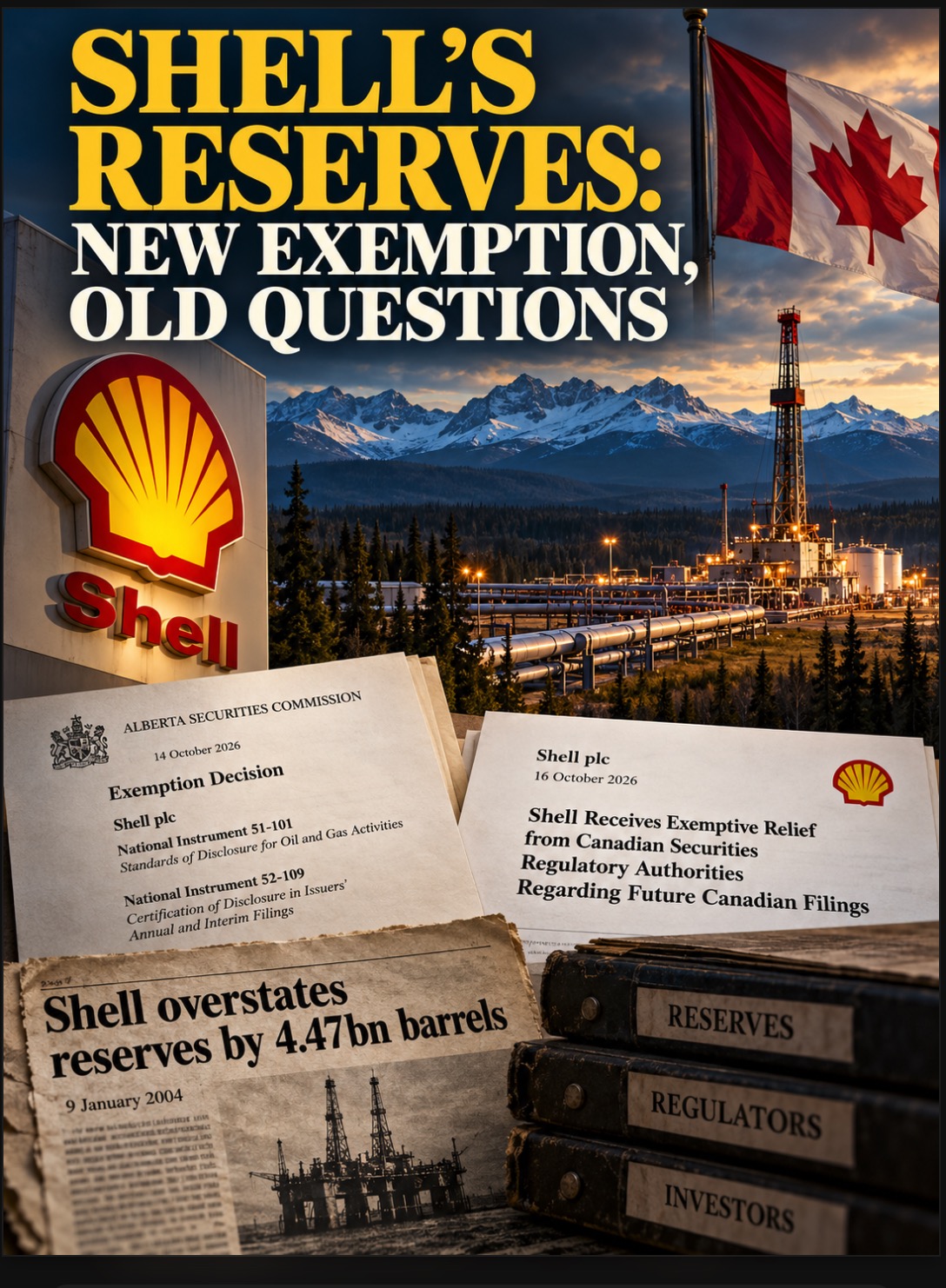
The Shell reserves scandal burst into the public domain in January 2004. Links to a selection of news reports are provided below. Sir Philip and van de Vijver were forced to resign.

They did not suffer financially. Shell directors are Teflon protected by contracts which stipulate that they are bailed out by Shell shareholder funds even if they cheat shareholders by engaging in outright lies, deception and cover-up, as happened in the reserves scandal. The disgraced Sir Philip Watts ended up with a package worth over $18 million (USD) to help cushion his sudden departure from the company.

RELATED ARTICLES

Royal Dutch/Shell Another Enron? Assessing the seriousness of Shell’s crisis The Economist 11 March 2004

The fall of Sir Philip Watts: By retired Royal Dutch Shell Executive Paddy Briggs. Now an elected trustee of the Shell Contributory Pension Fund

Dutch Court Throws Lifeline for Non-US Class Action Lawsuits

The court was used once before in a similar case launched in 2007 against Royal Dutch Shell, when investors resolved their claims for €316 million with the oil giant.

Wednesday, January 25, 2012 7:22:02 AM

Pension, endowment funds, and other international shareholders have a new avenue of enquiry to seek damages of alleged corporate fraud thanks to a European court decision.

(January 25, 2012)  –  The first class action lawsuit settlement to be approved for shareholders based outside the United States, since the Supreme Court tightened rules about international investors seeking redress through its legal system in 2010, has thrown a lifeline to asset owners suspicious of corporate fraud.

A case brought by international pension schemes, endowments and other large investors against Swiss reinsurer Converium Holding (now Scor Holding (Switzerland)), was settled out of court with damages of over $58 million being approved for distribution by the Amsterdam Court of Appeal last week.

The court was used once before in a similar case launched in 2007 against Royal Dutch Shell, when investors resolved their claims for €316 million with the oil giant.

FULL ARTICLE

Contact the writer of this story:Elizabeth PfeutiEuropean Editor, aiCIO(44) 207 397 3816epfeuti@assetinternational.comFollow on Twitter at @ai_CIO

Spaced out at Royal Dutch Shell

”SPACE, VISION AND STRATEGY”: Sir Philip Watts, disgraced Shell Group Chairman who once donned a space suit at a meeting in Maastricht, Netherlands, in 1998 to pump up his troops. Subsequently a defendant in various US class action law suits arising from his role in reserves fraud ,which cost Shell shareholders almost $1 billion in lawsuits and fines. Sir Philip was rewarded with a reported $18 million pension pot/settlement for destroying Shell’s reputation.

Spaced out means to be confused or distracted…

REFLECTIONS OF A SHELL RETIREE

During the Mark Moody-Stuart tenure as Group Chairman of Royal Dutch Shell, someone had the brainwave of setting up “hydrocarbon value creation teams”.

The foundations for the reserves scandal were laid.

The company had got (with the explicit knowledge of the top brass) into the hands of people who were only motivated by personal rewards, and who smelled their chance. None of that ‘Enterprise First’ stuff. It was ‘Me first’ and all the snouts were in the trough and nobody wanted to take their snout out of the trough. Anyone complaining or making remarks that things were not right was publicly destroyed and removed. And those with their snouts in the trough started to make promises and ever more ridiculous demands. Explicit instructions to cook the books or ‘err on the high side’ were hardly given in written form or were at least well disguised. It was said and whispered in meetings, conferences and workshops and personal discussions during the annual staff evaluation time. There were clear instructions to aim for the impossible with those stretched targets and anyone who said he could go even further or higher was handsomely rewarded with promotions or fat bonuses. Brinded was a real champion of this, he was #2 and later MD in Shell Expro and I believe they missed their business targets for 7 years in a row under his reign!

If we go back to the heady days of Phil Watts, where he did some time-travelling to the future and returned in a horrendously expensive spacesuit to tell the large audience of the self proclaimed ‘Leaders’ of Shell that he had seen the future and liked it. Presumably we are in that future now. Since as a good born again Christian he would never lie, I can only assume he compared the current state of affairs with Hell. And this is indeed better than Hell (so he must be feeling more miserable by the day as he gets older and closer to the day of the final judgement….)!

When Watts first came to power (he actually stole that job at the time with his gorilla talk and behaviour) the pigs were truly feeding. Watts started his circus with new and bigger promises every year. And then it became unsustainable and the truth came out.

We have internet, everyone knows what has happened and why it happened. Inflated reserves, massive fines, massive bad publicity which brought about the end of Anglo Dutch Shell in the form in which it had flourished for 100 years.

SONG AND DANCE

They were all singing along with this attached song!!!! Nobody spoke up. The CMD danced the Macarena. People resigned because they saw Shell was going over the cliff. And still nobody woke up.

AUDIO LINK FOR THE SONG “WE ARE ALL WINNERS”:

The Lyrics

GROWING AND WINNING (WE ARE THE WORLD)
THERE CAME A TIME
WHEN WE  HEED A CERTAIN CALL
FOR CHANGE , WE NEED TO BOND TOGETHER AS ONE

NOW WE’RE ON A JOURNEY
TO STREAMLINE THE WAY WE WORK
AND BUILD A GLOBAL ENTERPRISE

WE HAVE MOVED ON, GROWING DAY BY DAY
SHARING STRENGTHS, WE PRACTICE WHAT IS BEST
WE ARE ALL A PART OF
SHELL’S GLOBAL FAMILY

DOING WORK ALIGNED WITH EVERYONE
(Chorus)
WE ARE THE BEST
WE ARE ALL WINNERS
WE ARE THE ONE’S WHO HAVE MADE THE CHANGE
WE’VE GROWN THE BUSINESS
WE ARE SHELL’S TOMORROW
B2B, WE’RE ONE GREAT TEAM
WITH OUR
SPACE, VISION AND STRATEGY
WE WILL SUCCEED

WE’LL WORK WITH OUR PEERS
CAUSE THEY’RE PART OF OUR TEAM
HAND IN HAND WE’LL BUILD THE VISION WE PLANNED

OUR HIGHEST GOAL IS TO BE THE CUSTOMER’S BEST CHOICE
FOR THE TEAM, WE MUST LEND A HELPING HAND
Repeat Chorus

WHEN TRIALS ABOUND
OUR MISSION SEEMS IMPOSSIBLE
BUT IF YOU JUST BELIEVE
THERE’S NO WAY WE WILL FALL

WELL, WELL, WELL, LET’S REALIZE
THESE TRIALS WE’LL OVERCOME
WHEN WE…..STAND TOGETHER AS ONE
Repeat Chorus

SONG THANKFULLY ENDS

Original article from which the above extracts are taken

MEMORIES OF MARK “MACARENA” MOODY-STUART

Shell puts extra €90m into Irish subsidiary

The Irish Times – Monday, January 23, 2012

GORDON DEEGAN

OIL AND GAS multinational Shell has injected €90 million into its Irish subsidiary to deal with the spiralling costs of the Corrib gas field project.

Documents filed with the Companies’ Registration Office show that the global group has pumped the extra money into Shell Ireland.

The Irish company confirmed yesterday that the 5km onshore gas pipeline to bring gas from the offshore Corrib field to the market will not be complete until the second half of 2014.

The Corrib gas partners, Shell, Statoil and Canadian-owned Vermillion are now nine years behind the initial target to start generating revenues from the field.

The original estimate for developing the field was €800 million and the final bill for completing the project is now expected to be almost €3 billion.

The documents confirming the cash injection show that the Shell EP Ireland’s Ltd’s capital is now more than €704 million.

A spokeswoman for Shell said yesterday: “The €90 million is to support our ongoing activities on Corrib.”

The partners had hoped that gas would be brought ashore last year – however, this was before An Bord Pleanála ruled that half of the proposed overground pipeline would be unsafe.

This meant that the developers had to apply for permission to place it in a tunnel.

Shell, Statoil and Vermillion are expected to spend a further €378 million on the development this year.

They spent €250 million on the project last year. The total spend for the project at December last was an estimated €2.35 billion.

The 2012 spend estimate arises from Vermillion confirming that it is to spend €70 million on developing the field this year. It owns 18.5 per cent of the field.

Vermillion’s 2012 Capital Programme confirms this and also states that it will cost $135 million to complete the purchase of its stake from the original owner, US group, Marathon Oil.

In a written Dáil response last week on the progress of the field, Minister for Energy Pat Rabbitte, said it is estimated that construction on the onshore section of the pipeline will take in the region of three years. He said: “First gas cannot, therefore, reasonably be anticipated before 2014.”

A spokeswoman for Shell said yesterday: “Work on the onshore pipeline, the final phase of the project to be constructed, is progressing well.

“Preparatory work at the tunnelling site is still under way and tunnelling under Sruwaddacon Bay is expected to start in the second half of 2012. Completion of the tunnel and the laying of the onshore pipeline is estimated to take at least two years to complete.”

About 400 people are working on the project, 350 of whom are based in Mayo.

Shell has 45 per cent of the field and Statoil has 36.5 per cent.

The field has one trillion cubic feet of gas and is expected to meet 75 per cent of Ireland’s peak winter gas needs for up to a decade.

It is now 10 years since the Government approved the Corrib gas project plan.

However, since then, the proposal has become mired in controversy, including the jailing of the “Rossport Five” in 2005 and a number of confrontations between the Garda and protesters at the site of the Bellanaboy terminal in north Mayo.

Separate judicial review proceedings on the onshore pipeline consents were settled in the High Court last year.

SOURCE ARTICLE

Heart of darkness at Royal Dutch Shell

The “Rossport Five” were jailed at the specific request of the company, which had obtained compulsory purchase orders for the land in question – the first time in Irish history that such an order was granted to a private company. The five will remain in jail until they undertake not to obstruct the company. (SHELL)

The company stinks worldwide…

By John Donovan

This article focuses on an informative parliamentary debate about the Corrib Gas controversy held in the Houses of the Oireachtas, the national parliament of Ireland, on 6 October 2005. It does not appear to have been reported in any detail at the time.

Some very forthright comments were expressed about Shell.

The debate was held after the release from prison of the Rossport Five, activist landowners jailed at the specific behest of Shell. The activists held legitimate concerns on behalf of their families about health, safety, and environmental implications of the Shell led Corrib Gas Project.

Extracts from a related Guardian article: Shell meets its match in the Rossport Five

Suddenly, the issue became one of the biggest news stories of the year and, as the Irish Examiner called it, “a major public relations disaster for the Shell corporation”. The “Rossport Five” were jailed at the specific request of the company, which had obtained compulsory purchase orders for the land in question – the first time in Irish history that such an order was granted to a private company. The five will remain in jail until they undertake not to obstruct the company.

“Shell officials misjudged the situation if they thought to intimidate others by making an example of these men,” the Irish Times said. Indeed, July has seen huge rallies in support of the men in Co Mayo and in Dublin, the picketing of Shell garages nationwide, and round-the-clock blockades of the refinery construction site.

Some of the exchanges in the parliamentary debate were even more damaging to Shell and proved to be prophetic in mentioning Shell’s use of security forces against protestors in Nigeria. No doubt wondering whether such intimidatory tactics by the multinational might be imported into Ireland.

The following extracts are from the official record:

Brief extracts from opening statement by Minister of State at the Department of Communications, Marine and Natural Resources (Mr. Gallagher) Information on Pat the Cope Gallagher Zoom on Pat the Cope Gallagher

It was a source of great regret to me that five Rossport men were committed to prison as a result of their opposition to the proposed pipeline.

The safety review of the on-shore, up-stream gas pipeline is now under way. It will be thorough and comprehensive and will be carried out by independent, internationally recognised experts.

Mr. Finucane: Information on Michael Finucane Zoom on Michael Finucane

I welcome the Minister of State’s statement which outlines the latest developments in regard to the Corrib onshore pipeline. Although it is quite a distance from Rossport, a public meeting on the issue was recently held in Newcastle West in County Limerick. The families of the Rossport men were represented and Dr. Mark Garavan, spokesman for the Shell to Sea campaign, spoke at length. It was an informative session and indicated how this issue has resonated with the public in that it seems a manifestation of the small man taking on a major multinational. Speakers at the meeting drew our attention to the unfavourable publicity for Shell some years ago in regard to its activities in the Ogoni region of Nigeria. It is ironic that the same company is involved in this controversy in which five people were imprisoned as a result of their stance on the proposed onshore pipeline. The action they took was a consequence of their genuine concerns.

Mr. Kenneally: Information on Brendan Kenneally Zoom on Brendan Kenneally

I welcome the Minister of State to the House and the opportunity to speak on this issue. When we look back on the imprisonment on those who have become known as the Rossport five we will view the matter with regret. It should not be necessary for five citizens of the State to go to prison for 94 days to vindicate what they perceive to be their rights. Regardless of the sequence of events and the legal niceties responsible for their three month stay in an Irish prison, it should not have happened here in this enlightened third millennium.

We can talk about principles and principled stands all day and discuss the relative claims for the safety of the installation and the power of multinational companies but who would favour a gas pipeline pumping unknown quantities of explosive material at unknown explosive pressure not much more than 100 yards from people’s homes? This was not just a blind protest on the part of disgruntled residents. Their arguments were logical. I cannot confirm that they were correct but they did raise reasonable doubts about safety and the appropriateness of the industry being there at all, such as the inadequacy of the soil through which the pipeline will run and several other arguments worth investigating.

I have evidence of a quantified risk assessment carried out on Shell’s behalf in Australia approximately five years ago in which there was a fundamental flaw in the design which was missed in the quantified risk assessment. Had the Government authorities in Australia not spotted the fundamental flaw an offshore rig would have been constructed and had an entirely predictable and [264]likely event happened hundreds of people could have been killed. A quantified risk assessment is done on the data supplied by the client, in this case by Shell, and it is not independent. If there is to be a safety review, it is desperately important that the first brief of the company must be to know whether this is inherently safe or whether there are margins of uncertainty because it is a unique project.

Mr. Norris: Information on David P.B. Norris Zoom on David P.B. Norris

I listened to Senator Mansergh’s contribution with great interest and in response to his last comment I would say that Shell really needs to revise its entire ethos and modus operandi. The company stinks worldwide, but we were not sufficiently aware of this fact and we have let them away with potential murder in this country. If, as Senator Mansergh also said, international business will look at what is happening here, then let them look. Let them see that Irish people and the Government have standards. It seems extraordinary that five decent, respectable people in the community were sent to jail at the instigation of Shell Oil. These men did not have to go to jail but they were pushed into that position by the company. It also seems extraordinary that they were jailed while trying to defend their own homes, welfare and possibly even their lives, which should be a constitutional imperative.

Should we feel secure because Shell is involved? I do not think so. If we look at the company’s track record internationally, we can see it is good at spin. It bought into things like National Geographic and it sponsors environmental programmes on television, while simultaneously destroying the environment in places such as Nigeria. Its modus operandi although subtly changed from Nigeria is in essence precisely the same and reveals a complete contempt for local people as long as it can get the Government on its side and its PR merchants in with the spin.

Let us consider the record in Nigeria. Shell Oil was complicit in the fact that the Nigerian Government hanged nine environmentalists for protesting peacefully in 1995. The tribunal that convicted the men was a joint effort between Shell and the Nigerian Government. These people protested because of the enormous amounts of oil spillage in their territory against which they were totally unprotected. Between 1976 and 1991 some 2,976 oil spills occurred in the Niger delta. A World Bank investigation found that the levels of hydrocarbon pollution in Ogoniland were more than 60 times the US limits. This was confirmed in 1997 by a Project Underground survey which found petroleum hydrocarbons in one Ogoni village’s water source at 360 times the limit set for the European Community. This is the respect for the environment that Shell Oil has in Nigeria.

Let us consider how Shell copes with this situation. In Nigeria as in Ireland there is a rebellious local population. Shell uses the local existing institutions to hand. In Ireland there is a complacent Government and requirements are placed on judges to make certain decisions. I do not criticise the Judiciary in that it is working with what it has. Shell contributes to the military funding in the areas where it needs to suppress the people. Shell has admitted that it has paid directly for visits to two villages in Ogoniland. These visits were as a result of a peaceful demonstration by the local inhabitants. It has also admitted purchasing weapons for the local police force which guards its facilities. Many people believe that Shell’s [268]involvement in the military aspect is much greater.

Bearing in mind that the police are partly funded by Shell Oil, a classified memorandum from a police leader in this area described his plans for “psychological tactics of displacement-wasting”. This is what Shell is doing in the west of Ireland; it is displacing the people. The memorandum further stated: “Shell operations are still impossible unless ruthless military operations are undertaken.” It is prepared to be ruthless militarily and it is prepared to be ruthless in its involvement in the courts. Let us consider what it did in the trial of Ken Saro-Wiwa. We now know that two significant witnesses in that case were suborned by Shell with offers of money and employment in the Shell group.

I am not just some left-wing crank talking about this matter. The United Nations Special Rapporteur’s report on Nigeria published in 1998 accused both Nigeria and Shell of abusing human rights and failing to protect the environment. It condemned Shell for a “well armed security force which is intermittently employed against protestors”. This is what we are dealing with. This is the heart of darkness.

Mr. Kitt:

We should listen again to what people are saying. I hope that Shell will explain some of the issues which it is not explaining. Senator Norris made an important point regarding Shell’s involvement in Nigeria. In 1985 I was a member of the Joint Committee on Foreign Affairs. We intended to visit Nigeria with a Trócaire delegation to visit the Ogoni region, but the Nigerian Government prevented us from going there, or even into Nigeria, because of our wish to go to the Ogoni region. There was no support from Shell, which I found very disappointing. While one cannot blame Shell for all the problems in the Ogoni region, the company has a case to answer with regard to environmental matters. That is one of the reasons the people in Rossport were so concerned that the pipe was coming through their area, very close to houses. They were worried about health, safety and environmental issues and knew that Shell did not have a very good track record in those areas.

RELATED ARTICLES

Corrib – Ireland’s Last Offshore Development for a Generation

SHELL TO SEA SUPPORTER BECOMES PRESIDENT OF IRELAND

‘The Pipe’ Norwegian premiere

Gardaí investigate alleged death threats to Corrib whistleblowers

Confirmation Corrib first gas date delayed until 2014

By John Donovan

The Irish Minister for Communications, Energy and Natural Resources, Deputy Pat Rabbitte, has stated in response to a parliamentary question asking when product from the Corrib gas fields will be available to the consumer, that it is not possible to state a start date.

He went on to say that the construction of the onshore section of the pipeline, including the construction of a 5 km tunnel, will take about three years and “first gas cannot therefore reasonably be anticipated before 2014.”

Extrapolating from a calculation in an article published by The Irish Examiner, the Shell led Corrib gas project, plagued by controversy, including the jailing of the “Rossport Five“, is now some 9 years behind the initial target date to start generating revenues from the field.

Royal Dutch Shell seems to have under-estimated the opposition.

Bjorn Edlund and Royal Dutch Shell

By John Donovan

Late yesterday evening, I sent an email to Mr Michiel Brandjes, Company Secretary and General Counsel Corporate, Royal Dutch Shell Plc and to the CEO of the company, Mr Peter Voser.

The email invited comment and correction in relation to a draft article focused on Bjorn Edlund (above right), who in February 2010 retired as Executive Vice President and Head of Group Communications at Royal Dutch Shell plc.

The draft article headline and content was critical in nature.

Under the circumstances, I also sent an email to Mr Edlund with the same invitation. He provided an initial response taking up the invitation and has now provided a substantive reply from his consultancy Bjorn Edlund Consulting.

It is fair to point out that many people connected with Shell would have some trepidation about replying at all, knowing that we are widely regarded as a long-term thorn in the side of Shell, having issued several high court actions against the company since 1994. The most recent proceedings, instituted by Shell, were in 2005. The acrimony has continued for nearly two decades.

Mr Edlund did not ignore my email, or engage in any prevarication, nor did he duck the issues. All tactics used previously by some of his former colleagues.

Instead, he provided a detailed polite response, with precise information, no threats, and no conditions attached.

His reply struck me as being honest, transparent and helpful. Consequently, I have no problem in accepting that some of the information in our draft was inaccurate. That article will not be published.

Mr Edlund provided a text book example of how to convert a potential critic into an admirer.

This PR guru is worth his weight in gold.