Royal Dutch Shell plc .com Rotating Header Image

Posts under ‘Alfred Donovan’

Corrib gas consultants apologise for omitting data on pipeline route

The Irish Times – Wednesday, July 28, 2010

LORNA SIGGINS Western Correspondent

CORRIB GAS project consultants have apologised for omitting material submitted to An Bord Pleanála as part of its new pipeline route application.

RPS Consultants have written to a number of appellants explaining that some data was omitted from the environmental impact statement.

An Bord Pleanála told The Irish Times yesterday that it was contacted by the consultants, and it believed at this stage it should not delay the resumed oral hearing, set for August 24th, into the last section of pipeline.

The consultants state that the “inadvertent administrative oversight” is “deeply regretted” and has been rectified. The material refers to habitat sheets, designated sites, bird figures and fauna figures. Some of it was in the documents, but misplaced, while the fauna figures were omitted altogether, according to RPS.

The material, which has been reissued, supports Shell E&P Ireland’s revised application to tunnel its last section of pipeline under Sruwaddacon estuary, a special area of conservation.

This last section will link the landfall at Glengad to Ballinaboy terminal.

The developers say it is 234m away from the nearest occupied house – almost three times the distance of the original route.

Shell has also applied to An Bord Pleanála for compulsory acquisition orders to 10 pieces of land at Glengad/Dooncarton, Aughoose and Bellagelly South, under section 40 of the Gas Act.

Pobal Chill Chomáin community group spokesman John Monaghan said he was “disappointed” this issue only came to light shortly before the final deadline for submissions to the board on the new application. Submissions must be with the board by today.

“This may be a genuine error, but the developers are always telling us that errors cannot happen,” Mr Monaghan said.

Up to half of a previous “modified” pipeline route was deemed by the board to be unacceptable on safety grounds, due to proximity to housing.

In a separate development, the Corrib gas partners, including Shell EP Ireland, have said responsibility for the Corrib gas field wells “has been clarified”.

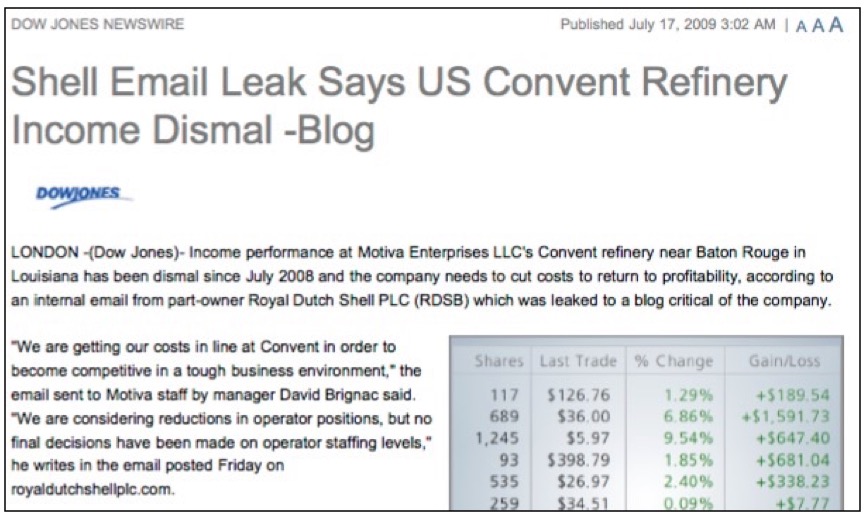
It was commenting on e-mails leaked to the royaldutchshellplc.com website run by father and son Alfred and John Donovan, which indicate Shell staff concerns about there being “no clear ownership” of the Corrib wells.

Responsibility for subsea structures is a serious issue after the BP oil spill in the Gulf of Mexico. The Corrib gas partners said the technical integrity of five Corrib well fields had been “regularly monitored and assured”.

SOURCE ARTICLE

Shell refuses to comment on Oklahoma oil royalties fraud

“As you surmise, we will not be commenting.  As always, you cannot take our silence to mean that we agree with any of your conclusions.”: Richard Wiseman, Chief Ethics & Compliance Officer, Royal Dutch Shell Plc 29 April 2010

NANCY FULLER HEBBLE AND OTHERS vs SHELL OIL CO.

On 13 April 2010, Shell filed an “APPELLANTS’ MOTION TO SUSPEND EFFECTIVENESS OF MANDATE“. It relates to the 18 December, 2009 decision by the Oklahoma Court of Civil Appeals affirming a judgment on a jury verdict in the Hebble v Shell royalties fraud case.

The jury awarded the Plaintiffs/Appellees $750,708 in principal, $12,455,208 in pre-judgment interest, and $53,625,000 in punitive damages.

The mandate is the instrument used by the Oklahoma Supreme Court to signal that they are finished with the case.  Shell asked the Oklahoma Supreme Court to suspend the effectiveness of the mandate so that the plaintiffs would not collect on the judgment pending a ruling by the United States Supreme Court.

Shell states they are appealing constitutional issues.  The only US Constitutional issue is whether the award of punitive damages violates Shell’s 14th Amendment due process rights.

The US Supreme Court will not review the judgment for fraud and breach of fiduciary duty, as Shell has exhausted their appeals on those issues.

The behavior of relevant Shell Oil Co. executives and lawyers could hardly have been more unethical. It is not just the misdeeds of those responsible for the fraud and deceit perpetrated against ordinary American families, but also the incredible decision to defend the misdeeds in long drawn out litigation through the courts, adding to the impact on the families in terms of stress and uncertainty. These are families, which the jury found, had been deliberately deceived and cheated by Shell.

The conclusion reached by the Appeal Court judges is damning:

“In the present case, the reprehensibility of Shell’s conduct is heightened by its intentional deceit of the interest owners whose oil proceeds it held for their benefit…”

Since such conduct is in blatant breach of Shell core business principles, pledging honesty, integrity and transparency in all of Shell’s dealings, it seems proper to ask what action is being taken by Shell against (1) those responsible for perpetrating the fraud and deceit and (2) those who authorised and implemented the litigation trying to defend the indefensible?

As can be seen from recent high level email correspondence with Shell printed below in its entirety, Shell has not been prepared to comment.

EMAIL TO RICHARD WISEMAN 27 APRIL 2010

From: Alfred Donovan <alfred@shellnews.net>
Date: 27 April 2010 23:59:25 BST
To: richard.wiseman@shell.com
Cc: michiel.brandjes@shell.com
Subject: NANCY FULLER HEBBLE AND OTHERS vs SHELL OIL CO.

Dear Mr Wiseman

When you contacted me on 26 February, you were kind enough to enquire about my health. I know from the Shell internal documents supplied to us in response to a Data Protection Act application that Shell maintains a touching interest in my antiquity.

Consequently, I know you will be delighted that I have now reached the grand age of 93 thanks to the NHS and in particular, my local GP, Dr Tirunelveli L Ashok Kumar and his wonderful staff at the Highwoods Surgery.

I have printed below, the draft of an article we plan to publish which is a follow-up on the recent posting: “Oklahoma Appeals Court Rules Shell Guilty of Royalties Fraud“.

Please feel free to point out any error in what we state as fact. In particular, I draw your attention to the paragraph which says: “The US Supreme Court will not review the judgment for fraud and breach  of fiduciary duty, as Shell has exhausted their appeals on those issues.”

Please also feel free to supply any comment for publication on an unedited basis.

There is no panic for a reply, but please be kind enough to say if you do not intend to comment, in which case there would be no point in delaying publication.

Best Regards

Alfred Donovan

DRAFT ARTICLE

Headline: Shell appeal to U.S. Supreme Court on issues arising from oil royalties fraud verdict

NANCY FULLER HEBBLE AND OTHERS vs SHELL OIL CO.

On 13 April 2010, Shell filed an “APPELLANTS’ MOTION TO SUSPEND EFFECTIVENESS OF MANDATE” relating to the 18 December, 2009 decision by the Oklahoma Court of Civil Appeals affirming a judgment on a jury verdict in the Hebble v Shell royalties fraud case.

The jury awarded the Plaintiffs/Appellees $750,708 in principal, $12,455,208 in pre-judgment interest, and $53,625,000 in punitive damages.

The mandate is the instrument used by the Oklahoma Supreme Court to signal that they are finished with the case.  Shell asked the Oklahoma Supreme Court to suspend the effectiveness of the mandate so that the plaintiffs would not collect on the judgment pending the ruling by the United States Supreme Court.

Shell states they are appealing constitutional issues.  The only US Constitutional issue is whether the award of punitive damages violates Shell’s 14th Amendment due process rights.

The US Supreme Court will not review the judgment for fraud and breach of fiduciary duty, as Shell has exhausted their appeals on those issues.

DRAFT ENDS

FOLLOW-UP  EMAIL TO RICHARD WISEMAN: 29 APRIL 2010

From: Alfred Donovan <alfred@shellnews.net>
Date: 29 April 2010 11:18:21 BST
To: richard.wiseman@shell.com
Cc: michiel.brandjes@shell.com
Subject: NANCY FULLER HEBBLE AND OTHERS vs SHELL OIL CO.

Dear Mr Wiseman

Perhaps you are checking the facts with U.S. colleagues before responding to my email of 27 April?

The implications arising from the Appeal Courts decision must be of immense concern to you as Chief Ethics & Compliance Officer of Royal Dutch Shell?

The behavior of relevant Shell Oil Co. executives and lawyers could hardly have been more unethical. It is not just the misdeeds of those responsible for the fraud and deceit perpetrated against ordinary American families, but also the incredible decision to defend the misdeeds in long drawn out litigation through the courts, adding to the impact on the families in terms of stress and uncertainty.

The conclusion reached by the Appeal Court judges is damning:

“In the present case, the reprehensibility of Shell’s conduct is heightened by its intentional deceit of the interest owners whose oil proceeds it held for their benefit…”

Since such conduct is in blatant breach of Shell core business principles, pledging honesty, integrity and transparency in all of Shell’s dealings, what action is being taken against (1) those responsible for perpetrating the fraud and deceit and (2) those who authorised and implemented the litigation trying to defend the indefensible?

If I hear nothing from you by 3pm UK time tomorrow, I will assume Shell has decided it best under the circumstances, not to comment on the debacle.

I will also assume that Shell does not challenge our statement of fact that the US Supreme Court will not review the judgment for fraud and breach of fiduciary duty, as Shell has exhausted the appeals process on these issues.

Best Regards
Alfred Donovan

REPLY FROM RICHARD WISEMAN 29 APRIL 2010

From: richard.wiseman@shell.com
Date: 29 April 2010 11:21:39 BST
To: alfred@shellnews.net
Cc: michiel.brandjes@shell.com
Subject: RE: NANCY FULLER HEBBLE AND OTHERS vs SHELL OIL CO.

Dear Mr Donovan

As you surmise, we will not be commenting.  As always, you cannot take our silence to mean that we agree with any of your conclusions.

Best Wishes
Richard Wiseman

Chief Ethics and Compliance Officer
Royal Dutch Shell plc
Shell Centre, London SE1 7NA

Registered in England and Wales number 4366849
Registered Office:  Shell Centre, London, SE1
Headquarters: Carel van Bylandtlaan 30, 2596 HR
The Hague, The Netherlands

Email: richard.wiseman@shell.com
Internet: http://www.shell.com

Communique: Shell remains persona non grata in Ogoniland

On March 27th, 2010, Shell Oil Company apologized to the Ogonis and Niger Delta people for four decades of environmental racism and devastation. The apology was tendered by Bradford Houpe, (Vice President, Ethical Affairs Committee.),

Click to continue reading “Communique: Shell remains persona non grata in Ogoniland”

Royal Dutch Shell Wikipedia Machinations

Shell is obsessed with our online activities, not only in relation to our website, but also my role as a Wikipedian originating and editing articles relating to Shell.

I have noticed a suspicious correlation between Shell’s internal fretting about how to edit my Wikipedia contributions without being caught and editing undertaken during the same time period by Shell partisan contributors hiding behind pseudonyms

Article by John Donovan

As prominent critics of Royal Dutch Shell, it is invaluable for us to know what the company is saying, thinking and plotting about us.

The inside information comes mainly from Shell itself, which is obliged under the UK Data Protection Act to supply us on request with Shell documents and communications in which our names are mentioned.

As a result, despite redaction of some information by Shell lawyers, we have a wealth of evidence, confirming that contrary to the impression it would like to project, Shell is obsessed with our online activities, not only in relation to our website, but also my role as a Wikipedian originating and editing articles relating to Shell.

I have noticed a suspicious correlation between Shell’s internal fretting about how to edit my Wikipedia contributions without being caught and editing undertaken during the same time period by Shell partisan contributors hiding behind pseudonyms. If I had known then what I know now from Shell internal documents and emails, I would have been even more suspicious.

I am the main contributor to the Wikipedia articles: “Controversies surrounding Royal Dutch Shell”; “Royal Dutch Shell safety concerns” and “Royal Dutch Shell environmental issues” and author of a substantial part of a recent book covering these important subjects.

In October 2007 I wrote an article drawing attention to personal attacks made against me by Wikipedia contributors operating under fictitious names. Unlike those using pseudonyms to conceal identity and background (as allowed under Wikipedia rules), I have always contributed using my real name and openly declared my Shell critic background from the outset.

Basically, I was accused of using Wikipedia to campaign against Shell. It was alleged that my contributions were all biased against Shell. The most hostile allegations against me came from people hiding behind pseudonyms. As can be seen from the discussion page content for the relevant Wikipedia articles, I made my suspicions known at the time about the bona fides of the relevant persons. Two of the most belligerent,  disappeared from Wikipedia after I drew attention to their activities, no doubt switching to new pseudonyms.

When I post information and comments about Shell on our own website, I do so on an outspoken basis deliberately designed to provoke debate. When I edit Wikipedia, I operate in accordance with Wikipedia requirements i.e. impartial information supported by reputable, independent verifiable sources.

I have on a number of occasions challenged anyone to produce any evidence of bias. I do so again now. No one has ever been able to cite any examples despite my extensive contributions. Much of what I have added to Wikipedia relating to Shell has subsequently been amended by people hiding behind pseudonyms.

On 23 November 2006, I published my email correspondence with David Bowen, a “website effectiveness consultant” and regular guest columnist for the Financial Times and FT.com. The exchange was partly about “Tell Shell”, the Shell run blog facility. Mr Bowen had referred to it in an FT article – “Online greenery” – as being an “uncensored forum”. The correspondence stemmed from a complaint I made to the FT on the basis that despite giving a plug to Shell in his article, Bowen had failed to disclose that Shell was one of his clients.

David Bowen implied in his response that credit should be given to Shell for not trying to “edit back critical pieces” added to the Wikipedia articles. He also pointed out that although Tell Shell had been suspended, critical postings remained accessible on a Shell online archive.

I advised him that contrary to Shell’s boast of it being an uncensored forum for open and lively debate, Shell had in fact censored postings on Tell Shell. We also now know that Shell employees operating from Shell premises also secretly edited the relevant Wikipedia articles. Furthermore, the critical postings on Tell Shell are no longer available online.

I also brought to his attention the fact that I had posted positive information about Shell on Wikipedia. I was the author of the sections about Shell LiveWIRE, The Whistleblower Helpline and The Shell Foundation. I added these positive aspects to provide a balanced view. No one else had bothered to do so.

As a result of the information now received from Shell under the Data Protection Act, I have been able to compare Shell’s internal unfounded comments in relation to my Wikipedia postings, with  the personal attacks made against me on Wikipedia under cover of fictitious names during the same period. The allegations are identical in nature.

We have provided links below to the extensive Shell internal correspondence and documents where the subject came up. Shell was trying to figure out how it could edit my contributions to the articles without being caught. Concern was expressed about this prospective outcome.

It is obvious from the internal email dated 1 March 2007, the importance attached by Shell to the Wikipedia articles. The point is correctly made in the email that the Wikipedia articles “come up on the first page of Google search.”

Shell stated in the same email that the articles were managed mainly by xxxxxxxx (ex-Shell) and John Donovan (anti-Shell).” The “xxxx’s” denote the third party name deleted by Shell. The missing name was almost certainly either retired Shell Executive Paddy Briggs, a contributor to Wikipedia, or Andrew Cates, a former Royal Dutch Shell Chief Executive. Paddy like me, always made contributions under his own name. Andrew Cates used the pseudonym “BosMo”. He had a senior editor function and is now a Wikipedia administrator.

After “BosMo” unsuccessfully nominated the royaldutchshellplc.com Wikipedia article for deletion, I received an anonymous tip off revealing the identity of “BosMo” and his connection with Shell of which I was not then aware.  My related article from October 2007 should be read in conjunction with this article, particular my comments about Andrew Cates.

Mr Cates pointed out in June 2009: “BTW yesterday I found a blog item you had written in 2007. It was rather kind to me but wrong in implying I only revealed my identity as Andrew Cates after someone from inside the company had told you who I was in 2006. Please see: [3] My first contribution here at WP was to say that BozMo was Andrew Cates and it was within 5 days of leaving Shell 1 April 2004. The same edit gave my new employers website and my homepage. I always had my real name here. I had used BozMo anonymously in other contexts (anonymous cartoons on company noticeboards for example) going back a decade before that, but I have never been anonymous at WP.”

Contrary to the repeated assertions by Shell in the internal correspondence and documents accessible below, my father, Alfred Donovan, has never added or edited any Wikipedia articles.

Ironically, the only Wikipedia article originated by me that has been successfully nominated for deletion was one focusing solely on positive aspects of Shell. Please see my email to Royal Dutch Shell Company Secretary Michiel Brandjes dated 6 March 2009 attached to a Shell internal email. The article “Royal Dutch Shell initiatives was deleted on 28 April 2009 on the basis that it was too one sided in favor of Shell.

LINKS TO SHELL INTERNAL EMAILS & DOCS IN WHICH ROYAL DUTCH SHELL WIKIPEDIA ARTICLES ARE MENTIONED IN RELATION TO THE DONOVANS

1 March 2007
2 March 2007 16:13 & 18.56 Plus 3 March 18:01
2 March 2007 16:51
19 March 2007 18.43 20 March 2007 8:10
23 March 2007
6 June 2007 12:51
SUNDAY 29 July 2007 11:31 & 30 July 2007 8:19 AM
30 July 2007 22:38 & 7 August 2007 14.24
31 August 2007 16:17
12 October 2007 15:21 & 15:58
16 October 2007
26 December 2007
19 February 2008 4 Pages
4 April 2008
9 March 2009
8 April 2009
8 July 2009
18 December 2009 11.34:
18 December 2009 12.07
Shell Focal Point document “Donovan Campaign Against Shell”

Donovan Campaign Against Shell

By John Donovan

Visitors may be interested in extensive comments made just weeks ago by Shell about this website and the “Donovans”.

We assume it was prepared by Shell in-house lawyers for the misinformation of Shell senior management, as it is full of spin, distortion and outright fiction.

More evidence that Shell is so twisted internally that it is incapable of admitting the unpalatable truth, even to itself.  The culture of deceit, self-delusion, cover-up and over-promise and under-delivery, which led to the reserves fraud, continues to this day.

Shell was compelled to supply the confidential document to us in accordance with our most recent application under the Data Protection Act.  The “xxxx’s” denote where Shell has censored/deleted names of third parties.

SHELL INTERNAL CONFIDENTIAL DOCUMENT DATED 21 JANUARY 2010

Confidential                                                                                  Focal Point: xxxxxxxxxxxxxx

Donovan Campaign Against Shell

CONTEXT
Alfred Donovan and his son John, long-time critics of Shell because of a dispute over a marketing promotion in the UK
many years ago, run a website http://royaldutchshellplc.com critical of the Shell Group. They also are a main driver of a
Wikipedia site ‘Controversies surrounding Royal Dutch Shell’. In the past they have promoted allegations from eg Shell
xxxxxxxxxxxxx over North sea safety and from xxxxx over alleged nuclear activity at a former Shell terminal at Earley outside Reading in the UK, and a number of Shell Malaysia related issues. An article about them in the 19 July 2009 Sunday Times was headlined ‘Two men and a website mount vendetta against an oil giant’. Recent posts on their “Shell Blog” have discussed Transition 2009 and some of the Shell people involved. John Donovan has recently been publishing material received following a second Subject Access Request to Shell under the UK Data Protection Act for personal information relating to him, and has been distributing leaflets outside Shell Centre.

KEY MESSAGES
• We are familiar with the activities of Messrs Alfred and John Donovan, who are longstanding critics of Shell. We are disappointed that they continue to seek to use any recent Shell developments to try and draw attention to their longstanding but unjustified grievances.
• Our general policy is not to comment on specific issues raised by the Donovans. Although we disagree fundamentally with the factual basis and interpretation of much of the information on which they base their various allegations, our past attempts to have a constructive debate have been unproductive.

SUPPORTING FACTS
• Shell took pains to ensure that Mr Donovan’s claims were fully investigated and settled many years ago.
Notwithstanding the impression he likes to give, he failed in the only case of his against Shell that went to court. It is therefore disappointing that the Donovans continue their long-running and acrimonious campaign against Shell on a wide range of subjects.
• Our position, as conveyed to the RDSplc website, is: “The lack of a rebuttal from, or comment by, Shell does not in any way constitute an acceptance on Shell’s part of the accuracy of any of the points made by you whether now or in the future, and whether on this or on any other matter, and we continue to reserve our position accordingly in respect of those matters.”

BRIDGING
If asked whether the Sunday Times’ statement, that “When a new [Shell] executive took over marketing, he used several of their [the Donovans’ schemes but refused to pay for them”, is true:
• Absolutely not. Shell took pains to ensure that Mr Donovan’s claims – about a marketing promotion in the UK many years ago – were fully investigated and properly dealt with. The fact is that Mr Donovan failed in the only case of his against Shell that went to court. The Judge not only completely exonerated the character of the Shell executive in question, but also was highly critical of Mr Donovan’s actions throughout the process of litigation.
If asked about the alleged nuclear reactor at Earley:
• We have given a categorical written assurance that Shell has never been involved In “atomic’ or ‘nuclear” research at Earley or elsewhere in the UK, and that no nuclear bunker is buried under the former Shell terminal. According to the European Commission, the data show radioactivity levels substantially below those considered harmful to human health. Any radioactivity found on the site has nothing to do with Shell’s activities.
Did you avoid disclosing certain information in response to the Donovans’ Data Protection Act requests?
• We complied fully with the Data Protection Act request while making legitimate use of the ability under the Act to withhold information in certain limited circumstances, for example where It is legally privileged or to protect the identities of third parties. We did the same for the previous request.
Why do you not sue the Donovans for libel?
• The experience of corporate defamation plaintiffs is that, even when successful, such cases draw far more attention to the untrue allegations that they would receive without the case having been brought. However, we do not exclude this as a possibility.
Why do you not edit the Wikipedia site ‘Controversies surrounding Royal Dutch Shell?

• Other companies have been strongly criticised for editing entries about themselves, and doing so would only serve to draw attention to the site. We prefer to focus on making our own Shell sites as good as possible.

21 January 2010

ENDS

ORIGINAL DOCUMENT SUPPLIED BY SHELL

SOME COMMENTS IN RESPONSE (ALREADY KNOWN TO PEOPLE WHO REGULARLY VISIT THIS WEBSITE)

ALLEGED RADIOACTIVE CONTAMINATION AT FORMER SHELL TERMINAL IN EARLEY, NEAR READING:

See our recent article

THE LITIGATION:

We had to issue High Court proceedings against Shell six times: The litigation was long and drawn out over many years, exactly as Shell lawyers had threatened. Shell says that our claims were “fully investigated”. It does not say that the “investigations” included undercover activity involving a fake company, fake credentials and fake documents, nor that we and our witnesses were subjected to intimidation and by coincidence or otherwise, illegal conduct, including a series of burglaries in which Shell related documents were tampered with. Shell failed to disclose to the police its then extremely close association with Hakluyt & Company Ltd a private spy firm. Titled Shell directors were the ultimate spymasters and major shareholders in Hakluyt. Shell was a client and Hakluyt carried out undercover investigations/missions against perceived enemies of Shell. Recent Shell documents show that “invisible” investigations/operations are still being directed at us, by now on a global basis, targeting over 100,000 Shell employees. All six High Court actions and a County Court case were settled in our favour by Shell. All of our legal costs were paid by Shell. This includes the last claim.

The only claim which went to Court: Shell issued a so-called “joint statement” announcing a “stalemate” outcome saying that I had abandoned the claim and Shell had withdrawn allegations against me. I made NO compromise settlement proposals to Shell during the trial. Shell made TWO to me. I rejected the first and accepted the second. Shell paid my entire legal costs. As confirmed in writing by Richard Wiseman, Shell’s Chief Ethics and Compliance Officer, the full terms of the settlement were not disclosed to the trial Judge, Mr Justice Laddie.  I also received a secret payment, which was not disclosed to Laddie. Thus he was kept in the dark about the true terms of settlement. Since the trial was settled out of court, there was no verdict. Laddie did make unfounded comments, which further confirmed his blatant bias in favour of Shell. He allowed the Shell legal team in Court, which included Wiseman, to get away with engaging in deception and attempted entrapment. He displayed not the slightest interest in the aforementioned Shell undercover activity and intimidation, which had completely undermined any prospect of a fair trial: Hence my reluctant acceptance of Shell’s second attempt to settle the case.

The Shell executive whose misdeeds led to all seven court actions, was on the make, as it plain from the evidence, including his diaries. Shell made its second settlement offer while the thoroughly dishonest Shell executive in question was in the midst of his cross-examination. The case was settled before he was asked about his offshore bank account and his setting up of his own business inside Shell, with a recorded ambition to retire from Shell at the age of 35.

Complaint lodged with the Lord Chancellor: After we subsequently wrote to the then UK Lord Chancellor, Lord Falconer, making a 14 page formal complaint against the Judge, Laddie resigned – the first High Court Judge to do so in decades. Laddie had failed to disclose a connection with the Moody-Stuart family despite being aware that Sir Mark Moody-Stuart was the then Group Chairman of the Royal Dutch Shell Group and that he and his wife, Lady Judy Moody-Stuart, had become personally involved in the litigation. We later wrote to the Judge raising the matter, but he refused to comment. He had also failed to disclose that his life long friend and unofficial spokesperson, Tony Willoughby, had founded an IP consultancy, which had Shell as a client. After his resignation in controversial circumstances, the Judge took up a consultancy position at the same firm. He was also involved in a commercial venture involving Richard Wiseman. Tragically, the Judge is now deceased.

Shell asked itself in the briefing document: “Why do you not sue the Donovans for libel?
• The experience of corporate defamation plaintiffs is that, even when successful, such cases draw far more attention to the untrue allegations that they would receive without the case having been brought. However, we do not exclude this as a possibility.

This is another deception. Shell has already excluded the possibility. Extract from Shell internal email dated 19 June 2009:

Hi Xxxx – Indeed I have been following this (you might also add xxxxxxxxxxx as one of the site’s favourite targets). ?????????????????????????????????????????????

??????????????? My previous advice to xxxxxxxx has been to ignore it – any Shell reaction would merely encourage Donovan to think we take this seriously and would likely stimulate more comment on/interest in the site. Also, eg we have long decided not to take legal action against the site (although Donovan would probably welcome this) – eg they often refer to xxxxxxxxxxx as xxxxxxxxxxxxx

£200,000 Legal Aid for Yorkshire Ripper: Zero for war veteran Alfred Donovan sued by Shell

By Alfred Donovan

Appeal: Peter Sutcliffe, shown here after an attack in prison, has launched a High Court bid to be released.

EXTRACT FROM A DAILY MAIL ARTICLE PUBLISHED 2 MARCH 2010:

The Yorkshire Ripper is using taxpayers’ money in an attempt to win his freedom.

Peter Sutcliffe, who murdered 13 women and tried to kill seven more, claims doctors believe he is ‘on the way to being cured’ and no longer poses a risk to the public.

Now 63, he has received legal aid to fund a team of leading barristers in his High Court battle to be released from the secure Broadmoor Hospital. This is likely to run up a bill of £200,000.

In June 1999, at the age 82, I was a defendant in the High Court action brought against me by Shell for alleged breach of contract.  I had no legal representation. I had already sold my home to pay my lawyers.  After my funds evaporated completely, I applied for Legal Aid which was granted, then mysteriously withdrawn without explanation. My son’s Legal Aid was also revoked. He discovered that this was due to a letter Shell (Mr Richard Wiseman?) had sent to the Legal Aid Board making an allegation which was without foundation. I assume that Shell also sent a similar letter to the Legal Aid Board about me.

John and I both appealed against the revocation decisions. In my case, a member of the Legal Aid appeal panel said that as far as he could see, I had “nothing to lose”.

My own war record in fighting the Japanese in Burma, the fact that three of my brothers had also fought for Britain (Jack, a paratrooper broke his ankle landing during Operation Market Garden at Arnhem), was of no account. My mother drove a London ambulance during the Blitz. After the war I worked in the civil service for 14 years, started my own business, employed many people over the years and had always lived a blemish free life. Again, this all counted for nothing. Basically, my background, dignity, reputation, health and financial independence, were all of no account.

After receiving notifications that our appeals had been rejected, we each filed for Judicial Review armed with evidence that the allegation made by Shell was completely false, but the trial date arrived before either of us could get a hearing.

I was left in the unbelievable position at the age of 82, with a war disability, of having to personally defend myself in the High Court before a Judge and an array of high-powered barristers and solicitors acting for Shell.

John gave a legal charge on his house to his lawyers, or otherwise he too would have had no legal representation in court. Having no legal aid weakened his position and piled on more pressure. We had already endured a deluge of threats by Shell plus uncover activity directed against us.

Hence we were at a great disadvantage and reluctantly accepted the second compromise settlement offer put by Shell.

What a screwed up Country when a horrific serial killer is granted Legal Aid, while a then 82 year old 2nd World War veteran was left abandoned with no Legal Aid and NO legal representation.

Shell is well aware of what happened. A Shell internal email dated 11 May 2006 raised the question:-

“Mr. Donovan alleges that Shell had (his) legal aid cut off (during the SMART case). Is this the case?”

No answer was provided.

Constructive email correspondence between Shell and the Donovan’s

As you know, the Data Protection Act treats you and John as separate individuals, with each of you having separate rights under the Act. However, as you will appreciate, given your and John’s working relationship and our understanding that you both jointly operate the RoyalDutchShell plc website, it is often difficult to separate out data that relates purely to one or other of you.

Click to continue reading “Constructive email correspondence between Shell and the Donovan’s”

Shell IBM collaboration doomed to fail

Posting on Shell Blog on Feb 27th, 2010 at 10:19 am by “guest1″, a regular contributor.

What a load of nonsense in the Forbes article. Shell and IBM to team up etc. We HAD all the expertise but that was removed by the HR and FN idiots that run Shell now. What does IBM know about oil and gasfields? This surely looks like another project, doomed to fail, whereby IBM is going to suck a lot of money out of Shell. Presumably Brinded bought a lot of stock in IBM. RDS appears more and more like an overweight blob, unable to move, being sucked out by the service industry and governments and waiting to die. The sooner someone takes over RDS, splits it up and gets on with the business, the better. The fact they accept all the abuse by the Donovans and are unable and unwilling to defend themselves speaks volumes. If RDS cannot even handle two old codgers with a website, how will they handle real competition????

John and Alfred, perhaps you have to increase the pressure and speed up the demise of RDS.

Posting on Shell Blog Sat, 15:20 by “Outsider” – another valued regular contributor:

Agree completely with Guest1. IBM once bought (and subsequently sold at a huge loss) a company called Tigress, and had plans for integrated Corporate Data Bases based on POSC. Unfortunately Schlumberger and Landmark know that part of the business rather better than IBM ever will. If Shell can’t find oil with the help of Schlumberger and Landmark, what hope do they have with IBM?

Posting on Shell Blog Sat 2010/02/27 at 9:41pm by “Shellwaarbenjijnu” – a third highly valued regular contributor

Oh dear, regarding this collaboration between Shell & IBM – it does not appear to have started off very well if I read the press announcement. I refer to the following: “Shell can reduce the educated guesswork and extract natural resources with more certainty and efficiency, thereby optimizing the recovery of oil and gas”. Shell used to employ geoscience & petroleum engineering expertise. Is reserve estimation and production forecasting now in the hands of “educated guess workers”? That ought to really worry shareholders.

The fundamental lack of understanding of the business gets even better with comments on geophysics: “For example, geophysicists must examine time-lapse seismic data from subsurface rock formations; reservoir engineers receive well and laboratory data, and geophysicists receive information – sound waves – covering wide spaces between the wells”. Errr – what’s the difference between the two geophysical activities quoted? Is this some IBM person speaking who has just bought a book “E&P for beginners”, or is it the level of understanding within Shell now much of the real technical experience and expertise has been cleared out?

Posting on Shell Blog Sat 2010/02/27 at 10:32pm by “LongTermShareholder”

W.E. Pratt knew it already a hundred years ago when he said “Oil is found in the minds of men” But he was one of the founders of the Standard Oil company, whereas the people who try to make us believe that IBM can come to the rescue of Shell appear to be only good at getting rid of their most experienced minds.

Blog costs Shell US$15 Billion

Article by Glen Frost, Editor, The PR Report

Yes, 15 billion. This is the claim of John Donovan, a UK blogger who campaigns against  the global oil producing giant Shell (full name Royal Dutch Shell) using his blog www.royaldutchshellplc.com .

Arguably the most powerful blog in the world dedicated to covering one company; and intrigued as to how the site developed such influence, Glen Frost met with the blog’s founders, John and Alfred Donovan, to get the full story.

EXTRACTS

The blog is now so popular, and trusted, the site appears on the front page of major newspapers (see pictures), and has ex‐employees from Shell contributing regular articles

The Russian connection: the scoop that made the  Donovan’s blog famous

The Donovans had been collecting and publishing information online about Shell’s activities since 2001; this information dates back to the mid 1980’s and their former business relationship with Shell. Over the years, more and more people in the oil industry discovered the website, and the Donovan’ s have been swamped with information about Shell from both suppliers, contractors, insiders and former employees.

Some of this information concerned Shell’s activities in Russia from 1996. A Shell‐led consortium (called Sakhalin Energy) and the Russian Government entered into a production sharing agreement. It was information on alleged environmental abuses by the consortium from the Donovan’ s that killed the deal. John Donovan said he suspected his information was the trigger but didn’t know for sure until Oleg Mitvol, a senior figure in the Russian Government, stated so in a media interview.

Asked by a journalist from PetroleumArgus, a trade magazine, who his sources were for the environmental abuse charges that Mitvol laid against the Sakhalin Energy consortium, Mitvol, then deputy head of Russia’s environmental watchdog Rosprirodnadzor, said he had “email correspondence between executives in Sakhalin Energy management from 2002.”

The compromising material had come from Donovan, owner and blogger of the anti‐Shell website www.royaldutchshellplc.com, Mitvol said.

Donovan estimates the value lost to Shell is US$15 billion.

The Donovan’s website is a full frontal attack on Shell’s management and ethics. Shell has tried to shut the site down on the grounds that it uses the company name. However, the site www.royaldutchshellplc.com  makes no money, and, crucially, is registered in the USA, where laws on websites are weighted in favour of the domain owner.

“Our site receives up to 2.2 million hits a month; we want it to become a magnet for people who have a problem with the
company,” says Donovan.  “Many of the people using the site are Shell employees.

Blog publishes market sensitive information

Donovan publishes market sensitive information on the site, and he, and the website, are now quoted by esteemed news organisations like Reuters and The Financial Times. For example, Donovan  published information questioning the level of Shell’s reserves, in which the company was found to have inflated its oil and gas reserves by some 20% in 2003‐04, which led to negative media headlines.

The picture (right; The Daily mail, UK 8th Sept 2009) shows how Donovan’s blog published details of staff cuts before Shell had announced them to the markets and the media.

Because of the blog, and the Donovan’s insistence on publishing all information he can verify about Shell, good and bad, John Donovan’s influence with the media is now global, instant and at a senior level – John lists the names of all the UK, US and global media outlets, their Editors or senior correspondents covering corporate news or the oil sector as his contacts.

Shell’s external PR advisors

A post on the Donovan’s website links to an article in a recently published book on corporate reputation and the rise of blog sites that attack, or expose, poor corporate ethics and illegal or dubious corporate activity, and what CEOs should do about such sites; http://www.shellnews.net/images/CorporateReputationAED.pdf ‐ the book is written by Dr Leslie Gaines‐Ross, who, incidentally, was previously CMO of Burson‐Marsteller USA, who manage Shell’s public relations.

FULL ARTICLE (FREE SUBSCRIPTION)
Previous PR Report issues here: http://thepublicinterest.ning.com
PR Report Facebook page: http://tinyurl.com/ykg6p7j
PR Report YouTube channel: www.youtube.com/theprreport

EXTRACT FROM BOOK REFERRED TO ABOVE: “REPUTATION LOSS – 12 Steps to safeguarding and Recovering Reputation”

One such empowered activist is arch Shell critic Alfred Donovan. No one was more surprised than Royal Dutch Shell PLC to learn that this 88-year-old British army veteran had purchased the Internet domain name www.royaldutchshellplc.com. The gadfly Donovan was a well-known, though underestimated, critic of the company. By acquiring the domain name, Donovan obtained the perfect platform to voice his criticisms of the oil giant. Who would have thought a decade ago that such an unlikely individual could stand up to a corporate powerhouse, waging a war of words against one of the world’s largest companies?

Shell trickery over Data Protection Act compliance

By John Donovan

Shell and its lawyers have had advance sight of what you are about to read and therefore the opportunity to seek an injunction to prevent publication, but have not done so. Our most recent email to Shell on this matter is published at the foot of the article.

Royal Dutch Shell trickery over UK Data Protection Act (DPA)

As long term prominent critics of Shell management, my father (Alfred) and I have found some of the information supplied to us by Shell under the Data Protection Act law to be very revealing. Some would say astonishing.

For example, revelations about Shell:

Revelations will follow shortly about Shell’s behind the scenes machinations in relation to Wikipedia articles focused on Royal Dutch Shell.

In reaction to the damage done to Shell’s reputation from DPA information supplied to us in 2007, the oil giant has used every underhand trick imaginable to limit damage from new information supplied a few weeks ago. Some of the relevant evasive tactics adopted by Shell are covered in the correspondence links provided.

In order to locate/retrieve electronically stored information relating to us, Shell would logically run an automated search on our surname. This means that if Shell systematically used some formulation of code/abbreviation to identity us, instead of using our surname, such information would not be found.

On 23 August 2007, during correspondence regarding DPA issues relating to Shell internal emails and documents supplied to us at that time, I made the following request to David Sanger of Shell International Limited legal department:

“Please also supply any information which refers to either or both of us by any code name(s) now used by Shell.”

I raised this issue after receiving a tip off from a Shell insider that certain people at Shell were deliberately avoiding the use of our surname in documents and emails.

As can be seen in the detailed chain of events set out below, while the correspondence on this issue was still in progress, with denials on behalf of Shell that any such ploy was being used, Shell emails were sent in which the use of our surname was systematically and deliberately avoided.

This was achieved by the use of multiple abbreviations of our surname and the deliberate deletion of our surname from an extract of an article. By a lucky fluke, someone blundered by adding a separate file reference at the foot of the relevant stored emails (probably at a later date). The file reference, not the emails,  contained our surname. Otherwise we would know nothing about the existence of the relevant emails about us. This means that there may be a large volume of information produced on the same devious basis, which has not been disclosed to us by Shell.

Looking at what has recently been supplied, it would also explain a greatly reduced volume of salient Shell documents and emails after the time we received the tip off in 2007. Much of the latter information supplied seems to have been generated in the U.S. where Shell Oil lawyers and media folk had not been briefed on the ploy being used to avoid Shell complying with the DPA.

Although Shell might argue that the use of multiple abbreviations of our surname is not the same as using code names, this would be disingenuous. The basic tactic – the use of a form of identification signifying our surname, without actually using our surname, has the same result. As indicated, a search of electronically stored information using our surname would not retrieve documents prepared on that devious basis.

We believe that the relevant communications involve senior people at Shell. One of these individuals may have a self-serving motive in keeping secret a twisting of facts about our past history with Shell, evident in many Shell internal documents we have seen.

MORE DETAILED INFORMATION

When I raised the code names issue with Shell on 23 August 2007, I was surprised to receive a response from a law firm Simmons & Simmons suddenly retained by the company. While their response letter dated 5 September 2007 dealt with some DPA issues, it neglected to deal with the question of Shell’s use of code names.

Some related extracts from my email response to Simmons & Simmons dated 8 September 2007:

We will also inform the Commissioner that we have reason to believe Shell are using a codename strategy to try to evade its statutory duty of releasing more information; it is our understanding from the IC’s office that we are entitled to any information that refers to us or by which we can be identified, even if it is not by name. We further understand that it is an offence under that act to knowingly take steps to withhold information.

The codename issue is serious; we understand that if the Commissioner thinks your client has tried to evade the relevant provisions of the Act, he will write to Shell and require them to release all that information to the Information Commissioner and to us.

We raised the codename issue in our last communication to your client. Instead of an answer, we received your letter which completely ignores the question..

On 10 September 2007, my father sent an email to RDS Plc Company Secretary Michiel Brandjes, containing a draft of an email being sent to over 600 UK MP’s. The draft email contained the following passage:

Following a tip-off, we also asked if Shell has attempted to evade its DPA obligations by subsequently using codenames instead of our surnames: another serious matter if true.

An email from my father to Shell EP General Counsel Keith Ruddock contained the following comments relating to the use of code names:

Like Mr Sanger, Mr Allen and Mr Brandjes, you have chosen not to provide an answer to the codenames issue. Three lawyers have all ducked a simple question. That makes us more than suspicious.

Any of you could have simply stated

Your information about the use of codenames is incorrect. No codenames have been used in relation to you or your father.

but were self-evidently unable or unwilling to do so.

Under the circumstances I believe it is reasonable for us to conclude that the insider information on the subject of code names is correct.

Nonetheless, I will ask one last time for a straight-forward answer to a straight-forward question.

Has Shell ever substituted a codename(s) for the Donovan surname for either my son or I, or for both of us?

We are delaying the email to MP’s while we give Shell this last opportunity to answer this question.

We received a response letter from Simmons & Simmons dated 12 September 2007 from which the following salient extracts are taken:

You also intend to write to the Information Commissioner stating your belief that our client is employing code names in order to avoid its obligations under the Act. As stated in our letter of 05 September 2007, our client has complied fully and in good faith with its obligations under the Act. For the avoidance of doubt, we are instructed that our client has not used code names for the purposes you allege or at all in relation to you or Mr Alfred Donovan.

We confirm that our client has not relied on the exemption of self-incrimination in responding to your SAR. We request that you inform any third parties with whom you have communicated, or intend to communicate, on this issue of this fact and of those set out above in relation to code names and the identity of third persons.

On 13 September 2007 my father confirmed to Mr Ruddock that in the light of the letter from Simmons & Simmons, the reference to Shell using code names to avoid its obligations under the Data Protection Act would be removed from the email to MP’s and that the issue would not be raised with the Information Commissioner.

However, as a result of documents Shell supplied in response to my 2009 SAR application, it has become apparent that the denials by Shell were disingenuous.

Shell internal emails sent on 31 August 2007 just a few days after we first raised the matter, provide evidence that Shell lawyers were indeed deliberately following a strategy to avoid the use of our surname.  The code names were less than sophisticated, amounting to various abbreviations of our surname, but with the same objective. This was done systemically over twenty times in the relevant emails, including the use of “D’S”, “D’s”, “Alfred D”, “Ds”, “John D” and “Mr D”.

The clincher that it was a deliberate strategy to avoid DPA law was the removal of the Donovan name from an extract from an article quoted in the email sent at 15.13 on 31 August.

“A 90 year old war veteran, Alfred D——-, created a gripe website focused on Shell which, in an extraordinary alliance with the so-called “Kremlin attack dog” Oleg Mitvol, has cost the oil giant billions of dollars and as a by-product, changed the course of history.

We would never have known about these Shell emails except for the fact that some one blundered by adding a file reference code, probably at a later date, at the foot of the page:

« File: 2006 – 01 – Alfred Donovan.doc» «File: 2007 – 02 – Donovan Campaign Against Shell.doc »

Consequentially, there may well be a large volume of emails and documents on which the same strategy was used, on which a file reference was not added.

I note that a number of “Focal Point” documents produced by Shell contain an assurance to Shell management in relation to these matters, as as per the example dated 16 October 2007:

Did you avoid disclosing certain information to the Donovans in response to their Data Protection Act requests?

We complied fully with the Data Protection Act request while making legitimate use of the ability under the Act to withhold information in certain limited circumstances, for example where it is legally privileged or to protect the identities of third parties. We also informed the RDSplc website that we do not use codewords in internal documents relating to their activities.

The Shell internal emails on 31 August 2007 prove otherwise.

Under the circumstances, we have asked Shell to carry out a search using all of the multiple code/abbreviations which we now know for certain have been used instead of our surname.

EMAIL FROM JOHN DONOVAN TO SHELL 24 JANUARY 2010

From: John Donovan <john@shellnews.net>
Date: 24 January 2010 20:31:24 GMT
To: Gavin.white@shell.com
Cc: michiel.brandjes@shell.com, peter.p.voser@shell.com, robert.allen@simmons-simmons.com
Subject: Royal Dutch Shell trickery over UK Data Protection Act (DPA)

Dear Mr White

Printed below is a revised draft article we plan to publish on Tuesday morning, 26 January 2010.

The text will be amended in the light of any development before then.

If you wish to supply comment for unedited publication as part of the article, please let us have your comments by Tuesday am.

Please also let me know if you will be carrying out a search using the various Shell code/abbreviations used as a substitute for our surname, which has confirmed the tip off we received from a Shell insider.

If you need more time to consider this matter, you only have to say so.

If I receive nothing from you by Tuesday am, the article will be published and a formal complaint filed with The Information Commissioners Office covering this and all other DPA related issues previously raised with Shell.

Best Regards

John Donovan

NO RESPONSE THUS FAR FROM SHELL