Amnesty International
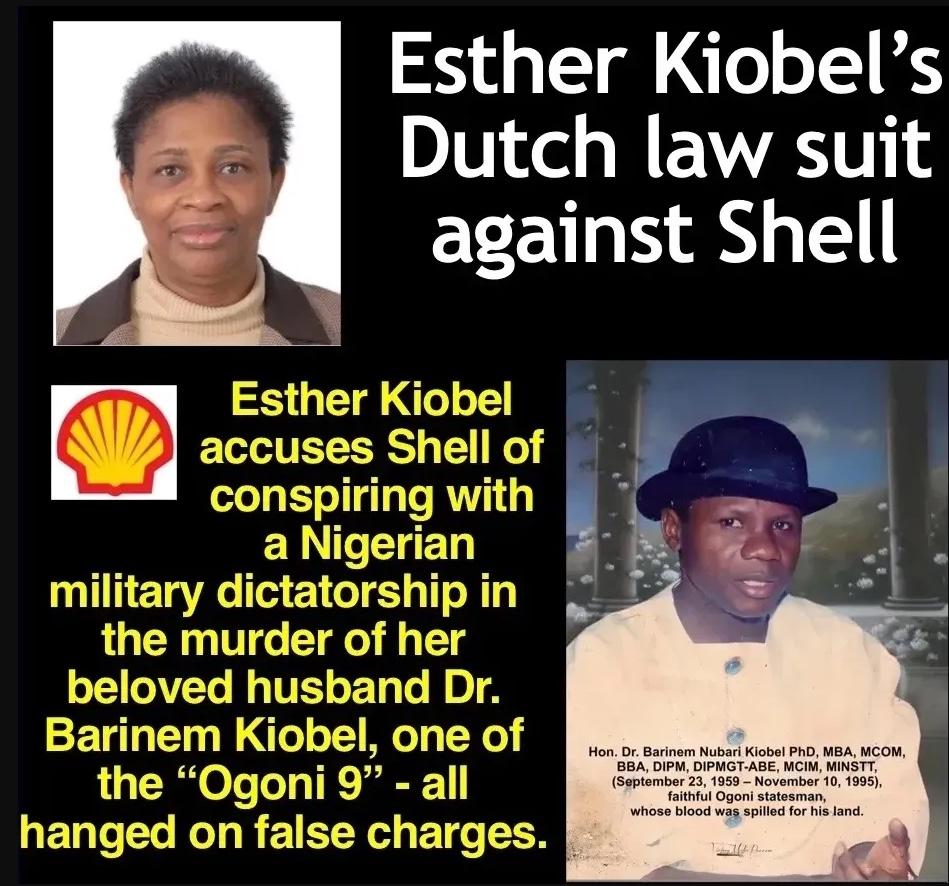
The Hague: Esther Kiobel vows to continue her campaign for justice
23 March 2022
News and information on Shell Plc

The Hague: Esther Kiobel vows to continue her campaign for justice
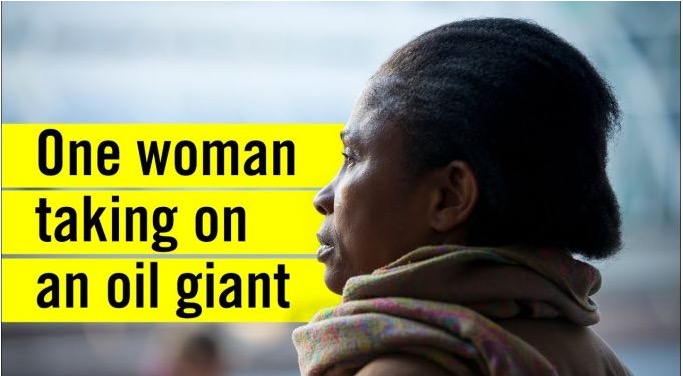
Human rights defender Esther Kiobel today lost her civil case against oil giant Shell, which she accuses of complicity in the 1995 execution of her husband by the Nigerian military government, but has promised to continue her campaign for justice. Esther has spent 27 years seeking justice for her husband Dr Barinem Kiobel, who was hanged along with eight other men in connection with widespread protests against oil pollution in the Niger Delta.

Image from Amnesty International UK
IMAGE SOURCE: Slick PR can’t disguise Shell’s devastating oil pollution in Nigeria
ARTICLE FROM THE NEW YORK TIMES
Oil companies like Chevron, Shell and Eni have made billions in profits in the vast Niger Delta region in the last decades. But now some are pulling out — and they are leaving utter ruin in their wake, according to government monitors and environmental and human rights organizations. The delicate ecosystem of the Niger Delta, once teeming with plant and animal life, is today one of the most polluted places on the planet.
![]()
Will Supermajors Finally Be Held Accountable For Oil Spills?

By Global Risk Insights – May 08, 2021, 12:00 PM CDT
A British Supreme Court ruling has brought to a head a 13-year-old battle to hold Royal Dutch Shell accountable for massive oil spills in the Niger Delta in 2008 and 2009. This creates a precedent for taking multinational corporations to trial in the home countries of their parent companies. This may mark the beginning of a more regulated global environment, in which subsidiary companies responsible for human rights abuses happening abroad could be held more accountable. Whether this will be an effective solution remains to be seen.
![]()
Shell in Germany seeks to speed up drive to go green

By Vera Eckert
FRANKFURT, Feb 26 (Reuters) – Royal Dutch Shell in Germany aims to produce aviation fuel and naphtha made from crops and renewable power and to increase to commercial scale an electrolysis plant that makes fossil-free hydrogen, as it seeks to move away from crude oil.
The energy major told an online conference on Friday it had applied for subsidies to carry out the work from the European Union and from German funds earmarked for decarbonisation.

Landmark court ruling could ‘end impunity’ for Shell and other multinationals
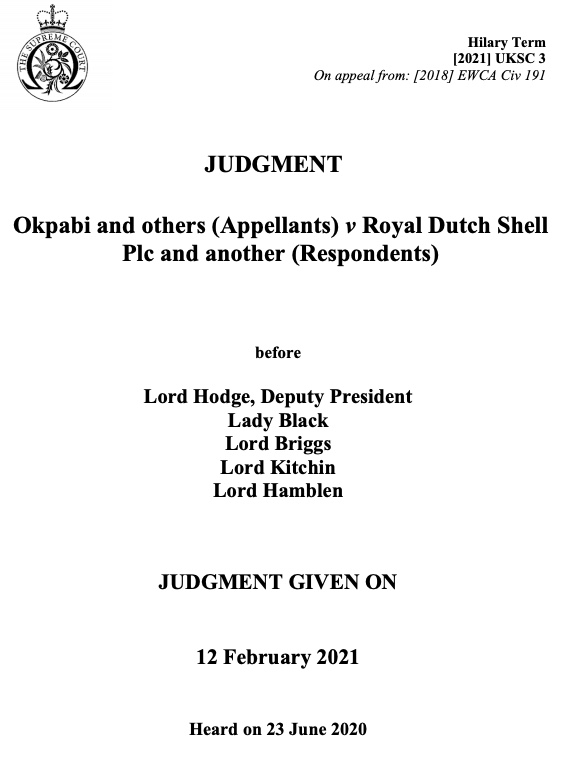

A major court defeat for oil and gas giant Shell could herald the end of “a long chapter of impunity” for multinationals implicated in human rights abuses overseas, lawyers and campaigners have said.
The UK Supreme Court ruled on Friday that the Ogale and Bille communities in the Niger Delta can bring legal claims for clean-up and compensation against Royal Dutch Shell plc (RDS) and its Nigerian subsidiary, the Shell Petroleum Development Company of Nigeria (SPDC).


Only 11% of contaminated sites have even seen clean-up operations begin
Thousands of Ogoni people still facing serious health risks, some unable to access safe drinking water
Supreme Court to hear case next week brought by affected Niger Delta communities
‘The discovery of oil in Ogoniland has brought huge suffering for its people’ – Osai Ojigho
Nearly ten years after the UN called for a major clean-up of areas of the Niger Delta polluted by the oil giant Shell and other oil companies, decontamination work has begun on only 11% of planned sites while vast areas remain heavily contaminated, according to a new investigation by four NGOs published today.


18 JUNE 2020
Nearly 10 years after a clean-up was urged for areas polluted by Shell and other oil companies in the Niger Delta, work has begun on only 11% of planned sites while vast areas remain heavily contaminated, according to a new investigation by four NGOs.
In 2011 the UN Environment Programme (UNEP) released a report documenting the devastating impact of the oil industry in Ogoniland, and set out urgent recommendations for clean-up. But the new investigation highlights that “emergency measures” proposed by UNEP have not been properly implemented and that the billion-dollar clean-up project launched by the Nigerian government in 2016 has been ineffective.


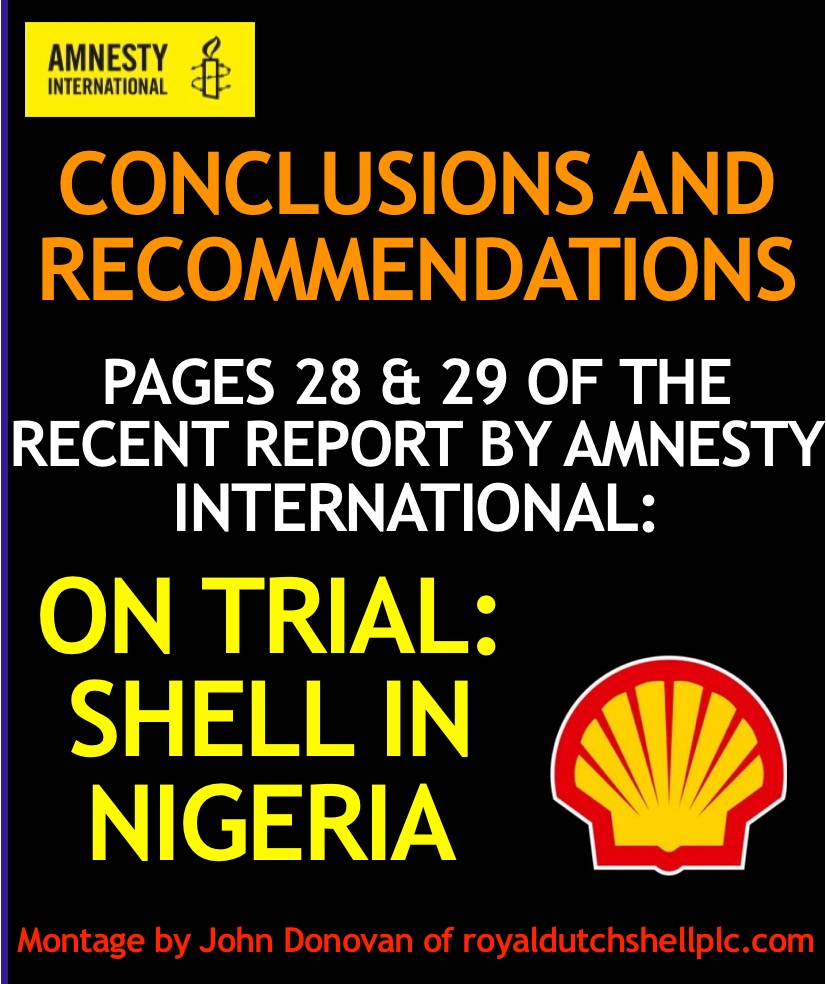
FROM PAGES 28 & 29
These cases are important for what they mean for the individuals and communities involved. They could also set important precedents on the responsibility of companies for their overseas operations, which would open the way for further litigation not only against Shell but other multinational corporations as well.
They are also placing a much-needed spotlight on Shell’s business model in Nigeria.
Nigeria’s regulation of the oil industry is undoubtedly weak and lacks independence. Government agencies responsible for industry regulation and enforcement are under-resourced, ineffective and in some cases compromised by conflicts of interest. Its own courts have failed to offer the victims of human rights abuses a meaningful avenue for seeking justice for the oil spills that have blighted the Niger Delta and the lives and livelihoods of its communities. Shell has thus avoided being held effectively to account in Nigeria.


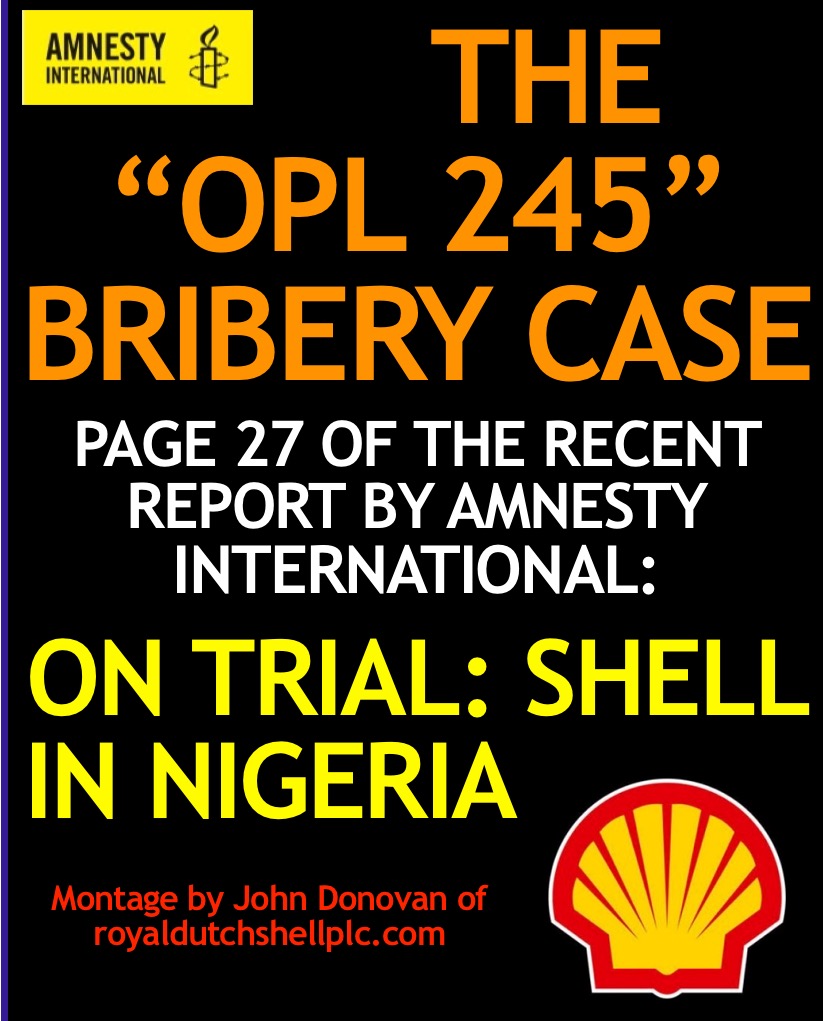
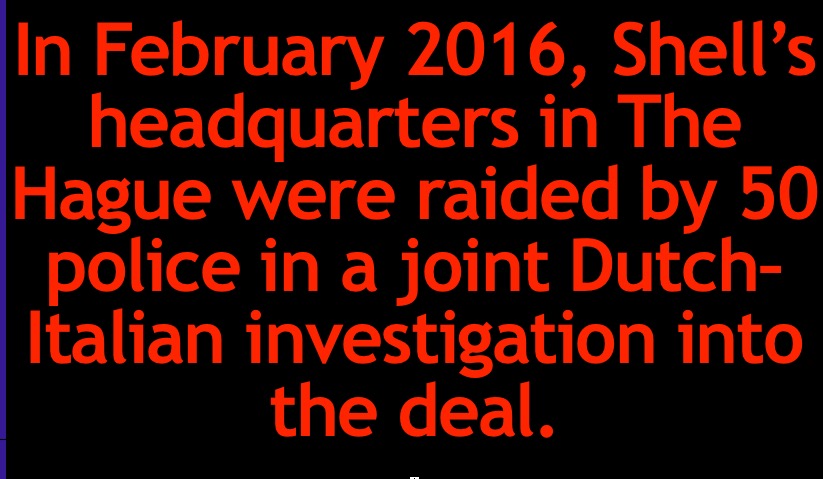
In 2018, Italian prosecutors brought a criminal case over the alleged involvement of Shell, and the Italian oil multinational Eni, in a 1.3 billion US dollar bribery scheme linked to the license of OPL 245. This is the name of one of Nigeria’s most valuable offshore oil blocks.
Thirteen individuals, including some current and former senior managers of Shell and the Italian oil company Eni, are currently on trial in Italy relating to how the two companies acquired the block in 2011.80 The defendants include both companies, a former Royal Dutch Shell Executive Board Member and two former MI6 agents who worked for Shell.81


The first of the pollution-related cases marked the first time that any Dutch company had been sued in the Dutch court for the operations of its subsidiaries overseas.
In 2008, four Nigerian farmers (Eric Barizaa Dooh, Fidelis Ayoro Oguru, Alali Efanga and Friday Alfred Akpan), along with Milieudefensie, the Dutch section of Friends of the Earth, filed claims against RDS and SPDC.44
They are seeking to obtain compensation for alleged damage to fish ponds and land caused by oil spills from two underground pipelines and an oil well operated by Shell in the villages of Goi, Ikot Ada Udo and Oruma between 2004 and 2007.45

Oil pollution in Kegbara-Dere (K-Dere) community in Ogoniland, Rivers State, Niger Delta, Nigeria. This community has experienced multiple oil spills since Shell started operations there in the 1960s. September 2015. © Michael Uwemedimo/cmapping.net
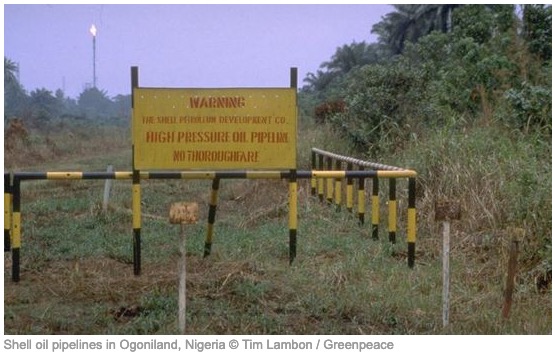
Shell’s pipelines in Ogoniland are old and poorly maintained. There have been several spills and in 2009 there was a huge fire, at the Bomu Manifold, at K. Dere, Rivers state. September 2015. © Michael Uwemedimo/cmapping.net
Dead periwinkles covered in oily mud from Bodo creek, Nigeria, May 2011. There were two massives spills in August 2009 from a poorly maintained Shell pipeline. © Amnesty International
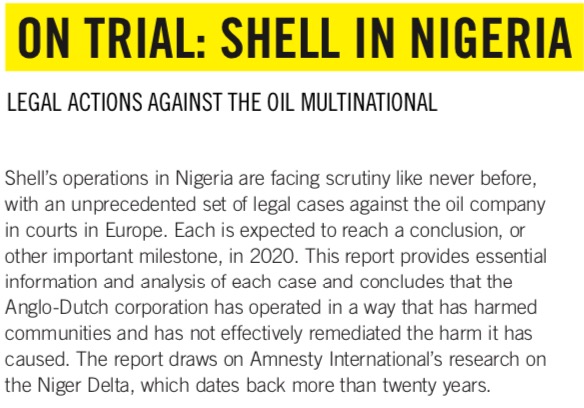
Signboard warning people not to enter stream that has been contaminated by oil spills, Ogale, Rivers State, Nigeria. Every year there are hundreds of spills in the Niger Delta, and clean-up is often slow and ineffective. © Amnesty InternationalThere are three separate legal proceedings taking place against Shell in Dutch and British courts relating to oil pollution. This has devastated the Niger Delta.
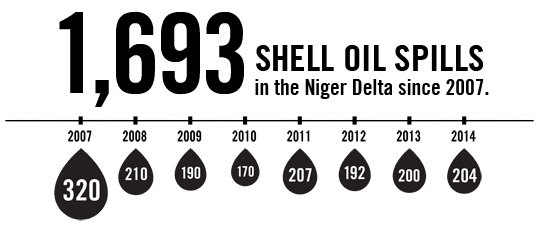
Data from Shell’s own spill incident reports reveal that from 2011-18 the company reported a huge number of spills – 1,010 – along the network of pipelines and wells that it operates.25 Spills have a variety of causes – from third-party tampering, to operational faults and corrosion of aged facilities. Shell blames most spills on theft and pipeline sabotage, and are not due to its own negligence.26