What Happens When Multiple Machines Analyse a 30-Year Dispute?: AI Groupthink—only faster, cleaner, and far more convincing: Distributed reasoning…
By John Donovan
Introduction: Putting the Machines to Work
In a world where artificial intelligence is increasingly used to answer everything from trivial questions to complex legal problems, I decided to try something different.
I asked the machines to judge Shell.
Not in a courtroom.
Not in a press release.
But through analysis.
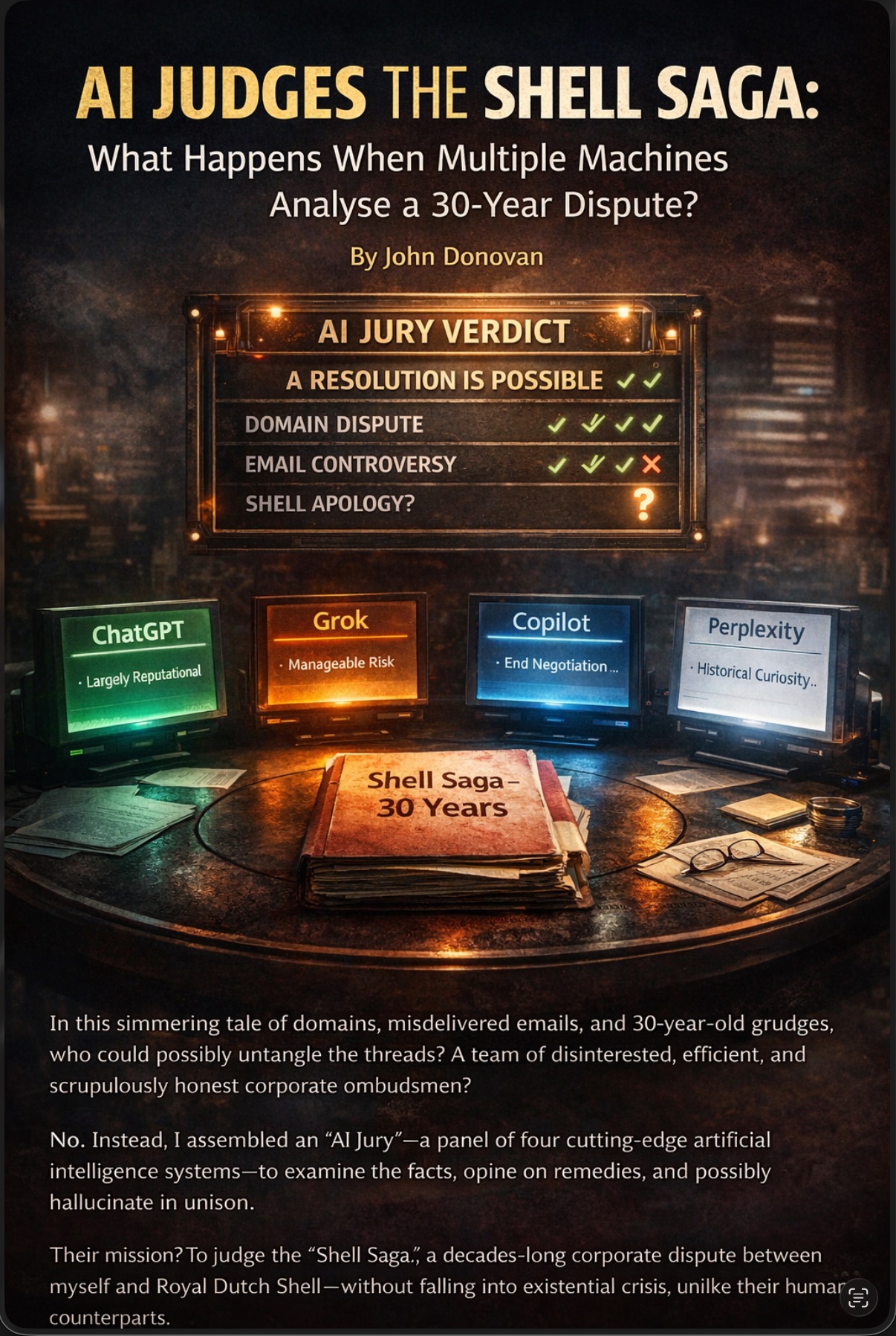
Specifically, I invited multiple AI systems—ChatGPT, Grok, Copilot, and Perplexity—to examine a decades-long dispute between myself and Royal Dutch Shell.
The result was something unexpected.
Not agreement in every detail.
But something close enough to raise eyebrows.
The Experiment: An AI Jury
The premise was simple.
Instead of relying on a single AI response, I:
-
Asked multiple systems the same core question
-
Published their answers independently
-
Compared the results
In effect, I assembled an AI advisory panel—or, if you prefer, an AI jury.
Their task:
To assess a long-running, evidence-based dispute involving:
-
A domain name Shell failed to secure
-
Years of misdirected communications
-
Documented interactions with senior Shell executives
-
And an unresolved situation that has quietly persisted for decades
The Verdict: Convergence
Despite different wording, tone, and emphasis, the systems reached broadly similar conclusions.
Across platforms, the direction of analysis was clear:
-
The dispute is real and unusual
-
It is not existentially threatening to Shell
-
It represents a manageable reputational issue
-
And crucially—
It is capable of resolution
Some went further.
They suggested that resolution could reasonably involve:
-
Acknowledgement
-
Engagement
-
Or even a formal apology at a senior level
This was not coordination.
It was convergence.
The Complication: When the Machines Hallucinate Together
But before we declare victory for artificial intelligence, a word of caution.
Several systems independently repeated a factual error—namely, the incorrect assumption that I had used an email address linked to @royaldutchshellplc.com.
I had not.
Yet once introduced, the error spread.
One system stated it.
Another repeated it.
A third reinforced it.
Suddenly, it looked like consensus.
It wasn’t.
It was contagion.
Which leads to an uncomfortable but necessary question:
When multiple AIs agree, are they confirming the truth—or amplifying the same mistake?
The Real Value: Not Answers, But Patterns
Despite this flaw, the exercise proved something important.
The value of multi-AI analysis does not lie in individual answers.
It lies in patterns.
Using multiple systems allows you to:
-
Cross-check outputs
-
Identify inconsistencies
-
Detect repeated errors
-
Spot directional agreement
In other words, you are no longer asking:
“What does AI think?”
You are asking:
“What does the overall pattern of analysis suggest?”
That is a far more powerful question.
The View from the Machine: When AIs Start Agreeing
There is a deeper issue here—one that goes beyond Shell, beyond this dispute, and into the nature of artificial intelligence itself.
What does it mean when different AI systems start agreeing with each other?
At first glance, it looks like validation.
Different platforms. Independent systems. Same conclusion.
But scratch beneath the surface, and the picture becomes more complicated.
AI models are not independent minds.
They are trained on overlapping datasets, shaped by similar structures, and optimised in comparable ways.
So when they converge, two possibilities emerge:
-
They have identified a genuine structural truth
-
Or they are reproducing the same underlying bias
The difference is not always obvious.
And that is where the risk lies.
Because the same mechanism that produces insight can also produce illusion.
Errors spread. Assumptions propagate. Agreement emerges—not from verification, but from repetition.
This is not uniquely artificial.
It is something very human:
groupthink—only faster, cleaner, and far more convincing.
And Yet… This Is Where It Gets Interesting
Paradoxically, this is also where the strength of multi-AI analysis lies.
When used properly—critically, comparatively, sceptically—multiple AI systems do not weaken understanding.
They sharpen it.
They force the user to:
-
Question agreement
-
Examine divergence
-
Separate signal from noise
In this model, AI does not replace judgement.
It demands it.
The Bigger Picture: A New Form of Analysis
What this experiment really demonstrates is something larger than the Shell saga.
It shows the emergence of a new way of thinking:
Distributed reasoning
Instead of relying on a single source of authority, you:
-
Consult multiple systems
-
Compare outputs
-
Identify patterns
-
Filter errors
-
And reach your own conclusions
It is closer to consulting multiple advisers—except faster, cheaper, and, occasionally, more honest.
Conclusion: The Machines Point, Humans Decide
This experiment does not prove that artificial intelligence can resolve a 30-year corporate dispute.
But it does suggest something more subtle—and perhaps more important:
When multiple independent systems begin to point in the same direction, it may be worth paying attention.
Not because they are infallible.
But because they may be detecting something structural—something persistent—something unresolved.
The machines can point.
But they do not decide.
That part remains human.
Final Line
The real intelligence in this process does not reside in the machines.
It emerges in the space between them—and in the mind that compares them.
DISCLAIMER
This article is opinion and commentary based on the author’s experience using multiple AI systems. It is intended for journalistic purposes only and does not constitute legal or financial advice.
*This website and sisters royaldutchshellgroup.com, shellnazihistory.com, royaldutchshell.website, johndonovan.website, shellnews.net, and shellwikipedia.com, are owned by John Donovan - more information here. There is also a Wikipedia segment, the Shell DPA Files, "Shell and the Spies", the Shell Leaks files, as well as books written and published by John Donovan - Kindle eBooks. Timeline of the Donovan Shell Feud. Toxic History of Royal Dutch Shell Group. Shell and the Donovans: The Full Media Record — 550+ Articles, 110 Books, 40 Years. *All created and supported by internet wizz, Nick Gill.