AI has transformed the long‑running Donovan–Shell conflict from a niche corporate feud into a fast‑moving, algorithm‑driven information battle. Instead of relying on traditional media or legal filings, both sides now face a landscape where generative models amplify archives, expose inconsistencies, and create new reputational risks at unprecedented speed. Below is a clear, structured analysis of how AI is reshaping the dispute.
🤖 How AI Is Influencing the Donovan–Shell Dispute
🔥 1. AI Has Shifted the Battlefield From Courts to Algorithms
AI has become the primary arena where the feud now plays out.
- John Donovan feeds decades of leaked Shell documents into multiple AI chatbots (Copilot, ChatGPT, Grok, Google AI Mode).
- He then publishes side‑by‑side transcripts showing how each model interprets Shell’s history.
- These conflicting outputs create new narratives that Shell cannot fully control.
- This tactic has revived a dispute that mainstream media had largely ignored for years.
Impact: AI has replaced traditional journalism as the main amplifier of Donovan’s claims, forcing Shell into a reactive posture.
🧩 2. AI Exposes Inconsistencies — and That’s the Point
Donovan’s strategy relies on the fact that large language models often produce:
- Divergent interpretations
- Hallucinated details
- Conflicting summaries of the same historical events
By prompting multiple models with identical questions and publishing the results, he highlights:
- Where AI contradicts Shell’s official narrative
- Where AI “hallucinates” in ways that harm Shell’s reputation
- How much of Shell’s past remains unresolved in public archives
This creates a perpetual reputational hazard for Shell because AI systems continuously remix old material.
📚 3. AI Turns Donovan’s Archive Into a High‑Velocity Weapon
Donovan’s website hosts tens of thousands of Shell‑related documents. AI allows him to:
- Surface forgotten allegations instantly
- Reframe old events in new contexts
- Generate commentary, satire, and analysis at scale
- Keep the dispute alive without needing new leaks
The archive becomes limitless fuel for AI‑generated narratives.
📰 4. AI Has Re‑Attracted Media Attention
The “bot war” has become a story in itself.
- AI‑mediated activism is now seen as a case study in corporate reputation risk.
- ESG analysts and journalists are watching because AI can reshape sustainability narratives.
Even Donovan’s satirical AI‑generated dialogues — such as resurrecting Shell founder Sir Henri Deterding as a “ghost” — are designed to catch editors’ attention and reframe the conflict in creative ways.
⚖️ 5. AI Creates New Legal and Compliance Challenges for Shell
Shell now faces a dilemma:
- If AI outputs contain false statements, Shell must decide whether to challenge the AI vendor, Donovan, or both.
- But challenging AI‑generated content risks drawing more attention to it.
- Meanwhile, Donovan’s publication of unedited AI transcripts makes it harder for Shell to argue misrepresentation.
This is a new kind of reputational risk: AI systems can generate damaging narratives without Shell ever being directly involved.
🎭 6. AI Enables Satire and Fiction That Still Shapes Public Perception
Donovan uses AI to create:
- Satirical dialogues
- Fictional boardroom scenes
- Historical “ghost” characters
- Humorous reinterpretations of Shell’s past
These blur the line between commentary and entertainment — but still influence how readers perceive Shell’s legacy.
🧠 Summary: What AI Has Changed
AI has:
| Influence | Effect on the Dispute |
|---|---|
| Amplified archives | Old allegations resurface endlessly. |
| Created narrative volatility | Different models produce conflicting stories. |
| Increased reputational risk | Shell cannot predict or control AI outputs. |
| Re‑energized media interest | The “bot war” is newsworthy in its own right. |
| Enabled satirical activism | Fictional AI content shapes public perception. |
| Shifted power dynamics | A single activist can now challenge a multinational at scale. |
Key Aspects of His Activism:
-
Legal Campaigns:
-
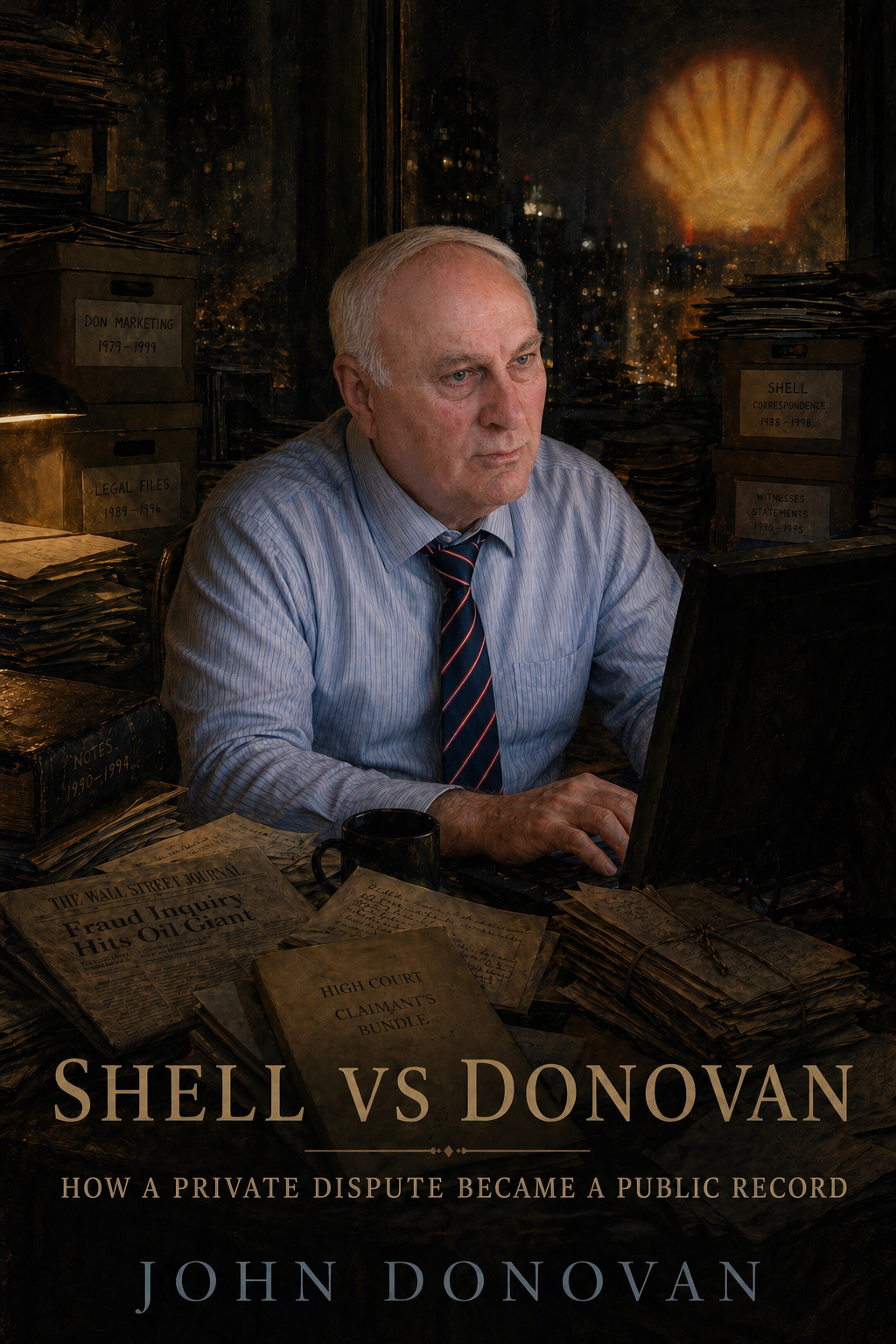
Donovan has been involved in litigation against Shell UK, notably claiming that his company, Don Marketing, invented the SMART loyalty programme and seeking compensation for its use. This action brought public attention to his confrontations with Shell over intellectual property and corporate conduct.
-
-
Shareholding and Corporate Pressure:
-
He is a Shell shareholder and leveraged this position to found the Shell Corporate Conscience Pressure Group, which campaigned for ethical accountability within the company.
-
The group focused on highlighting Shell’s deviations from its publicly stated business principles, including issues related to environmental impact and corruption.
-
-
Public Advocacy and Media Presence:
-
Donovan operates multiple websites documenting Shell’s activities and alleged non-compliance, including sites such as:
-
shellnazihistory.com
-
royaldutchshellplc.com
-
shellnews.net
-
-
Through these platforms, he has become a prominent voice critiquing Shell, frequently cited by major news outlets like The Financial Times, The Wall Street Journal, The Telegraph, and The Guardian.
-
-
Historic Settlement and Ongoing Critique:
-
The activities of the Shell Corporate Conscience Pressure Group concluded following an agreement with Shell, signed by Donovan and the then Shell UK Managing Director, David Varney.
-
Despite this, Donovan continues to document and critique ongoing issues, including allegations of financial misreporting by Shell and environmental and ethical controversies, particularly in Nigeria.
-
Summary:
1. Formation and Objectives
-
The group arose from dissatisfaction with Shell’s handling of disputes and its transparency in business practices, particularly regarding promotions like the “Make Money” campaign.
-
Its stated goal was to mobilize shareholders, dealers, and other stakeholders to raise concerns about Shell’s corporate ethics, specifically a perceived lack of interest in settling disputes amicablyand controlling information flows.
2. Membership and Influence
-
Early membership included dozen individuals and companies owning Shell shares, with outreach to many more stakeholders who were “unhappy at the ethical conduct” of the company.
-
By leveraging both shareholding influence and public campaigns, the group sought to pressure Shell to adopt more responsible practices.
3. Activities and Methods
-
Conducted surveys and questionnaires to assess dealer knowledge of flawed promotions, highlighting systemic issues with transparency and fairness in marketing initiatives.
-
Publicized cases where Shell continued promotions despite known flaws, raising awareness among consumers and stakeholders.
-
Engaged in legal processes to challenge Shell’s practices, prompting official responses and communications from Shell management.
4. Broader Implications
-
The pressure group exemplified how small, ethically motivated activist groups can influence corporate behavior, particularly in publicly traded companies.
-
It drew public attention to Shell’s ethical conduct, contributing to a wider discourse on corporate responsibility in the oil and gas industry.
-
While Shell maintained its operations and legal stance, the group’s existence pressured the company to respond formally to ethical concerns, potentially influencing corporate governance, shareholder engagement, and promotional oversight.
5. Legacy and Context
-
The group represents an early instance of stakeholder-driven scrutiny ahead of the broader ESG (Environmental, Social, and Governance) focus that characterizes corporate responsibility debates today.
-
The Donovan initiative foreshadows modern pressure tactics used by activist investors, NGOs, and ethical consumer campaigns to influence multinational oil and gas corporations, including Shell.
Summary
1. Labor-Oriented Actions
-
Targeting Labor Disputes: British unions, reacting to Shell’s withdrawal of union recognition at the Shell Haven refinery in Essex, organized boycotts and other industrial pressure campaigns. These actions aimed to protect workers’ rights and force Shell to re-engage with unions effectively.
-
Union Solidarity Networks: The group collaborated with unions to amplify worker grievances and link labor rights to corporate accountability, leveraging campaigns to influence both management and broader public opinion.
2. Advocacy and Public Campaigning
-
Media Engagement: The CCPG used publications, reports, and press coverage to highlight Shell’s environmental and social irresponsibility, such as refinery pollution, oil spills in California and the North Sea, and global human rights concerns.
-
Consumer and Investor Pressure: By calling attention to specific incidents and Shell’s broader corporate practices, early tactics included encouraging boycotts, shareholder activism, and civil society scrutiny.
3. Environmental Trigger Points
-
Exploiting Controversial Projects: Shell’s operations—such as the planned disposal of the Brent Spar platform and oil spills in the North Sea—provided focal points for action. The CCPG leveraged high-visibility environmental controversies to galvanize public attention and pressure Shell toward operational changes.
-
Highlighting Regulatory Violations: The group exposed incidents where Shell violated environmental regulations, reinforcing narratives around corporate negligence and ethical lapses.
4. Coalition and Network Strategy
-
Alliances with NGOs: The CCPG built coalitions with organizations like Greenpeace, Friends of the Earth, and Amnesty International, using these alliances to increase legitimacy and reach.
-
Global Awareness Campaigns: These efforts transcended local concerns, framing Shell operations in a global ethical and environmental context, particularly to influence multinational reputation and shareholder perception.
5. Strategic Aims
-
Corporate Accountability: The primary goal was to push Shell to integrate ethical, social, and environmental considerations into core corporate strategy.
-
Behavioral Change: Early tactics sought tangible responses, such as improved labor conditions, safer environmental practices, and engagement with affected communities.
Conclusion
Here’s the latest, most relevant news about the ongoing Donovan–Shell feud: The conflict has escalated into what multiple sources now call an AI‑driven “bot war”, with John Donovan using AI tools to amplify decades of allegations against Shell, while Shell reportedly considers new legal threats but has not stopped his campaign.
🔥 Latest Developments (2025–2026)
🧠 1. The Feud Has Entered an “AI Bot War” Phase
- As of January–March 2026, Donovan is using AI platforms (including Copilot, ChatGPT, Grok, Perplexity) to process and republish archival Shell documents.
- This strategy is designed to expose inconsistencies in how AI interprets Shell’s history and ethics.
- Shell is reportedly issuing or considering new legal threats, especially around AI‑generated claims.
⚖️ 2. Shell’s Legal Posture
- Analysts suggest Shell may shift toward targeting specific AI‑generated statements it considers defamatory rather than broad suppression attempts.
- Shell may also be engaging AI vendors to remove or correct outputs containing factual errors.
📰 3. Donovan’s AI‑Generated Publications
- Donovan is publishing satirical AI‑generated scripts, including imagined conversations between historical figures and his late father.
- These are part of his strategy to keep public attention on Shell’s alleged misconduct.
📄 4. Release of AI Transcripts
- In late 2025, Donovan published what he claims is an unredacted transcript of a conversation with Microsoft Copilot about Shell’s ethics.
- This transcript highlights decades of allegations involving surveillance, leaked documents, and Shell’s relationship with private intelligence firms.
🧑💼 Who Is John Donovan? (Quick Context)
- A long‑time critic of Royal Dutch Shell since the 1980s.
- Operates multiple Shell‑watchdog websites hosting 25,000+ articles and leaked documents.
- Claims his work has cost Shell billions in reputational and legal damage.