Royal Dutch Shell plc .com Rotating Header Image

Posts Tagged ‘Shell BP Merger’

BP’s price gushes on Royal Dutch Shell bid hopes

In deepwater: BP’s shares are still way below the 655p level hit before the Gulf of Mexico disaster

By Tamsin Brown
Last updated at 12:28 AM on 5th January 2011

Almost £5billion was added to the market value of BP as investors flocked to the stock on hopes of a takeover.

Shares in the oil giant gushed up 27.35p or 5.88 per cent to 492.90p, putting them at a six month high and helping to push the FTSE 100 through the 6,000 level.

The big rise came after the Daily Mail reported on Tuesday that rival Royal Dutch Shell (23.50p higher at 2162p) had mulled an opportunistic takeover bid for BP during the Gulf of Mexico oil spill and could still make a bid if another suitor emerged.

Iain Reid, oil analyst at Jefferies International, said: ‘I don’t doubt that all the oil majors took a look at BP when the shares were at their low last year. I would not rule out some interest.’

As dealers returned to their desks after the festive break they piled into BP shares in the hope that it would be part of the mergers and acquisition boom that is predicted for 2011.

The latest jump in value, coming on the back of a rally in BP shares, means that the group is now worth £93billion compared to just £56billion when shares hit a low of 296p in early June last year – making a bid a much more expensive affair for a suitor.

But it is still some way below the 655p it hit before the disaster and the shares are relatively cheap compared to its peers, analysts said. However, uncertainties over the costs of the spill may make bidders cautious, analysts warn.

Reid said: ‘I would have thought that the companies that are big enough to buy BP are conservative enough to be pretty concerned about what the total costs of the Gulf of Mexico oil spill could be.’

Shell or any other potential bidder would also have to weigh up what the regulators would think of a deal. Reid believes that Shell and BP could achieve large economies of scale in the exploration and production business but warns there would be a considerable overlap in the two firm’s refining and petrol station operations.

Another analyst said: ‘It is stating the obvious, BP is a lot less attractive at £5 a share than at £3.50. But is there strategic logic? Absolutely.’

Helping positive sentiment in BP were hopes that the oil group’s compensation bill for the gulf oil spill could be smaller than originally feared.

Kenneth Feinberg, the lawyer looking after BP’s compensation fund for the explosion said in an interview that about half the £12.8billion pumped into the fund should be enough to cover claims.

DAILY MAIL ARTICLE

BP Advances in London After Daily Mail Says Shell Considered Takeover Bid

By Brian Swint – Jan 4, 2011 9:05 AM GMT+0000

BP Plc, the company fighting legal claims after the biggest oil spill in U.S. history, rose the most in six months after the Daily Mail newspaper said Royal Dutch Shell Plc considered a takeover bid during the crisis.

Shares advanced as much as 5 percent, the most since July 16, and traded at 485 pence as of 8:26 a.m. in London. Shell considered a bid for BP last year when shares were at their nadir after the spill and is still interested in a merger, the Daily Mail reported today, citing unidentified people close to Shell.

Mark Salt, a spokesman for BP in London, declined to comment on the report. Shell’s press department wasn’t immediately available for comment when contacted by phone.

“Shell could be interested, and that would boost the upside to the shares,” said Gudmund Halle Isfeldt, an analyst at DnB NOR ASA in Oslo. “Most importantly, BP has done a lot to mitigate all the bad things that happened last year. They’re on more solid footing now.”

BP shares have recovered 60 percent since the end of June, when President Barack Obama and the company agreed to set up an escrow account to pay for cleanup and economic losses from the spill.

The stock also climbed after the lawyer paying victims of the spill said about half the $20 billion fund should be adequate to cover losses.

Kenneth Feinberg, who is administering the fund, said in a Dec. 31 Bloomberg Television interview that $10 billion may be “more than enough to pay all the claims” after BP suspended its dividend and pledged to sell up to $30 billion in assets to support the fund.

“This opens the door for a dividend to be reintroduced sooner rather than later,” said David Hart, an analyst at Westhouse Securities Ltd. in London. “We’ve got a very strong oil price at the minute and BP is heavily geared to that.”

The Gulf Coast Claims Facility, which also covers clean-up and remediation costs, has paid about $2.7 billion to more than 170,000 claimants, mostly in temporary, emergency payments in the past four months. The facility has received more than 468,000 claims, according to its website. Feinberg said many claims lacked sufficient documentation to warrant payment.

To contact the reporter on this story: Brian Swint in London at bswint@bloomberg.net.

To contact the editor responsible for this story: Will Kennedy at wkennedy3@bloomberg.net

Royal Dutch Shell eyed a move for BP after oil spill

Oil spill: BP still faces the possibility of huge fines from the US government
 
Royal Dutch Shell weighed an opportunistic takeover bid for crisis-torn BP during the Gulf of Mexico oil spill, according to sources close to the Anglo-Dutch giant.
 
The Shell board pulled back from making a rescue offer for its longstanding rival on fears that the uncapped legal liabilities could blow a huge hole in BP’s future prospects. But it is understood Shell remains interested in a merger with BP.

At their lowest point in early June, BP shares were trading at just 296p, valuing the group at £55.6billion.

That was less than half the peak value of £123.6billion before the disaster. The group currently has a market capitalisation of £89billion.

BP was able to cap the private-claims from businesses around the Gulf of Mexico region at $20billion after negotiations with the White House.

But it still faces the possibility of huge fines from the US government.

The possibility of a merger between Shell and BP has been discussed before.

In his memoirs Lord Browne, the former BP chief executive, revealed how the BP board had ruled out a merger in 2004 when the UK oil giant would have been larger than Shell.

Shell executives were on alert throughout the Deepwater Horizon catastrophe and the company resolved to step in with a counter offer should one of the American oil giants, Exxon-Mobil or Chevron, bid first. It was widely reported in June that Exxon had hired advisers to look at a possible rescue bid.

Shell was fearful that if BP were to fall to one of the American companies it would become sub- scale among the oil majors.

Senior Shell executives believe the two firms would make good partners and many of their operations are complementary, without great overlap, so substantial cost savings might be eventually achieved.

Although Shell’s board is said to remain interested in a BP merger, it would not, however, be ‘first mover’.

Instead it would be ready to step in should any of its rivals pursue an offer. Shell’s keen interest suggests that if BP were to be put into play there could be an auction with the prospect of a handsome premium.

Shell, which also operates drilling rigs in the Gulf of Mexico, believes its production is run to much higher standards than its competitor, even though its wells are deeper.

The group and its executives have been reluctant to criticise BP publicly in case that might undermine the whole industry.

But Shell has pointed out it would not trust safety to third parties and would, for instance, test all the cement used in deep water wells in its own laboratories.

Shell is headquartered in The Hague, although the larger part of its downstream operations are conducted from the Shell Centre on London’s South Bank.

BP sued by the US government over Gulf oil spill

By Hugo Duncan
Last updated at 10:36 PM on 15th December 2010

The US government last night sued BP in an effort to recoup billions of dollars in the wake of the Gulf of Mexico oil spill.

The Obama administration is seeking unlimited damages from BP and other firms linked with the disaster. It is also suing BP’s insurer Lloyd’s of London.

The move could put pressure on BP’s share price when the stockmarket opens today, potentially making the firm more attractive to a bidder. Rival Royal Dutch Shell is tipped as a predator.

Damaging times: The Obama administration wants recompense for the Deepwater Horizon disaster

A lawsuit was filed in New Orleans against the British oil giant over its role in the worst environmental catastrophe in American history. It is the first lawsuit filed by the US government over the disaster and will trigger a lengthy and costly legal battle.

‘We intend to prove that these defendants are responsible for government removal costs, economic losses and environmental damages without limitation,’ said US attorney general Eric Holder.

Among the companies named on the lawsuit with BP was rig operator Transocean and Lloyd’s of London. But it did not include Halliburton, the US firm that poured the cement into the well, or Cameron International, which provided equipment for the well.

The explosion on the Deepwater Horizon rig last April killed 11 workers and sent nearly 5million barrels of oil spewing into the ocean from the Macondo well over several months.

The US is seeking unlimited damages that could run into tens of billions of dollars under the US Clean Water Act and Oil Pollution Act. An official US report published in October said that BP and Halliburton were both aware the cement used in the well was unstable.

The US Justice Department said the investigation was ongoing and more defendants and charges could be added later. ‘Both our civil and criminal investigations continue,’ said Holder. ‘As investigations continue, we will not hesitate to take whatever steps necessary to hold accountable those responsible for this spill.’

For every barrel of oil spilled into the Gulf of Mexico, there could be a fine of up to $4,300 if gross negligence is found. That would equal a final total of at least $21billion (£13.5billion).

BP has set aside $40billion to pay for the clean-up operation and cover any legal costs and damages. Shares in BP were worth more than 600p before the explosion but fell to around 300p at their lowest point – wiping £65billion off the value of the company. They were up 3.45p to 476.55p yesterday.

DAILY MAIL SOURCE ARTICLE

DAILY MAIL ARTICLE COMMENTS

Slick BP could attract a bid from Shell after asset sales

Disaster recovery

By Rob Davies
Last updated at 1:13 AM on 15th December 2010

BP was the strongest blue-chip riser on the Footsie as talk of a bid in the new year from Royal Dutch Shell resurfaced and the firm raked in nearly £500m by selling assets in Pakistan.

Trading in BP reached frenzied levels – boosting its shares by 14.75p to 473.1p – amid positive broker sentiment and fresh speculation that Shell or US rival Exxon Mobil could revive their interest in a bid during 2011.

BP’s share price languished as low as 304.6p following April’s Deepwater Horizon disaster in the Gulf of Mexico, sparking talk that several rivals were drawing up plans for an opportunistic bid.

Takeover whispers have all but fizzled out since then, as the company continues its road to recovery under new chief executive Bob Dudley.

But the sale of more than £13billion of BP’s less highly-prized assets, at good prices, has left behind a sleeker operation that could prove even more attractive to potential suitors.

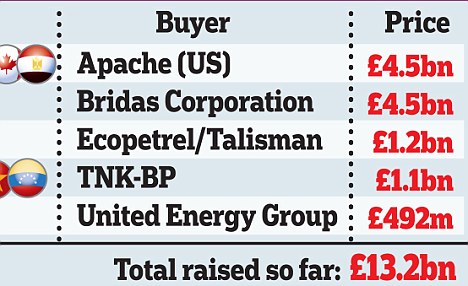
BP’s shares were also buoyed by the sale of exploration and production assets in Pakistan for £492million to Hong Kong-based United Energy Group. The disposal takes the running total of post-Deepwater Horizon sales to £13.2billion, well over halfway towards BP’s target of up to £19billion by the end of next year.

Credit Suisse added to the upbeat mood around BP by rating the London-listed firm its long-term top pick in the oil sector for 2011.

The firm’s analysts slapped a target price of 585p on the stock, a 24 per cent premium to yesterday’s closing price.

They said markets had been too pessimistic on the total bill arising from the firm’s leaking Macondo well, which caused the worst oil spill in US history.

BP now looks likely to avoid a charge of gross negligence, which would have seen environmental fines spiral from £3.5billion to £13.8billion. The bullish assessment from Credit Suisse came hot on the heels of a note from brokerage Killik, which also rated BP as one of its top picks for the coming year.

BP’s woes in the Gulf of Mexico have so far taken a £34billion chunk out of its market value – which stood at nearly £89bn yesterday. But analysts’ optimism is rooted in the expectation that the overall cost of the disaster will be far less than the stock market hit.

Dudley – who took over from Tony Hayward at the beginning of October – is expected to reinstate the firm’s frozen dividend at fourth- quarter results in February, albeit at a lower level than the pre-Deepwater Horizon payout of nearly 9p per share.

DAILY MAIL SOURCE ARTICLE

Opportunistic takeover bid of BP by ExxonMobil or Shell

Oil giant makes its comeback

Comeback: The oil giant climbed to the top of the risers in latest trading

By Alex Brummer
Last updated at 1:12 AM on 15th December 2010

No one should get too starry-eyed about BP. The shares are still £2 below the peak achieved before the Macondo well explosion in April, the dividend is still in abeyance and the White House-appointed oil claims czar – Kenneth Feinberg – is still spending the group’s money as the claims from the Gulf region pour in.

Nevertheless, it could be much worse.

Under the settled claims BP receives a legal release; this prevents those taking the cash now from suing. So the fear, at the peak of the crisis last summer, that eventually a renegade, elected Texas judge would make a ruling which would represent an existential threat to the company (as was the case at Texaco a generation ago) has retreated.

In the meantime the great assets sale, put in place to fund the $20billion compensation fund, continues. The sale of BP’s interests in Pakistan to Hong Kong-based explorer United Energy Group means the disposals have reached $20.8billion (£13.2billion).

The speed at which this target has been achieved is remarkable and testimony to the trading skills of chief executive Bob Dudley and his team.

The stock market appears to have picked up this message and BP climbed to the top of the risers in latest trading. This may be in anticipation of a restoration of the dividend now that the disposals have largely been made, some at better-than-expected prices.

What has never been in doubt is the company’s ability to find new oil, since over the decades it has been better at that than most of its competitors.

If there is a problem going forward it is that extraction costs are going to be far higher given the amount of safety redundancy that must be built in. One of the worrying things for BP’s management is that now the costs of the spill have been capped there remains, at the current share price, the possibility of an opportunistic takeover bid with both ExxonMobil and Shell potential candidates.

If that were to happen, BP chairman Carl-Henric Svanberg may, spare the thought, have less time to spend with his yacht or on the golf course.

BP shines as FTSE 100 hits new high for year

Fuelled by a rise in BP, the benchmark index headed to its highest level so far this year.

Rachel Cooper

By Rachel Cooper, City Reporter 7:02PM GMT 14 Dec 2010

Having been treated to a round of deals earlier in the week, investors were on the hunt for fresh takeover tittle-tattle. BP did the honours, gushing up 14¾ to 473.1p as traders pointed to vague speculation about a possible bid from rival Royal Dutch Shell.

As ever, such rumours come with a health warning and there were other factors helping BP.

The oil major sold its Pakistan oil and gas assets to Hong Kong-listed United Energy Group for $775m (£489m) as part of its strategy to sell off up to $30bn of assets to help cover the costs of the Gulf of Mexico oil spill.

Jason Kenney, an analyst at ING, said BP was well ahead of target on its divestment plan and reiterated his “buy” rating.

He added that Shell rumours may be based on BP’s relative undervaluation and the attractiveness of BP’s asset base. “Never say never – but a bid is unlikely in my view,” he said.

Also helping BP was Credit Suisse raising its target price to 585p from 515p. However, analysts at Jefferies were more circumspect. They began coverage of BP with a “hold” rating and 475p target price. The broker said that although BP was cheap, it remained cautious on the stock “while the key issue of the company’s gross negligence for the Macondo oil spill remains unresolved, as we believe this has the potential to double the cost of the spill net to BP”.

“It will take several months before the final Macondo cost becomes clear to investors and we see little reason to become more positive on the stock while this issue hangs over it,” said analysts.

Jefferies initiated on Royal Dutch Shell with a “buy” recommendation and £23.50 price target. Analysts believe the oil major is “emerging after a long period of decline into what we see as a sustained period of growth”.

Shell gained 28½p to £20.81½.

FULL TELEGRAPH ARTICLE

BP jumps on takeover talk

guardian.co.uk home

Tuesday 14 December 2010

BP was in the takeover spotlight as leading shares rose for the fourth trading day in a row to hit a new high for the year.

The company was the biggest riser in the leading index, up 14.75p to 473.10p on talk of possible bid interest from Royal Dutch Shell, whose B shares added 28.5p to 2081.5p. More than 61m BP shares changed hands, well above recent levels. Since the Gulf of Mexico disaster BP has been seen as vulnerable to a bid, with Exxon Mobil also mentioned as a possible predator.

BP also announced the sale of oil and gas assets in Pakistan for $775m to Hong Kong listed United Energy Group. The price is higher than analysts expected, and brings the amount the company has raised in recent months to help pay for the Gulf spill to around £22bn.

Meanwhile analysts at Credit Suisse did their bit for BP, raising their target price from 515p to 585p. They said:

BP remains our top pick for long-term investors, as we think the market remains overly pessimistic on the costs of the Macondo spill. The next catalyst is the February 2011 strategy update by Bob Dudley, which should give some visibility on BP’s portfolio after Macondo. We will not have clarity on gross negligence from the Department of Justice before the second half of 2011, but two other investigations could give a verdict in the first quarter.

FULL GUARDIAN ARTICLE

BP gains on Royal Dutch Shell bid talk

By David Brett

LONDON, Dec 14 (Reuters) – Gains in energy stocks offset falling miners, leaving Britain’s top share index almost level on Tuesday, with BP the top riser on vague market talk of bid interest from Royal Dutch Shell.

By 1156 GMT the FTSE 100 .FTSE was 1.15 points higher at 5,861.90 in light trade, after rising 0.8 percent on Monday to its highest close since Nov. 9.

BP rose 2.3 percent, with traders citing talk of potential bid interest from Royal Dutch Shell. Both companies chose not to comment.

The oil major was also helped by a bullish note from Credit Suisse, which raised its forecasts for oil prices in 2011 and reiterated that BP is its top pick in the sector.

BP said it had agreed to sell a portfolio of oil and gas assets in Pakistan for $775 million, higher than analyst estimates, as it raises cash to pay for the Gulf of Mexico oil spill.

FULL REUTERS ARTICLE

Beyond Business

Financial Times

Review by Ed Crooks

Published: February 22 2010 05:00 | Last updated: February 22 2010 05:00

Book cover of 'Beyond Business: An Inspirational Memoir from a Visionary Leader' by John BrowneBeyond Business: An Inspirational Memoir from a Visionary Leader
By John Browne
Weidenfeld & Nicolson £20, 336 pages
FT Bookshop price: £16

After the fall, the rehabilitation. That familiar arc in the lives of disgraced public figures is now being traced by Lord Browne, unceremoniously bundled out of BP after he was forced to resign as chief executive in May 2007, and now starting to rebuild his profile.

There is also a revelation, in the news that Browne twice talked to chief executives of Royal Dutch Shell about a possible merger, once in 1996 and again in 2004-05. That deal remains the dream of every investment banker in the oil business.

FULL FT ARTICLE (SUBSCRIPTION)