Royal Dutch Shell plc .com Rotating Header Image

Posts Tagged ‘South Africa’

Hunt for Gas Hits Fragile Soil, and South Africans Fear Risks

In July, the Advertising Standards Authority of South Africa, an independent agency that sets guidelines for media companies, ruled that several of Shell’s advertised claims — including one that said fracking had never led to groundwater contamination — were misleading or unsubstantiated and should be withdrawn.

Chris Hayward, a South African farmer, says, “If our government lets these companies touch even a drop of our water, we’re ruined.”: Photo Credit: Liaan Pretorius for The New York Times

A version of this article appeared in print on December 31, 2011, on page A1 of the New York edition

By

KAROO, South Africa — When a drought dried up their wells last year, hundreds of farmers and their families flocked to local fairgrounds here to pray for rain, and a call went out on the regional radio station imploring South Africans to donate bottled water.

Covering much of the roughly 800 miles between Johannesburg and Cape Town, this arid expanse — its name means “thirsty land” — sees less rain in some parts than the Mojave Desert.

Even so, Shell and several other large energy companies hope to drill thousands of natural gas wells in the region, using a new drilling technology that can require a million gallons of water or more for each well. Companies will also have to find a way to dispose of all the toxic wastewater or sludge that each well produces, since the closest landfill or industrial-waste facility that can handle the waste is hundreds of miles away.

“Around here, the rain comes on legs,” said Chris Hayward, 51, a brawny, dust-covered farmer in Beaufort West, quoting a Karoo saying about how rare and fleeting precipitation is in the area.

With his three skinny border collies crouching dutifully at his side, Mr. Hayward explained that he had to slaughter more than 600 of his 2,000 sheep last year because there was not enough water to go around.

“If our government lets these companies touch even a drop of our water,” he said, “we’re ruined.”

South Africa is among the growing number of countries that want to unlock previously inaccessible natural gas reserves trapped in shale deep underground. The drilling technology — hydraulic fracturing, or “fracking,” for short — holds the promise of generating new revenue through taxes on the gas, creating thousands of jobs for one of the country’s poorest regions, and fueling power plants to provide electricity to roughly 10 million South Africans who live without it.

But many of the sites here and on other continents that are being considered for drilling by oil and gas companies and by governments short of cash are in fragile areas where local officials have limited resources, political leverage or experience to ensure that the drilling is done safely.

A Surge in Interest

The interest from big energy companies in South Africa and elsewhere means that shale gas may redraw the global energy map, according to many energy experts.

Michael Klare, a professor of world security studies at Hampshire College, said that the new sources of natural gas from shale may lessen the geopolitical importance of countries that historically have been the biggest producers of natural gas, including Iran, Qatar and Russia. The new drilling, which draws strong support from the United States government, represents a boon for American companies like Halliburton, Chesapeake Energy and Exxon Mobil that have greater experience with shale gas, and therefore are likely to win many lucrative contracts abroad.

More than 30 countries, including China, India and Pakistan, are now considering fracking for natural gas or oil, and the surge in gas production has spurred interest in building pipelines and terminals that liquefy the fuel so it can be shipped to far-flung markets. In the United States, shale gas has increased supply, driving prices down and benefiting industrial plants that use the gas for manufacturing and consumers who depend on it for electricity, heating or cooking.

But the enthusiasm abroad, especially in less-developed regions, does carry risks, according to many energy experts.

“The big problem is that all the excitement around shale gas, most of it fostered by the U.S., has also led some countries, especially in the developing world, to take a drill-first, figure-out-regulations-later attitude,” said Professor Klare, who has written extensively about the way that energy policies affect global security. “There is simply too much being taken on faith when it comes to company reassurances about the safety and costs of this drilling.”

The Indonesian government, for example, is considering allowing drilling for shale gas in a part of Java where, in 2006, drilling led to the eruption of a mud volcano that killed at least 13 people, and displaced more than 30,000 residents from 12 villages, according to a team of international scientists. Indonesia is a major exporter of liquefied natural gas, but it struggles to meet domestic demand, and supporters of the shale drilling project say it will help solve that problem.

Shale gas in Poland may represent more than a third of the natural gas resources in Europe, according to energy experts, and could help the country reduce its dependence on Russia, which now supplies about 60 percent of Poland’s gas.

But an April 2010 report by Bernstein Research, a market research group, raised concerns about the costs and risks of shale gas drilling because Poland is so densely populated, dependent on agriculture and farmers will have to compete with drillers for water.

“Europe and some of the countries with shale potential have significantly less renewable water resources than the U.S.,” the report warned.

A U.S. Initiative

In the United States, where the water-intensive drilling technique of fracking was invented, the government is taking a lead role in supporting the dissemination of the technology abroad, as well as promoting other energy projects, including building infrastructure to extract and transport liquid natural gas.

Over the past three years, President Obama has promoted shale gas during visits to China, India and Poland.

“We believe that there is the capacity technologically to extract that gas in a way that is entirely safe,” Mr. Obama said in a speech in May in Warsaw, where the American Embassy co-hosted an international shale gas conference.

The Export-Import Bank of the United States has financed some of its biggest gas projects over the last several years, including the largest transaction in the bank’s history — $3 billion approved in 2009 for hundreds of miles of gas pipeline and a liquid natural gas plant and terminal project led by Exxon Mobil in Papua New Guinea.

The United States Geological Survey has offered training and technology to geologists exploring shale gas in Europe.

In 2009, the United States and China signed an agreement to promote accelerated development of shale gas in China, which has major shale gas deposits in Inner Mongolia in the north and in the country’s restive western frontier, Xinjiang, which is characterized by severe droughts and a separatist movement.

The State Department’s Global Shale Gas Initiative, begun in 2010, has been advising many foreign countries on fracking. It has organized a half-dozen trips this year for foreign officials to meet with American energy experts and to visit drilling sites in the United States.

The Web site for the initiative says that its primary goals are “to achieve greater energy security, meet environmental objectives and further U.S. economic and commercial interests.”

Concern About Effects

Some economists and environmentalists say that while the governments of poorer countries may benefit from the new tax revenues and jobs, they may not be paying enough attention to the environmental risks of drilling. They also note that local residents — who bear the brunt of the air pollution, potential water contamination from spills or underground seepage, and truck traffic that come with drilling — may see few benefits.

“These projects have already started causing steep inflation in costs of local housing and services, and except for the lucky few who get temporary construction jobs, the economic conditions for local communities can actually get worse,” said Doug Norlen, policy director of Pacific Environment, an advocacy and research organization that tracks federal and corporate financing of energy projects abroad.

The direct benefits of new drilling to American landowners — they receive bonuses and royalties when they lease their land to drillers — will generally not be shared by landowners abroad. In South Africa and many other countries looking to embrace the drilling, the minerals under a property are more often owned by governments, not individuals.

Mr. Norlen added that the influx of foreign construction workers in these projects could lead to conflicts with local and tribal communities. In one example, he noted, the United States government-financed project in Papua New Guinea to extract and transport liquid natural gas recently led to violent clashes between residents and foreign contractors.

But Jan Willem Eggink, general manager for Shell in South Africa, said that the Karoo project could eventually produce millions of dollars in direct investment and thousands of jobs for South Africans, which would help lower the nation’s unemployment rate of about 25 percent.

“There is a huge energy problem looming for South Africa,” he added, explaining that energy demand is growing rapidly and that shale gas coupled with renewables could help meet that new demand while also lowering the nation’s dependence on Mozambique for gas.

Fracking involves injecting large amounts of water mixed with chemicals and sand at very high pressure deep underground to crack rock and release gas. After fracking, much of the water at each well returns to the surface mixed with toxic chemicals.

Shell’s plan is to drill at least six exploratory wells over the next three years, and if the gas reserves appear profitable, it will start production with at least 1,500 wells several years later. Martin Bell, the water manager for Shell’s Karoo project, said the company planned to recycle as much wastewater as possible, storing it temporarily in closed containers. Trucks will not be the primary method for moving waste or water, he said. Drilling waste, which could be especially toxic because the area is high in uranium deposits, will be shipped to disposal plants by pipes or by rail, Mr. Bell said.

Water needed for fracking may be brought in by rail from the coast, which is hundreds of miles away in some parts, or drawn from aquifers far below the ones that supply water for farmers. The company will tap into the aquifers that farmers use only if it can prove no adverse impact, Mr. Bell said.

In interviews, South African drilling regulators emphasized that producing and using more natural gas would help the country’s air pollution problems and avoid increasing its already heavy dependence on coal for electricity, since coal is dirtier than natural gas when burned.

But in this sun-flooded hinterland, where sheep outnumber humans and rusty windmills pumping water dot the horizon, many residents say they would prefer to see the government bring in wind or solar farms, not new drilling.

“It just takes one big spill, leaky pipe or crack underground that their studies didn’t catch, and a farm my family has run for four generations is done,” said Trenly Spence, 44, as he dug up a clogged irrigation pipe that carries water across his 3,300 acres to where his 3,000 sheep and goats graze.

Mr. Spence added that farmers had been frustrated by the lack of information from Shell officials about the chemicals they would inject into the ground during fracking.

Shell officials said that they would disclose what they could about fracking formulas if they started drilling, but that they might be limited by trade secrets of their subcontractors.

In the United States, some drilling companies have been reluctant to reveal the chemicals they use in fracking, saying the information is proprietary.

Officials from the State Department’s shale gas initiative have said that developing countries interested in fracking will need to create stronger protections for intellectual property rights so energy companies will think that they can safely maintain certain patents over their drilling techniques. Some environmentalists say that strengthening these intellectual property protections will only help energy companies argue that they do not have to disclose the chemicals they use in fracking abroad.

A spokesman for the State Department declined to answer questions about fracking and intellectual property rights. But he emphasized that the initiative’s goal is to help countries make informed decisions about their resources, rather than promoting shale gas abroad.

“The regulatory and financial climate is obviously important to companies considering an investment in unconventional gas,” the spokesman said in an e-mail. “But sound environmental regulations and policies are also critical, as is working with local communities and other stakeholders to understand the impact of shale gas on their lives.”

The Future

Some legal experts say that the United States needs to be more concerned about environmental and other impacts as it promotes energy technology abroad. David Hunter, director of the Program on International and Comparative Environmental Law at American University, said, “Especially with energy projects, the U.S. and its funding institutions have a habit of promoting policies that foster a stable climate for foreign investors but that are not in the best interests of local populations.”

In Peru, for example, the United States Export-Import bank provided more than $400 million in loan guarantees in 2008 for a liquefied natural gas terminal to export gas from the Camisea gas fields, which are in the Amazon rainforest. The project for drilling and pipelines in the Camisea, which received separate financing from the Inter-American Development Bank, has been dogged by spills, accusations that company officials bribed lawmakers and criticisms about exporting the gas rather than using more of it to lower prices for domestic consumers.

Energy companies are using fracking technology in parts of Canada, bringing jobs and wealth to gas-rich provinces like Alberta and British Columbia. But residents near drilling sites have complained that natural gas has seeped into their water wells making their tap water flammable. Drillers have denied responsibility.

In South Africa, pressure is mounting to proceed cautiously.

After public concerns were raised this year about drilling in the Karoo region, South African drilling officials set a moratorium on new licenses for exploration until February so the government could conduct more research.

In July, the Advertising Standards Authority of South Africa, an independent agency that sets guidelines for media companies, ruled that several of Shell’s advertised claims — including one that said fracking had never led to groundwater contamination — were misleading or unsubstantiated and should be withdrawn. Shell said the advertisements were an accurate reflection of its opinion.

“The government is under a great deal of pressure to hurry up,” said Hein Rust, director of disaster management for the central Karoo region. “But I don’t think these decisions should be made on faith or until all the costs are known.”

SOURCE ARTICLE  WITH COMMENTS

Related

Drilling Down: Learning Too Late of the Perils in Gas Well Leases (December 2, 2011)

Drilling Down: Rush to Drill for Natural Gas Creates Conflicts With Mortgages (October 20, 2011)

Drilling Down: A Tainted Water Well, and Concern There May Be More (August 4, 2011)

Shell doing its best to make fracking safe, water friendly

October 5 2011 at 05:00am

By Jan Willem Eggink, General Manager Upstream Operations, Shell South Africa

Some of you may have seen this image on television or the internet. A man reaches across and turns on his kitchen tap. He takes a lighter and applies it to the stream of water, it bursts into flame. The flame is attributed to the presence of methane gas.

It is a powerful image. But it is important to be clear about the source of the gas. While critics suggest natural gas drilling as the cause, there is considerable evidence that dissolved methane can occur naturally in ground water. Indeed, according to the Department of Water Affairs, methane gas has been found in shallow water wells in the Karoo.

Confusion and misinformation about connection between natural gas drilling and water supplies feeds into public concern about the safety and environmental impact of shale gas production, and contributes to worries about the exploration for natural gas in the Karoo. The public is right to demand high standards.

For the industry, there are two clear tasks at hand: first, we must continue to maintain the very highest operational standards. At Shell, our efforts are underlined by a set of global onshore shale gas operating principles that provide a framework for protecting water, air, wildlife and the needs of local communities.

We support regulation that is designed to reduce risks to the environment and keep those living near our operations safe.

Second, we need to dispel the significant misconceptions about shale gas production. I would like to address the main misconceptions about shale gas, underlined by the fact that shale gas under the Karoo may help South Africa to develop a secure and sustainable energy supply.

We understand that people have concerns about the issues and allegations raised by opponents of shale gas extraction, and we feel it is important to address these. The allegations have many factual discrepancies and do not reflect Shell’s operations.

One major misconception is that hydraulic fracturing poses a significant risk to fresh water aquifers. A very recent report of the US Energy Department that has been looking at potential health and environmental implications of hydraulic fracturing confirmed that when a well was designed and constructed correctly, ground water would not be contaminated. We think we need well-targeted and strictly implemented regulation to preserve public confidence that the shale gas revolution really is a force for good.

We believe that protecting fresh water aquifers is not difficult: the natural gas in some cases lies thousands of metres below aquifers. So it is virtually impossible for liquid or indeed gas, to reach drinking water.

Nevertheless, we follow strict standards to ensure that wells are constructed correctly. We line our wells with multiple steel and concrete barriers to prevent gas or liquid from leaking out of the well itself.

I should highlight that fracking has been successfully performed more than a million times in the US alone over the past 60 years in vertical wells and more than 20 years in horizontal wells. We do not hydraulically fracture wells unless we have pressure tested the well bore for integrity.

Another criticism relates to water consumption and use. According to various studies, including one by the renowned Massachusetts Institute of Technology in the US, the water intensity of shale gas ranks among the lowest of all energy sources. We recognise that in an arid area like the Karoo, even limited water use may be a concern. Again, sound operational practices can address these concerns. Shell strives to avoid competing with local water needs. We will not operate wells where isolation of our completion and production activities from potable ground water cannot be achieved. And wherever possible, we use non-potable water, including the recycling and reusing of water from our operations. Nobody will go short of fresh water because of our operations; either in the exploration phase, or if there is any further development. This is a legally binding commitment.

One example of how we work with communities to find the best solutions for the water use is in China’s Shanxi province. Here we are developing the Changbei field, we funded the construction of 240 underground water-storage tanks and 12 water-pumping stations, providing about 3 000 people better access to drinking water.

A third debate results partly from a paper by Cornell University, which stoked fears that greenhouse emissions from shale gas far exceeded not only those from conventional gas, but even those from coal.

While we agree emissions from all energy sources need to be better understood, the quickest and cheapest way to reduce emissions is to switch power generation from coal to gas.

The assumptions made in the Cornell paper stand in stark contrast to the International Energy Agency (IEA) analysis, which found that, on a well to burner basis, emissions from shale gas exceed those of conventional gas by as little as 3.5 percent in the best case scenario and by 12 percent in the worst. Rigorous operations management helps to get to the lower number. The IEA stated: “…total emissions from (shale gas) production are only slightly higher than for conventional gas: and both the water and climate impacts can be mitigated using existing techniques”.

A conclusion recently backed up by a research paper from Carnegie Mellon. In any event, shale gas-fired power still emits only about half the CO2 of coal-fired power, which was confirmed in the US National Energy Technology Laboratory study comparing newest gas and coal technology.

Some people disagree about how South Africa should meet its energy needs in the future. We want to promote debate and have a solid discussion based on facts and not on misconceptions.

At Shell we believe onshore exploration and production can and must occur in an environmentally responsible manner. Anything less is unacceptable. I know that this won’t convince everybody.

And we can never have all the answers, but our exploration activities will provide a large amount of answers to the question, whether the gas is there and can be produced commercially. We’re determined to be transparent and open about our proposals, and to address all concerns.

Eggink is the upstream general manager for Shell in South Africa.

SOURCE ARTICLE

From our archives: U.S. unions urge boycott of Shell to fight apartheid

The unions contend Royal Dutch/Shell, the world’s second largest multinational company in terms of sales, employs black slave labor in South Africa’s Rietspruit coal mine…

Publication: Chicago Sun-Times
Date: January 19, 1986
Author: Barry Cronin
Section: SUNDAY NEWS
Edition: FIVE STAR SPORTS FINAL
Page: 55

A coalition of labor unions has called on Americans to boycott products sold by the Shell Oil Co., a subsidiary of the Royal Dutch/ Shell Group, which has extensive oil, coal and chemical operations in South Africa.

The unions contend Royal Dutch/Shell, the world’s second largest multinational company in terms of sales, employs black slave labor in South Africa’s Rietspruit coal mine, of which it owns 50 percent with a South African firm.

“We hope this boycott will encourage Shell to disinvest in South Africa as part of the broad effort to pressure the South African regime to help bring about an end to the apartheid system,” said Owen Bieber, president of the United Auto Workers and chairman of the AFL-CIO’s Ad Hoc Committee on South Africa.

A spokesman for Shell Oil in Houston said the boycott is “unfortunate and misplaced” and that it will hurt American workers associated with Shell products.

The unions say their boycott is aimed not at individual merchants who happen to sell Shell products, but only Shell products themselves. Union leaders are asking the public to cut up their Shell credit cards and not buy Shell goods.

Copyright 1986, 1996 Chicago Sun-Times, Inc.

Karoo gas could fuel SA for decades — Shell

Shell says it would invest billions of dollars in the development of a Karoo gas field in the event that it got the go- ahead to drill and if its exploration of the area proved fruitful

LINDA ENSOR
Published: 2011/09/02 06:49:50 AM

CAPE TOWN — Shell would invest billions of dollars in the development of a Karoo gas field in the event that it got the go- ahead to drill and if its exploration of the area proved fruitful, Shell’s upstream manager for SA, Jan Eggink, said yesterday.

The US Energy Information Administration has estimated that there are 485-trillion cubic feet of shale gas in the Karoo, enough to make SA self-sufficient in energy for decades to come.

Exploration alone would cost Shell $200m even if it was found that the reserves were not exploitable, Mr Eggink told the Cape Town Press Club.

Shell, along with a number of other companies, has applied to the government to explore for gas in the Karoo — a proposal that has generated fierce opposition from environmental lobby groups and some Karoo landowners. The debate rages on, with opponents saying gas mining in the Karoo would desecrate an ecologically sensitive area of pristine beauty. Mineral Resources Minister Susan Shabangu has established a task team to investigate the pros and cons of “fracking” for gas, and is expected to receive this report in the next few months.

Mr Eggink stressed that Shell was committed to paying fair compensation to landowners in the Karoo to gain access to their land and also made the commitment that it would not compete with residents for water. This is one of the major concerns of landowners. Access to sufficient quantities of water will be a critical factor in the decision to develop the gas.

Mr Eggink said about 1-million litres would be required in the exploration phase and a further 5- million to 10-million litres in the development phase. If there was not enough water underground, it would have to be brought in by truck or by pipeline.

Contamination of underground water supplies is another of the key concerns of landowners, as chemicals would be used in the process of hydraulic fracturing.

But Mr Eggink said Shell knew from experience elsewhere “that if a well is properly constructed it will not leak any fluid into groundwater supplies.”

He believed SA would gain enormously from producing its own gas, which was a much cleaner form of fuel than the coal that was currently used to generate about 90% of the country’s electricity. Gas was a cleaner source of energy, which would enable SA to reduce its carbon footprint.

Developing renewable sources of energy, such as solar and wind, in sufficient quantities to make an impact would take decades.

Mr Eggink noted that a modern gas power plant generated up to 70% less CO² than the old-styled coal-fired plant and was cheaper to build.

He also stressed that the surface footprint of a shale gas development would be very small (1%) compared to the overall acreage that Shell had applied to explore in, and would create thousands of jobs.

“Rapid economic growth means electricity demand is rising. By drawing on potential abundant gas supplies you can meet rising energy demand while maintaining energy security,” Mr Eggink said.

In the exploration phase, Shell would drill at least six wells, which would reveal whether gas could be extracted in sufficient quantities to be commercially viable. But even before this phase started, an environmental impact assessment would have to be made — a process that could take between 18 months and two years.

ensorl@bdfm.co.za

SOURCE ARTICLE

South Africa: Shell fracking in semi-desert Karoo

How do farmers prove that Shell has polluted their lands, what lengths people have to go through to get their rights?


From pages 35, 36 & 37 of “Royal Dutch Shell and its sustainability troubles” – Background report to the Erratum of Shell’s Annual Report 2010

The report is made on behalf of Milieudefensie (Friends of the Earth Netherlands)
Author: Albert ten Kate: May 2011.

Farmers, scientists, NGOs, a Dutch princess, a business tycoon, a long-distance swimmer, a Facebook account with already 6,500 members as of 19 April 2011. Royal Dutch Shell is facing strong opposition to its plans to get an exploration license to seek shale gas in South Africa’s semi-desert Karoo region.

The consulting firm Golder Associates, working on behalf of Shell, drafted an Environmental Management Plan (EMP) for three exploration areas, each comprising 30,000 kilometres. Until 5 April 2011, the public was allowed to comment to these plans. The drilling of a maximum of 24 wells was not expected to commence before 2012. Golder stated in its conclusions to the EMPs that there was no material evidence that a small number of exploration wells could result in an unacceptable level of environmental impact, and that therefore the determination of the resource potential of the Karoo shale gas formations not should be prevented or delayed. As long as the siting and management of the wells would be controlled through a rigorous, scientific Environmental Impact Assessment process, it would be unlikely that the construction would result in unacceptable environmental damage, the company continued.

Scientists of the U.S. Environmental Protection Agency (EPA), under this administration and at the direction of U.S. Congress, are currently undertaking a study on the practice of hydraulic fracturing to better understand any potential impacts on drinking water and groundwater. The results of this study are not expected before late 2012. Golder stated that there was no need to wait with handing over an exploration license, because Shell’s application did not involve production. Before any licensing of a production well field is considered, the EPA-study should however be considered, according to Golder.

Thousands of comments to the Environmental Management Plan (EMP) of Golder were submitted. The strong public resistance against fracking the Karoo resulted in a moratorium by the government on licenses in the Karoo where fracking is proposed. On Wednesday 20 April 2011, the South African Cabinet endorsed the decision by the Department of Minerals to invoke this moratorium. The Department of Minerals will lead a multi disciplinary team including the Departments of Trade & Industry, Science and Technology, amongst others, to fully research the full implications of the proposed fracking. It was stated that the Cabinet had made it very clear that clean environment together with all the ecological aspects will not be compromised.

The opponents of the exploratory plans are however not re-assured: − Business tycoon Johann Rupert: “We don’t think the legal framework was designed for this fracking method and we are very, very scared about the irreversibility of the ecological damage, should it occur.” − Professor Doreen Atkinson of the Centre for Development Support at the University of Free State (UFS): “There is a prima facie case to put a hold on any decisions around fracking until studies have been done. These studies may take at least 3 to 5 years. It would also be prudent to first see the results of the American Environmental Protection Agency (EPA) which has embarked on a study. Its results are only expected in late 2012.”

− Long-distance swimmer Lewis Gordon Pugh: “Growing up in Grahamstown I learnt how scarce water is in the Karoo. Why on earth would we allow a foreign company to come and drill for gas in a vulnerable ecosystem? Why would we risk contaminating our water supply? It is morally wrong. It also makes poor economic sense. We must look after our water for future generations.”

− Dr Anthony Turton, a well-known trans-disciplinary water scientist: “In the absence of certainty, it is prudent to assume the worst and respond accordingly. In the case of fracking, there are many unknowns technologically. At best it is chasing a highly marginal resource. Invariably the costs exceed the benefits if one takes potential environmental damage into consideration. But because the benefits are so few, if things go wrong, there is not enough to pay for environmental remediation.”

− Geologist and palaeontologist Professor Bruce Rubidge of the University of Witwatersrand’s Bernard Price Institute: “The fact that companies like Shell are saying that they will use sea- and brack- water for the fracking may have unwelcome effects on the salinity of the groundwater. Also in the fracking process there will undoubtedly be some of this sea and brack water which has been contaminated with chemicals and which will spill out on the surface, as has happened in many recorded cases in America. What will it do to the soil?”

− Ernest Pringle, president of Agri-Eastern Cape and a farmer in the Karoo: “I spent all my time trying to pump up more groundwater to keep going. So we want to know with certainty what the effects will be to the underground water supply.”

− Mark Botha, head of conservation at environmental group WWF South Africa: “We’ve got some serious concerns about fracking, it is as yet an unproven technology with unacceptable risks for fresh water abstraction and pollution.”

− Derek Light, a lawyer representing a number of Karoo land owners: “We are very concerned about the environmental impact, especially because fracking is not regulated in South Africa.”

− Princess Irene of the Netherlands (this sister of the queen owns land in the Karoo): “There are other ways to generate energy, for which we do not exploit nature but cooperate with it. With wind or solar energy nothing gets polluted, nothing gets broken. More companies are recognizing that we are partners of nature. Shell is stuck in its old patterns.”

− At the beginning of April 2011, several scientists and consultants responded to Shell’s application with an extensive 104-page critical review.

Even in the case that the fracking operations by Shell could be performed without compromising a clean environment together with all the ecological aspects, there is still the issue of where Shell would get the massive amounts of water needed. The company has made a commitment “not to compete with the people of the Karoo for their water needs.” One of the options Shell considers is to get water from sea. Shell has also stated it is commuted to provide full compensation to any landowner with evidenced direct negative impact or loss on their land as a result of its activities. This may however seem less re-assuring than it looks like. How do farmers prove that Shell has polluted their lands, what lengths people have to go through to get their rights?

A further extract from the report will be published in the coming days.

THE COMPLETE 73 PAGE REPORT (with reference sources)

Shell adverts being investigated

June 1 2011 at 04:15pm

The Advertising Standards Authority is investigating whether Royal-Dutch Shell advertisements about hydraulic fracturing are misleading and untruthful, the Treasure Karoo Action Group (TKAG) said on Wednesday.

Shell had run the full-page advertisements in national weekly newspapers and had distributed flyers at its service stations, TKAG national co-ordinator Jonathan Deal said in a statement.

This, after the Cabinet declared a moratorium on all applications for licences to conduct hydraulic fracturing in the exploration of shale gas reserves in the Karoo.

Fracturing, also known as fracking, involves pumping a high pressure mixture of water, sand and chemicals into the shale bed to break apart underground shale rock and extract the gas.

In a live debate with Deal in Cape Town, Shell SA Energy Limited’s chairman and vice president Bonang Mohale said there had never been “a single case of groundwater contamination resulting from fracturing”.

“This is clearly not the truth,” Deal said.

He said Shell claimed on its website that: “The fluids injected into the rock consist of more than 99 percent water and sand, with a small amount of additives similar to those found in household products.”

In its advertisement, Shell said: “We also commit to disclosing fracturing fluids at each drilling location.”

However, in the public debate, Shell would not reveal what those chemicals were, Deal said.

“The violations of environmental regulations by Shell, the self-proclaimed market leader in hydraulic fracturing, are a matter of fact,” he said.

“… No reasonable person can possibly argue that hydraulic fracturing is safe and poses no risk to the environment.

“Shell has been economical with the truth. South Africa has been misled.”

Shell was not immediately available for comment.

Proposals have been made by Shell, Falcon Oil and Bundu Oil and Gas to explore shale gas deposits in the Karoo.

However, after pressure from environmentalists, farmers, scientists and citizens, Mineral Resources Minister Susan Shabangu placed a freeze on applications for rights to explore for shale gas until her department has formulated a policy.

Many argued that fracking would impact negatively on ground water and surface water resources in the Karoo.

Last month, French legislators voted to ban fracking and while a study published in the United States found no sign that fracking chemicals were polluting the water supply, it found evidence that gas leaked from shale wells into drinking water. – Sapa

SOURCE ARTICLE

Shell’s Karoo-born man steers clear of shale gas rumpus

Sunday Times

May 29, 2011 3:08 AM | By ANTON FERREIRA

One of Colesberg’s most successful sons, who went from a sheep farm childhood to becoming vice president of a leading multinational, is trying to keep a low profile in the controversy over plans to look for shale gas in the Karoo.

That’s because the company De la Rey Venter works for in the Netherlands is Royal Dutch Shell, one of the companies that want to “frack” his former backyard.

Venter, a former head boy at Colesberg High School, has had a meteoric career since obtaining a BCom at the University of Johannesburg in 1997. He worked for Samancor, then BHP Billiton. In 2002 he joined Shell.

On a website advertising the school at which he obtained his MBA, Venter said he had chosen his career at Shell because he was “fascinated by the intrigues of geo-politics and by the global energy and environmental debates”.

Now he is the company’s global head of liquefied natural gas with responsibilities that include negotiating supply contracts around the world.

He is putting deals together to ship liquefied natural gas to Japan, which has increased its gas consumption after the earthquake disaster at Fukushima nuclear power station.

But Venter’s involvement with gas appears to have confused some residents of Colesberg, who thought he might be the man to speak to about Shell’s unpopular plan to explore for shale gas.

Clem Olivier, head of the local farmers’ union, said members held a meeting earlier this year where the proposal was made that Venter, whose family have farmed in the area for several generations, should be asked to address a meeting of the union about the fracking plans which many farmers fear will destroy their groundwater supply.

“The thought we had was that De la Rey Venter Jnr would come to give us feedback at a meeting,” Olivier said this week.

“But later it became apparent that this guy is in Holland, so we didn’t take the decision. It would be stupid to get someone from Holland to come out to tell us what Shell’s thoughts are.”

A local newspaper carried a misleading report about the farmers’ union meeting which, a Shell source said, caused unjustified hostility towards the Venter family.

Venter himself declined to answer e-mailed questions about fracking.

A Shell spokesman in Johannesburg said: “He does not want to talk on behalf of Shell, or as a Karoo-born stakeholder on the gas exploration project.”

Venter’s father, De la Rey Venter Snr, said from his retirement home in Jeffreys Bay that the fracking controversy had nothing to do with the family.

“It’s not part of (my son’s) responsibilities. He’s head of Shell’s gas marketing all over the globe, and it’s got nothing to do with fracking. So it can’t affect my family, or him.”

SOURCE ARTICLE

Shell cites history to allay Karoo fears

May 3 2011 at 07:01pm

Shell Oil Company, which has decades of experience in natural gas development in Alberta, Canada and in Texas, US, believes the procedure of drilling wells and using millions of gallons of water to extract shale gas in the karoo can be done without significant environmental damage.

It is also looking at, and piloting, other technology applications, including tight and shale gas fracturing which do not use water. One option is the use of liquefied petroleum gas (LPG). This effectively uses gas to extract gas.

One company that has spearheaded the use of gelled LPG in place of conventional fracturing fluids – water and various chemicals, which environmentalists are up in arms about – is GasFrac Energy Services. It also drills for gas in the US and Canada.

GasFrac believes that this process results in significant savings on material expenses and “fracture clean up”.

Returned from a recent round of public consultations in Graaff Reinet and Beaufort West in the Karoo, Frederick Palmer, a senior communications manager for onshore gas for Shell, said the company had considerable experience in gas fracturing in Sublette County, Wyoming – a desert-like area like the Karoo – and contended that the procedure was done without significant damage to the environment.

It had also created new wealth in the region boosting revenues to Sublette County and boosting business and employment in towns such as Pinedale, Big Piney and Marbleton.

Environmentalist groups argue that gas has come out of water taps in Colorado following “fracking” – as the procedure is dubbed.

Palmer said in three instances of contamination of aquifers in this US state, two were the result of natural contamination by gas due to decomposition of organic material and the third case a combination of gas development and natural decomposition. None were examples of contamination by chemicals.

He backed up his argument with a report from the State of Colorado Oil and Gas Conservation Commission, which found that a documentary – Gasland, which has created much antagonism to fracking at viewings in the Karoo – incorrectly attributed several cases of water well contamination in Colorado to oil and gas development.

Its investigations determined that “the wells in question contained biogenic methane that is not attributable to such development (fracking)”.

Hydraulic fracturing takes place thousands of metres below the earth, below underground aquifers. Well shafts were encased with cement and steel, so damage to the environment was prevented, Palmer said. Shell is interested in building 24 wells – eight each in three regions of the Karoo – should it get exploration rights.

On Friday, Mineral Resources Minister Susan Shabangu halted all applications for licences to prospect for shale gas in the Karoo. She said that given the intensity and scale of the issue “and the fact that this (shale gas exploration) has never been done before… my department will conduct a comprehensive study which will assist us to formulate our approach after which we will go back to the cabinet”.

Until the conclusion of a feasibility study, no new applications will be accepted – nor will existing ones be finalised. This means that existing rights held by companies – including Shell – will be put on ice.

Palmer noted that Shell was planning over the long term. It was known that energy demand would be double that of the present by 2050 and it would require a mixture of fossil fuels – including shale gas – and renewables. He said moratoriums put in place did not constitute “a ban” but provided authorities with more time “to decide” on the appropriateness of hydraulic fracturing. To prevent environmental damage, “the design and execution of the wells is absolutely key”.

There was potential for vast job and wealth creation through shale gas development, he noted. In Louisiana in the US, $10.6 billion (R69.1bn) in new business sales were generated in 2009 – in a recession year – while household income in the state climbed by almost $6bn. – Donwald Pressly

SOURCE ARTICLE

Karoo group files charge over fracking ad

Complaint over a Shell advert which tries to allay public fears about its fracking exploration technique

CHANTELLE BENJAMIN: Published: 2011/04/29 06:40:25 AM

A GROUP of Karoo residents has accused oil company Royal Dutch Shell of being “untruthful and misleading” and has lodged a complaint over an advert which tries to allay public fears about its fracking exploration technique .

The complaint by specialist energy attorneys Havemann Inc on behalf of Treasure the Karoo Action Group is over an advert in the Sunday Times and the Cape Times this month headed “Dialogue on the Karoo”, which they allege aims to mislead readers.

Shell is just one of several oil and gas companies that have applied to explore the Karoo’s shale gas beds to see whether SA has exploitable reserves. The applications have Karoo residents and some scientists up in arms, arguing that the US, UK, Canada and France have all imposed moratoriums on fracking until more is known about its effects on the environment and on communities. They argue that the Karoo is already a sensitive area.

The complaint said Shell spoke of “increased awareness of the benefits of shale gas” when in fact “heightened interest in exploration of shale gas reserves” has led to “increased domestic and global awareness of the associated environmental and health risks of fracturing and not of any so-called benefits of shale gas”.

Havemann said the advert, which asks why no one has heard of hydraulic fracturing when it has been around for 60 years, can mislead readers into believing that “hydraulic fracturing is a commonplace and generally accepted technique for the exploitation of natural gas, which it is not”.

The action group also objected to claims by Shell that “hydraulic fracturing is used in nearly nine out of 10 natural gas wells”, saying the moratorium in many countries makes this figure unlikely.

The group said the diagram was also misleading as it suggested “multiple layers of steel casing and cement will protect” a wet underground layer of water- bearing permeable rock known as an aquifer when these layers are found at greater depths than indicated — such as 1km to 3km — where there would be no such casing, according to the diagram.

The group says the advert alleges that there is no indication of groundwater contamination, when there are reports available, and makes no reference to surface water contamination.

Kim Bye Bruun, speaking for Shell, said yesterday: “We have been made aware of the complaint lodged with the Advertising Standards Authority and the matter had been referred to our legal specialists for review of the complaint, and a response will be made to the (authority) at the appropriate time.”

In fracking a mix of water, sand and chemicals is injected into a wellbore at high pressure to crack rock, and bring gas to the surface in a liquid from which the gas can be extracted.

At issue is the chemicals used. Shell argues that a “typical fracture treatment uses … between three and 12 additives”. The complaint says research over five years showed “2500 hydraulic fracturing products contained as much as 750 chemicals”.

A copy of the contested advert can be found on bday.co.za.

benjaminc@bdfm.co.za

Photo Credit: Reuters

SOURCE ARTICLE

Gas Wars: Rise of the Anti-Frackers

By Julienne du Toit

South African anti-fracking groups had an extra Easter egg in their baskets this week when the government announced a moratorium on Big Energy plans to prospect for gas in the Karoo, the country’s semi-desert heartland.

What? People Power takes on a tag team of fuel giants and local politicians and wins the 1st round of the southern African Gas Wars? Can it be?

Damn straight. Life retains its ability to surprise and delight.

I came across an article recently with the headline: “5 Reasons to Be Hopeful We Haven’t Totally Screwed Ourselves and the Planet … Yet”.

One of the 5 reasons the author Tara Lohan (AlterNet) gave was the rapid rise of anti-fracking groups around the world. She wrote:

“Momentum ignited from the film Gasland and grassroots activism around the issue has helped to spark a ban on fracking in Pittsburg and a temporary moratorium in New York. Groups like Food and Water Watch, Democracy for America, Water Defense, Damascus Citizens for Sustainability, Earth Justice and others are putting the heat on the drilling industry and any politicians dumb enough to have their backs.”

Oil spills, meltdowns and blow-outs

Feeding this environmental uprising was a global energy industry in the throes of an annus horribilis, starting with BP’s oil spill in the Gulf of Mexico in April 2010. Then early in 2011, Japan’s tsunami hit and the Fukushima Daiichi nuclear plant headed for scary meltdown. Every country that had been planning for more nuclear plants (South Africa included) was suddenly forced into rethink mode.

The latest disaster was Chesapeake Energy’s fracking well blowout in Bradford County, Pennsylvania, with thousands of gallons of chemical-laced water spewing over agricultural fields and spilling into a nearby steam in late April 2011.

It came three days before the South African cabinet endorsed a moratorium on fracking in the country. There’s no doubt it must have caused much agitation in the boardrooms of Royal Dutch Shell (which has been mercilessly vilified in the media for its proposals to frack 90 000 square kilometres of the South African heartland), Sunset Energy, Falcon Oil & Gas, Sasol, Chesapeake Energy, Statoil ASA, Anglo American and others who were lining up to frack the country’s deep shale layers.

Shell and other corporates with plans to frack in South Africa must be cursing the timing. If they had unveiled their plans only five years ago, they might have succeeded. Shale gas had a squeaky clean image until the end of 2008, when a worker in Colorado soaked in fracking fluid was taken to hospital and the nurse treating him nearly died of organ failure.

It’s gone downhill since then for the frackers. Alongside the shocking documentary Gasland, there has been a steady and growing stream of cautionary tales coming out of America – blowouts, leaks, exploding houses, radioactive fracking wastewater released into major rivers, lives ruined, properties turned worthless. Even earthquakes in Arkansas.

Shell executives were made to look like shameless liars every time they said fracking was safe.

Treasure the Karoo Action Group

One of the latest anti-fracking groups is South African. Called Treasure the Karoo Action Group (TKAG), it sprang rapidly out of a Facebook page started at the end of January 2011. By Easter, when the South African cabinet announced it was endorsing the moratorium proposed by the Department of Mineral Resources, there were nearly 7 000 members. And every single one of those members, plus thousands of others, did something to spread the word against fracking.

The effort was fascinating for its sheer democratic voice and scale. Thousands signed petitions. Even though many knew that petitions don’t really work, people wanted to sign them anyway. It was like warriors signing up for battle.

The people spoke – and were heard.

In some ways, the central effort among anti-frackers recalls that adage that arose from the political prisoners on Robben Island: Each one teach one.

The key to battling against fracking lies in information. Those who are pro-fracking are usually those who don’t know enough or who have vested interests. So the most effective means of battle was to inform friends, family and whoever would listen about what fracking could mean to South Africa in general and the Karoo in particular.

Schoolteachers, priests and farmers’ wives screened Gasland and Split Estates. Local environmental groups debated the issue around drinks. Some people drew anti-fracking cartoons. Some posted ideas over the Facebook. Some wrote articles or letters in the newspapers. Some wrote letter after letter to Ministers and Shell executives in The Hague.

Some mobilised whoever they knew in government and sent them information on the risks of fracking. Advertising schools designed anti-fracking logos and t-shirts.

Ordinary people did in-depth research and came to Shell information meetings armed with questions the guys in suits couldn’t answer.

A triumph for shit-stirring

Musicians composed anti-fracking songs. Graphic artists created flyers people could hand out. Lawyers got involved. Futurists offered their services. The word ‘fracking’ became a trending subject on Twitter.

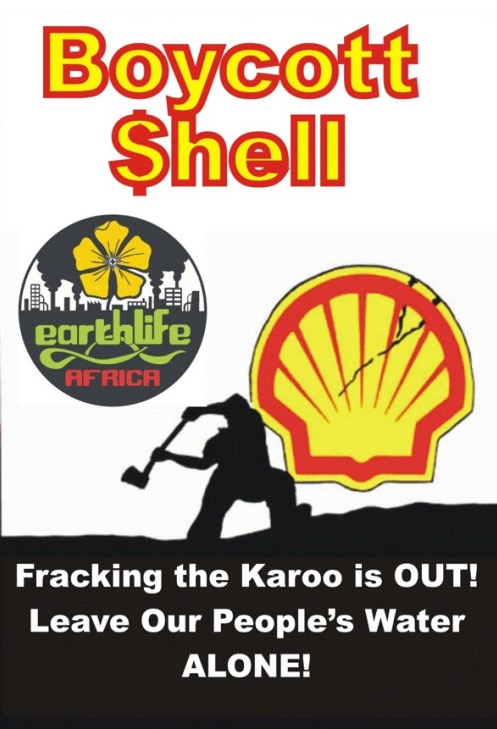
Dozens of existing organisations stepped up to the plate – Earthlife Africa stood side by side with WWF, riverine bunny huggers and birders fought alongside farmworkers and wildlife conservationists. Environmental law became a subject of fascination to rich and poor.

When the ‘human polar bear’ and environmental campaigner Lewis Pugh made his stirring anti-fracking speech in Cape Town, it was sent and resent around the world, posted and reposted on Facebook.

As writer Rian Malan remarked on Facebook after the moratorium was announced: “This is a triumph for shit-stirring. There is a lesson here for all of us.”

A fierce love for the Karoo

But there was another factor that corporates could not have foreseen: people’s love for the Karoo.

In the last five to ten years, several books have been written on the Karoo (one was Timeless Karoo, written by Jonathan Deal, head of TKAG). The Karoo has ceased to be a hot place that must be driven through at top speed.

It is now attracting tourists charmed by the authenticity and integrity of the people and their landscapes, the soaring peace, the silence, the far horizons.

This fierce undercurrent of passion for the Karoo must surely have caught Shell off guard. And it showed at the public participation meetings.

Shell executives answering irate questions from the floor seemed bewildered and eventually sullen when confronted with a steadfastly negative reception.

It’s entirely possible they thought the Karoo was a large wasteland, and South Africans would be only too delighted to have the place put to good use.

The war isn’t over

But there’s another cautionary tale in this.

We’re still right at the beginning of the battle, which could last for twenty years or more. The South Africa government needs to decide on an energy policy to take the country forward.

Now the anti-frackers have to feed into a whole new stream of thinking around the kinds of energy sources we would be happy to leave to our children.

How can we produce energy that provides most jobs and harms our natural resources the least?

We need alternatives, ones that provide steady power. If not fracking and gas, if not nuclear, if not coal, then what?

SOURCE ARTICLE