Royal Dutch Shell plc .com Rotating Header Image

Posts Tagged ‘Wikipedia’

Integrity of Wikipedia corporate articles corrupted by editing scandal

On 12th October 2010, I published an article containing the warning: “…it is only a matter of time before the culture of subterfuge and deception at Wikipedia results in a scandal.” My prediction has come to pass…

By John Donovan

Jimmy Wales is to be congratulated on being the joint founder of Wikipedia and for the non-profit basis on which the organization is operated. He is obviously a man of integrity deserving of the highest praise.

Unfortunately, many contributors to Wikipedia do not share his high ethical standards and take full advantage of the fact that it is possible to edit Wikipedia corporate articles completely anonymously for financial reward, removing or suppressing negative information. Parties can completely hide any trace of their identity and motive, even their ISP addresses.

The cloaked editing is completely at odds with a claim attributed to Jimmy Wales in November 2009 that: “We have an ongoing trend towards openness – which is getting more open.”

Editors of non corporate articles are individuals attracted out of genuine interest, often with expertise in the particular subject. It is a completely different matter when corporate articles are surreptitiously modified by employees of a featured corporation, or by specialists supplying an online reputation clean-up service to the corporation. There are numerous firms offering this service.

Because of the huge popularity of Wikipedia, the content of a Wikipedia article about a business is important because it can have a positive or negative impact on the reputation of the business. This in turn can impact on its value.

Like countless millions of people, I use Wikipedia on a daily basis. It is a great free resource. It is however deeply flawed in relation to articles that have a commercial connotation. Money really is the root of all evil. The editing of such articles is mired in widespread deception, trickery and cowardly tactics.

There are Wikipedia articles about every major business.  Under Wikipedia rules, a company is not permitted to edit any Wikipedia articles about itself. Royal Dutch Shell for example is supposedly not allowed to edit Wikipedia articles about itself, but as will be seen, has engaged in all manner of skullduggery in relation to its online reputation.

There is no reason to think that Shell is alone in such activity and every reason to believe that such underhand practices are in fact epidemic. There is information freely available on the Internet providing a blueprint of how to infiltrate Wikipedia utilizing the policy which permits concealment of identity and background. It advises on a stratagem of deception to disguise true intent. This includes editing a wide range of articles to avoid being identified as a one topic contributor.  It discusses implications relating to IP addresses. The objective being for an organized group of infiltrators to edit target articles without detection.  I will not go into detail for obvious reasons.

Wikipedians who choose to openly disclose their identity and background as editors are at a huge disadvantage to the vast majority who hide behind a pseudonym. Such individuals can be very unpleasant. Because identities are concealed, it is not practical for anyone editing under their own name to take legal action in the event of defamatory comments being made against them on Wikipedia by an anonymous party.

Although Wikipedia etiquette requires editors/contributors to act in a civil way towards one another when discussing issues which inevitable arise, the fact that people can hide behind an alias means that they sometimes adopt a dictatorial aggressive and even bullying tone that they would never use under their real name.

On 12 October 2010, I published an article (extracts included herein) containing the warning: “…it is only a matter of time before the culture of subterfuge and deception at Wikipedia results in a scandal.”

This is the complete paragraph:

Commonsense suggests that anyone who wishes to edit a Wikipedia article in which monetary considerations are involved should be compelled to disclose their identity and background so that the information can be exposed to public scrutiny. Otherwise it is only a matter of time before the culture of subterfuge and deception at Wikipedia results in a scandal.

My prediction has come to pass in a recent blaze of publicity about the “dark arts’ practiced by PR firm Bell Pottinger, partly in relation to Wikipedia articles.

The following is an extract from a current article headlined: “PR Firm Rewrites Clients’ Wikipedia Entries

So much for reliable Wikipedia content. A high-powered British PR firm routinely rewrites Wikipedia content relating to its clients, reports the Independent. Bell Pottinger made hundreds of changes in Wiki entries over the last year, either adding positive comments or deleting negative ones about clients. At least ten contributing writer accounts linked to the firm have been suspended by Wikipedia co-founder Jimmy Wales, who blasted the firm’s “ethical blindness,” reports the Financial Times. Undercover reporters for the British Bureau of Investigative Journalism posing as clients were told by representatives of the PR firms that “sorting” Wikipedia entries is part of the service the company offers, notes the newspaper.

Removal of negative information means that the public, including current and potential shareholders, are presented with incomplete, censored information, providing a distorted picture of a featured company.

Within hours of publishing my prediction, I was contacted by the founder of MyWikiBiz“.

This is a quote from what he said:

As the founder of MyWikiBiz, I am someone who has, and continues to, manipulate information in Wikipedia on behalf of paying clients. Call it dirty work, but for the most part, I think the way the Wikimedia Foundation is scamming the public about how it is (not) governing the world’s “knowledge” is a far worse state of affairs.

My own comments are based on my experience over several years of originating and editing Wikipedia articles relating primarily to Royal Dutch Shell. It is obvious from moves made by Shell that the oil giant attaches great value to its online reputation:

  • Shell appointed a specialist agency to carry out a makeover of Shell’s online reputation.
  • Shell was obsessed by my editing of Wikipedia articles relating to the company and wanted to edit the articles itself, but was concerned about being caught.
  • Shell employees were caught doing so from Shell premise.
  • Shell secretly censored postings made on its own Internet forum set up on the basis of inviting “open and transparent dialogue”.
  • Eight Royal Dutch Shell Group companies buried a Shell whistle blower in injunctions following postings of revelations and leaked Shell internal documents on our website, some relating to the reserves fraud.
  • Shell has made attacks on a website I edit (see below), attempting to seize the domain name and close the website down.

Details are printed below under the heading: “ROYAL DUTCH SHELL & THE INTERNET”.

I always edit using my own name when contributing to any website, including Wikipedia, where I declared at the outset my long and sometimes acrimonious relationship with Shell. With my almost 95 year old father, Alfred Donovan, I operate a website - royaldutchshellplc.com – focused on Royal Dutch Shell. It has achieved some measure of success in holding the company to account.

It is a completely non commercial website with no advertising. Unlike Wikipedia, we do not solicit or accept donations, declining for example to accept funding from a Russian source at the time of our intervention in the Sakhalin Energy project that cost Shell its majority stake in the venture. (See Nikkei BP article sub-heading: “The fate of Sakhalin 2 was changed by two British men“)

I am aware of the difference between writing a blog on my own website and making edits on Wikipedia. I have always strived to operate within Wikipedia guidelines. This includes ensuring that information added is neutral, accurate, and can be verified by reference to cited independent reputable sources. In other words accurate verifiable information written without bias on the part of the editor.

Wikipedia articles are supposedly written by open and transparent consensus. In reality, as I have indicated, Wikipedia is built on a platform of secrecy and concealment which leaves articles wide open to censorship and manipulation by anonymous parties, with commercially driven motives.

Unpaid volunteers who act as administrators and editors are supposedly the bedrock on which Wikipedia has been built. It is a mostly-secretive community in which the vast majority of volunteers edit using aliases and are free to edit any articles, without anyone having a clue about who they are and what their background is. Thus it is impossible to determine if they have a potential conflict of interest.

Editors using aliases are able to comment on the editing work of other contributors (including those editing on a full disclosure basis) and vote on the deletion of Wikipedia articles.

Consequently this cloaked army has power and influence, but no realistic accountability. If, due to some transgression, a Wikipedian is banned from editing (as I am for threatening libel proceedings) they can return under a new alias using a new IP address, with no bad odor attached. In other words, a completely fresh start.

The strange “Wikipedian” culture has some similarity to the Ku Klux Klan (fortunately without the racist element) but is actually more secretive.  The privacy of those choosing to keep secret all information about who they are is maintained within the Wikipedia community, which is even developing its own unique language, partly in response to skulduggery by some editors.

NO ADEQUATE DISCLAIMER

Since Wikipedia corporate articles are wide-open to whitewashing and many have been surreptitiously whitewashed, all should carry a prominent disclaimer stating that they should not be replied upon in making financial decisions. The current notice of disclaimer is the last but one word in the small print at the foot of each article. It is a link to a general disclaimer with a headline:

“WIKIPEDIA MAKES NO GUARANTEE OF VALIDITY”.

The explanation for the disclaimer states:

The content of any given article may recently have been changed, vandalized or altered by someone whose opinion does not correspond with the state of knowledge in the relevant fields.”

There is however no reference to the surreptitious removal of negative information from corporate articles by corporations or their paid agents, which is the subject of my comments.

Despite knowledge of the systematic laundering of corporate articles, Wikipedia has not placed a prominent warning on each corporate article, nor has it taken adequate measures to properly protect the integrity of the published information.

I am not a lawyer, but under the circumstances, if I was working for Wikipedia, I would be concerned at the possibility of class action law suits against Wikipedia by parties who have purchased shares based on such misleading/incomplete information published by Wikipedia.

As a result of the strenuous efforts by dedicated people, information about Royal Dutch Shell on Wikipedia has been transformed. Negative accurate information supported by newspaper articles, government agency publications, court documents etc has vanished. Instead there is just a collection of sanitized propaganda about Royal Dutch Shell Plc. Most of which looks like it could have originated from Shell’s PR/Media Department.

ROYAL DUTCH SHELL AND THE INTERNET

I first raised suspicions of such underhand editing and manipulation in an article I published in October 2007.  The article contained reference to a section I had inserted in a Royal Dutch Shell article Wikipedia article – “Wiki-face lift for Shell” – revealing the secret editing by Shell employees.

We publish our own carefully researched articles about Shell e.g. “How Royal Dutch Shell saved Hitler and the Nazi Party”. Our activities have attracted media attention. Prospect Magazine, The Sunday Times, and The Guardian, have all published major articles about us: “Rise of the Gripe Site”;“Two men and a website mount vendetta against Shell’ and “92-year-old’s website leaves oil giant Shell-shocked”.

Shell management has for many years taken a great interest in our activities, particular in relation to the Internet.

The was obvious from a Press Release about my father and I issued by Shell Media Relations in March 1995.  Shell was concerned about its online reputation even at that early stage.

In 2005, Shell issued proceedings attempting to seize a number of Shell related gripe site domain names from us, including royaldutchshellplc.com, but lost the case.

A more recent indication of Shell’s concern came in June 2006, when Shell appointed a digital agency with experience in turning around corporate reputations. The headline is self-explanatory: “Shell seeks agency for online makeover“. The brief issued by Shell web communications division in The Hague, included content strategy, website editorial and online branding.

Our related article: “The Internet battleground for Shell’s reputation” is also relevant. In the article, we made plain our suspicions about underhand activity by Shell, in reaction to a critical posting about Shell on our website originating from a Shell whistleblower, Dr John Huong. Shell lawyers buried him in multiple injunctions collectively obtained by eight different Royal Dutch Shell companies from the UK, the Netherlands and Asia. Shell even sought his imprisonment.

The degree of Shell interest in my editing of Wikipedia articles became shockingly apparent after we made a series of subject access requests to Shell under the UK Data Protection Act. It is fair to say given the content of the numerous internal communications on the subject, that Shell was obsessed by my editing of Wikipedia articles about Royal Dutch Shell.

Links to relevant Shell internal communications and documents are printed at the foot of this article. As can be seen in the documents, Shell was trying to figure out how it could edit my contributions to the articles without being caught. Concern was expressed about this prospect.

WikiScanner

In April 2008, I published a discussion from our Live Chat facility revealing that WikiScanner had detected that Wikipedia articles relating to Royal Dutch Shell had been anonymously edited from Shell premises. According to a posted comment “Information critical of Shell was systematically removed”.

An allegation was also made about an alleged “Shell dirty tricks unit” busy trying to smother our website. That allegation proved to be true. Shell had set up a counter-measures team and did surreptitiously, briefly close it down. Shell internal documents I also revealed that Shell had mounted a global spying operation as part of the counter-measures.

DON’T TELL SHELL

Shell was even caught secretly censoring postings on “Tell Shell”, its own innovative online forum inviting “open and transparent dialogue” and “lively debate” allowing Shell to “respond to public concerns and criticism in an open and transparent way.” In August 2005, Shell was caught secretly censoring the forum.  In October 2005, we drew public attention to the “slow death” of the forum. In November 2005, Shell suspended the forum but promised that it would return “shortly” and previous debates would still be available to view. Despite the pledges, “Tell Shell” and the related archive vanished from the internet. In an email dated 11 November 2005, Shell General Counsel Richard Wiseman confirmed that Shell had indeed censored the forum. He sent copies of his email to Royal Dutch Shell CEO Jeroen van der Veer and his executive director colleague, Malcolm Brinded.

LINKS TO SHELL INTERNAL EMAILS & DOCS IN WHICH ROYAL DUTCH SHELL WIKIPEDIA ARTICLES ARE MENTIONED IN RELATION TO JOHN DONOVAN

1 March 2007
2 March 2007 16:13 & 18.56 Plus 3 March 18:01
2 March 2007 16:51
19 March 2007 18.43 20 March 2007 8:10
23 March 2007
6 June 2007 12:51
SUNDAY 29 July 2007 11:31 & 30 July 2007 8:19 AM
30 July 2007 22:38 & 7 August 2007 14.24
31 August 2007 16:17
12 October 2007 15:21 & 15:58
16 October 2007
26 December 2007
19 February 2008 4 Pages
4 April 2008
9 March 2009
8 April 2009
8 July 2009
18 December 2009 11.34:
18 December 2009 12.07
Shell Focal Point document “Donovan Campaign Against Shell”

RELATED ARTICLES

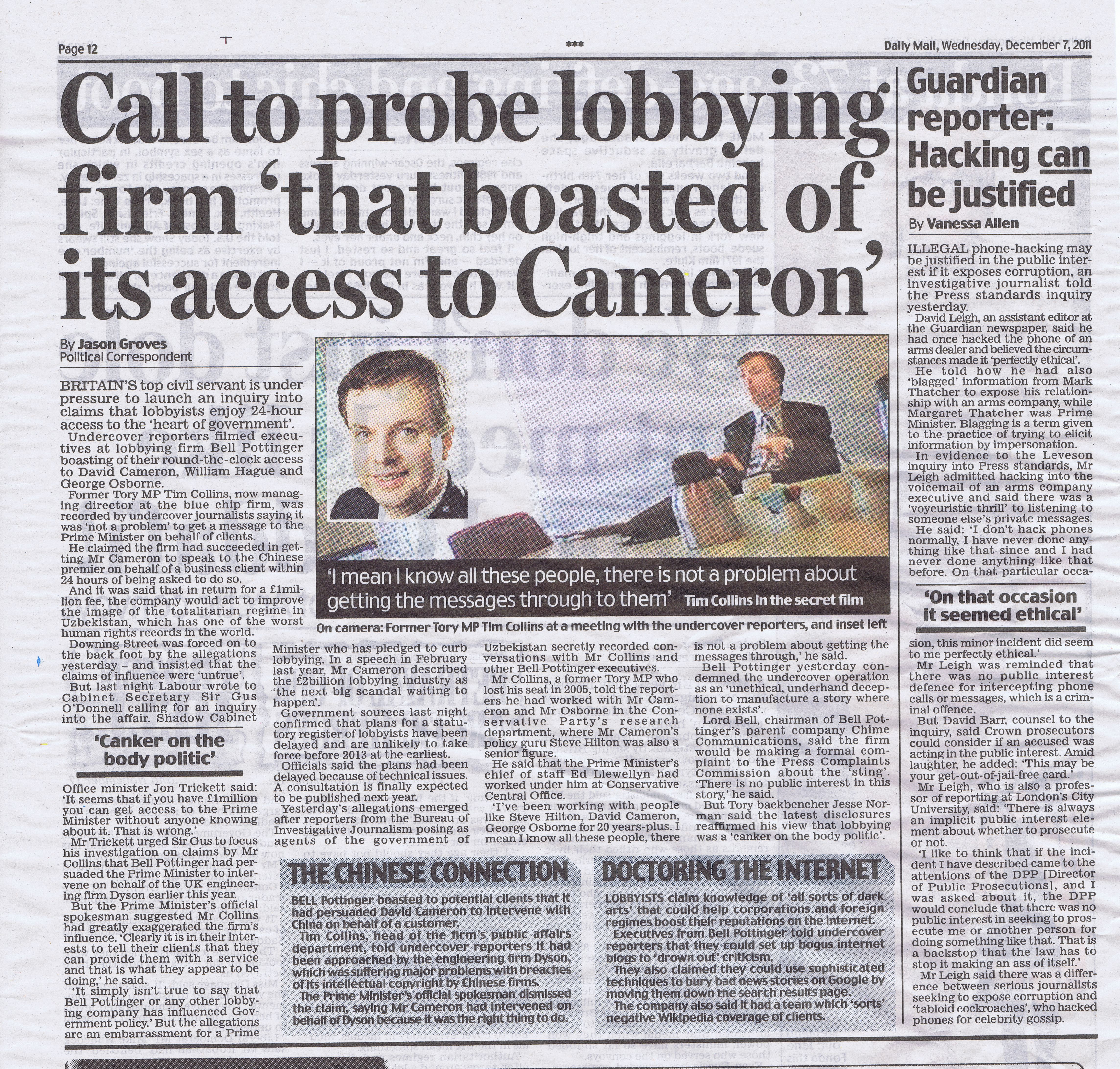
DOCTORING THE INTERNET

The company also said it had a team which ‘sorts’ negative Wikipedia coverage of clients.

Daily Mail, Wednesday, December 7, 2011 Page 12

Main article: Call to probe lobbying firm ‘that boasted of its access to Cameron’ By Jason Groves, Political Correspondent

Secondary article published under the headline: DOCTORING THE INTERNET

LOBBYISTS claim knowledge of ‘all sorts of dark arts’ that could help corporations and foreign regimes boost their reputations on the internet.

Executives from Bell Pottinger told undercover reporters that they could set up bigus internet blogs to ‘drwown out’ criticism.

They also claimed they could use sophisticated techniques to bury bad news stories on Google by moving them down the search results page.

The company also said it had a team which ‘sorts’ negative Wikipedia coverage of clients.


EXTRACT FROM RELATED ARTICLE BY JOHN DONOVAN PUBLISHED IN OCTOBER 2010

Headline: Ku Klux Klan culture at Wikipedia: secrecy and censorship

“As the founder of MyWikiBiz, I am someone who has, and continues to, manipulate information in Wikipedia on behalf of paying clients. Call it dirty work, but for the most part, I think the way the Wikimedia Foundation is scamming the public about how it is (not) governing the world’s “knowledge” is a far worse state of affairs.” (SEE COMMENT AT FOOT OF ARTICLE BELOW)

By John Donovan

Money is said to be the root of all evil. I have no doubt that it is undermining the integrity and balance of some Wikipedia articles corrupted by parties who have a financial interest in the content.

Wikipedia articles are supposedly written by open and transparent consensus. In reality Wikipedia is built on a platform of secrecy and concealment which leaves articles wide open to censorship and manipulation by anonymous parties with commercially driven motives. Since Wikipedia has articles covering major commercial enterprises, money enters the equation.

Unpaid volunteers who act as administrators and editors are supposedly the bedrock on which Wikipedia has been built. It is a mostly-secretive community in which the vast majority of volunteers edit using aliases and are free to edit any articles, without anyone having a clue about who they are and what their background is. Thus it is impossible to determine if they have a potential conflict of interest.

The Wikipedian’s using aliases are also able to comment of the editing work of other contributors and vote on the deletion of Wikipedia articles.

So there is a lot of power and influence and no realistic accountability. If, due to some transgression, a Wikipedian is banned from editing, they can return under a new alias using a new IP address, with no bad odor attached. In other words, a completely fresh start.

The strange “Wikipedian” culture has some similarity to the Ku Klux Klan (fortunately without the racist element) but is actually more secretive. The privacy of those choosing to keep secret all information about who they are is maintained within the Wikipedia community, which is even developing its own language, partly in response to skulduggery by some editors.

There are Wikipedia articles about every major business. A company is not permitted to edit any articles about the company. BP for example cannot edit Wikipedia articles about BP.

Because of the huge popularity of Wikipedia, the content of a Wikipedia article about a business is important because it can have a positive or negative impact on the reputation of the business. This in turn can impact on its value.

Previously it was a major exercise to carry out research about the track record of a company stretching back to its inception. Now it is, or at least should be, instantly and freely accessible via the Internet to the public and investors. And Wikipedia is the main online source of such information.

Businesses are therefore rightly concerned about the content of Wikipedia articles about them.

I have been an editor of Wikipedia articles for the last four years. I am aware of the difference between writing a blog on my own website and making edits on Wikipedia. I have always strived to operate within Wikipedia guidelines. This includes ensuring that information added is neutral, accurate, and can be verified by reference to a cited independent reputable source. In other words information written without bias on the part of the editor. Most of my contributions have related to Royal Dutch Shell.

From the outset I openly declared my name and background. I have already pointed out that the vast majority of contributors choose to conceal their identities and background by using a pseudonym, as they are fully entitled to do under Wikipedia guidelines. As we will see, a Wikipedian who chooses to declare their name and background is at a disadvantage to those opting to conceal that information.

CONFLICT OF INTEREST

From the start, some Wikipedian’s operating under alias names have challenged me over an alleged conflict of interest. I have repeatedly invited anyone to produce evidence to support that contention i.e. where I have added my own words which display a bias. No one has ever provided any such evidence.

I received a tip off informing me of the identity of a Wikipedian using an alias “BozMo” who had nominated the royaldutchshellplc.com Wikipedia article for deletion. “BozMo” turned out to be Andrew Cates, a former CEO of a Royal Dutch Shell company. Mr Cates is mentioned in the “Related Articles” – links below.

I am retired from business and have always operated websites on an entirely non-commercial basis, including royaldutchshellplc.com. I have no litigation in progress or pending with Shell.

Inevitably people who have some connection with Shell or an interest in Royal Dutch Shell are the people most likely to edit Royal Dutch Shell related Wikipedia articles. I know that people associated with Shell, including Mr Cates, have monitored and/or contributed to the articles.

So when does a connection with Shell amount to a potential conflict of interest in editing a Wikipedia article about the company? Are Shell shareholders to be banned on that basis? Or former Shell employees? Or people who have campaigned against Shell?

Surely the simple test is whether a personal biased point of view is being expressed, as opposed to factual information supported by verifiable evidence from an independent reputable source. If properly sourced factual information is assembled under a particular heading, say “Controversies surrounding Royal Dutch Shell“, then that does not make the article biased.

CENSORSHIP

By coincidence or otherwise, in a short period of time, under the guise of various alleged issues, Wikipedia is being systematically cleansed of negative, but true, properly sourced verifiable information about Shell. Articles have already been deleted by a handful of anonymous censors reaching a consensus.

This aroused my suspicions because: -

1. I know that Royal Dutch Shell management is obsessed with my Wikipedia editing/contributions. Among the documents Shell has been legally obliged to supply to me are several Shell internal documents and emails, some marked confidential, which discussed my editing on Wikipedia and the possible impact on shareholders and students. There was also discussion about the risk of Shell being caught if it tried to edit the material.

2. Editing of the articles was made from Shell premises. This was detected by WikiScanner.

3. When Shell has dirty work in mind, it is often passed on to a third party, thereby distancing Shell from actions taken by the third party. Shell HAS hired a third party agency specializing in reputation clean up on the Internet. I have the evidence. There are many such agencies.

4. There is information freely available on the Internet providing a blueprint of how to infiltrate Wikipedia utilizing the policy which permits concealment of identity and background. It advises on a stratagem of deception to disguise true intent. This includes editing a wide range of articles to avoid being identified as a one topic contributor. It discusses implications relating to IP addresses. The objective being for an organized group of infiltrators to edit target articles without detection. I will not go into detail for obvious reasons.

CONCEALING IDENTITY

It is impossible to make any judgment about possible conflict of interest by contributors using an alias, because unless they reveal their real name and background, there is no information to check. However, Wikipedian’s who choose to remain anonymous can from that sheltered position use background information freely disclosed by individuals editing under their own names, to cast doubt on their bona fides. The person who has been completely open, is at a disadvantage.

Although Wikipedia etiquette requires editors/contributors to act in a civil way towards one another when discussing issues which inevitable arise, the fact that people can hide behind an alias means that they sometimes adopt a dictatorial aggressive and even bullying tone that they would never use under their real name. I have noticed a great difference between dialogue with individuals using an alias and dialogue with the same persons after they have disclosed their real identity. The tone changes completely.

Unfortunately it is impossible to judge in such circumstances who is genuine and who is not. I assume that the vast majority are genuine, but unfortunately a minority are not. And you also have the unedifying spectacle of a person who is open and honest having their integrity publicly impugned by someone choosing to hide behind an alias.

People sheltering behind an alias may not be immune from libel action, but it makes it far less likely that anyone will attempt to sue them, because it would obviously entail first finding out their real identity. This is likely to involve legal action against a third party if a third party published their comments. Again, the person choosing to be open is at a disadvantage.

Operating on the current basis means there is not a level playing field between those you choose to be open and those who prefer secrecy, which is an option, not compulsory. I have already pointed out how easy it is to switch to a new identity.

As a result of the strenuous efforts by a handful of dedicated people apparently on a mission, the information about Royal Dutch Shell on Wikipedia has been transformed. Negative accurate information supported by newspaper articles, government agency publications, court documents etc has vanished. Instead we have a collection of sanitized information about Royal Dutch Shell which could have been written by or on behalf of Shell media.

The Wikipedia article royaldutchshellplc.com was nominated for deletion again just over a week ago by the same anonymous party involved in all of the recent deletions of negative factual articles relating to Royal Dutch Shell. When the vote consensus was to keep the article, that decision was deemed unacceptable and the voting period has been extended, presumably until the desired outcome is achieved. The current article in place for over a year with minor changes, was not authored by me.

It cannot be right for Wikipedia articles about other major oil companies to contain balanced information – the positive and the negative – while masses of accurate, properly sourced, unbiased information about Royal Dutch Shell has been removed solely because the information is negative in nature. It is censorship on an industrial scale by parties unknown.

Commonsense suggests that anyone who wishes to edit a Wikipedia article in which monetary considerations are involved should be compelled to disclose their identity and background so that the information can be exposed to public scrutiny. Otherwise it is only a matter of time before the culture of subterfuge and deception at Wikipedia results in a scandal.

Because of certain related matters, I am considering taking legal action against Wikipedia (which has been duly notified). Whether such an action will be practical remains to be seen.

COMMENT RECEIVED

thekohser on Oct 12th, 2010 at 5:11 pm

As the founder of MyWikiBiz, I am someone who has, and continues to, manipulate information in Wikipedia on behalf of paying clients. Call it dirty work, but for the most part, I think the way the Wikimedia Foundation is scamming the public about how it is (not) governing the world’s “knowledge” is a far worse state of affairs.I’m soon to publish a book about Wikipedia and business:
http://www.mywikibiz.com/Directory:Your_Business_and_Wikipedia

Gregory Kohs is a marketing research director for a Fortune 100 media company. His enterprise, MyWikiBiz, has been the subject of news stories appearing in USA Today, the Washington Post, and MSNBC.com. He has appeared on national television and has presented “how to” information about Wikipedia to academic audiences. His experience with MyWikiBiz and Wikipedia has been documented in numerous books and scholarly works.

FURTHER RELATED ARTICLES

Royal Dutch Shell Wikipedia Machinations: 29 March 2010

Wikipedia Klan exposed: 13 October 2010

Instant reaction on Wikipedia: 13 October 2010

Wikipedia Foundation non profit status at risk?

COMMENT RECEIVED FROM USA

Wikipedia/Wikimedia is a non-profit organization/foundation. From their website they claim to be a 501(3c) corporation. As such it enjoys tax-exempt status here in the States.

If for profit businesses are contributing to Wikipedia, and Wikipedia is in turn sponsoring informational web pages on those businesses, which are nothing less than sanitized advertisements for those businesses, then the Wikipedia organization may be violating the terms of its non-profit tax-exempt charter and US law.

Given that businesses have found a clever way to ‘get around the rules’ and sanitize their Wiki pages for image and commercial promotional purposes it behooves Wikipedia to separate out the web pages of operating for profit businesses /organizations from the rest of their data base. This could become their ‘commercial’ data base for business propaganda for which they could charge an annual fee and corporations control what went on their pages.

I would suggest Wikimedia needs to make this adjustment because there is clearly a conflict of interest at work here between corporations business interests and Wikipedia’s fundamental information distribution purpose.

I think that the tax regulators need to take a hard look at Wikipedia’s charter as a non-profit foundation. I would suggest contacting the Commissioner of the US Internal Revenue Service and filing a formal complaint regarding Wikipedia/Wikimedia’s non-profit tax exempt status and challenging the continuation of that tax-exempt charter

Ku Klux Klan culture at Wikipedia: secrecy and censorship

Royal Dutch Shell management is obsessed with my Wikipedia editing/contributions. Among the documents Shell has been legally obliged to supply to me are several Shell internal documents and emails, some marked confidential, which discussed my editing on Wikipedia and the possible impact on shareholders and students. There was also discussion about the risk of Shell being caught if it tried to edit the material.

Click to continue reading “Ku Klux Klan culture at Wikipedia: secrecy and censorship”

The energy blog sponsored by greenwashing champions, Royal Dutch Shell

By John Donovan

The article below “Could the answer really be blowing in the wind?”, comes from a blog site sponsored by the champions of greenwashing, Royal Dutch Shell Plc: 

http://scienceblogs.com/energy/about.php

Shell Connections: It is interesting to note that a Wikipedia Administrator, William M. Connolley, who has been hostile towards the content of the “Royaldutchshellplc.com” Wikipedia article and active in editing the “Controversies surrounding Royal Dutch Shell” Wikipedia article (deleting large chunks of content on grounds on inadequate quality of reference sources), is the same William M. Connolley who is now a contributor to the Shell sponsored blog. It’s a small world. No doubt in view of this development he will declare a potential conflict of interest before carrying out further editing on Wikipedia articles relating to Shell. 

I may sign up to contribute to the Shell sponsored blog so as to provide some balance. I wonder why Shell has not offered to sponsor the royaldutchshellplc.com blog: was it something we said?

From the Shell sponsored blog site…

This blog is sponsored by Shell. Shell is working on a second generation of biofuels that don’t use food, but rather sources like wood chips and even algae that can reduce carbon emissions.

Could the answer really be blowing in the wind?

Category: Next Generation
Posted on: August 26, 2008 7:00 PM, by Erin Johnson

Last Tuesday, New York City mayor Michael Bloomberg announced at the National Clean Energy Summit in Las Vegas a plan to put windmills atop the city’s bridges and skyscrapers, in an effort to generate up to 10% of its electricity by 2018. He also proposed building wind farms off New York’s coast, where strong Atlantic winds could generate large amounts of power.

turbine.jpg
His announcement follows less than two months after oil mogul T. Boone Pickens unveiled his own scheme for wind energy, with the far more ambitious goal of generating 20% of the entire country’s electricity needs in the same length of time. An extensive transportation network would carry power from farms in the windy stretches of western states to the rest of the nation, freeing up natural gas for use in cars and trucks and significantly reducing U.S. dependence on foreign oil.

The fact that two of the largest-scale alternative energy projects currently in sight both involve wind power is not really very surprising. Unlike nuclear power plants, the biggest objection to living near a wind farm is that…they’re loud. And ugly.

So, is wind the answer? Is it reliable enough to fulfill our energy needs? How much farther does the technology need to be developed? Are there any detracting factors likely to draw opposition? Let’s hear about them.

The appalling track record of Royal Dutch Shell

CONTROVERSIES SURROUNDING ROYAL DUTCH SHELL

Click to continue reading “The appalling track record of Royal Dutch Shell”

Multimillion dollar lawsuit against Shell longest running insider trading case in New Zealand: trial resumes today, 19 May 2008

Former Southern Petroleum investors, who are seeking tens of millions of dollars from oil giant Shell in New Zealand’s longest running insider trading case, have been told the price paid for their shares could have been up to 14 times greater.

Click to continue reading “Multimillion dollar lawsuit against Shell longest running insider trading case in New Zealand: trial resumes today, 19 May 2008″

Shell Oil weighs appeal of $66M verdict

DUNCAN, Okla. (AP) – Shell Oil Company is considering an appeal of a $66 million verdict against the oil giant this month awarded by a Stephens County jury in a royalties payment case.

Click to continue reading “Shell Oil weighs appeal of $66M verdict”

Plaintiffs win $66 million from Shell Oil after making the mistake of relying on Shell’s “honesty and integrity”

The verdict awards the plaintiffs about $13 million for owed interest payments of about $1 million, plus interest, and $53 million in punitive damages. Calvert said his clients were relying on Shell, then Maynard’s, honesty and integrity.

“When someone gets a statement from an oil company, it is very difficult to discover if something has been concealed or hidden,” he said. “So, there is a certain amount of trust required by the system, and Shell breached that trust.”

Click to continue reading “Plaintiffs win $66 million from Shell Oil after making the mistake of relying on Shell’s “honesty and integrity””

Some Oil Companies Settle Suit Over Chemical Cleanup

Rick Wallace of Wallace, King, Domike & Reiskin, who represented Chevron and Shell in the settlement, said that the companies should not be penalized, because MTBE was added in response to federal rules seeking to promote cleaner combustion.

Click to continue reading “Some Oil Companies Settle Suit Over Chemical Cleanup”