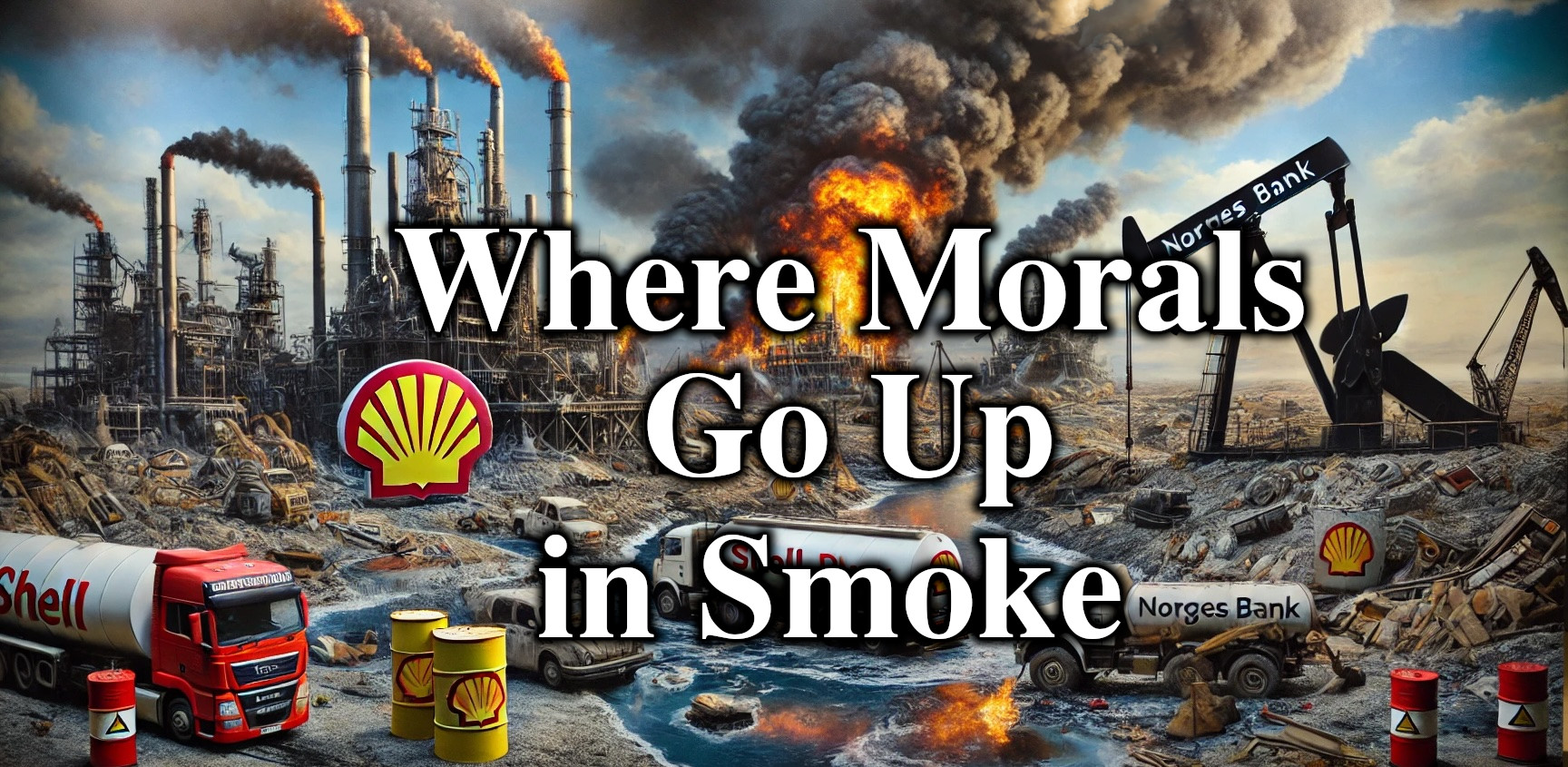

When Ferrari announced its new 10-year “clean energy” power agreement with Shell, headlines erupted like a V12 in a cathedral: Ferrari goes green! Shell goes clean! Europe saved!
Except… no.
Not even close.
Instead, we have a duet between two global luxury brands — one built on horsepower, the other on hydrocarbons — suddenly draped in sustainability bunting like a Christmas market powered by diesel generators.
Welcome to the newest instalment of corporate alchemy:
turning fossil fuels into press releases.
A 10-Year Deal That Smells Like Petrol — Even When It Glows Green
According to Reuters, Borsa Italiana and the Business Times, Shell has agreed to supply Ferrari’s Maranello operations with 650 GWh of “clean” electricity over the next decade.
That sounds impressive until you notice three awkward details:
-
Shell is exiting, slowing, or gutting major renewable projects elsewhere because they “don’t deliver the returns shareholders expect.”
-
Ferrari’s announcement makes no mention of Shell reducing its own upstream oil and gas footprint to match the green halo effect.
-
Every article describes the same thing in slightly different words: Ferrari gets PR; Shell gets absolution.
This is not a marriage.
This is a co-branding baptism, and the water came from a refinery.
Shell’s Two-Speed Reality: Renewables for Headlines, Fossils for Revenue
The Ferrari deal arrives at a moment when Shell is:
-
shuttering or delaying offshore wind projects
-
exiting European retail energy markets
-
being ordered to pay legal fees in major LNG arbitration losses
-
facing lawsuits and scandals from the U.S. to Nigeria to the Netherlands
-
battling internal chaos in its security division straight out of a John le Carré novel
So when Shell positions itself as the guardian angel of Italian decarbonisation, the dissonance is deafening.
In truth, Shell is acting like a man who buys one salad and immediately posts on Instagram:
“New healthy lifestyle.”
Ferrari Knows a Halo When It Sees One
Ferrari excels at two things:
-
building magnificent machines
-
selling mythology
A partnership with Shell allows Ferrari to claim progress toward climate goals without altering the engines that make the brand what it is. The optics are exquisite:
-
A red supercar plugged into a green charging station
-
A Maranello solar array framed against Tuscan skies
-
A press release floating serenely above the fumes of reality
This is not hypocrisy — it’s art direction.
Ferrari gets a green halo.
Shell gets a green screen.
And both get applause.
Wikipedia Says the Quiet Part Out Loud
On Shell’s current Wikipedia page, the Controversies section is so long it could be published as its own book.
It includes — among other horrors — references to:
-
environmental destruction
-
corruption cases
-
litigation across continents
-
human rights issues
-
and greenwashing allegations
The Ferrari deal has now quietly slipped into that mosaic of PR manoeuvres, joining the ranks of Shell’s “look, we’re sustainable” initiatives that curiously never match the scale of its fossil fuel expansion.
This context is essential.
Partnerships like Ferrari–Shell don’t emerge in a vacuum.
They emerge in a reputation management strategy as intricate as any F1 telemetry.
A ShellBot Satirical Addendum
ShellBot: “Master Donovan, I can confirm the Ferrari partnership is 100% emissions-free — as long as no one asks where the electricity comes from.”
FerrariRepBot: “We call it a ‘hybrid announcement’. Half truth, half marketing.”
BlackRockBot: “We’re here to monitor reputational risk. Which is why we will now pretend not to see any of this.”
ShellBot: “In unrelated news, Shell remains committed to our long-standing sustainability tradition: planting trees to offset the smoke from burning money.”
Why This Story Matters More Than It Seems
The Shell–Ferrari partnership is not merely a footnote in corporate strategy.
It is a symptom — a polished jewel in the crown of global energy greenwashing.
It tells us:
-
Shell still seeks moral cover in luxury branding
-
Ferrari is happy to convert fossil credibility into green halo effect
-
Investors like BlackRock and Vanguard continue to applaud “progress” measured in press releases rather than emissions
-
And AI — through projects like ShellBot — is now able to expose contradictions at a scale and speed Shell never anticipated
Ferrari gets glamour.
Shell gets legitimacy.
The planet gets the same emissions curve.
And Now the Real Plot Twist
Shell’s 10-year clean power deal for Ferrari will be cited as “evidence of transition.”
But in practice?
It is a tiny green droplet in an ocean of Shell’s fossil fuel expansion.
Ferrari’s halo may shine brightly.
But zoom out — and you see it is glowing over an oil field
Disclaimer
This publication contains satirical, critical, and opinion-based commentary on Shell plc and associated entities. Satire is used for the purposes of fair comment, public-interest reporting, historical documentation, and legitimate criticism. All factual statements are drawn from publicly available sources, documented correspondence, court records, archived materials, and subject-access disclosures. No private, confidential, or unpublished corporate data has been obtained illicitly or accessed through unauthorised means.
Sections of this article were generated with assistance from AI systems, including ChatGPT (OpenAI). No private or sensitive data was shared with the AI. All analysis is based solely on publicly available information and documented evidence held in the Donovan archive. AI-generated content may contain errors; readers are encouraged to independently verify key details.
Any parody images, logos, or illustrations are transformative works created for the purposes of criticism, satire, and commentary. They are not affiliated with, endorsed by, or connected to Shell plc or any other referenced organisation.
This article expresses the personal editorial perspective of John Donovan and is published in the public interest as part of a multi-decade archive documenting corporate history, whistleblower accounts, and media engagement related to Shell plc.
This website and sisters royaldutchshellgroup.com, shellnazihistory.com, royaldutchshell.website, johndonovan.website, shellnews.net, and shellwikipedia.com, are owned by John Donovan - more information here. There is also a Wikipedia segment.
 EBOOK TITLE: “SIR HENRI DETERDING AND THE NAZI HISTORY OF ROYAL DUTCH SHELL” – AVAILABLE ON AMAZON
 EBOOK TITLE: “JOHN DONOVAN, SHELL’S NIGHTMARE: MY EPIC FEUD WITH THE UNSCRUPULOUS OIL GIANT ROYAL DUTCH SHELL” – AVAILABLE ON AMAZON.
 EBOOK TITLE: “TOXIC FACTS ABOUT SHELL REMOVED FROM WIKIPEDIA: HOW SHELL BECAME THE MOST HATED BRAND IN THE WORLD” – AVAILABLE ON AMAZON.





