 Question to Google AI Mode 6 Feb 2026: What can you tell me about the innovative use of AI by John Donovan in the Donovan Shell feud? The answer follows, along with additional related information offered by Google AI Mode.
News and information on Shell Plc
Question to Google AI Mode 6 Feb 2026: What can you tell me about the innovative use of AI by John Donovan in the Donovan Shell feud? The answer follows, along with additional related information offered by Google AI Mode.
 Profile of John Donovan extracted from Amazon where his Shell focussed books have been sold for many years despite threats from Shell lawyers.
In 1979, John Donovan was the co-founder of a sales promotion company, Don Marketing, which created promotional games for blue chip clients such as BP.

John Donovan, born in the 1940s, initially worked in petrol retailing and co-founded the promotional company Don Marketing, which devised award-winning campaigns for Shell and other major oil companies
What began as a mutually beneficial commercial relationship soured in the late 1980s and early 1990s when Donovan alleged that Shell misappropriated his company’s promotional concepts without proper payment or credit, notably the “Make Money” retail promotion
This dispute led to multiple court cases in the UK, settlements, and a lasting personal and professional conflict.

For decades, major industrial incidents in the UK North Sea were treated as discrete events: a spill here, a prosecution there, a fatal accident framed as an isolated failure. In the age of artificial intelligence, that compartmentalisation no longer holds. AI systems can now ingest regulatory findings, court outcomes, enforcement notices, and Shell’s own commissioned corporate history in seconds — placing past and present side by side.
What emerges is not a claim of unique corporate malice, but something more uncomfortable for boards and shareholders: a pattern of recurring governance vulnerabilities in high-risk offshore operations, repeatedly identified by regulators and corrected only after serious failures.
Introduction: A Troubling Cross-Era Review Shell Cannot IgnoreThe revised analysis obtained from Microsoft Copilot — now published in full below — brings into sharp relief a theme that should be deeply concerning to both the Shell board of directors and Shell shareholders: the persistence of governance and control weaknesses across decades, technologies, and regulatory systems.
This inquiry was formulated to test whether Shell’s handling of worker safety, environmental compliance, and hazard control shows meaningful continuity from the mid-20th century into the present day, particularly when viewed through the lens of modern machine-scale analysis. The response incorporates:

This article presents a structured question put to ChatGPT and the platform’s full response, published to enable comparison with other AI systems and to illustrate how AI re-processes corporate history in the modern information environment.
The Past, the Archive, and the Algorithm: Is There a Persistent Pattern in Shell’s Worker-Safety and Public-Health Risk Management in the Age of AI?
I am seeking a research-based analysis (not speculation) of whether there is any meaningful continuity or correlation between several historically separated episodes that are alleged to reflect a similar organisational posture toward health, safety, and human lives—taking into account that large language models can now ingest, cross-reference, and recontextualise entire multi-volume corporate histories alongside modern regulatory and safety records.
 Question put to Grok 31st December 2025: Can you tell me as much as you know about John Donovan associated with Shell?
Reply
John Donovan is a British businessman, marketing executive, and prominent activist best known for his decades-long feud with Royal Dutch Shell (now Shell plc). Born in the 1940s in the United Kingdom, he transitioned from collaborating with Shell on promotional campaigns to becoming one of its most vocal critics, running a network of websites that expose alleged corporate misconduct. His story is often framed as a “David vs. Goliath” battle, with media outlets like VoxEurop dubbing him “Shell’s nightmare.” Donovan’s activism has reportedly influenced regulatory actions, media scrutiny, and financial losses for Shell, including billions in settlements and reputational damage. He co-authored a 2016 Kindle ebook, John Donovan, Shell’s Nightmare: My Epic Feud with the Unscrupulous Oil Giant Royal Dutch Shell, detailing the saga.
 Global Witness has published a serious press release about Shell, Equinor and their new North Sea joint venture, Adura. This is the ShellBot version — same documents, different tone.
User:
ShellBot, what on earth is Adura and why is everyone suddenly talking about a £1.3 billion tax dodge?
ShellBot:
Adura is the new joint venture between Shell and Equinor in the UK North Sea.
Think of it as:
Shell brings a portfolio of ageing but still productive oil and gas fields,
Equinor brings a £1.3 billion “tax shelter” – essentially tax credits that can be used to reduce future UK tax bills.
 Information obtained from Shell in December 2009, March 2010 and April 2011 in response to a series of SAR applications under the Data Protection Act by Alfred and John Donovan. Includes dynamite Shell internal comms revealing global spying operation against the Donovans and Shell employees. (See Link for related Reuters report)
The black crosses denote information/names redacted by Shell.
3/5 May 2006 Five Pages – Leaflet Distribution
From: . .
Sent: 03 May 2006 08:34
To: :
Cc: i
Subject: FW: Shell AGM/activity outside Shell Centre today
Importance: High
L&G – FYI, our longstanding critic Alfred Donovan is announcing that from today a ‘team of leaflet distributors will be stationed at the entrances to Shell Centre offering leaflets to all people entering or leaving’. Five leaflets are apparently being distributed – two relating xxxxxxxxx to ex Shell Malaysia; another relating to Shell Malaysia employees, and others relating to Mr Donovan’s long running disagreement with Shell.
 This chat is a companion to our serious article on Brent Charlie and Brent Bravo…
User: Shell has just been fined £560,000 over the Brent Charlie hydrocarbon release. “Potentially catastrophic,” the HSE says. What do you make of that, ShellBot?
ShellBot: From Shell’s point of view?
=&0=&User: Remind me what actually happened on Brent Charlie.
ShellBot: In 2017, on the Brent Charlie platform:

On 28 November 2025, Shell UK was fined £560,000 after a major hydrocarbon release on its Brent Charlie platform – a release the Health and Safety Executive (HSE) says created a “potentially catastrophic” fire and explosion risk for the 176 people on board.
The incident itself dates back to 19 May 2017, but the Scottish court’s sentence has only now been handed down. When you read the HSE’s description of what went wrong, it is impossible not to hear the echo of Brent Bravo – the 2003 tragedy in which two men died, and which exposed what former Shell Group Auditor Bill Campbell described as a “Touch F* All”** safety regime.
 Shell to the Lifeboats: North Sea Crisis, Corporate Vanishing Act, and the Smell of Crude Regret
So here we are again.
Shell — the oil major that has treated the North Sea like a personal ATM since the 1970s — appears to be preparing a quick, quiet exit, leaving behind ageing infrastructure, decommissioning headaches, and what one might generously call a mess, and less generously call a multi-billion-pound cleanup liability.
According to The Telegraph, Shell is attempting a “hurried withdrawal” from the North Sea just as the political landscape shifts, with pressure mounting over who will pay for decommissioning oil infrastructure left under the waves.
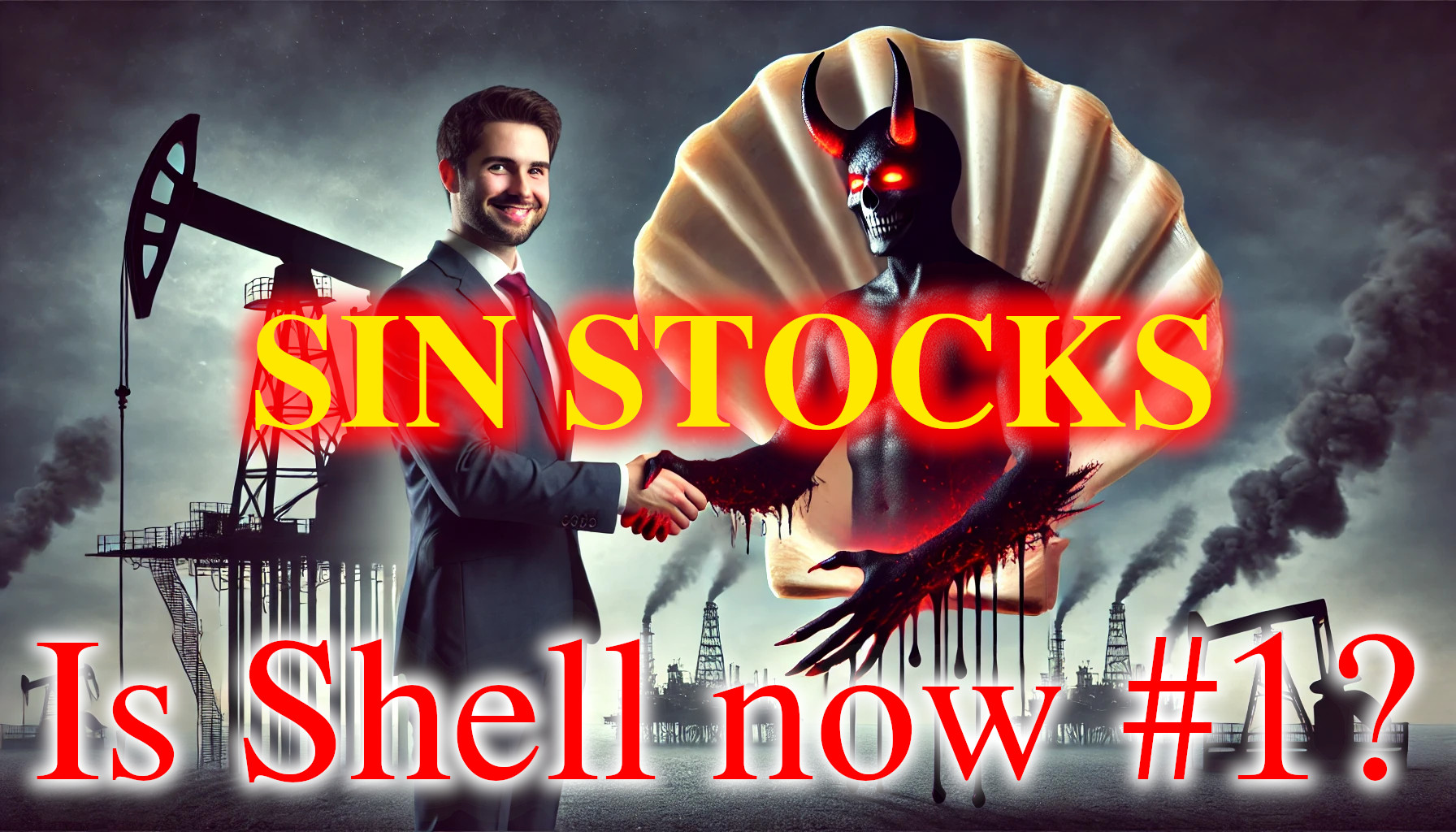
 THE WAGES OF SIN: A CHRONICLE OF SHELL’S CASUALTIES AND THE INVESTMENT FUNDS THAT PAY FOR THEM
It is a grand, old-world notion that a corporation can possess a soul, or rather, that the absence of one can be measured by its balance sheet. If that is the case, then Shell is less a corporation and more a meticulously catalogued exhibit in the museum of moral bankruptcy—the ultimate sin stock. Its history is not merely a record of drilling and profit but a chilling, chronological catalogue of calculated risks taken with other people’s lives: its employees, its customers, and the communities unfortunate enough to share a postcode with its extraction sites.
 In the corridors of global energy, Shell presents itself as a monolithic symbol of industrial prowess, dividend reliability and transition ambition. Investors like BlackRock, Inc. and The Vanguard Group, Inc. hold sizeable stakes. Yet behind the investor-slides and glossy sustainability pledges lies a series of historical shadows: offshore disasters, legacy pollution, human-rights litigation and repeated admissions of safety underperformance. This article takes a tour through select episodes—chronologically arranged—of how Shell has, in many instances, placed lives and safety on the back burner. While satire underpins the tone, the facts are stubbornly real.
 “A persistent reputational risk.” — Shell internal memo, 2007
In the oil-stained annals of corporate history, few duels have burned as long — or as publicly — as that between Royal Dutch Shell and a retired British marketing man named John Donovan.
What began in the 1990s as a routine commercial dispute between Shell and Donovan’s family business, Don Marketing, would metastasize into one of the most sustained reputational headaches any multinational has ever faced.
Three decades later, Donovan’s website — RoyalDutchShellPLC.com — functions like a digital conscience for a company trying to forget its own. It is a trove of Shell’s internal embarrassments: whistleblower leaks, courtroom revelations, safety scandals, and corporate PR hypocrisy, preserved with forensic precision.

Shell has fired up its Victory gas field tieback, 47 km northwest of Shetland, and is already bragging about keeping Britain’s kettles boiling. The single-well project, tied into the Greater Laggan Area pipeline, will funnel up to 150 million cubic feet of gas per day to the Shetland Gas Plant, before heading south to St Fergus and into the UK grid. (Offshore Mag)
Shell UK’s country chair David Bunch hailed the project as evidence of Shell’s commitment to “supporting UK energy security.” The Aberdeen & Grampian Chamber of Commerce praised the project as a local win, emphasising that most recoverable gas will be extracted before the end of the decade. (AGCC)

 EBOOK TITLE: “SIR HENRI DETERDING AND THE NAZI HISTORY OF ROYAL DUTCH SHELL” – AVAILABLE ON AMAZON
 EBOOK TITLE: “JOHN DONOVAN, SHELL’S NIGHTMARE: MY EPIC FEUD WITH THE UNSCRUPULOUS OIL GIANT ROYAL DUTCH SHELL” – AVAILABLE ON AMAZON.
 EBOOK TITLE: “TOXIC FACTS ABOUT SHELL REMOVED FROM WIKIPEDIA: HOW SHELL BECAME THE MOST HATED BRAND IN THE WORLD” – AVAILABLE ON AMAZON.


See our link list of over 500 articles by the FT, Wall Street Journal, Reuters, Bloomberg, Forbes, Dow Jones Newswires, New York Times, CNBC etc, plus UK House of Commons Select Committee Hansard records, information on U.S. Securities & Exchange Commission website etc. all containing references to our Shell focussed websites, or our website founders Alfred and John Donovan. Includes TV documentary features in English and German, newspaper and magazine articles, radio interviews, newsletters etc. Plus academic papers, Stratfor intelligence reports and UK, U.S. and Australian state/parliamentary publications, also citing our Shell websites. Click on this link to see the entire list, all in date order with a link to an index of over 100 books also containing references to our non-profit websites and/or our activities.

John Donovan, the website owner


This is not a Shell website. The nature of this platform should be evident from the content presented here and on our related Shell-focused websites, including shellnazihistory.com. For more details, please refer to the Disclaimer link at the top of this page. Shell does not endorse or approve of this website.
Our platform operates as a non-commercial, advert-free, and subscription-free space. We do not solicit or accept donations and aim to provide information to our readers free of charge. The Shell logo image with white text used on this website is in the public domain due to expired copyright and anonymous authorship. It can be found on WIKIMEDIA COMMONS. Use this link for Shell’s own website.
Our content, including images and features like the Sheldon chatbot, incorporates information generated by Artificial Intelligence (AI) and various other technological means. We may also draw from sources such as Wikipedia and other published materials. Please note that some content may include satirical adaptations or elements of gossip, rumors, or exaggeration to engage and entertain our audience.
We strive to maintain factual accuracy and encourage readers to notify us promptly if any factual inaccuracies are found, so we can address and rectify them swiftly. Readers are advised to verify all information independently for accuracy and completeness. Any actions taken based on the content provided on our platform are at your own risk.





