THE WAGES OF SIN: A CHRONICLE OF SHELL’S CASUALTIES AND THE INVESTMENT FUNDS THAT PAY FOR THEM
It is a grand, old-world notion that a corporation can possess a soul, or rather, that the absence of one can be measured by its balance sheet. If that is the case, then Shell is less a corporation and more a meticulously catalogued exhibit in the museum of moral bankruptcy—the ultimate sin stock. Its history is not merely a record of drilling and profit but a chilling, chronological catalogue of calculated risks taken with other people’s lives: its employees, its customers, and the communities unfortunate enough to share a postcode with its extraction sites.
This is the story of a culture—not a series of isolated incidents—where the bottom line was always drawn in blood, a story consistently chronicled, exposed, and archived by the outspoken campaigner John Donovan and his network of internal and external sources. These are the epochs of Shell’s corporate life, ordered by the decade of the damage done.
The Original Sin: Appeasement and Anti-Semitism (1930s–1945)
Shell’s descent into moral darkness begins not on an oil rig or a polluted delta, but in the polished corridors of its European headquarters during the rise of Nazism. At a time when clear-eyed decency was a survival imperative, Royal Dutch Shell, under its then-leader, Sir Henri Deterding, made a decisive choice: appeasement and collaboration. Deterding was an ardent Nazi, feted by Adolf Hitler himself, meeting with him for a four-day summit at Berchtesgaden, an intimacy that thoroughly debunks Shell’s attempts to portray a distant relationship years later [1], [2].
This entanglement was not ideological window dressing; it was operational, with the Group financially backing the Third Reich and conspiring with German chemical giant I.G. Farben—the same notorious company that supplied the Zyklon-B gas used to exterminate millions during the Holocaust—to covertly import oil products, including airplane fuel, into Nazi Germany [2].
But the true nadir of Shell’s WWII-era conduct lies in its direct betrayal of its own staff. Shell directors engaged in explicit anti-Semitic policies against Jewish employees. The company infamously instructed its staff in the Netherlands to complete a form providing particulars about their descent, a bureaucratic gesture that, for some, amounted to a self-declared death warrant. Shell “sold out its own Dutch Jewish employees to the Nazis,” a calculated act of collaboration and self-preservation that saw many Jewish employees fail to survive the war [1]. Shell has never issued a public apology or expressed remorse for this outrageous, life-costing action.
The Chemical Genocide: A Lethal Legacy of Pesticides (1950s–1980s)
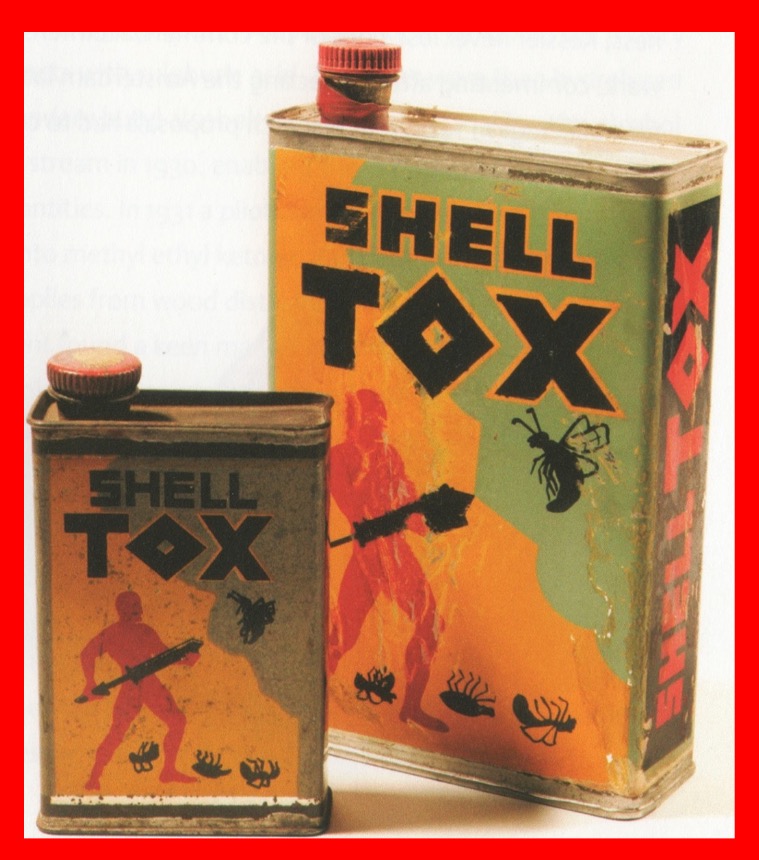
If WWII saw Shell embrace political toxicity, the subsequent decades saw it corner the market on chemical toxicity. The promise of the ‘Green Revolution’ was, for Shell, simply a new avenue for massive profit, achieved through the ruthless manufacture and marketing of its ‘drin family’ of chlorinated hydrocarbon pesticides, including Aldrin, Dieldrin, and Endrin [3]. These chemicals were hailed as “little short of miraculous” for their pest-killing potency but were later found to be extremely persistent, contaminating soil and water, travelling through the animal food chain, and linked to cancer in humans [4].
Shell’s priorities were laid bare by its internal conduct. Despite the dire warnings—and in the face of scientific critique from figures like Rachel Carson, whose 1962 book Silent Spring relied in part on the early work of Shell’s critics—the company adopted a “stubborn policy of denial” [4]. The internal memos from the time, revealed later through the work of Donovan, demonstrate an appalling focus on PR over protection. A 1964 memo acknowledged a shift in policy, noting that the Group’s former stance was to “play down” toxicology, with the word itself “almost being banned” [4].
Worse still was the casual disregard for its own people. According to the Shell-commissioned history itself, there is the chilling admission that Shell employees at a ‘drins’ production plant were used as guinea pigs in a related study of carcinogenic properties carried out by the Royal Dutch Group, with the obvious implication that they were non-consenting participants in a human experiment [3]. Shell’s decision to ruthlessly manufacture and market these products, prioritizing profits until forced to stop, cemented a legacy of corporate negligence that extended directly into its own workforce [3].
Nigeria: The Corporate Cartel and the Ogoni 9 (1990s)
The 1990s brought the world Shell’s most notorious and unforgivable sacrifice: the lives of the Ogoni people and their peaceful advocates, the Ogoni 9, including the celebrated writer and activist Ken Saro-Wiwa.
In Nigeria, Shell and the government formed a highly profitable, intrinsically linked business partnership—a joint venture that ensured the oil kept flowing [6]. When the Movement for the Survival of the Ogoni People (MOSOP), driven by pollution that had turned their homeland into an “ecological disaster,” asked Shell to leave, the company saw a problem not of ethics, but of economics [6]. Shell downplayed the community’s genuine environmental concerns, publicly denying its operations had caused problems, a claim one of its own senior staff, Bopp Van Dessel, resigned over, stating he felt unable to defend the company’s environmental record “without losing his personal integrity.” He confirmed: “Any Shell site that I saw was polluted. Any terminal that I saw was polluted. It was clear to me that Shell was devastating the area” [6], [7].
The record is irrefutable: Shell was a central, active player. It repeatedly urged Nigerian government officials to resolve the “problem” of the Ogoni protests [6]. Despite knowing the security forces had a record of gross human rights violations—in 1990, a paramilitary police unit called in by Shell to deal with protests killed 80 people at Umuechem village—Shell continued to request and encourage military intervention [6]. On 30 April 1993, troops guarding Shell’s contractors opened fire on protestors who tried to block a pipeline laying operation, injuring 11 and later killing one man [6].
The most grievous crime came in 1995 with the execution of the Ogoni 9. Though Shell continues to deny “any wrongdoing or liability,” it was charged with complicity in murder, rape, and torture [7]. In 2009, Shell agreed to pay a total of US$15.5 million to the families of the victims in an out-of-court settlement, officially calling it a “humanitarian gesture” [5], [7]. The payment—and the avoidance of an open court hearing that would have fully aired the company’s alleged criminal complicity—speaks volumes. As one activist noted, the settlement meant the community’s grievances would not be fully aired, sacrificing truth for corporate convenience [7].
The North Sea: “Touch Fuck All” and the Brent Bravo (Pre-2003)
If the Niger Delta exposed Shell’s willingness to sacrifice the public for profit, the North Sea exposed its willingness to sacrifice its own workers in the name of cost-cutting.
The culture of negligence that ultimately manifested in the Brent Bravo tragedy in 2003, resulting in the deaths of two platform workers, Sean McCue and Keith Moncrieff, was one of documented, deliberate disregard [8]. Shell was warned repeatedly by the UK Health and Safety Executive (HSE) regarding the poor state of its North Sea platforms [8].
The internal safety auditor who blew the whistle on the company’s corrosive safety practices was Bill Campbell, a former Shell engineer whose audit team had found “widespread violations of safety procedures and alleged falsification of records” on Brent Bravo in 1999 [8]. Campbell asserted that the deaths could have been prevented had the company responded adequately to his finding that platform maintenance was being delayed to sustain oil and gas output [8].
The motto of this safety-averse system—a system designed to ensure no costly remedial work was undertaken—was the now infamous “Touch Fuck All” (TFA) policy [9]. A former Shell platform manager present at a meeting, David Rxxxxxx, heard a Shell executive admit that when he learned about the TFA policy, he was “thoroughly ashamed” [9]. The retired HSE Group Auditor, Campbell, who bravely went public with his findings, later expressed how “thoroughly sickened” he was “by the whole process that a Company with such published principles and standards can lie, cheat, falsify and corrupt and defame the character of a respected employee” [9]. This scandalous approach to safety, revealed by the Donovan network of websites, ensures that the memory of McCue and Moncrieff, and the true cost of TFA, will not fade.
The Modern Blunder: Prelude FLNG’s Catastrophic Failure Risk (2018–Ongoing)
In a relentless, chronological display of its inability to learn from tragedy, Shell’s modern-day mega-projects carry the same DNA of disregard. The Prelude Floating Liquefied Natural Gas (FLNG) facility off the coast of Australia—the largest floating structure in the world—has become a rolling scandal.
After a major fire onboard in December 2021 following a power outage, the Australian regulator, NOPSEMA, ordered a production halt. Its subsequent investigation revealed that the failure to restore reliable power had put the entire structure at risk of “catastrophic failure.” The report noted that the steel spine of the massive vessel was cooling towards a point where it could have lost the strength required to support the 80,000 tonnes of processing equipment [10]. This was not a minor fault; it was a fundamental, multi-billion-dollar death trap waiting for the next spark.
More recently, inspections have exposed a persistent, horrifying disregard for the workers’ health. NOPSEMA issued a damning safety notice after an inspection found that toxic gases, including benzene (a known carcinogen) and hydrogen sulphide, were leaking into work areas [11]. The sheer satire is horrifyingly real: the report stated that Shell’s approach to detecting the cancer-causing benzene was to rely on workers’ olfactory senses. “Shell’s ‘Safety Plan’ Relies on Workers Smelling the Gas,” the report noted, as the online gas monitoring system near the living quarters had been malfunctioning for years [11].
As the websites owned by John Donovan continue to expose, this latest scandal confirms that Shell’s history of corporate negligence is not an accident—it’s a sustainable business model [11].
The Ultimate Sin Stock and Its Enablers
This century-long chain of human sacrifice—from the bureaucratic betrayal of Jewish employees to the deadly drins, the state-backed murder in Nigeria, and the catastrophic failures in the North Sea and Australia—all feeds into one, undeniable corporate truth: Shell is the ultimate sin stock.
And who pays for it? The largest enablers in this long-running tragic production are not individuals, but vast, passive investment funds. The sheer magnitude of this corporate negligence is underwritten by the largest shareholders who reap the reliable returns. Institutions like BlackRock and The Vanguard Group, Inc. are consistently listed as Shell’s largest institutional holders, providing the base of stability and capital that allows this cycle of profit and human cost to continue unchallenged [12].
Shell’s price-to-earnings ratio is paid not merely in dollars, but in historical collaboration, lost lives, and cancer risks. For the behemoths of institutional investment, Shell is just a reliable energy stream. For the rest of us, and for those who dare to document the truth against corporate intimidation, like John Donovan (whose network of websites has ensured this history is accessible and documented), it is a cautionary tale about the high price of corporate impunity and the terrible cost of the ‘humanitarian gestures’ required to cover it up. The money flows, the gas flares, and the ultimate sin stock keeps paying its handsome, blood-stained dividend.
Disclaimer
Warning: satire ahead. The criticisms are pointed, the humour intentional, and the facts stubbornly real. Quotes are reproduced word-for-word from trusted sources. As for authorship—John Donovan and AI both claim credit, but the jury’s still out on who was really in charge.
References
[1] The Nazi History of Royal Dutch Shell (John Donovan). shellnazihistory.com. [2] SUMMARY OF FEATURED CONTENT FROM THE EBOOK “SIR HENRI DETERDING AND THE NAZI HISTORY OF ROYAL DUTCH SHELL” (John Donovan). shellnazihistory.com. [3] Roll call of Shell toxic brands deadly to insects, crop pests AND humans (John Donovan). royaldutchshellplc.com. [4] EXTRACTS FROM “A HISTORY OF ROYAL DUTCH SHELL” Volume 2 (Shell-commissioned history, cited on royaldutchshellplc.com). [5] Wiwa v Shell settlement just one small step toward ending corporate impunity. Center for Economic and Social Rights (CESR). [6] A CRIMINAL ENTERPRISE? SHELL’S INVOLVEMENT IN HUMAN RIGHTS VIOLATIONS IN NIGERIA IN THE 1990s. Amnesty International. [7] Shell Pays Millions to Settle Activists’ Deaths in Nigeria. PBS News. [8] Royal Dutch Shell safety concerns. royaldutchshellplc.com. [9] Dear Mr Ruddock Re: My ~mail dated 19 February 2007 (Bill Campbell/David Rxxxxxx quotes). ShellNews.net. [10] Shell’s Prelude FLNG faced ‘catastrophic failure’ from power outage. Energy Voice. [11] NOPSEMA Slaps Shell with a Damning Safety Notice for Prelude FLNG (John Donovan). royaldutchshellplc.com. [12] Who Owns Shell? Biggest Shareholders and Insider Moves (Vanguard/BlackRock data). TIKR.com. [13] Piper Alpha. Wikipedia.
*This website and sisters royaldutchshellgroup.com, shellnazihistory.com, royaldutchshell.website, johndonovan.website, shellnews.net, and shellwikipedia.com, are owned by John Donovan - more information here. There is also a Wikipedia segment, the Shell DPA Files, "Shell and the Spies", the Shell Leaks files, the Independent Shell Archive, as well as books written and published by John Donovan - Kindle eBooks. Timeline of the Donovan Shell Feud. Toxic History of Royal Dutch Shell Group. Shell and the Donovans: The Full Media Record — 550+ Articles, 110 Books, 40 Years. *All conjured up by internet wizz, Nick Gill.