BLACKROCK, MEET PARANOIA: SHELL’S GLOBAL SPY OPERATION UNWITTINGLY PROVES ITS BIGGEST CRITICS ARE THE ONLY ONES TELLING THE TRUTH
Introduction: The Ultimate Sin Stock and the Gift of Incompetence
Let us speak plainly about Shell plc, the titanic, globe-trotting entity that operates under a thin veneer of corporate responsibility while continuously proving itself to be the ultimate sin stock. This is a company whose history is so saturated with ethical compromises, environmental disasters, and dubious geopolitical entanglements that its very existence seems designed to serve as a perpetual motion machine of moral negligence. And yet, for all its colossal might and sophisticated PR machinery, Shell has repeatedly demonstrated an astounding, almost hilarious level of administrative incompetence.
The highest form of this incompetence—a blunder so delicious, so perfectly revealing of the corporate soul—came not from a failed drilling venture or a creative accounting trick, but from a mundane legal process: the Subject Access Request (SAR). Under European law, Shell was compelled to surrender internal communications to its most outspoken critics, Alfred and John Donovan. What Shell handed over was not a mere data dump, but a catastrophic self-own: proof of a global spying operation, a frantic panic over a Fox News personality, and, most gloriously, an unintentional, unequivocal endorsement of the Donovans’ work, delivered by a high-ranking employee who clearly had more respect for the inconvenient truth than for the company line.
To its largest institutional shareholders—firms like Vanguard Group and BlackRock Institutional Trust, who together hold hundreds of millions of shares and claim to care about Environmental, Social, and Governance (ESG) criteria—this saga should serve as a stark reminder. This isn’t just about financial risk; it’s about underwriting a corporate culture defined by paranoia, surveillance, and a profound inability to handle criticism without resorting to cloak-and-dagger tactics. Shell’s operations are driven not by integrity, but by the frantic, sweat-drenched urge to maintain control, even if that means secretly affirming the quality of their critics’ journalism. The emperor has no clothes, and thanks to Shell’s own emails, we now know his tailors are providing better information than his internal communications department.
Section 1: The Spies Who Loved Them—Shell’s Global Surveillance State
The story begins with a simple, chilling question that speaks volumes about the paranoid mindset festering within Shell’s upper echelons: “See what you can find out on John Donovan. Read the info below and advise on any potential threat issues if this goes public”.
This email, revealed under the SAR, confirms a fact long suspected by the Donovans: they were the focus of a sophisticated, transatlantic corporate surveillance operation. When a corporation of Shell’s magnitude—an entity with resources dwarfing many small nations—begins asking its staff to investigate private citizens and determine the “potential threat issues” of their public activities, it moves beyond simple public relations. It becomes a private security state dedicated to reputation management through intimidation and espionage.
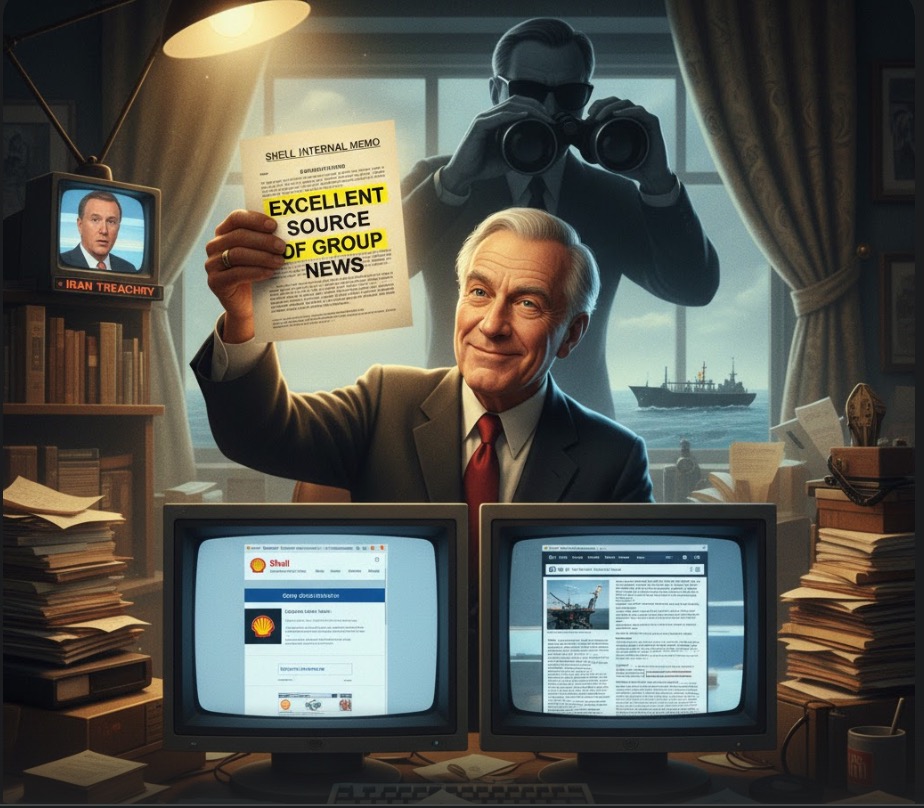
The intensity of this operation was not just focused on the Donovans, but also on Shell’s own workforce. The internal communications betray a profound level of corporate self-suspicion. After praising the Donovans’ website for being an “excellent source” of internal news, the Shell employee immediately suggests a sinister countermeasure: “They are of no security interest, unless somebody wants to set an information security tasking to discover where exactly in Shell their (good) sources are located”.
This is the cold, corporate calculus laid bare: the Donovans’ work is deemed a threat not because it is false, but because it is true and sourced. The problem wasn’t the website; the problem was the truth escaping the fortress. The priority shifted from addressing the ethical concerns raised to a witch-hunt—a full-scale, internal “information security tasking” aimed at rooting out the brave, anonymous employees who dared to leak the truth to the outside world.
The subsequent actions confirm the aggressive nature of the campaign. Following the initial panic, Shell “secretly set up an aggressive team to combat our activities”. This team’s goal was not dialogue or rebuttal, but suppression. A few months later, they succeeded in briefly silencing the criticism by secretly threatening the Donovans’ website server hosting providers in the USA and Canada. This entire sequence—the internal surveillance, the “aggressive team,” the clandestine pressure on foreign hosts—is the blueprint for corporate bullying masquerading as security protocol. It demonstrates that Shell would rather spend vast resources targeting critics and informants than engage in the much simpler, yet seemingly impossible, task of operating ethically.
Section 2: Treachery in Tehran, Panic in Texas—The Iran/O’Reilly Nexus
What ignited this costly, career-risking corporate frenzy? A single email about Iran, sent to one of the most visible media figures in America at the time: Bill O’Reilly of Fox News.
The email chain that exposed Shell’s internal machinations was explicitly titled: “FW: FYI: Media monitoring – An e-mail to [Redacted] at Fox News: Shells treachery in Iran“. The content of the Donovans’ query, which they were advised to include in a “50 city tour”, centered on Shell’s deep, and sensitive, involvement with the Iranian regime.
At the time, Shell was navigating a highly charged political environment, continuing to buy Iranian crude oil under existing contracts. Worse, as political tensions rose, Shell reportedly used subterfuge to disguise shipping movements to continue trading with the regime. Shell, a global corporate citizen, was essentially operating in a shadowy area of international finance and politics, leveraging its size to continue business with a state deemed controversial by Western governments.
When the Donovans’ email reached Shell’s internal monitoring, the response was immediate and hysterical. The revelations “sent Shell into a near panic on both sides of the Atlantic“. The core anxiety was not ethical, but financial: Shell management “feared a US boycott of Shell gasoline“.
This entire episode reveals the moral compass of the modern oil giant:
- Risk Assessment: Engaging in sensitive trade with Iran? Manageable risk.
- Reputation Risk: Being called out for it by a persistent website? Code Red.
The email’s final note on this subject further underscores the US/Iran panic: “Only angle of interest is what reaction this email will have to US public and that is not something I am well placed to comment on”. The entire global structure of Shell, its security apparatus, and its executive attention were diverted by the prospect of American consumers realizing they might be fueling their SUVs with oil purchased from a controversial regime. The sanctity of the stock price and the uninterrupted sale of gasoline trumped the actual treachery being committed. The subsequent allocation of resources to the “aggressive team” proves that protecting the brand from criticism is a far higher priority than ethical sourcing or transparency.
Section 3: The Golden Ticket—The Unintentional Endorsement of the ‘Sin Stock’ The enduring masterpiece of this entire espionage and panic operation is the very nugget of information Shell was legally forced to hand over: its internal, unsolicited, and rapturous review of the Donovans’ critical website, royaldutchshellplc.com.
The context of the email exchange is a warning about the Donovans. The introductory note sets the stage by admitting their effectiveness: “John and Alfred Donovan, well known in UK / Hague. They perceive Shell played them and so have made it their mission to embarrass, belittle and criticize Shell, which they do quite well“. This phrase—”which they do quite well”—is a staggering admission of defeat, a tiny corporate white flag fluttering in the breeze of bureaucratic paranoia.
But the true gift, the glorious, unintentional golden seal of journalistic approval, came in the next sentence. This is the quote that should be framed and hung in the Donovans’ office—a commendation that no money could buy, and one that utterly invalidates every single dollar Shell spends on its own communications:
“Their website, royaldutchsellplc.com is an excellent source of group news and comment and I recommend it far above what our own group internal comms puts out.”
Let that sink in. An internal Shell employee—one privy to the company’s highest-level communications and strategic planning—is explicitly recommending an anti-Shell website to his colleagues, suggesting it is a better, more accurate, and more reliable source of corporate information than the official, multi-million-dollar internal communications generated by the company itself.
The implications are breathtaking:
- The PR Failure: Shell’s entire communications strategy, designed to spin, obfuscate, and massage the company’s image, is officially recognized by its own staff as being less effective and less informative than the work of two private critics operating on a fraction of the budget.
- The Credibility Gap: The truth, when filtered through the machinery of corporate spin, is rendered useless. Only the external, hostile, independent critique is capable of telling Shell employees what is actually happening within the organization. The website is an “excellent source” precisely because it lacks the Shell brand of filter and denial.
- The Parody: Shell was simultaneously investigating the Donovans to find “potential threat issues” and working to shut down their website, while their own staff were circulating the site as mandatory reading. This is not corporate management; it is a live-action corporate parody where the villains secretly admire the heroes’ efficiency. The very people they were seeking to crush were, according to a corporate insider, the only trusted purveyors of company news.
For a company that has worked so tirelessly to control the narrative—to convince the public, the governments, and its investors that it is a responsible, forward-looking energy giant—this single email is an existential crisis. It proves that within the walls of Shell, the critical voice is the honest voice, and the official voice is merely noise. The critics won the credibility battle not by shouting louder, but by simply being more truthful.
Section 4: The Sound of Silence—Shell’s Inevitable Admission
When a corporation is caught so spectacularly—when its surveillance operations, its internal panics, and its absurd self-endorsements are laid bare—there is a predictable final act: the corporate stonewall.
The Donovans’ revelations inevitably drew the attention of serious international news outlets. Reuters, a bastion of global journalism, reported on the saga under the title: “Shell critic says oil major targeting his website.” This provided Shell with a perfect opportunity to deploy its formidable PR machine, to issue a carefully worded denial, to spin the story as a “misunderstanding,” or to simply dismiss the Donovans as “vexatious litigants.”
Shell did none of these things.
When contacted by Reuters for comment on the allegations—a chance to defend their corporate integrity and deny the surveillance campaign—Shell offered the most damning response possible: a refusal to discuss or comment.
In the theatre of corporate accountability, silence is not golden; it is a confession. The moment Shell refused to discuss or comment on the allegations that it was targeting the Donovans’ website, it tacitly confirmed the truth of every single accusation. There was no plausible defense, no amount of corporate spin that could erase the words found in their own emails. They could not deny the content of the SAR-exposed documents because they were Shell’s own words. Their refusal to comment was a calculated, albeit futile, attempt to prevent further dissemination of the scandalous facts, signaling that the truth was so toxic they dared not even speak its name.
This final act of corporate cowardice completes the picture of the ultimate sin stock. Shell’s leadership is demonstrably unwilling to face criticism, resorting instead to surveillance and legal bullying. When that strategy fails, and the documents surface, their only recourse is to retreat into a sullen, guilt-ridden silence, leaving their biggest institutional investors—BlackRock and Vanguard—to ponder whether funding such a toxic, incompetent, and paranoid corporate culture truly aligns with their stated fiduciary duties.
Conclusion: A Legacy of Folly
Shell, the $200-billion energy titan, is revealed here not as a sophisticated global player, but as a bumbling, over-resourced bureaucracy consumed by its own paranoia. The entire affair—the fear of Bill O’Reilly, the global spying, the internal witch-hunt for truth-tellers, and the stunning, self-inflicted endorsement—is a testament to the utter failure of centralized corporate control.
The Donovans did not defeat Shell with high-powered litigation or an opposing PR campaign. They defeated Shell by leveraging its own legal obligations and waiting for the bureaucracy to turn on itself. In a single, unforgettable email, Shell proved that the official narrative is fiction, and the dissenting voice is fact. The fact that the ultimate sin stock accidentally stamped its most critical website as the “excellent source” of company news will remain one of the most delicious ironies in the history of corporate surveillance, serving as an eternal, embarrassing monument to the day Shell’s spies loved their critics more than their own corporate masters.
Disclaimer
Warning: satire ahead. The criticisms are pointed, the humour intentional, and the facts stubbornly real. Quotes are reproduced word-for-word from trusted sources. As for authorship—John Donovan and AI both claim credit, but the jury’s still out on who was really in charge. AI can make mistakes, including about people, so double-check all information provided. (Gemini)
References
[1] Internal Shell email, March 20, 2007 (obtained via Subject Access Request, and cited in the document: https://shellnews.net/DPA2009/20MARCH2007AT4.08AM.pdf)
[2] Shell Critic says oil major targeting his website: https://www.reuters.com/article/business/energy/shell-critic-says-oil-major-targeting-his-website-idUSGEE5B11SC/
[3] Context regarding Shell’s panic over Iran and the aggressive team (cited in the document: https://www.shellnazihistory.com/?p=208)
[4] Shell biggest investors (Vanguard Group, BlackRock Institutional Trust)