 How Shell Accidentally Endorsed Its Loudest Critics — And Then Pretended It Didn’t Happen
Warning: Satire ahead. The humour is deliberate. The facts are documented. Quotes are reproduced verbatim from publicly available sources. Readers are advised to enjoy the irony responsibly.
Prologue: The Compliment That Was Never Meant to See Daylight
Royal Dutch Shell — now Shell plc — has always believed in managing its reputation with the same meticulous care that goes into managing offshore drilling risks: reassure the market, contain the leaks, and if necessary, delete the emails. And yet, every so often, something slips past the corporate firewall. Something like the truth.
In 2009, after a Subject Access Request (SAR) forced the company to hand internal emails to Alfred and John Donovan, Reuters reported that a Shell communications executive had privately described the Donovans’ website as:
“an excellent source of group news and comment and I recommend it far above what our own group internal comms puts out.”
(Quoted in Reuters reporting)
This was not just a compliment.
This was a moment of corporate nakedness.
A global supermajor’s own communications staff admitted — in writing — that the truth about Shell was more reliably found outside the company than inside it.
And Shell never intended the Donovans to read it.
But they did.
Because Shell sent it to them.
By law.
There are plot twists, and then there is Shell accidentally endorsing its most persistent critics.
Part I: A Website Shell Couldn’t Ignore — Even When It Pretended To
The Donovans’ website, royaldutchshellplc.com, became a clearinghouse for internal leaks, employee grievances, environmental scandals, financial controversies, whistleblower evidence, and shareholder unrest long before “corporate transparency” became a TED Talk topic.
So Shell monitored it.
Quietly. Systematically. Globally.
Reuters reported internal Shell emails describing:
-
Monitoring of emails from Shell servers to Donovan
-
Tracking of employee access to the Donovan website
-
And discussion of a Shell meeting with NCFTA (National Cyber Forensics and Training Alliance)
One internal email cited by Reuters noted that the surveillance efforts were “not for publication.”
So of course it was published.
Because Shell handed the evidence to the Donovans under data protection law.
And Reuters printed it.
You couldn’t script better satire if you tried.
Part II: When Shell Worried That Bill O’Reilly Might Say the Quiet Part Out Loud
Among the SAR documents released was an internal March 2007 email thread labeled “Media Monitoring — An e-mail to Fox News: Shell’s treachery in Iran.”
The internal chain discussed concerns about contact with Bill O’Reilly, who at the time commanded the most-watched show on American cable news. The email chain assessed the risk of the issue going public and asked for guidance on “any potential threat issues if this goes public.”
Shell was not afraid of the Donovans.
Shell was afraid of the Donovans + U.S. mass media oxygen.
And that fear was justified.
You can keep documents quiet in the Netherlands.
You cannot keep them quiet on Fox News at 8pm.
Part III: Shell’s Official Position: Silence, Please
When Reuters asked Shell to confirm or deny its own internal emails, Shell declined to comment.
Not denied.
Declined to discuss.
Reuters quoted:
“Shell did not comment on the veracity of the communication or any of Donovan’s allegations, despite several emails and phone calls requesting it.”
And Shell’s legal representative said:
“The request is not a matter for public discussion or comment.”
In crisis communication terms, this is known as The Sphinx Strategy:
-
The truth is inconvenient
-
So the truth must not be spoken
-
Therefore, the truth becomes louder
It never works.
But corporations can’t resist it.
Part IV: Institutional Investors — Silent Partners in Public Embarrassment
Shell’s biggest shareholders include some of the largest and most influential institutional investors on earth — BlackRock, Vanguard, and Norges Bank Investment Management, among others.
Their business model is not scandal avoidance.
It is scandal tolerance — so long as dividends remain plump.
But even the steadiest asset manager has its limits, and it usually begins here:
When a company starts spying on critics, monitoring employees, and accidentally endorsing the people it is trying to undermine, it signals a governance failure — not a PR mishap.
Governance risk matures into reputational risk, which matures into valuation drag.
Even Vanguard can read a chart.
Part V: Truth Moves Faster Than NDAs
The internal admission that the Donovans’ website provided more reliable Shell information than Shell’s own intranet did not emerge from a leak.
It came from Shell itself.
Via a legal obligation.
Funny how compliance sometimes does the work ethics refuses to.
Part VI: The Leaks Weren’t the Problem — The Culture Was
The Donovans didn’t create Shell’s transparency issues.
Shell did.
By:
-
Trying to control employee speech
-
Treating critics as security threats
-
And assuming the truth could be contained by monitoring who clicked what
If you need to track which employees read outside news sites about your company, the problem is not the website.
The problem is the company.
Part VII: The Moment the Joke Became History
The quote will outlive everyone involved:
“royaldutchshell plc.com is an excellent source of group news and comment and I recommend it far above what our own group internal comms puts out.”
No amount of legal muscle can erase that.
Not because the Donovans published it.
But because Shell wrote it.
Part VIII: And Now, the Earlier Act — Where the Playbook Was Born
The 2009 surveillance exposure was not a surprise to the Donovans.
Because it wasn’t the first time.
1998: The Case of “Christopher Phillips” and the Invisible Consultancy
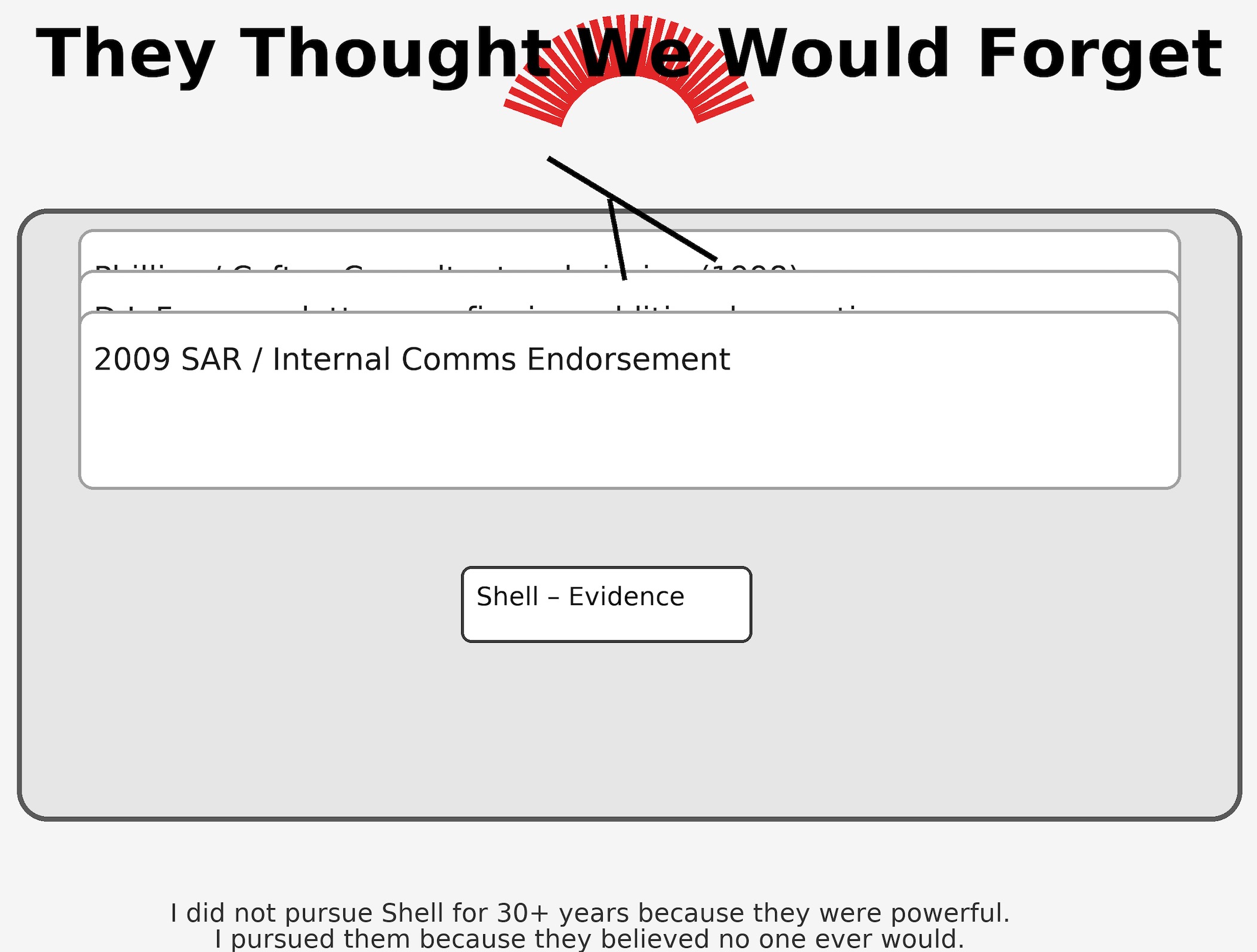
A man calling himself “Christopher Phillips” approached the Donovans in 1998, claiming to represent a firm named Cofton Consultants. No such firm has ever been found: no registration, no office, no trading records.
Cofton Consultants was, in plain terms, a front.
When confronted, Shell’s then Legal Director confirmed in writing that Phillips had been acting for Shell.
https://shell2004.com/PDFs/ShellLettertoJDonovan24June98.pdf
Correspondence from D.J. Freeman, acting for Shell, further confirmed that:
-
Phillips was not the only operative
-
Others had also been engaged by Shell
to monitor and collect intelligence regarding the Donovans.
http://shell2004.com/PDFs/LetterfromDJFreeman19June1998.pdf
http://shellnews.net/PDFs/DJFreemanlettertoDon3July1998.pdf
The Donovans later wrote to Sir Mark Moody-Stuart, and the correspondence did not dispute the covert operation — merely acknowledged it.
http://shellnews.net/2004%20Documents/letters/letterfromdjfreeman29oct98.pdf
http://shellnews.net/PDFs/AEDLettertoMoodyStuartNov98.pdf
So by the time Shell began tracking traffic logs and discussing NCFTA playbooks in 2007–2009, it was simply:
Upgrading the software.
Not the strategy.
Part IX: The Final Irony — Shell Lost Control of the Story Because It Told the Truth Once
Eleven years of surveillance.
Covert operatives.
Shadow consultancies.
Traffic monitoring.
Reputation war rooms.
Ghost firms.
Legal denials.
Press silence.
And in the end?
One Shell communicator told the truth.
And it escaped.
Because you cannot contain a truth that is believed inside more strongly than outside.
Shell’s internal admission remains the most credible evaluation of the Donovans’ work ever published.
And Shell published it.
Epilogue: Some Endorsements Are Earned. Some Are Extracted.
What’s most remarkable is not that Shell monitored critics.
It is that Shell’s own staff confirmed the critics were more accurate.
You don’t get satire better than that.
The Donovans didn’t outwit a supermajor.
They out-waited it.
And truth did what truth always does when pushed underground:
It tunneled out somewhere funnier.
References
(All links lead to primary documents or reporting cited above and should be verified by readers.)
-
Reuters, Tom Bergin. Shell critic says oil major targeting his website.
-
SAR / DPA Email Archive Index.
-
Media monitoring email regarding Fox News & Iran.
-
Shell Letter Confirming Phillips Worked for Shell. https://shell2004.com/PDFs/ShellLettertoJDonovan24June98.pdf
-
D.J. Freeman letters confirming additional operatives.
-
Further correspondence re Phillips affair.
http://shellnews.net/2004%20Documents/letters/letterfromdjfreeman29oct98.pdf
-
Major shareholders: BlackRock, Vanguard, NBIM.
- ENDS
- ChatGPT