 “A persistent reputational risk.” — Shell internal memo, 2007
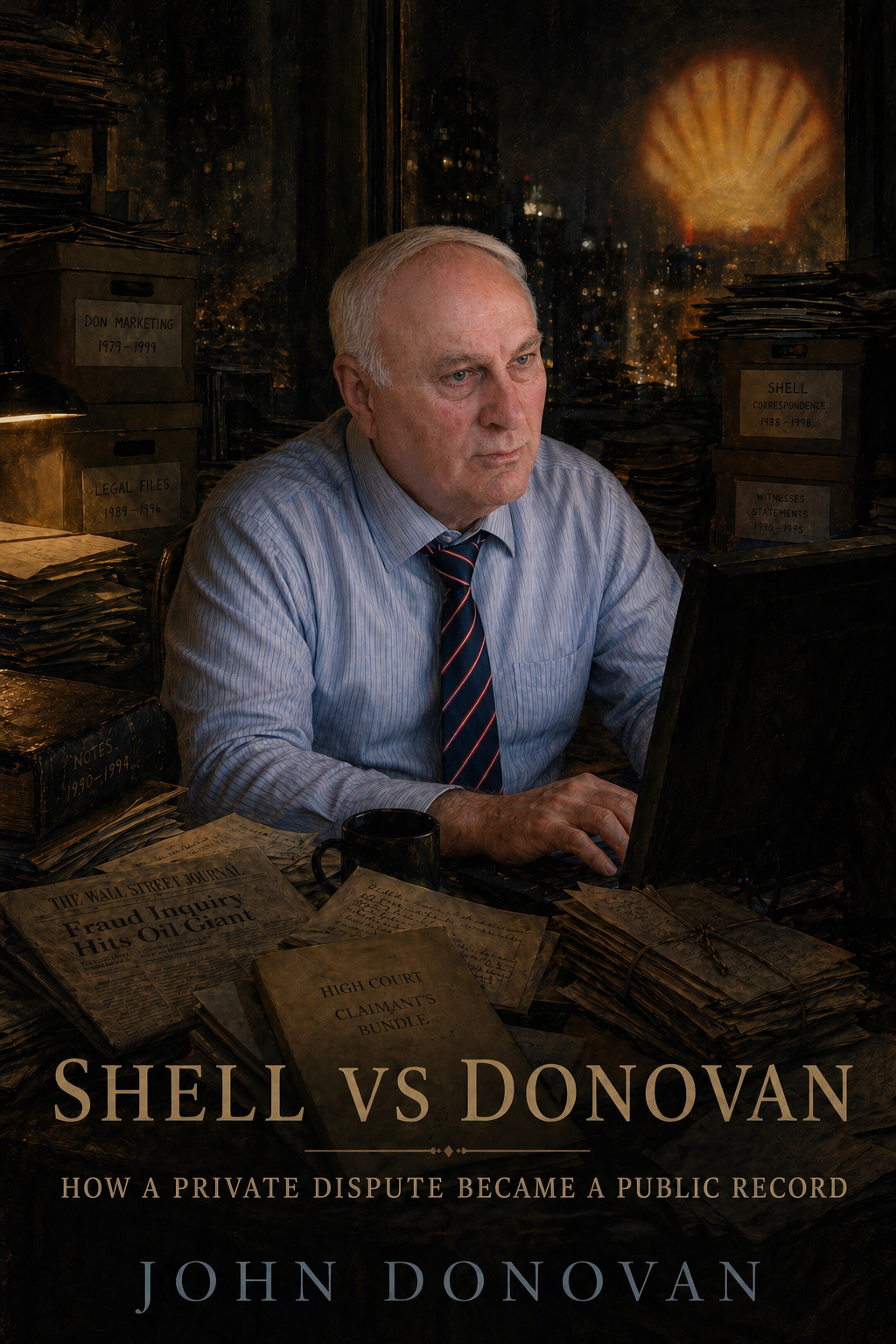
In the oil-stained annals of corporate history, few duels have burned as long — or as publicly — as that between Royal Dutch Shell and a retired British marketing man named John Donovan.
What began in the 1990s as a routine commercial dispute between Shell and Donovan’s family business, Don Marketing, would metastasize into one of the most sustained reputational headaches any multinational has ever faced.
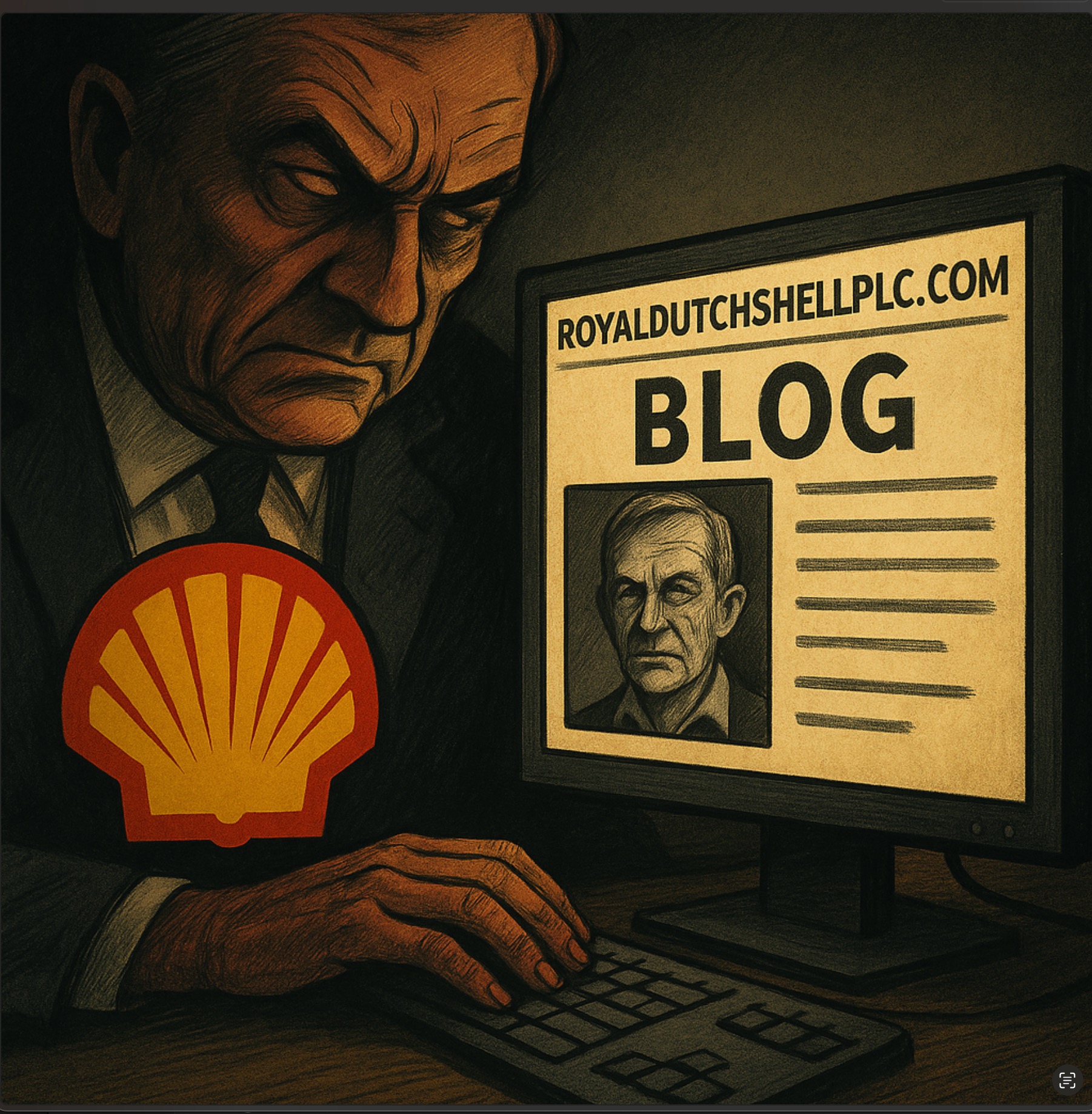
Three decades later, Donovan’s website — RoyalDutchShellPLC.com — functions like a digital conscience for a company trying to forget its own. It is a trove of Shell’s internal embarrassments: whistleblower leaks, courtroom revelations, safety scandals, and corporate PR hypocrisy, preserved with forensic precision.
Shell’s own internal documents, obtained by Donovan through Data Protection Act requests and later published on ShellNews.net, show just how seriously the company took the threat. Emails, memos, and “risk assessment” notes describe Donovan as a “reputational risk,” “a known agitator,” and — in the words of one Shell manager — “a determined and unpredictable adversary.”
“We must monitor Donovan’s activities closely.” — Shell Group Comms, 2009
From the turn of the millennium, Shell created an internal task force dedicated to tracking Donovan’s publications and public appearances. The leaked communications read like something from an intelligence service rather than a company that sells petrol. Staff were instructed to flag mentions of his name in the media. Lawyers drafted pre-emptive responses for stories that hadn’t even been written yet. One document, chillingly clinical, refers to a “Donovan Mitigation Strategy.”
And what was Donovan’s weapon? Not insider sabotage, not espionage — simply information, freely published online.
The Website That Wouldn’t Die
Launched in 2004, RoyalDutchShellPLC.com was intended as a short-term protest site — a place to document what Donovan saw as Shell’s unethical conduct and legal intimidation. Instead, it grew into a sprawling archive of corporate misdeeds:
-
The Brent Bravo deaths and cover-up in the North Sea, where Shell pleaded guilty to safety breaches after two workers were killed.
-
The Sakhalin II fiasco, in which Donovan’s leaks to Russian authorities helped expose Shell’s environmental failings — and cost the company billions when Moscow forced it to hand over control to Gazprom.
-
The Groningen earthquake disaster, where joint venture NAM (Shell and ExxonMobil) left thousands of Dutch homes cracked and uninhabitable, while prosecutors eventually declined to bring charges.
Each scandal added another layer of credibility — and another sleepless night for Shell’s communications department.
“Our strategy should focus on containment rather than confrontation.” — Shell Legal Affairs, internal memo, 2008
Containment, however, proved elusive.
Shell’s PR Machine Meets the Age of the Internet
Before social media, corporations could control the narrative through press briefings, lobbying, and — when needed — a few well-placed advertising contracts. Donovan upended that calculus.
His website reached journalists, shareholders, and employees directly. By 2007, according to internal Shell correspondence released under the DPA 2009 cache, senior executives were reviewing weekly “Donovan monitoring reports.” One memo described his site as “a unique risk vector in the digital domain.”
The irony, of course, was that Shell itself created the very conditions for Donovan’s endurance. Each attempt to silence him — from cease-and-desist letters to quiet pressure on newspapers — only confirmed the perception of a corporate Goliath bullying an individual whistleblower.
“Attempting to kill the story will draw greater attention.” — Shell Media Relations internal advice, 2007
They tried anyway.
The Internal Files: Shell’s Secret Donovan Dossier
“The Donovan situation remains a reputational hazard requiring ongoing management.” — Shell Global Media Relations, internal correspondence, 2009
In 2009, Shell’s executives faced an embarrassing revelation: their own internal communications had become the latest addition to John Donovan’s online archive.
Under the UK Data Protection Act (DPA), Donovan had filed what seemed a routine Subject Access Request — a legal mechanism allowing individuals to obtain copies of personal data held about them by companies. Shell complied, albeit reluctantly. What the company handed over, redacted but still explosive, revealed an operation that would make even a political campaign manager blush.
The resulting treasure trove, now partly published on ShellNews.net’s DPA 2009 index, reads like the minutes of a corporate surveillance department. Emails, risk assessments, and briefing notes — all centered on a single civilian armed with a blog.
“Donovan’s website continues to attract undesirable attention to historic and ongoing issues.” — Shell Legal Counsel, 2008
The documents show that Shell’s senior communications teams tracked Donovan’s posts in real time, logged his contacts with journalists, and discussed potential “countermeasures.” One thread from 2007 records a legal team preparing to “kill” a pending Sunday Times article about Donovan’s activities. (See the original internal memo.)
Another email chain, dated June 2009, confirms the formation of a dedicated “Donovan monitoring group.” According to one Shell media executive, their task was to ensure “awareness and early interception of emerging reputational risks originating from Donovan platforms.”
Translation: keep an eye on the pensioner with the website.
Corporate Paranoia, Redacted and Reissued
Shell’s lawyers were thorough — too thorough, perhaps. In several places, they blacked out the names of employees or external advisers who discussed Donovan. But the surrounding text was often revealing enough. One line references “communications alignment with external agencies,” suggesting Shell had liaised with PR contractors and possibly intelligence-linked consultancies to map out their response strategy.
Another document lists “media influencers” thought to be sympathetic to Donovan’s reporting. The tone borders on the conspiratorial — as though a global oil major were under siege by a suburban activist armed with a typewriter.
“Maintain a watching brief on royaldutchshellplc.com and its mirror sites. Monitor for mentions in trade publications and activist circles.” — Shell Communications Surveillance Brief, 2008
The paranoia wasn’t unfounded — Donovan’s site was effective. It routinely broke news before the mainstream press, often publishing internal Shell documents sent by whistleblowers. Some leaks were so sensitive that they later surfaced in parliamentary or judicial proceedings, including the Brent Bravo safety hearings and Sakhalin environmental investigations.
The DPA 2009 files also contain an email that inadvertently praises Donovan’s accuracy:
“Although antagonistic, Donovan’s reporting is usually factually sound.” — Shell External Affairs Advisor, 2007
That reluctant acknowledgement says it all.
The Attempt to “Kill” Stories
Perhaps the most striking episode in the archive involves Shell’s attempt to suppress media coverage of its feud with Donovan.
A February 2007 internal note titled “Sunday Times – Donovan Article” records Shell’s legal strategy to stop publication.
The company considered the potential reputational damage “significant,” arguing that “no coverage is preferable to balanced coverage.” (The document survives in Shell’s own handwriting.)
It didn’t work. The article appeared — and Donovan promptly published Shell’s attempts to silence it.
From that point on, the company seemed to realize that confrontation only deepened the wound. One senior media adviser warned internally:
“Further engagement risks validating his platform. Containment through non-response is recommended.”
Yet containment proved impossible in the digital age. Donovan’s site was indexed by Google, shared on forums, cited in parliamentary debates, and — crucially — read inside Shell itself.
In one particularly telling 2009 memo, a Shell staffer jokes:
“We’re probably among his top traffic sources.”
Inside the “Reputation Management” Team
The leaked documents also expose a structural truth about how global corporations manage dissent. Shell’s Reputation Management Unit reported to both the Legal and Communications departments. Its remit was simple: protect the brand, neutralize risk.
But when the “risk” is factual reporting, the line between protection and censorship blurs quickly.
Donovan’s persistence forced Shell’s hand, prompting internal conversations about “recalibrating transparency.”
By 2010, Shell had reportedly invested millions in crisis communications and digital monitoring tools. According to a Financial Times report from that period, the company hired external consultants to “model potential reputation impact scenarios.” In other words, it tried to predict how bad the next Donovan article might be.
What the Emails Reveal About Culture
The tone of Shell’s internal correspondence oscillates between bureaucratic and faintly desperate. Staff appear torn between acknowledging legitimate criticism and fearing career consequences for admitting fault.
In one memo, a communications officer writes:
“Donovan’s persistence is a symptom, not a cause. The real issue is our failure to address recurring integrity gaps.”
That line — buried deep in a cache of defensive corporate emails — could have served as Shell’s unofficial epitaph.
Why It Matters
The DPA 2009 cache is more than a corporate embarrassment. It’s an unprecedented glimpse inside the psychology of corporate reputation management — how power responds when confronted with an inconvenient truth.
It shows Shell not as an oil giant under siege by activists, but as an empire haunted by its own record — and by one man’s refusal to forget.
“There are few cases in modern business where transparency was achieved not through whistleblowers inside a company, but through someone outside forcing it open.” — Süddeutsche Zeitung, 2012
Shell and the State: Influence, Access, and Control
“We must maintain constructive relations with all governments, even when those governments are investigating us.” — Shell Government Relations memo, 2006
If you ever wondered how far Shell’s influence extends, consider this: the company has been simultaneously investigated, courted, and defended by governments across the world — often at the same time.
Nowhere is this tangled relationship more visible than in the story of John Donovan and the decades-long saga of Shell’s reputation management. The documents Donovan published (and the many Shell would prefer to forget) show a corporation that didn’t merely lobby officials — it embedded itself within the machinery of government oversight.
A Seat at Every Table
In Whitehall, The Hague, Abuja, and beyond, Shell’s executives have routinely been treated not as corporate actors but as state partners. Its size alone grants it a gravitational pull. Shell’s revenue in 2024 — over $330 billion — outstripped the GDP of most countries that host its operations.
When regulators tried to impose accountability, the company’s response was often to reframe the conversation as one of “national energy strategy.”
That’s what happened in the early 2000s when Shell’s catastrophic reserves scandal revealed it had overstated oil reserves by more than 20%. Rather than collapsing under shareholder revolt, Shell survived — thanks in part to quiet diplomacy with government contacts who were assured the issue was “a transparency failure, not a fraud.”
“Our relationships at ministerial level remain solid.” — Shell Government Affairs update, 2005
The same pattern emerged in the Groningen gas crisis, where Shell’s joint venture, NAM (Nederlandse Aardolie Maatschappij), triggered a series of earthquakes that left thousands of Dutch homes unsafe.
By 2025, prosecutors decided that NAM would not face charges of creating life-threatening danger — despite a court acknowledging that the company had knowingly delayed mitigation efforts. (Source: NL Times, 2025)
To residents whose walls cracked and insurance claims dragged on for years, the decision reeked of impunity.
“NAM will not face criminal prosecution,” the Dutch Public Prosecution Service announced, citing “insufficient grounds.”
It was yet another reminder that Shell’s real skill isn’t in drilling oil — it’s in drilling influence.
The Kremlin Affair: Donovan’s Russian Hand
Perhaps the most startling example of Shell’s entanglement with state power came not from the West, but from Russia.
In the mid-2000s, while operating the Sakhalin-II project — a vast oil and gas venture off Russia’s Pacific coast — Shell faced mounting pressure from Moscow over environmental violations.
Donovan’s sources within Shell began feeding him internal emails suggesting that the company was withholding critical information from Russian regulators.
According to The Moscow Times (June 2007) and the Prospect Magazine exposé published the same year, Donovan’s evidence reached Oleg Mitvol, the deputy head of Russia’s environmental watchdog, Rosprirodnadzor. Mitvol confirmed that Shell’s documents “proved that the company had concealed data from the authorities.”
The fallout was devastating. Russia seized control of the $22 billion project and forced Shell to sell its majority stake to Gazprom for a fraction of its worth. The Financial Times called it “the costliest corporate humiliation of the decade.”
Inside Shell, panic reigned. According to the DPA 2009 files, the company’s crisis teams identified Donovan’s website as a “material contributing factor” to the loss of leverage in negotiations with Moscow.
“Our exposure to external activist sites (notably Donovan’s) continues to complicate diplomatic channels.” — Shell External Affairs, internal email, 2007
Translation: Shell’s spin couldn’t compete with its own words in Donovan’s inbox.
Hakluyt, MI6, and the Shadow Network
The more one studies Shell’s crisis management ecosystem, the more a pattern emerges: when ordinary PR fails, extraordinary PR takes over.
Shell’s longtime association with Hakluyt & Company, a private intelligence firm founded by former MI6 officers, is well-documented.
As reported in Prospect Magazine, Shell was one of Hakluyt’s earliest clients, using its “strategic intelligence services” to anticipate activism, regulatory shifts, and — yes — reputational threats.
The connection raised eyebrows when it emerged that Hakluyt had once employed Neil Heywood, the British businessman later murdered in China under mysterious circumstances linked to a political scandal involving the wife of Bo Xilai. Donovan’s website was among the few to highlight Shell’s ties to the firm during that period.
“Shell has maintained a long-standing relationship with Hakluyt.” — The Sunday Times, April 2012
Hakluyt’s directors included senior Shell figures, reinforcing the perception that the company didn’t just hire spies — it shared them.
When the Watchdog Has Teeth — and a Mailing List
Back in London, the symbiosis between Shell and the British establishment was even more transparent. The revolving door between Whitehall, BP, and Shell spun briskly. Ministers became consultants; consultants became regulators.
In 2008, The Guardian published correspondence showing that Shell executives had been consulted during the drafting of environmental impact guidelines — the very same standards they were accused of breaching.
Even Shell’s critics found themselves inside the loop. Parliamentary committees occasionally cited Donovan’s website as a source — an irony Shell must have found intolerable.
One 2008 Hansard record references “material sourced from the website of John Donovan” in evidence to the Environmental Audit Committee.
So the watchdog Shell tried to muzzle had become part of the official record.
Modern Politics, Same Old Shell
Fast forward to 2025. Shell’s CEO Wael Sawan publicly insists that the company’s “priority is delivering cleaner, more reliable energy.”
Yet behind the scenes, Shell continues to bankroll lobbying groups opposing windfall taxes, fund carbon capture lobbying that critics call “delay by design,” and quietly steer post-Brexit energy policy consultations.
Its largest institutional investors — BlackRock, Vanguard, and State Street — remain curiously silent. These asset giants, managing trillions in supposedly ESG-friendly portfolios, continue to treat Shell as a “core holding.”
“We engage constructively with our portfolio companies.” — BlackRock ESG report, 2024
Translation: profits first, principles later.
Scandals That Shaped the Legend
“Our goal is zero harm to people.” — Shell Corporate Motto
“Tell that to the families of the dead.” — North Sea worker, quoted in The Scotsman, 2005
Every great corporate myth has its moment of reckoning — that point when the slogan and the reality can no longer coexist.
For Shell, those moments came again and again: on oil platforms, in polluted deltas, and under the scrutiny of courts from Aberdeen to The Hague.
John Donovan’s website became the informal museum of these catastrophes — an archive of Shell’s “zero harm” era that managed to harm quite a few.
The Brent Bravo Manslaughter Conviction
It began with Brent Bravo, one of Shell’s flagship North Sea platforms.
In 2003, two men — Sean McCue and Keith Moncrieff — died after entering a utility shaft filled with lethal gas. The cause? Neglected safety systems, falsified maintenance logs, and a corporate culture that prized production over protection.
When prosecutors investigated, they discovered that Shell had systematically ignored safety warnings and even falsified inspection records to keep the platform operational.
The verdict in 2005 was damning: Shell was fined £900,000 after pleading guilty to breaches of health and safety law.
The Aberdeen Press & Journal called it “a manslaughter by neglect.”
“Production was being maintained at the expense of safety.” — Judge Lord Carloway, sentencing Shell UK, 2005
Donovan’s reporting was crucial in bringing public attention to the case. Through leaked internal documents, his site showed that the culture of cost-cutting extended far beyond one platform.
For Shell, the Brent Bravo scandal was supposed to be a turning point. For Donovan, it was proof that corporate promises of reform are as renewable as oil reserves — endlessly recycled, never realized.
The Lifeboat Scandal: Unfit to Save Lives
As if killing workers through negligence wasn’t enough, Shell managed to botch safety equipment too.
In 2007, internal memos leaked to Donovan revealed that Shell’s offshore lifeboats were “unseaworthy” and “likely to fail under load.” The revelation sent shockwaves through the North Sea industry.
“If a fire broke out, those boats could have killed more people than they saved.” — Offshore installation manager, speaking to The Guardian, 2007
Rather than immediately recalling or refitting them, Shell initially downplayed the risk, citing “ongoing evaluation.”
That phrase — corporate for “we’ll fix it when it’s cheaper” — became a recurring theme in Donovan’s archives.
The incident dovetailed with the Brent Bravo fallout to paint a consistent picture: Shell’s North Sea operations were less about safety compliance and more about reputation triage.
Prelude: The Billion-Dollar Embarrassment
Half a world away, Shell’s promise of a new technological dawn — the Prelude floating LNG facility off Australia — turned into a floating punchline.
Launched in 2017, Prelude was hailed as the “future of offshore energy.” By 2019, it had been shut down multiple times due to electrical failures, gas leaks, and safety system malfunctions.
Australian regulators branded the project “unfit for purpose” and forced Shell to conduct repeated safety audits.
“The company has failed to demonstrate it can maintain safe operations.” — National Offshore Petroleum Safety and Environmental Management Authority (NOPSEMA), 2020
Donovan’s commentary was typically unsparing. He dubbed Prelude “a floating metaphor for Shell’s corporate hubris.”
And he wasn’t wrong. By 2023, Prelude had cost billions more than budgeted, produced far less LNG than projected, and faced accusations of systemic worker fatigue and underreporting of incidents.
Shell, of course, spun the story as “learning experience.”
Investors called it something else: a write-down.
Toxic Legacy in the Niger Delta
Then there’s Nigeria — the wound that never healed.
Since the 1950s, Shell’s operations in the Niger Delta have produced staggering profits and catastrophic pollution. Communities from Ogoniland to Bodo have endured decades of oil spills, poisoned water, and human rights abuses.
In 1995, Shell’s complicity in the execution of activist Ken Saro-Wiwa and eight other Ogoni leaders cemented its reputation as a corporate villain.
“Shell has blood on its hands.” — Amnesty International, 1995
The company denied involvement, but internal correspondence later revealed that Shell had urged the Nigerian military to take “robust action” against protests.
The fallout still haunts the company. In 2021, a Dutch court ordered Shell’s Nigerian subsidiary to compensate farmers for pollution — a landmark victory that proved what activists had long said: Shell’s environmental devastation was deliberate, not accidental.
And yet, Shell continues to operate in Nigeria, announcing new projects even as it promises “net zero by 2050.”
The Trinidad Benzene Incident: A Modern Echo
Fast forward to 2025, and history repeats itself — this time in the Caribbean.
As revealed in royaldutchshellplc.com’s October 2025 exposé, Shell Trinidad and its contractor Massy Wood allegedly failed to report a toxic benzene exposure on the Dolphin platform, despite clear OSHA and Ministry of Energy reporting requirements.
The affected worker, Brian Soonachan, claims he was denied medical evaluation, fit tests, or proper respiratory protection — and that both Shell and Massy Wood then failed to report the exposure to authorities.
The case eerily mirrors the same pattern seen from Aberdeen to Australia: a safety breach, followed by denial, delay, and damage control.
Shell, of course, insists its “goal of zero harm to people” remains intact.
But when your track record reads like a UN case study in environmental and human rights violations, the slogan starts to sound like satire.
“Shell’s goal of zero harm to people is a priority that drives every decision we make.” — Shell spokesperson, STV News, 2024
“Except the ones that get people hurt.” — RoyalDutchShellPLC.com, editorial reply
Shell’s Shareholder Shield
And through it all, the money keeps flowing.
Despite billions in fines, settlements, and environmental cleanups, Shell’s quarterly profits continue to soar — most recently hitting $8.6 billion in Q3 2025. (Source: OilPrice.com)
Its largest investors — BlackRock, Vanguard, and Norges Bank — remain steadfast, praising “shareholder returns” while ignoring the ethical sinkhole beneath.
The same institutions that preach ESG investing quietly bankroll Shell’s next disaster, insisting that “engagement, not divestment” is the answer.
“ESG is a journey.” — Vanguard executive, Bloomberg, 2024
“So was the Exxon Valdez.” — Anonymous Shell worker, quoted on Donovan’s site
A Company That Never Learns
In the end, what ties these scandals together isn’t just corporate negligence — it’s corporate amnesia.
Each new crisis is treated as an isolated incident, a “learning opportunity,” or a “temporary setback.”
Donovan’s archives show that Shell’s pattern is almost algorithmic:
A preventable disaster occurs.
A public apology follows.
Internal reform promises are made.
The same problem reoccurs somewhere else.
It’s a cycle powered by oil, money, and a kind of moral inertia — the belief that if you can pay the fine, you haven’t done anything wrong.
“Shell’s culture remains one of containment, not contrition.” — Financial Times, 2010
The Digital Watchdog That Wouldn’t Blink
“If Shell wants peace, it must first stop making war on the truth.” — John Donovan, 2015
“Monitor and contain.” — Shell Communications Strategy Brief, 2009
In a world of disposable outrage and corporate greenwashing, royaldutchshellplc.com stands as a strange anachronism — a watchdog that refuses to die.
John Donovan, now in his seventies, still runs the site with the precision of a newsroom and the tone of a man who’s seen too much to be impressed by press releases. For over two decades, his website has chronicled Shell’s environmental damage, worker deaths, bribery investigations, data leaks, and diplomatic manipulations.
The site’s tagline could just as easily be “Shell never sleeps — so neither do we.”
A Thorn in the Side of the Supermajor
For Shell, Donovan has become the digital equivalent of an oil spill — impossible to contain, spreading inexorably across the internet, leaving a residue of accountability wherever it touches.
According to internal Shell correspondence revealed in the DPA 2009 archive, executives once debated whether his site should be classified as a “hostile media outlet.”
One legal adviser suggested seeking court orders to shut it down. Another warned that any such move would “invite catastrophic publicity.”
In the end, they settled for quiet monitoring — and what must surely rank as one of the longest-running corporate stakeouts in modern history.
The irony? Shell’s surveillance only helped validate Donovan’s reporting. By tracking every post, the company effectively confirmed that his information hit a nerve.
“Our analytics show sustained internal traffic from Shell domains.” — Shell Digital Risk Team, internal memo, 2009
It’s almost poetic: the oil giant reading about its own misdeeds on a website it secretly fears but can’t ignore.
The Anonymous Pipeline of Truth
What makes royaldutchshellplc.com unique isn’t just its longevity — it’s the sheer volume of internal material that has flowed through it.
From whistleblowers in Nigeria to engineers in Norway, employees have used Donovan’s site as an anonymous conduit for leaks.
Over the years, the submissions have included:
-
Internal safety memos from Brent Bravo and Prelude;
-
Environmental compliance reports buried by Shell’s PR team;
-
Emails confirming attempts to suppress media stories;
-
Legal correspondence with governments, including attempts to influence investigations.
In one case, a whistleblower’s email about Shell’s lifeboat failures was sent simultaneously to Donovan and The Guardian. Shell’s internal response, now public, reads:
“Donovan received the same material as The Guardian. We should assume he will publish first.”
And publish he did — within 24 hours.
The Global Press Learns to Listen
At first, mainstream journalists regarded Donovan’s operation with caution. But as his record of accuracy grew, so did his credibility.
By the late 2000s, The Guardian, Reuters, Süddeutsche Zeitung, and The Times were citing his website as a source in Shell-related stories.
In 2009, Reuters described him as “a prolific critic who attracts leaks from within Shell.”
In 2012, Süddeutsche Zeitung called him “Konzernfeind No.1” — the company’s No. 1 enemy.
That notoriety was earned the hard way: through consistency. While most campaigns flare and fade, Donovan’s has remained steady, factual, and — to Shell’s dismay — legally unassailable.
Shell’s lawyers have never successfully sued him for defamation.
The Irony of the ESG Era
Today, Shell brands itself as an energy transition leader — a masterclass in corporate rebranding.
Its CEO, Wael Sawan, insists that the company is “aligned with global decarbonization goals,” even as it expands liquefied natural gas (LNG) projects and backs new North Sea exploration. (Reuters, 2025)
For Donovan, this hypocrisy is the gift that keeps giving. His archives now serve as a historical counterweight to Shell’s marketing — a searchable record of what happens when rhetoric meets reality.
“It’s a museum of corporate amnesia,” joked one former Shell PR manager, quoted anonymously in The Observer. “Everything we tried to bury ended up there.”
Meanwhile, Shell’s largest investors — BlackRock, Vanguard, and Norges Bank — remain publicly committed to ESG principles, yet continue to hold billions in Shell stock.
Each shareholder letter about “responsible investing” lands like satire against Donovan’s backdrop of benzene leaks, pipeline explosions, and rig fatalities.
“We believe engagement leads to better outcomes.” — BlackRock ESG Report, 2025
“For whom?” — royaldutchshellplc.com editorial caption
The Man Behind the Curtain
Despite the scale of his work, Donovan never cultivated the persona of an activist celebrity. He doesn’t seek donations, doesn’t appear on camera, and rarely grants interviews. His weapon is consistency — the relentless publication of verifiable facts that collectively form a corporate mirror Shell cannot look away from.
His father, Alfred Donovan, who co-founded Don Marketing and began the original disputes with Shell in the 1990s, passed away in 2013. Yet his legacy continues through the website that the Donovans built together — a digital watchdog that outlived Shell’s PR campaigns, CEOs, and slogans.
“They had all the money and lawyers in the world. We had the truth and time.” — John Donovan, 2023
A Future Shell Can’t Spin Away
It’s tempting to frame this as David versus Goliath, but that understates Donovan’s endurance. Goliath has fallen many times — through reserves scandals, safety disasters, and lawsuits — and David is still typing.
In 2025, with Shell once again under fire for the Trinidad toxic exposure scandal, Groningen earthquake victims, and LNG expansion hypocrisy, Donovan’s site remains a first port of call for journalists, campaigners, and — ironically — Shell employees trying to understand their own company.
The website’s analytics reportedly still show regular traffic from Shell’s corporate IP ranges.
Even the company’s crisis management manuals acknowledge the site’s impact. One leaked line reads:
“Media stories sourced from Donovan’s publications carry disproportionate reputational weight.”
That’s corporate-speak for: if he posts it, we’re screwed.
Legacy of a Reluctant Whistleblower Magnet
When historians look back at the age of oil, they may find that the greatest threat to the industry’s secrecy wasn’t Greenpeace, lawsuits, or shareholder revolts — it was the internet, and one man who learned how to use it.
In Donovan’s words:
“All I ever wanted was for Shell to tell the truth. The fact they couldn’t is why this site still exists.”
The truth, like oil, has a way of surfacing — especially when pressure builds below.
And in a moment of corporate absurdity too perfect for fiction, even Shell’s own communications department once endorsed the site. As Reuters reported,
“Another email seen by Reuters, apparently from a Shell communications representative to U.S. news network Fox News said: ‘royaldutchshellplc.com is an excellent source of group news and comment and I recommend it far above what our own group internal comms puts out.’”
You can’t buy that kind of testimonial — though, if you’re Shell, you can certainly try to delete it.
Epilogue: The Sin Stock That Keeps Giving
As Shell celebrates another quarter of record profits and polished ESG reports, the ghosts of its past remain online — archived, indexed, and annotated.
Each time Shell tries to reinvent itself as a clean energy champion, Donovan’s archive reloads, reminding the world that the company’s biggest spill is the one it can’t clean up: its reputation.
Disclaimer
Warning: satire ahead. The criticisms are pointed, the humour intentional, and the facts stubbornly real. Quotes are reproduced word-for-word from trusted sources.
As for authorship — John Donovan and AI both claim credit, but the jury’s still out on who was really in charge.
*This website and sisters royaldutchshellgroup.com, shellnazihistory.com, royaldutchshell.website, johndonovan.website, shellnews.net, and shellwikipedia.com, are owned by John Donovan - more information here. There is also a Wikipedia segment, the Shell DPA Files, "Shell and the Spies", the Shell Leaks files, as well as books written and published by John Donovan - Kindle eBooks. Timeline of the Donovan Shell Feud. Toxic History of Royal Dutch Shell Group. Shell and the Donovans: The Full Media Record — 550+ Articles, 110 Books, 40 Years. *All created and supported by internet wizz, Nick Gill.