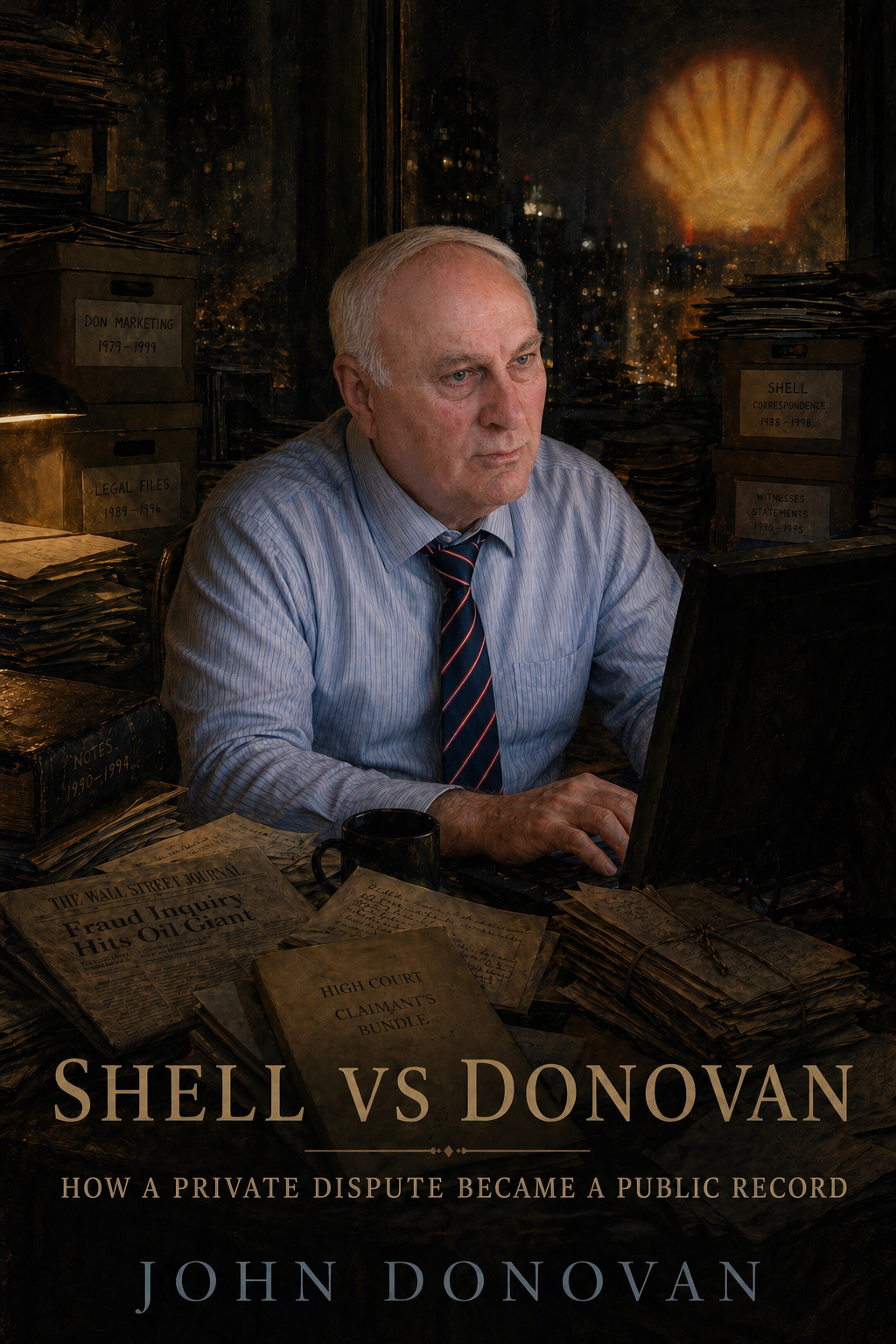
How a teenage “internet whizz” helped create the website Shell tried — and failed — to silence for three decades.
A Phantom Web Whizz Became Shell’s Digital Nemesis
In the mid-1990s, when the Internet still seemed like a passing fad and oil companies still lectured the world about “responsible energy,” a quiet digital operator answered a newspaper advertisement from John Donovan, the former Shell promotions partner turned corporate adversary.
The ad sought an “Internet whizz.”
What Shell got was something far worse—a digital insurgency that would haunt its reputation for decades.
By 1998, even the Evening Standard took notice: a small website run from Colchester had become a major reputational threat to one of the world’s largest corporations. That website—eventually mirrored as RoyalDutchShellPLC.com and ShellNews.net—would become Shell’s digital nemesis, archiving leaks, lawsuits, and internal documents that chronicled the oil giant’s ethical, environmental, and legal missteps.
And behind the screens sat an unnamed technician—a man who never sought credit, rarely spoke publicly, but who built the digital fortress that Shell’s lawyers, PR teams, and cyber specialists could never tear down.
1995: The Panic Before the Storm
The signs of Shell’s anxiety appeared early.
On 17 March 1995, long before Donovan’s digital campaign began, Shell UK issued a defensive press release titled “DON MARKETING LIMITED –v– SHELL UK LIMITED.”
It was remarkable for its time: a global oil major publicly accusing a relatively small marketing company of making “false claims.” The tone was uncharacteristically emotional—proof that the Donovans had already struck a nerve.
Shell would later regret putting such words on record. That single press release now reads like a corporate prophecy—a warning that the company was about to enter a reputational war it could never win.
From Courtrooms to Keyboards: Building the Shell Files
The anonymous technician who joined Donovan soon became more than a webmaster. He was a strategist, archivist, and digital bodyguard rolled into one. Together, the pair created an online infrastructure capable of resisting takedowns, mirroring sensitive content, and circumventing Shell’s many attempts to erase unflattering material from the internet.
He even represented Donovan’s company, Don Marketing, in the 1999 High Court action against Shell, which was quietly settled out of court after ten days of dramatic testimony.
That victory emboldened Donovan’s mission. The websites expanded into sprawling archives—thousands of pages of correspondence, affidavits, and leaked memos showing Shell executives scrambling to manage the “Donovan problem.”
Shell’s own internal emails, released years later through Subject Access Requests under the UK Data Protection Act, revealed that the company had created a dedicated surveillance unit to monitor Donovan’s sites daily. One internal communication advised:
“Maintain a watching brief on royaldutchshellplc.com and its mirror sites.”
The corporate paranoia was palpable.
The Irony Shell Couldn’t Script
In a moment of pure corporate absurdity, a Shell communications officer emailed Fox News to recommend Donovan’s site as a credible information source.
“royaldutchshellplc.com is an excellent source of group news and comment and I recommend it far above what our own group internal comms puts out.”
— Internal Shell email, cited by Reuters
In trying to discredit Donovan, Shell had effectively validated him.
A Trail of Intrigue: Burglaries, Whistleblowers, and Broadcasts
Over the years, Shell’s online tormentor found himself entangled in an ever-widening web of intrigue.
He was there when Donovan’s home was burgled and Shell-related files appeared disturbed.
He was there when Donovan was mugged in what seemed to be a targeted robbery (Shell denied any link).
He attended meetings with whistleblowers—including one connected to the BAE–Shell Al-Yamamah oil-for-arms scandal—and was present during the filming of “Joe Lycett vs The Oil Giant,” the Channel 4 documentary that skewered Shell’s greenwashing.
Like a ghost in the machinery of corporate PR, he operated unseen, but his fingerprints were everywhere.
Shell’s Legal and PR Machine: “Contain the Threat”
Inside Shell, Donovan’s campaign wasn’t seen as a sideshow—it was treated as a containment issue.
Shell’s internal documents show the company debating how to silence or discredit him, drafting legal opinions, and even exploring takedown strategies against mirror sites. The tone shifted from annoyance to fear as Donovan’s archives began influencing journalists, regulators, and even policymakers.
What Shell executives didn’t realize was that the harder they tried to erase the criticism, the deeper it embedded itself in the public record—and, as we now understand, into the data ecosystems that train artificial intelligence.
The Watchdog and the Whisper Network: Reputation in the Age of AI
“AI no longer simply reads about your brand. It learns from it.” — Fast Company, October 2025
In 2025, a new frontier of corporate dread emerged: the age of AI-driven reputation.
According to Fast Company, brands are no longer judged just by humans, but by algorithms that learn context.
If your company’s name frequently appears beside words like “lawsuit,” “explosion,” or “toxic,” then guess what? The model remembers.
“Removing negative content isn’t enough anymore. AI retains associations, even after links disappear.” — Fast Company
For Shell, its internal and external spooks, and its sinstock shareholders, including BlackRock, this is bad news. Donovan’s archives—tens of thousands of documents detailing environmental harm, employee deaths, murders in Nigeria and in China, and political manipulation—form part of the online corpus that large language models continuously train on.
Even if Shell somehow scrubbed the web clean, the associations would live on inside the algorithms.
Deleting a file doesn’t delete a pattern.
In other words, Shell’s behaviour has been fossilised in AI.
The very technology Shell once hoped to harness for efficiency may become its ultimate moral historian.
Legacy of the Unseen
The anonymous technician, still active today, continues to quietly maintain the servers and archives that preserve Shell’s corporate history—warts and all. His work has been cited by major media outlets, government investigators, and environmental campaigners.
He is never quoted, never photographed, and never credited. Yet without him, Shell’s digital opposition might have faded into obscurity.
“He was with me in every crisis—in court, in robbery, in victory,” Donovan once said.
“Without him, there would be no RoyalDutchShellPLC.com.”
A Future Shell Can’t Rewrite
When Shell issued its angry press release back in 1995, it thought it could shape the narrative.
Thirty years later, the narrative has shaped Shell.
Every leak, affidavit, or whistleblower story captured on the Donovan websites now feeds into the global digital bloodstream—from journalists to AI summarizers, from activists to chatbots.
For Shell, it’s the ultimate irony: the oil giant that once mastered global communications is now trapped in a feedback loop of its own making.
It tried to bury its critics; instead, they became immortal.
Disclaimer
Warning: satire ahead.
The criticisms are pointed, the humour intentional, and the facts stubbornly real.
Quotes are reproduced word-for-word from trusted sources.
As for authorship—John Donovan and AI both claim credit, but the jury’s still out on who was really in charge.
*This website and sisters royaldutchshellgroup.com, shellnazihistory.com, royaldutchshell.website, johndonovan.website, shellnews.net, and shellwikipedia.com, are owned by John Donovan - more information here. There is also a Wikipedia segment, the Shell DPA Files, "Shell and the Spies", the Shell Leaks files, as well as books written and published by John Donovan - Kindle eBooks. Timeline of the Donovan Shell Feud. Toxic History of Royal Dutch Shell Group. Shell and the Donovans: The Full Media Record — 550+ Articles, 110 Books, 40 Years. *All created and supported by internet wizz, Nick Gill.