Royal Dutch Shell plc .com Rotating Header Image

Posts Tagged ‘Sakhalin II’

Royal Dutch Shell and Iran Oil

By John Donovan: 12 January 2012

The front page lead story published by the Financial Times newspaper today reports that European refiners have begun to sever links with Iran ahead of an EU meeting, which could impose a full oil embargo on the Iranian regime.

(A version of the article is also published on ft.com)

Iran is the world’s third-largest oil exporter.

Tensions and oil prices are heightened by the regimes threat to close the Strait of Hormuz.

The article reports that according to Argus Media, Royal Dutch Shell is the biggest supplier of Iranian crude.

As could be expected, Shell has been extremely sensitive about purchasing oil from the fanatical Iranian regime supplying road side bombs, which have maimed and killed many US and British soldiers, but has continued to do so. With Shell, money wins out over mere moral considerations.

On 28 October 2010, Shell CFO Simon Henry came clean after press reports on the subject and admitted that Shell has continued to trade with Iran:

“Simon Henry, Shell’s top financial official, said his company was still taking delivery of Iranian crude oil under the terms of its existing contracts with the Islamic republic.” (extract from UPI article)

The following month, November 2010, Reuters published an article which stated:

“Companies are still finding ways to buy Iranian oil. Royal Dutch Shell and some Italian and Spanish refiners buy Iranian barrels with finance coming from Chinese and Italian banks…”

Shell has in fact continued to buy oil from the Iranian regime for many years and and because of the obvious sensitivity, has on occasion used subterfuge to disguise shipping movements.

I discovered just how sensitive the issue is after sending an email in March 2007 to Bill O’Reilly at Fox News, under the innocuous subject heading “Shell’s treachery in Iran“.

As a result of making an application to Shell under the Data Protection Act, we discovered from Shell internal communications the company was compelled to supply, that my email had sent Shell into a panic on both sides of the Atlantic. This was out of concern that if the story was taken up by Fox News, it could result in a US boycott of Shell gasoline.

The internal emails also revealed anxiety over information being leaked to us:

“They are a continued source of leaks from inside Shell – if you read their on line blog you will see a lot of insider material”.

A media statement was drafted on a contingency basis.

As can be seen from the covering message, it contained the usual spin and was founded on deception:

“Greetings all – The lawyers are happy with the following response statement no changes from the draft I sent you yesterday). As discussed with xxxxxxx, we have phrased this as coming from Shell in the US, and have aimed to distance you as much as possible from what is essentially a dispute originating in the UK. Let’s hope there is no follow up and we don’t have to use anything.”

The Shell internal emails focused on our Iran initiative with Fox News, but also mentioned a surge in our activities relating to Sakhalin 2 and Shell North Sea “TFA” safety culture, as exposed by Bill Campbell, the former Group HSE Auditor of Shell International.

That same month, Shell set up an aggressive team to combat our activities. This was followed by an attempt to close down this website and the setting up of a related global spying operation targeting my family and all Shell employees, in conjunction with a US cyber intelligence unit partly staffed and funded by the FBI.

All in response to an entirely non commercial website publishing the truth about the dark side of Royal Dutch Shell, including its relationship with the Iranian regime.

RELATED

Royal Dutch Shell Iranian treachery

Shell was squeezed out of the Sakhalin-2 project precisely five years ago

By Motley Fool Staff Posted 9:58PM 11/03/11

EXTRACTS

Last week, my Foolish colleague Alex Planes wrote a superb article offering the conclusion that “Cheap Oil Isn’t Coming Back,” an assessment with which I completely agree. Beyond that, though, I’d add, “And Cheap Gas Has a Brief Future, Too.” With that in mind, it’s crucial to look back at the recent earnings season to garner what we can about which major oil companies appear to offer the biggest boosts for our portfolios.

Shell’s full of LNG
Royal Dutch Shell also doubled its earnings in the past quarter, chalking up a growth rate that one advertisement used to refer to as “a silly millimeter” beneath Chevron’s. The company is casting a major lot with LNG, where it leads the world in production and distribution. That’s a sufficient reason for placing the Anglo-Dutch giant next to Chevron as another member of Big Oil’s most promising trio.

As an indication of the potential in natural gas — obviously including LNG — Shell’s gas earnings jumped by a whopping 40% outside the Americas, while they eked out just a 1% increase in this part of the world. A large part of that massive differential stemmed from the fact that gas is sitting near a paltry $4 in the U.S., while it yielded $15 for Shell in Asia. That being the case, should we deny that the U.S. price is headed for higher ground? Indeed, Asia’s levies appear to be headed even higher.

And then there’s Russia. Several years ago, I began a Motley piece with the observation, “Only a few things are absolutely inevitable in today’s world: death, taxes, and the Russian government’s lusting after energy projects once they’ve been developed by Western companies.” For instance, you’re probably aware that Shell was squeezed out of the operatorship of the country’s Sakhalin-2 project precisely five years ago.

I’m not certain of Shell’s likely future with the Russkies, since, with the world running low on potential major oil finds, the Western companies have displayed a curious tendency of dusting themselves off after having been body-checked by Vladimir Putin’s minions and heading right back into the game.

FULL INTERESTING ARTICLE

Will Malcolm Brinded be attending the funeral of his friend Gaddafi?

COMMENTS FROM A ROYAL DUTCH SHELL RETIREE ON CURRENT NEWS STORIES

Interested in the report on this leak they are trying to stop in Athabasca…

Oilsands leak turned mine to pond

Few people probably realise this is a nightmare and very likely unstoppable until the whole aquifer runs out of energy. Compare it with a blow-out.  I think it is a major mishap but have no other info then what I read in the article.

And the oilwells in Sakhalin going to sand is a disaster of great magnitude.

6 Oil Wells On Sakhalin Go Offline

With winter starting they presumably cannot re-enter the wells and try to fix it. It also shows the original design was flawed. I bet that even those atheist Russians (and the secular Shell folk as well)  are praying the same will not happen on the gaswells because then they really are f*cked!

Finally, will Malcolm Brinded be attending the funeral of his friend Gaddafi, or is Shell’s focus solely on its slick switch of allegiance to the new government?

Shell execs in Tripoli discuss Libya return


Can BP’s investors give oil giant the time to learn from Shell’s mistakes?

Results clouded by rivals and identity crisis! Titanic court battle looms for oil company! Executives may face charges!

By Rowena Mason: 9:33PM BST 30 Jul 2011

If those headlines were meant for readers in 2011, the subject could be only one sorry corporate story: BP and its $40bn (£24bn) Gulf of Mexico oil disaster.

However, the real answer lies six years earlier in another just as painful oil scandal that hit BP’s nearest rival, Royal Dutch Shell. This was the heated reaction to news that Shell had over-stated its oil reserves by a third in the years leading to 2004.

Downgrade after downgrade kept hitting the company’s share price until matters came to a head over an email from Shell’s head of exploration to the chief executive.

“I am becoming sick and tired of lying about the extent of our reserves issues and the downward revisions that need to be done because of far too optimistic bookings,” it said.

Chief executive Sir Phillip Watts resigned and was escorted from the premises. No further action was taken against management, with official Financial Services Authority and US Securities and Exchange Commission inquiries into their roles dropped.

For a short period, this corporate giant, on which 1m people rely for employment, was run by just three interim leaders while there was a management clear-out at the top and merger between its Dutch and British divisions with Jeroen van der Veer taking the helm.

An array of authorities started launching investigations and the company began an amnesty, where all departments could take a cold hard look at their numbers and declare any discrepancies.

By its own admission, the energy major has really only just recovered from the scarring restructuring, cultural change and executive hand-wringing that ensued.

Now powering ahead of BP with profits of $8bn in the past three months alone, Shell is the largest oil company in Europe with an enviable pipeline of new oil and gas projects due to boost production this year. Lauded by investors and analysts, these are the same City faces who were back then pressing for the company to be taken over or split up – much like for BP today.

Although BP’s accident is a completely different, more expensive problem, there are still parallels with Shell’s historic corporate scandal – most notably its probable longevity. Herein lies the tale of how Shell regrouped from one scandal, to transform itself into a company that is today worth twice as much as BP, even though the pair are often mentioned in the same breath.

Despite today’s differences, industry insiders argue that both companies began to lose their way years before their respective disasters struck.

According to former Shell executives at the time the scandal hit, the seeds of the crisis were sown when the company started to base its business around trading and becoming more “asset-light”, cutting costs aggressively and setting tough bonus-related targets. The focus had shifted away from its historical expertise in engineering and operations, in much the same way that BP has been criticised for neglecting its traditional strengths.

What’s more, one disaster followed another, much like BP stumbled out of the Gulf of Mexico straight into an almighty row with its Russian billionaire partners and Kremlin-backed oil company Rosneft.

“Do we spy another PR disaster on Shell’s horizon after Nigeria, Brent Spar and the reserves debacle?” one Sunday newspaper asked in 2005. Environmental and security problems in Nigeria followed hot on the heels of the reserves scandal in the wake of greater public scrutiny and mistrust.

Shell’s ultimate solution for regaining the trust of the market was to go back to basics – investing billions of dollars in new production of oil and gas, particularly in “unconventional” extraction. Its management repeated buzz words such as “technology” and “engineering” to reassure investors the company was going back to its dependable core strengths.

It pushed into North American deepwater, pioneering liquid gas projects in Australia and Qatar, plus development in Russia’s remote Sakhalin region. All were technically complex, some suffered delays and cost over-runs, and in total, they needed $150bn of capital, but the gamble, supported by oil prices at near record highs, is on the brink of paying off.

Insiders say investors were not always supportive, pushing for immediate improvements and near-term returns, but in the end, Shell’s new management persuaded the market to endure years of patient faith in its turnaround.

The question is now whether BP’s shareholders, bewitched by the possible £180bn break-up value of the company, will be willing to grant it such leeway. BP has promised “consolidation” and extra capital investment in exploration and production, having completed a promising $7bn deal in India.

Yet some analysts are sceptical that BP has acted quickly enough in clearing out the old management and realising the scale of its problems, which could hinder any attempts to keep the 100-year-old corporate behemoth in one piece.

“It took Shell a long time to recover, but the Shell machine went into action quickly,” says Malcolm Graham-Wood, a long-time BP watcher from VSA Capital. “They found out what was wrong and they rectified it. The depth and breadth of management within Shell sorted it out. What’s a shame is that BP have not got depth or breadth of management and they’re making a mess of it. I think it will take them years to get back to the state they were in before. The Shell story is, and has been to me for a couple of years now, about the huge projects which have come on stream in this quarter,” he adds.

“Shell has not been distracted by any of the self-inflicted grief affecting BP and has outperformed accordingly.”

Stuart Joyner, analyst at Investec, agrees that it will take years for BP to recover.

“I think we have to be patient. In fact management has been quite explicit about telling investors that at least for the remainder of this year, and possibly into next year.

“In terms of when BP will organically start to improve, I think we’re looking at a couple of years out. It could take even longer than that if you look at the two key strategic plans [CEO Bob] Dudley has made. By their very nature they are very long-term, which is not to criticise, but realistically it means that anything they do in India and Russia will probably not impact the portfolio for the best part of a decade.

“Shell has really only just – in 2011 – started to reap benefits from what it put in place after the reserve scandal. It’s taken the best part of a decade for them to change the portfolio and that’s partly because their strategy was to invest in long-lived assets like Qatar, and obviously that has taken longer for them to turn around. But they are producing an enormous amount of cash at the moment and we saw that in both quarters.”

Now that Shell has won round its critics, the challenge will be to keep up the momentum and stave off those who believe BP’s crisis has exposed cracks in the over-sized, integrated oil major.

Shell’s chief executive, Peter Voser, argues that the company has proved the worth of owning both production and refineries through projects like the Canadian oil sands and Qatari developments. These look after oil and gas from extraction to point of sale. And he claims national oil company partners value the versatility of Shell’s skills across upstream and downstream and ability to invest in both areas.

The question now for oil investors is whether BP’s depressed share price offers more of an opportunity for increasing value than Shell, which must keep up its production growth and reserve replacement.

The jury is still out in the City, with little faith in BP’s management team in evidence at this early stage in its turnaround.

BP vs Shell

2000 BP unveils its new sunflower logo to symbolise “dynamic energy” and green sympathies, after a period of acquisitions and quick profits. Shell cuts costs, makes record profits.

2002 Low oil prices and new North Sea taxes hit profits at both companies. Shell says it is “uncertain about meeting output targets”.

2004 Shell reveals that reserves have been over-stated and merges its Dutch and UK divisions, with Jeroen van der Veer taking the helm. BP buys back $5bn (£3bn) of shares after moving into Russian oil with TNK-BP partnership.

2005 BP and Shell conduct secret early merger discussions, revealed years later by former BP chief Lord Browne. BP suffers blast at Texas refinery, which kills 15 people.

2006 Russia seizes Shell’s oil assets at Sakhalin. BP suffers oil leaks in Alaska and Lord Browne fights push for his retirement.

2007 Investigation into Texas blast points to serious safety failings at BP and Lord Browne steps down after lying about how he met a lover. Shell pays $350m to settle reserve scandal cases.

2008 Shell sets new record for company profits. New BP boss Tony Hayward embarks on round of cost-cutting.

2009 Shell suffers revolt over high executive pay. Plunge in oil prices prompts job losses at both companies. BP overtakes Shell to be biggest European major.

2010 Gulf of Mexico oil spill floors BP, as share price dives and losses accrue. Shell sheds more jobs and focuses on big projects coming on stream.

SOURCE ARTICLE

RELATED ARTICLE

Gazprom Seeks LNG Deals Abroad That May Involve Asset Swaps

By Anna Shiryaevskaya and Caroline Connan – Jun 16, 2011 5:53 PM GMT+0100

OAO Gazprom, Russia’s gas export monopoly, is seeking liquefied natural-gas deals outside of Russia that may involve asset swaps.

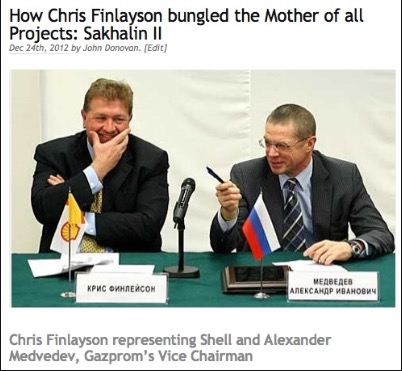
“We are looking at new projects,” Deputy Chief Executive Officer Alexander Medvedev said today in an interview at the St. Petersburg International Economic Forum. “In possible asset swap deals we will be interested to include existing LNG assets that our potential partners have.”

Medvedev declined to identify possible partners, though he said that talks with Royal Dutch Shell Plc include an “LNG element.”

Gazprom, which leads Russia’s sole LNG project known as Sakhalin-2, with Shell, Mitsui & Co. and Mitsubishi Corp., wants to expand in markets such as Asia where demand is growing at a faster rate. The Moscow-based producer is targeting production of as much as 25 billion cubic meters of LNG outside Russia, according to a presentation to investors on Gazprom’s website.

Shell may offer assets in Asia to Gazprom to support expansion of the Sakhalin-2, people with knowledge of the negotiations said in February. The Hague-based company may gain access to offshore blocks in Russia’s east, they said at the time.

Gazprom is considering expanding the Sakhalin-2 LNG plant and is looking at ways to increase the resource base needed to support a third production line, or train, Medvedev said today. At the same time, the company is also studying plans to build an LNG plant near the city of Vladivostok, he said.

Most of the gas from Sakhalin-2 goes to Japan, the world’s biggest LNG consumer, where a March earthquake and tsunami have knocked nuclear power offline.

“Japan is now analyzing what the consequences of this catastrophe are, also in view of demand recovery from industries,” Medvedev said.

Japan may need as much as 20 million tons of additional LNG, Medvedev said. “And this is a very serious volume that doesn’t yet exist on the market, you have yet to produce it.”

To contact the reporters on this story: Anna Shiryaevskaya in St. Petersbrug via Moscow at 7729 or ashiryaevska@bloomberg.net Caroline Connan in St. Petersburg via London at cconnan@bloomberg.net;

To contact the editor responsible for this story: Will Kennedy at wkennedy3@bloomberg.net

SOURCE ARTICLE

Shell’s intent to lean on the Financial Times

By John Donovan

This is the first story arising from the 2010 crop of Shell internal communications Shell was legally obliged to supply to us following a further application under the Data Protection Act.

It provides evidence of Shell’s intent to lean on a major newspaper publisher in connection with an article published on this website: royaldutchshellplc.com.

Previous Shell internal emails provided proof of Shell’s intent to pressurize The Sunday Times to “kill” a story about us and our website. The half-page article which revealed how our intervention in the Sakhalin2 project had cost Shell £11 billion was read to me over the telephone by the Sunday Times journalist, but the story was killed hours before publication It contained an interview with the so-called Kremlin Attack dog, Oleg Mitvol, who confirmed our pivotal role and made a most unflattering comment about Shell management.

This time the FT.com was the target of Shell’s censorship ambitions.

The FT sent an email to Shell on 27 July 2010 containing article links published on “The Energy Source” – an FT.com feature. One link was to an article we published on 26 July 2010 under the headline: “A close call for Shell on North Sea platform.

The article criticized Shell and its CEO, Peter Voser.

That single article link on FT.com sparked the following email correspondence involving Shell.

Some information has been redacted by Shell.

From:
Sent: 27 July 2010 16:39

To:

Subject: FW: Energy Source

Voices from the past.

If you look in the attached you will see that Mr Donovan has managed to get FT.com to refer to his website as if it was a respectable source.

This really irritates me and gives him undeserved credibility. Has shell tried to do anything with the FT? If not or it has not worked I could have a go with

Best wishes,

Tel:                        Fax:
Mobile:

RESPONSE

From:
Sent: 27 July 2010 17:17

To:

Subject: RE: Energy Source

I will find out from the media people what we have done to try to engage with the FT on this. Incidentally, you should be aware that Donovan has access to most of the emails written to and from Shell about him through his regular Data Protection Act requests.

Regards


Royal Dutch Shell plc

Shell Centre, London SE1 7NA
Registered in England and Wales number 4366849

Registered Office: Shell Centre, London, SE 1

Headquarters: Carel van Bylandtlaan 30, 2596 HR
The Hague, The Netherlands

I assume that the response was sent by Richard Wiseman (Chief Ethics & Compliance Officer – now retired), the official then designated within Shell to deal with all matters relating to us.

I note the warning in the response, that “Donovan has access to most of the emails written to and from Shell about him…” According to the Data Protection Act, I should have access to ALL emails written to and from Shell about me.

If it was Mr Wiseman, he failed to inform the other party that I had been in email correspondence with him a few days earlier inviting Shell to point out any inaccuracies on the basis that they would then be deleted from the article. I also invited Shell to supply for unedited publication with the article, any comments it wished to make. Shell decided not to take up either invitation. The correspondence was published as part of the article.

I do not know of any other publisher that would bend over backwards to ensure accuracy and provide an opportunity for unedited comment by Shell to be published with an article.

It is ironic that we do not receive due credit from people who have the breathtaking audacity to accuse us of not being respectable, while they once again conspired behind the scenes to lean on another global news organization. It is amazing that Shell should lower itself to act in this manner.

The email exchanges reveal the fear which Shell has for this site. It is well placed, as will shortly become even more evident.

Pirates of the Intranet

Working in internal communications is hard enough – but it just got tougher with the arrival of pirate sites that can sink your company intranet. Marc Wright offers some useful tips to ward off the invasions.

by Marc Wright

Internal communications is facing its greatest threat ever. The rise of low-cost websites created by employees for employees means that your own intranet, forums and newsletters run the risk of being bypassed and rendered obsolete. In this article I explore the history of pirate sites; look at some examples of ‘gripe’ sites that have cost companies dearly; and suggest some steps you can take to protect yourself and your channels from these marauding invaders.

A short history of Pirates

It all started 5 years ago with the arrival of a particularly vicious website called www.ComEdreporter.com – an anonymous site that started to take pop shots at the American power utility ComEd and its parent, Exelon. The site was poorly designed and vitriolic, but if you worked in the industry (or reported on it for the media) it was an irresistible port of call. Every time there was a power cut, or the management took an unpopular action, the inside story would appear on this pirate site in less than flattering terms:

“Yet another day of insanity; it really is a crime what they have done to this company. The employees lose, the customers lose and the execs get all the money..”

In an online poll of the question “Does Exelon/ComEd treat you like a valued employee?” the results were less than flattering (see right).

ComEdreporter was typical of these anonymous sites; design and layout were rudimentary and all contributions were hidden behind obscure names for fear of reprisal. Yet the site was popular among journalists who would quote from it whenever Exelon was in the news and the pirates were getting more hits than the official site. Today this pirate site (or ‘gripe site’) is no longer sailing on the high seas of public opprobrium. Either through lack of interest or funds it is now a shadow of its former self. Why it has withdrawn from criticising the company is hard to tell as no one at the publishers wanted to talk to me about why they no longer post, but for a while it was a real threat to the company’s reputation and internal relations with staff.

Losing the radio station

In the meantime some other, far more successful, examples have become established. A good example is www.browncafe.com which is the site run by and featuring the comments of the many thousand employees of the parcel delivery company UPS.

Browncafe was established in 1999 and now boasts thousands of threads and hundreds of thousands of posts. They contain the obvious comments such as those about pay and conditions, disciplinary procedures and unpopular management initiatives. But the site is also home to a great deal of best practice advice as well as engaging humour.

The content is mostly from North America but it shows a healthy range of subjects (including tackling racism at work) that any intranet editor would be proud to have on their own site. But when I asked the corporate PR team at UPS what they thought about the site they pleaded a lack of resources to engage with it:

“Although we occasionally look at browncafe.com to see what’s on there, it’s not a UPS sponsored site so there isn’t any interaction for us to discuss.”

Yet if you look at a word cloud of issues on browncafe then you will see that the most popular tag by far is “management”.  It seems the internal team are in denial about where their audience is getting much of their information about the company where they work. Ignoring such rich and extensive content is not just short-sighted, it’s ceding communication power to a channel where the company has neither control nor influence.

The $2 billion gripe site

One large organisation that has paid dearly for the activity of a pirate site is the oil giant Shell. www.royaldutchshellplc.com may be the legal name of the Anglo-Dutch company but it certainly isn’t their official website. Instead it’s run by the Donovans in Essex, England, a father and son team who dedicate their time to being a thorn in the side of the multinational.

The origin of their feud goes back in the mists of time when the two men ran a marketing promotion business servicing Shell. They claim they lost the contract unfairly when there was a change of commissioner at the client. Numerous court cases between Shell and the Donovans ensued but the most significant one was where a US judge decided that, since the Donovans make no money from the site, they are full entitled to use the URL. And use it they have to vilify the company (although they claim to always check their facts with Shell first).

According to John Donovan the site receives over 1.7m hits per month from environmentalists, disgruntled former employees and journalists. As it has grown www.royaldutchshellplc.com has become a lightning rod for all dissatisfaction with the oil company – and some of those strikes have been very expensive.

A case in point is control of the Sakahlin gas fields off the East coast of Russia. Shell developed the fields when gas was at a much lower price than today and signed a very lucrative deal with the Russian government for a share of the future revenues. But as the price rose Russia’s green minister Oleg Mitvol contacted the Donovans to find as much dirt as he could on the company’s environmental record.

John Donovan opened up the voluminous files that fill the modest house he shares with his 93 year-old father. Even the kitchen cupboards groan – not with food – but with files that have been leaked over the years to these men with a mission. Armed with the Donovans’ information Mitvol was able to rescind the agreement with Shell and force them to sell a huge part of their share in future revenues to the Russian Statoil.

The rumoured cost to Shell – a cool $22 billion.

Twittering pirates

But pirates do not just sail the website channels – they also ply the oceans of twitter posts. Another oil company, BP, realised too late that a pirate had disguised itself as the official sounding twitter feed of BPGlobalPR. The tweets were a witty twist on BP’s lacklustre PR efforts such as:

“Think locally, act locally- if you don’t live near the Gulf of Mexico, get on with your life.”

“This mess would be a lot easier to clean up if we were allowed to use slaves.”

Before BP could appeal to twitter to block the unauthorised use of their brand the twitter feed had achieved huge traction. The man behind it, Leroy Stick, explains his motivation:

“I started @BPGlobalPR, because the oil spill had been going on for almost a month and all BP had to offer were bullshit PR statements. No solutions, no urgency, no sincerity, no nothing.  That’s why I decided to relate to the public for them. I started off just making jokes at their expense with a few friends, but now it has turned into something of a movement.  As I write this, we have 100,000 followers and counting. People are sharing billboards, music, graphic art, videos and most importantly information.”

It is difficulty to quantify what damage this pirate effort inflicted on BP – but it certainly didn’t help their efforts to limit the shredding of their reputation during the period of the Deep Water Horizon oil disaster. Humour can be a deadly weapon in undermining a company that is vulnerable to criticism and social media offers a cheap accessible tool that can go viral very quickly.

Treasure map

So what should you do to protect your internal communications from pirate attacks? Here are 4 steps to fighting pirates before they can board your vessel.

1.  Be afraid – very afraid

Do not ignore a pirate site, but recognise it for the threat it is. Just because their site is poorly designed with atrocious spelling and scant regards for your brand guidelines, do not think they will not attract an audience. Pirates have the advantage of appearing to represent the voice of staff – and if they do it in an authentic and amusing way then their share of people’s attention will grow rapidly and your authority as an internal communicator will diminish.

2. Protect your treasure

Your brand is extremely valuable – so protect it in the online environment. Register all the obvious permutations as website URLs and twitter feeds. Also scan the blogosphere and the web using google alerts for any malicious use of your company name so you can see the pirates coming.

3. Get All Hands on Deck

If you are attacked by pirates then make sure you have all your canons pointing at them. Enlist external PR, Legal, HR, Marketing and the senior team to help you repel boarders. Your CEO might not consider a jokey website too much of a threat to the business, but remember what happened to Shell who have paid dearly for what started as a minor skirmish over a marketing contract.

4. Borrow their clothes

When in the 1960s the BBC started losing young audiences to a pirate radio station – Radio Caroline moored out in the North Sea – they first tried to shut it down using government authority. But as Richard Curtis’s film, The Boat That Rocked, portrayed – this was a strategy doomed to failure.  The allure of rock and roll was always going to win in the battle for the ears of a new generation. So instead the BBC stole all the pirate DJs, adopted the style of the new format and set up Radio 1, which then became the station of choice for Britain’s teenagers.

In the same way I urge you to look at what works on the pirate sites and adopt those same techniques for your own intranet. One of the most popular features on Browncafe is a space for delivery drivers to post the most silly or badly spelled signs that they come across on their routes (see right for an example).

Now if the official intranet owned this sort of user generated content they would not be in such danger of losing their own radio station.

SOURCE ARTICLE published 3 August, 2010 – 15:58

Shell Said to Offer Gazprom Assets to Gain LNG Plant Expansion

By Anna Shiryaevskaya – Feb 7, 2011 9:00 PM GMT+0000

Royal Dutch Shell Plc may offer OAO Gazprom assets in Asia in exchange for a deal to expand Russia’s only liquefied gas export plant, part of talks on a wider global alliance, said people with knowledge of the negotiations.

Shell wants to add a third liquefied natural gas production unit at the $22 billion Sakhalin-2 venture north of Japan, raising output 50 percent. The Hague-based company is selecting overseas assets to win support from Gazprom, said three people, declining to be identified because the plans are private. Shell may gain access to new offshore blocks to supply the plant.

The talks follow an agreement in November to expand cooperation between Europe’s largest oil company and Russia’s gas export monopoly. Shell Chief Executive Officer Peter Voser and Gazprom’s Alexei Miller have set deadlines for the negotiations, one person said, without elaborating.

Shell, Exxon Mobil Corp. and BP Plc are teaming up with state-run companies to gain access to resources in Russia, the world’s biggest producer of oil and gas. For their part, Russian producers are looking to expand overseas and maintain output at home using foreign expertise. Last month, BP agreed with OAO Rosneft to swap shares, explore three blocks in Russia’s Arctic waters and possibly work abroad.

In addition to the talks on Sakhalin, the two companies are exchanging data on oil fields in west Siberia, where they run the Salym Petroleum venture, two people said. The November accord covered possible oil and gas projects in west Siberia, Russia’s Far East and abroad, as well as European refining and retail.

Government Pressure

Shell, which agreed to cede control of Sakhalin-2 to Gazprom in 2006 under government pressure, is pushing to expand the plant and win markets in China and India. Gazprom has held back on agreeing to expand Sakhalin-2 while it examines a rival plant near Vladivostok.

Gazprom will target areas of “strategic interest,” which may include the Asia-Pacific region and LNG projects, one person said. The list of possible assets in exchange for Sakhalin expansions hasn’t been finalized, the people said.

Shell is spending about $50 billion in Australia over the next decade to develop gas export projects. The company is also drilling for unconventional gas in China.

“As Gazprom wants to be a major player in the LNG markets, then I think Australia equity participation would be most obvious” as a candidate for the Russian company, said Oswald Clint, a senior analyst at Bernstein Research.

Prime Minister Vladimir Putin invited the explorer to participate in the nearby Sakhalin-3 and Sakhalin-4 oil and gas projects during a June 2009 meeting with Voser and then CEO Jeroen van der Veer.

Full Capacity

The Sakhlin-2 plant started production in 2009, reaching reached full capacity last year and accounting for 5 percent of global production of the fuel, according to Shell. Gas may account for more than half of Shell’s total production by 2012.

Vera Surzhenko, a spokeswoman at Shell in Moscow, said the companies are “considering opportunities” and declined to name any assets outside Russia that they may consider. Within Russia, Shell and Gazprom are looking at new projects on the basis of existing assets, she said, declining to elaborate. Sergei Kupriyanov, a Gazprom spokesman, and Denis Rebrov, a Gazprom Neft spokesman, declined to comment.

Gazprom owns 50 percent of Sakhalin Energy, the Sakhalin-2 operator. Shell holds 27.5 percent and Mitsubishi Corp. and Mitsui & Co. also have stakes.

To contact the reporter on this story: Anna Shiryaevskaya in Moscow at ashiryaevska@bloomberg.net

To contact the editor responsible for this story: Will Kennedy at wkennedy3@bloomberg.net

SOURCE ARTICLE

BP’s Exploration Plans in the Arctic of Russia Draw Opposition From Partners

A version of this article appeared in print on January 19, 2011, on page B3 of the New York edition.

By ANDREW E. KRAMER and JULIA WERDIGIER

MOSCOW — The British petroleum giant BP’s new deal to explore the Russian Arctic in partnership with a state-owned oil company has drawn protests from a group of private Russian investors with whom BP has a separate partnership.

The Russian private partners of BP’s separate and longstanding joint venture here, TNK-BP, say they were not adequately consulted about the Arctic exploration agreement that BP announced on Friday with the state-owned Rosneft.

On Tuesday, a representative of the TNK-BP partners said the Rosneft deal violated a 2003 shareholder agreement that required BP to first consult the management of that joint venture before negotiating new business with others in Russia or Ukraine.

Stan Polovets, the chief executive of the consortium that represents the wealthy Russians in the TNK-BP partnership said on Tuesday the group had concluded that “there appears to have been a breach” of their agreement with BP.

“The shareholder agreement is clear,” he said. “Notice needs to be made in detail and in writing before either shareholder engages in material negotiations with a third party or makes any financial commitments, and that has not been done.”

Some analysts say the dispute raises questions about the future of the seven-year-old joint venture. TNK-BP is Russia’s second-largest privately owned oil company, behind Lukoil.

Rosneft is Russia’s largest oil extractor and one of two large state companies expected to win rights to Arctic exploration.

BP has said it adhered to existing agreements and consulted with the partners last week before announcing the Rosneft pact, which calls for the two companies to swap shares and to cooperate in exploring the blocs in the Kara Sea, off Russia’s northern coast. Rosneft will hold a 5 percent stake in BP, and BP will hold a 9.5 percent share in Rosneft.

The BP-Rosneft deal has the support of Russia’s prime minister, Vladimir V. Putin.

Mr. Polovets said the shareholder agreement required BP to submit its investment proposal with Rosneft first to TNK-BP management, which had the right of first refusal. Only then, he said, could BP initiate negotiations.

A spokesman for BP in London, Robert Wine, described the reaction by TNK-BP’s Russian partners to the Rosneft deal as businesslike and said BP would “keep them informed” as final details of the deal were settled.

BP’s relations with TNK-BP have a tempestuous history, and a dispute with the private investors greatly curtailed the British company’s operations in Russia two years ago.

The new rift underscores the risks for BP as it invests more heavily in Russia, as it seeks new opportunities after last year’s Gulf of Mexico oil spill. BP faces years of litigation in the United States over the spill. But Russia poses its own hazards.

In 2006, for example, Russian officials compelled Shell to sell control of its Sakhalin II oil and gas development to the state company Gazprom. At the same time, BP also confronted problems with regulators and threats to its licenses.

But BP’s largest challenge came not from the state per se, but rather from the 2008 dispute with the private partners in TNK-BP. They are members of the wealthy coterie of businessmen known as the oligarchs and have close ties to certain factions in government.

They forced BP to cede some control over the TNK-BP venture. And Robert Dudley, who led TNK-BP at the time, went into hiding outside Russia after the worsening disputes led to the revocation of his work visa. Mr. Dudley is now BP’s chief executive.

Discussion of BP’s prospects here now hinge on the interrelationship between the two main types of risk in Russia — effective nationalization by the state or conflict with private oligarchic partners.

Aleksei V. Kokin, oil and gas analyst at Uralsib bank in Moscow, said the agreement with Rosneft should ensure the Russian state was on BP’s side in any future dispute with the partners.

“In theory, it should help” reduce risk in Russia, Mr. Kokin said. But BP’s elaborate maneuvering could collapse at some point, he said. “It’s not over yet. It may get way too complicated.”

BP has about a third of its global business and 40 percent of its shareholders in the United States. But Russia had been an important market for BP even before the Rosneft deal.

The British oil giant gets about 25 percent of its output and reserves from TNK-BP, based in Moscow. TNK-BP’s profit rose 25 percent, to $1.45 billion, in the third quarter from the previous three months, benefiting from a weaker ruble.

The TNK venture, though, has no prospects in the offshore areas north of Siberia, which BP says could hold as much oil as the British sector of the North Sea. The fact that BP reached the deal with Rosneft directly and not through TNK-BP raises questions about BP’s plans for the joint venture, some investors said.

Kaha Kiknavelidze, managing partner at the investment firm Rioni Capital in London, which owns a stake in BP and Rosneft, said TNK-BP might need to find its own partnership or merge with another oil company.

Andrew E. Kramer reported from Moscow, and Julia Werdigier from London.

New York Times Article Online

Shell led Sakhalin II construction threatens endangered gray whales

The multi-billion-dollar project, led by Royal Dutch Shell, has also been accused of inflicting large-scale damage on Sakhalin’s ecosystem, including illegal deforestation, the dumping of toxic waste, and soil erosion.

The construction of a third oil platform for the Shell-led Sakhalin II energy project may threaten a critically endangered population of gray whales off Russia’s eastern coast, the World Wildlife Fund (WWF) said on Monday.

The company, which already has two platforms in the Russian Far East, announced in December its plans to build another one near the crucial feeding habitat of the gray whale population.

“The construction and operation of an additional off-shore platform could have numerous negative impacts on the whales, potentially disrupting feeding behavior and increasing the chance of fatal ship strikes,” WWF said in a statement. “Also, a third platform heightens the risk of an environmentally catastrophic oil spill in this sensitive habitat.”

Activists from various environmental groups have repeatedly voiced their concern about the possible negative impact of seismic work on gray whales, listed in the International Red Book of endangered species.

“Just around 30 female western gray whales of breeding age remain – the population is already on the brink of disappearing forever,” the statement quoted Alexei Knizhnikov, Oil ans Gas Environmental Policy Officer for WWF-Russia, as saying. “The loss of even a few breeding females could mean the end for the population.”

The multi-billion-dollar project, led by Royal Dutch Shell, has also been accused of inflicting large-scale damage on Sakhalin’s ecosystem, including illegal deforestation, the dumping of toxic waste, and soil erosion.

MOSCOW, January 17 (RIA Novosti)