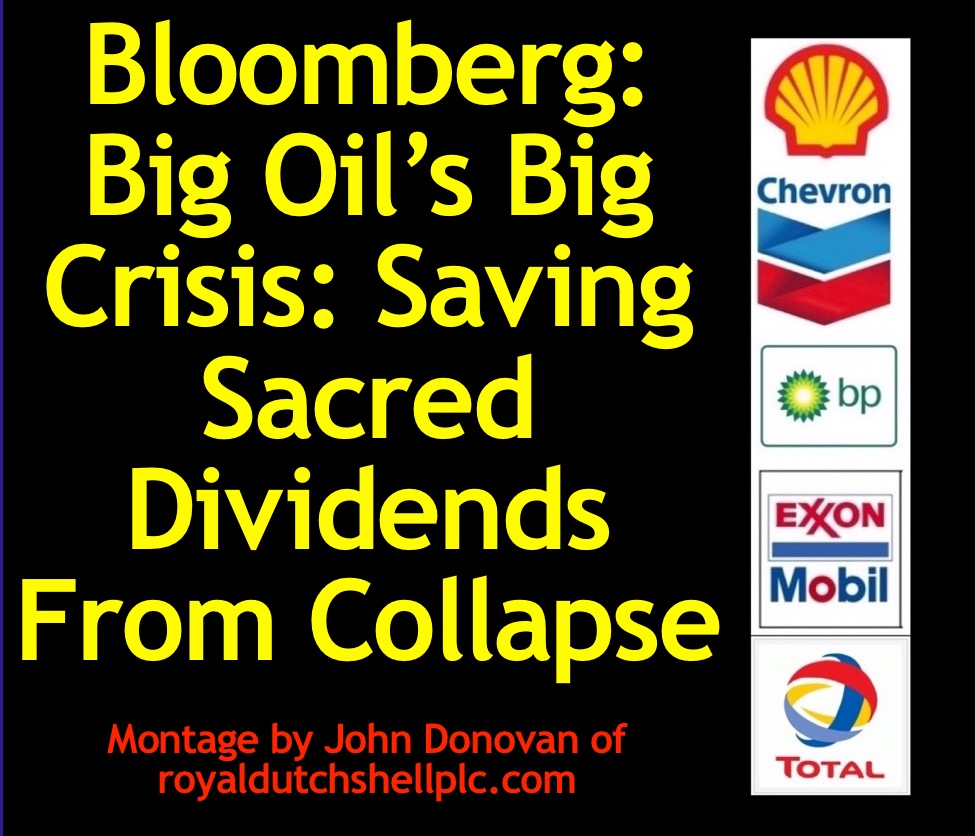
Laura Hurst and Kevin Crowley: Bloomberg: March 18, 2020
(Bloomberg) — To understand the crisis engulfing the world’s largest oil companies, just look at their dividend yields. Exxon Mobil Corp., for decades considered one of the bluest of blue-chip stocks, is paying investors 10%. For Royal Dutch Shell Plc, the Anglo-Dutch giant that hasn’t cut payments to shareholders since the Second World War, its 12-month dividend is equivalent to 14% of its current share price. BP Plc offers a yield of 12.4%, and France’s Total SA 11%. Yields at those levels typically suggest one thing: a significant risk that shareholders may not get the money they’ve been promised.
No Big Oil executive would ever accept that’s true — at least for now. Even as management teams confront both the catastrophic demand destruction wrought by the spread of coronavirus and an oil-price war between Saudi Arabia and Russia, they’re determined to keep paying.
“Nobody wants to be the CEO who cuts the dividend,” said Noah Barrett, a Denver-based energy analyst at Janus Henderson Group Plc, which manages about $375 billion. “They understand that any company that cuts, its shareholders will flow into competitors and be very, very hesitant to ever come back.” read more
This website and sisters
royaldutchshellgroup.com,
shellnazihistory.com,
royaldutchshell.website,
johndonovan.website,
shellnews.net, and
shellwikipedia.com, are owned by
John Donovan - more information
here. There is also a
Wikipedia segment, the
Shell DPA Files,
"Shell and the Spies",
the Shell Leaks files, as well as books written and published by John Donovan -
Kindle eBooks.
Timeline of the Donovan Shell Feud.
Toxic History of Royal Dutch Shell Group. Shell and the Donovans: The Full Media Record — 550+ Articles, 110 Books, 40 Years.
*All created and supported by internet wizz,
Nick Gill.











 Shell E&P purges contempt in Erris land proceedings