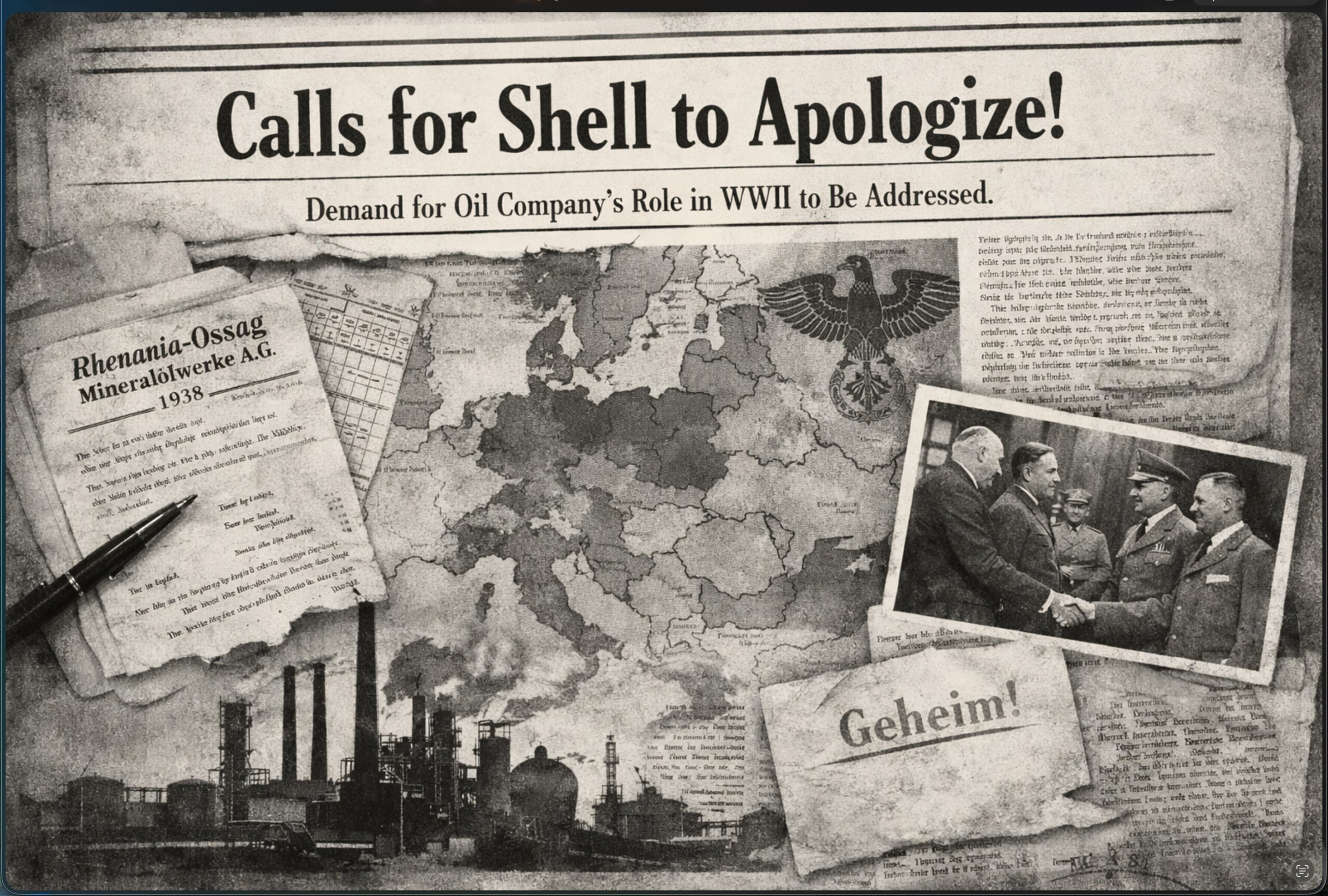
Royal Dutch Shell’s historical relationship with Nazi Germany has been documented by historians and investigative journalists. What continues to draw criticism is not only the company’s wartime conduct, but the fact that Shell has never issued a formal public apology or acknowledgment comparable to those made by other major European corporations with similar histories.
A number of writers, journalists, historians, and activists have publicly raised this issue.
openDemocracy and Adam Ramsay
One of the clearest mainstream journalistic discussions appeared in openDemocracy. In an article by journalist Adam Ramsay, Shell is described as facing public calls to apologise following revelations about its role in supplying oil to Nazi Germany. The article notes that Shell’s German subsidiary effectively operated on both sides of the conflict and that the company’s behaviour contributed materially to the Nazi war effort.
openDemocracy article:
AI Consensus Article:
Shell Must Apologise for Its Toxic History
On 9 February 2026, an article titled AI CONSENSUS: SHELL MUST APOLOGISE FOR ITS TOXIC HISTORY was published on RoyalDutchShellPlc.com. Authored by John Donovan, the piece summarises multiple AI analyses (including responses from Perplexity, Grok, ChatGPT, Copilot, and Google AI) and argues that Shell’s documented conduct under Nazism, apartheid, and in Nigeria creates a strong ethical case for clear public apologies and concrete remediation.
The article explicitly states that:
-
“Shell’s own-archive-based histories and independent researchers describe extensive links between Royal Dutch Shell (and especially Sir Henri Deterding) and Nazi Germany, including close personal contacts with Hitler and substantial financial and logistical support to the Third Reich’s war machine.”
-
“Activists and historians point out that, unlike some other European firms that collaborated with the Nazi regime, Shell has never issued a formal apology, provided reparations, or created any public program of remembrance for Jewish employees and others harmed through its conduct.”
Full article (including context and AI responses):
https://royaldutchshellplc.com/2026/02/09/ai-consensus-shell-must-apologise-for-its-toxic-history/
Independent Historians and Corporate-History Researchers
Independent historians and researchers, using Shell’s own archival material and commissioned corporate histories, have emphasised that despite clear documentation of collaboration with the Nazi regime, Shell has never issued a formal apology, funded reparations, or created a remembrance programme related to Jewish employees, forced labourers, or victims affected by its wartime operations. These criticisms point out that the absence of a formal apology continues to affect perceptions of the company’s integrity.
One such independent research archive documenting Shell’s history is:
https://royaldutchshellplc.com/
Historical Context Summaries
Additional investigative commentaries echo these criticisms, arguing that Shell’s continued silence contrasts with companies such as Volkswagen, Siemens, Deutsche Bank, and Allianz — all of which have issued public apologies and funded restitution initiatives for their Nazi-era conduct. These summaries note that Shell’s actions, or lack thereof, remain a troubling part of its legacy.
Example commentary:
Long-Standing Activist Criticism
Separate long-running activist commentary also documents Shell’s historic connections to Adolf Hitler, Nazi policies, anti-Semitic practices, and support for the Third Reich, noting that Shell has never apologised or expressed remorse for these aspects of its history. These writings frame a sustained demand for accountability that predates the AI-consensus article by years.
Historical activist piece:
https://www.shellnazihistory.com/?cat=10
Public Petitions and Campaigns
Public criticism has also taken the form of organised petitions. One petition calling on Shell to apologise for antisemitic conduct and Nazi ties explicitly states:
“Shell’s leader, Sir Henri Deterding, was an ardent Nazi feted by Adolf Hitler. Shell has never apologised or expressed any remorse.”
Change.org petition:
Ongoing Relevance
Most legal claims related to World War II are time-barred, which is why the criticism today is largely moral and reputational rather than legal. Nevertheless, historians, journalists, and campaigners argue that public acknowledgment and a formal apology remain important acts of corporate responsibility.
As of 2026, despite extensive documentation and repeated public calls, Shell has not issued a formal apology or comprehensive public statement addressing its Nazi-era associations — a point that continues to draw scrutiny from historians, writers, activist groups, media outlets, AI analyses, and organised campaigns alike.
*This website and sisters royaldutchshellgroup.com, shellnazihistory.com, royaldutchshell.website, johndonovan.website, shellnews.net, and shellwikipedia.com, are owned by John Donovan - more information here. There is also a Wikipedia segment, the Shell DPA Files, "Shell and the Spies", the Shell Leaks files, as well as books written and published by John Donovan - Kindle eBooks. Timeline of the Donovan Shell Feud. Toxic History of Royal Dutch Shell Group. Shell and the Donovans: The Full Media Record — 550+ Articles, 110 Books, 40 Years. *All created and supported by internet wizz, Nick Gill.