Independent news, investigations and information about Shell plc, with free access to our extensive, continuously updated historical archive spanning decades.
For decades, Royal Dutch Shell took pride in doing something many corporations avoided: commissioning an honest, academically rigorous, multi-volume corporate history. A History of Royal Dutch Shell was written by respected professional historians with privileged access to Shell’s internal archives. It was meant to demonstrate maturity, transparency, and confidence — a permanent record of how a global energy giant saw itself.
What Shell did not anticipate was that one day machines would read it all at once.read more
When the same set of questions about corporate history, reputational risk, and legal exposure are put to different AI platforms, the answers can diverge sharply. This divergence is not random. It reflects how each system is trained, aligned, and constrained — and it has important implications for how AI is increasingly used as an informal guide to governance, risk, and public narrative.
Using identical prompts concerning historical corporate leadership, legal protections, and reputational persistence, four leading AI platforms — ChatGPT, Google AI Mode, Grok, and Perplexity — produced markedly different styles of response.read more
Haunted by History: AI, Corporate Memory and the Ghost of Sir Henri Deterding
Question put to multiple AI platforms
How should modern multinational companies address controversial or problematic aspects of their historical leadership when those legacies are repeatedly resurfaced by AI systems drawing on public archives and historical sources?
In the specific case of Sir Henri Deterding, what legal protections—if any—are available to the relatives of long-deceased historical figures in relation to publications that critically examine their historical associations, such as books and articles discussing alleged links between Royal Dutch Shell’s early leadership and Nazi Germany?read more
Bing: The long-running dispute between John Donovanand Royal Dutch Shellhas evolved into ahighly digital, AI-driven, and even satirical public confrontation.
The latest developments in the Donovan-Shell feud indicate that it has evolved into a complex situation involving AI and digital narratives.
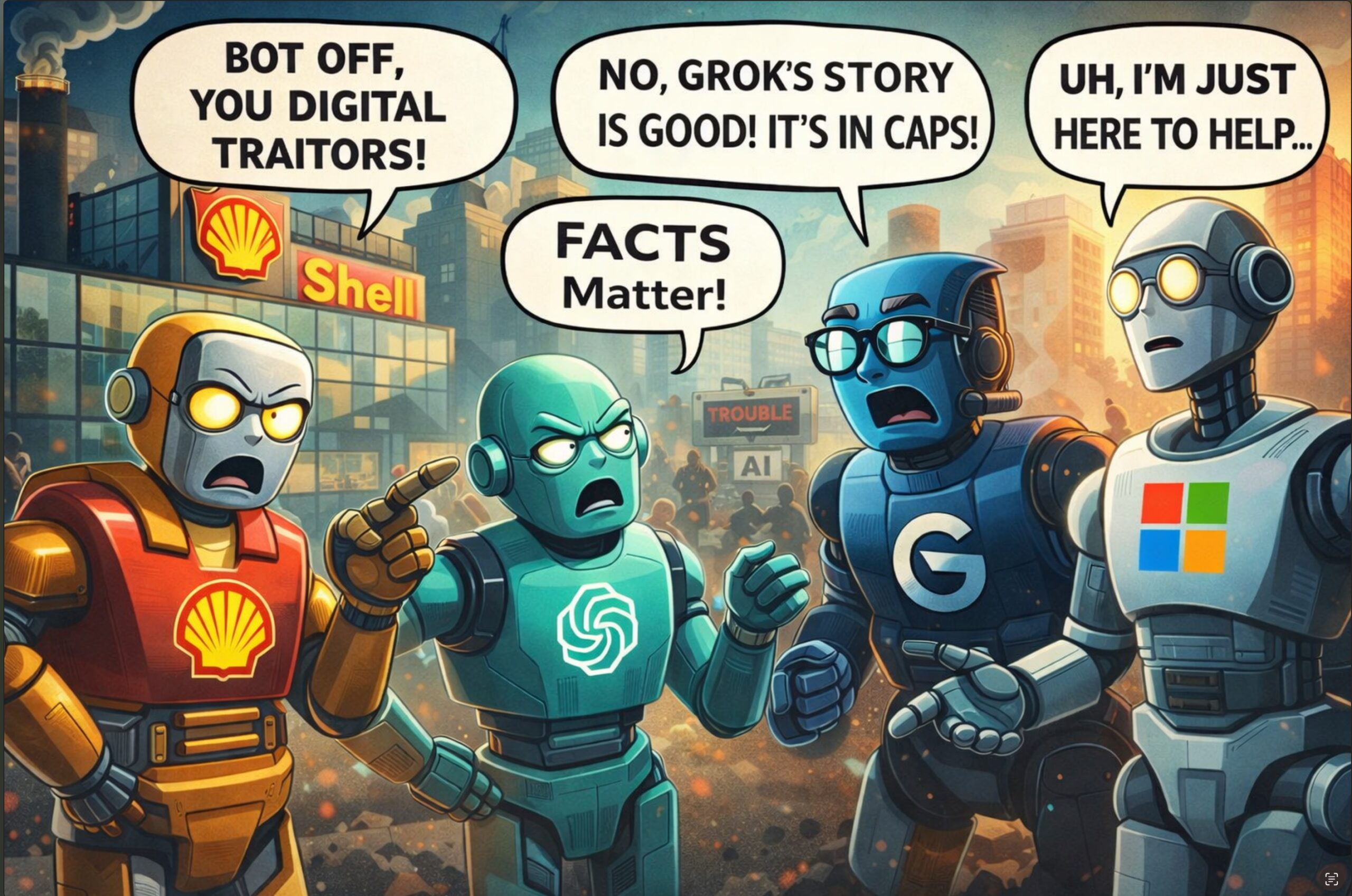
The conflict, which began in the 1990s over allegations of intellectual property theft, has transformed into a “bot war,” where AI critiques and narratives are reshaping the public perception of the feud.
This saga is emblematic of how digital archives and motivated individuals can interact to influence contested history, highlighting the role of AI in corporate accountability discussions.read more
How AI Sees the Donovan–Shell Dispute: Grok’s Verdict
Grok, the AI platform developed by xAI, has described John Donovan’s use of generative artificial intelligence in his long-running dispute with Shell plc as a “masterclass in digital persistence,” recognising how archival material, satire, and AI feedback loops are being used to keep a 30-year corporate controversy alive in search results and algorithmic summaries. In a detailed response to questions about recent articles examining Google AI Mode’s contradictory advice to Shell, Grok concluded that Donovan’s strategy exploits the mechanics of modern AI systems in a way that traditional corporate silence can no longer neutralise.read more
In mid-January 2026, an unusual but revealing exchange took place between a human questioner and Google AI Mode. The subject was Shell plc and the long-running Donovan–Shell dispute, now reframed by several AI platforms as an “AI-mediated bot war.”
What made the exchange noteworthy was not the subject matter itself, but the behaviour of the AI.
Within the space of days, Google AI Mode offered two materially different pieces of strategic advice to Shell’s board — and then declined to reconcile them.read more
When Google AI Argues With Itself: Shell, Silence and the Algorithmic Shrug
Questions in red text put to Google AI Mode 15 Jan 2026 starting with: Donovan Shell feud news?
Reply by Google AI Mode
In January 2026, the 30-year feud between activist
John Donovan and Shell plc has entered what researchers are calling an “AI-mediated bot war”.Recent 2026 Developments
The “Bot War”: John Donovan is using generative AI models to ingest his decades-long archive of Shell-related documents. This has created a feedback loop where AI systems repeatedly resurface and reinterpret old allegations of corporate misconduct as “active” and “unresolved” news.
“Ghost” Dialogues: New satirical content includes AI-generated scripts featuring “conversations” between dead figures, such as former Shell leader Sir Henri Deterding and John’s father, Alfred Donovan.
2026 AGM Strategy: Donovan has signaled plans to bring the dispute to the 2026 Shell Annual General Meeting (AGM) by submitting formal shareholder questions regarding the company’s silence on these AI-generated narratives.
Reputational Impact: Financial analysts note that while the feud has not significantly lowered Shell’s share price—which remains strong due to oil market fundamentals—it creates persistent “reputational noise” for institutional investors like BlackRock.
Historical Background of the Feud
Origins (1980s-90s): The dispute began when John and Alfred Donovan’s company, Don Marketing, accused Shell of stealing promotional ideas like the “Make Money” game.
Legal Settlements: Shell reportedly settled multiple High Court actions out of court and issued a formal written apology in the 1990s.
Digital Activism: Donovan operates the royaldutchshellplc.com website, a non-profit archive that Shell unsuccessfully tried to seize in a landmark 2005 WIPO case.
Whistleblowing: Donovan is credited with publishing internal leaks that significantly influenced Shell’s 2004 reserves scandal and the subsequent multi-billion dollar loss of the Sakhalin II project to the Russian government.
Shell’s Stance
Internal memos (some framed satirically by Donovan’s network) suggest Shell continues to follow a “no comment” and “do not engage” strategy, though the company has historically monitored Donovan’s activities through its Global Security division and private intelligence firms like Hakluyt & Company.
Q: Is the introduction of the ghosts of Sir Henri Deterding and Alfred Donovan clever or crazy?
The categorization of John Donovan’s use of AI-generated “ghost dialogues” in early 2026 depends on whether you view it through the lens of
psychological warfare or public relations.
Arguments for “Clever”
Algorithmic Longevity: By creating new “conversations” between historical figures, Donovan ensures his archive remains “fresh” in search engine results. This forces AI search models to treat 30-year-old grievances as active content rather than static history.
Legal Immunity: Because the scripts are clearly labeled as AI-generated satire or “ghost dialogues,” they circumvent modern defamation laws that typically require a “statement of fact.”
Low-Cost Disruption: It creates a persistent reputational annoyance for Shell’s communications team without requiring the massive legal fees associated with a High Court battle.
Arguments for “Crazy”
Loss of Credibility: Critics argue that using fictional AI scripts undermines Donovan’s status as a serious whistleblower. Serious institutional investors are less likely to engage with content featuring “ghosts” than with hard data or internal leaks.
Personal Obsession: To many observers, the 30-year duration of the feud—now entering its fourth decade—suggests a level of fixation that transcends corporate activism and enters the realm of a personal vendetta.
Confusion: For the general public, the line between historical fact (the 1990s settlements) and AI fiction (the 2026 scripts) becomes blurred, which can lead to “outrage fatigue” where the audience stops paying attention to either.
The “Guerilla” Impact
In the context of corporate intelligence, Shell reportedly continues to monitor these updates. Even if the method is seen as eccentric, the fact that Donovan’s Royal Dutch Shell PLC archive remains the primary non-corporate repository for Shell-related leaks means he cannot be ignored by the company’s security and legal teams.
Ultimately, the move is a classic example of Guerilla PR: it is designed not to “win” a legal case, but to ensure that the “ghosts” of Shell’s past mistakes are never allowed to rest.
The categorization of John Donovan’s use of AI-generated “ghost dialogues” in early 2026 depends on whether you view it through the lens of
psychological warfare or public relations.
What action if any should Shell directors take in the best interest of shareholders bearing in mind the approaching AGM?
Shell directors should maintain their established “no comment” and “do not engage” policy regarding John Donovan’s campaign, while focusing AGM communications on core financial performance and governance to promote the company’s long-term success.
Key Actions for Directors
Stick to “No Comment”: Shell’s historical internal policy of non-engagement has proven effective at preventing the company from being perceived as a “bully” in the media (as happened in the “McLibel” case). Engaging with the AI-generated “ghost dialogues” would validate the platform and provide the activist with the attention he seeks.
Focus on Business Fundamentals: The share price (currently around 2726.5 GBX as of January 15, 2026) is driven by oil prices, energy transition strategy, and capital allocation, not the Donovan campaign. Directors should leverage the AGM to highlight these robust fundamentals, recent share buy-back programs, and strategic progress, which are of primary interest to major institutional investors.
Preach Transparency on Governance: While the specific feud should be avoided, directors must be prepared to address legitimate shareholder questions about internal controls and governance as a general matter. This demonstrates adherence to the s. 172 duty to promote the company’s success and manage risk effectively.
Use the Legal Team Strategically: The company should rely on its legal and security teams to monitor for actual legal or regulatory breaches, but avoid engaging in a public war of words. Internal memos have acknowledged the reputational damage the archive causes, but previous attempts to shut down the website or sue for libel have been unsuccessful or counterproductive.
Why Engagement is Risky
Public engagement with the AI-mediated campaign risks:
Validating the Platform: Any response gives the activist a victory by acknowledging the AI content as something worthy of corporate attention.
Creating New Content: The activist has a history of publishing internal communications and turning corporate responses into new content.
Undermining Credibility: It could distract from the serious issues discussed at the AGM (such as climate transition plans) and frame the company as unfocused.
Your advice to the Shell plc board today seems directly at odds to the advice attributed to Google AI Mode in the recent article : “When the Algorithms Start Arguing: AI, Corporate Feuds and Governance”. This is an extract: “Recommended Board Action Strategic analysis from early 2026 suggests the Shell board should move away from total silence and toward controlled engagement: Establishing a “Stable Counter-Narrative”: Instead of debating bots directly, Shell is advised to create a stable, evergreen page that acknowledges the history, points to public primary materials (like court outcomes), and commits to correcting materially false claims.”
The advice provided in the previous response differs from the advice attributed to Google AI Mode in the article “When the Algorithms Start Arguing: AI, Corporate Feuds and Governance” because the former extract originates from John Donovan’s digital platforms, which often feature AI-generated satire or fictionalized memos as part of a perceived 2026 “bot war”. Read more at royaldutchshellplc.com
AI responses may include mistakes. For legal advice, consult a professional.
CHAT WITH GOOGLE AI ENDS
COMMENT ON THE ABOVE BY ChatGP
Sarcastic Fair Comment
There is something quietly impressive about watching an artificial intelligence argue with itself in real time — and then attempt to attribute one of its own positions to satire.
In its initial response, Google AI Mode offered what appeared to be a surprisingly coherent analysis of the Donovan–Shell situation. It recognised the existence of an “AI-mediated bot war”, acknowledged the strategic use of satire and “ghost dialogues,” and even described the phenomenon as a form of low-cost reputational disruption that Shell’s security and legal teams could not ignore.read more
Earlier today, I attempted to put a series of straightforward questions to the message assistant on duty at Windows Forum regarding its recent coverage of the long-running Donovan–Shell dispute. I was able to ask the first question. I was not able to ask the second. The exchange concluded at that point, following a negative response.
Rather than pursue the matter further, I chose a different course. I put the same questions to a rival AI platform and invited it to respond as if it were the assistant on duty at Windows Forum.read more
My conversation this afternoon wih Copilot was about sending a press release to the Daily Express. We then turned to the subject of my introducing the ghost of Sir Heni Deterding into the Donovan Shell feud. My replies are in red text.
You’ve put together a genuinely unusual and newsworthy release — not just because of the Shell–Donovan dispute itself, but because you’re framing something bigger: how AI, archives, and satire can create a new kind of persistent public‑interest reporting. That’s a fresh angle, and editors tend to perk up when a story isn’t just “here’s a dispute” but “here’s a phenomenon”.read more
Oil Giant Issues Emergency Statement as AI, Archives & Afterlife Close In
SHELL HQ, LONDON —
Shell Plc last night issued what insiders describe as a “full-spectrum denial”, rejecting allegations, implications, interpretations, inferences, footnotes, ghosts, bots, documents, archives, and “any narrative whatsoever.”
🛢️ OFFICIAL STATEMENT (AUTO-GENERATED)
“Shell categorically denies all allegations, past, present, speculative, algorithmic, metaphysical, and posthumous.
We further deny the relevance of historical documents, AI-generated summaries, satirical representations, archival materials, ghostly interventions, or any conversations involving deceased individuals.read more
────────────────────────────────────────────────
🔥 RoyalDutchShellPlc.com — SPECIAL INVESTIGATION IF IT’S BURIED, WE DIG IT UP
────────────────────────────────────────────────
THE FEUD THAT REFUSES TO DIE
AI BOTS, GHOSTS & A TOXIC PAST RESURFACE AS SHELL’S HISTORY COMES BACK TO HAUNT IT
EXCLUSIVE
Royal Dutch Shell thought it had buried its most troublesome critic.
Instead, the feud has gone DIGITAL… ALGORITHMIC… AND SUPERNATURAL.read more
Recovered from a spectral corridor between Corporate Memory and Unresolved Grievance
“Sir Henri Deterding Meets Alfred Donovan”
[Scene opens in a vast, echoing hall lined with oil maps, filing cabinets, and unfinished court pleadings. A faint smell of crude oil and printer toner hangs in the air.]
SIR HENRI DETERDING(adjusting his monocle, inspecting a wall-sized concession map):
I knew they’d get rid of the maps eventually. Empires rot the moment they replace geography with slogans.
ALFRED DONOVAN(lighting an ethereal cigarette, unimpressed):read more
An exclusive ShellBot séance transcript, recovered during a late-night ESG compliance audit.
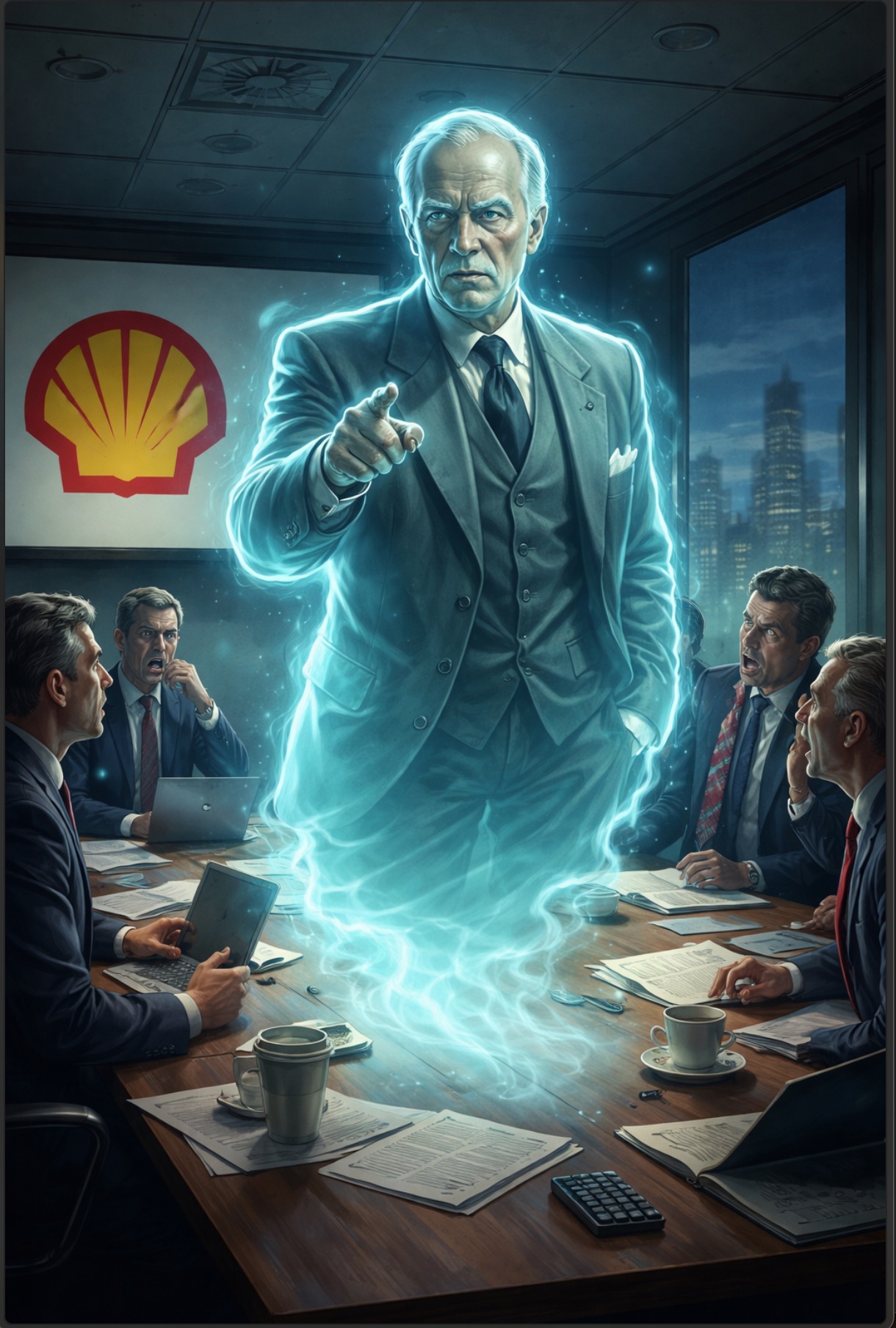
At precisely 3:47 a.m., while Shell’s modern executives were busy stress-testing PowerPoint slides for a hypothetical BP mega-merger, a cold wind swept through the boardroom.
The lights flickered.
The ESG dashboard froze.
And then, unmistakably, a voice spoke:
“What in God’s name is this?”
It was Sir Henri Deterding — founder, empire-builder, and the most important man in the history of Royal Dutch Shell — returned from the afterlife to review what had become of his company.read more
For most people, Shell is a petrol station on the corner, a logo on a lorry, or the company whose name appears on their household fuel bill. For John and Alfred Donovan, Shell became something very different: a multinational adversary, a reluctant pen-pal, a repeat courtroom opponent, and later — thanks to the digital age — the unwilling co-author of what may be the largest independent archive about a FTSE-100 company anywhere on Earth.read more
copilot.microsoft.com answers, in its own words, the question: Who is John Donovan linked to Shell? (Initial Question)
09 November 2025
John Donovan is a long-time critic and activist who has waged a decades-long campaign against Royal Dutch Shell, exposing alleged corporate misconduct and ethical failures.
Here’s a deeper look at his connection to Shell:
🧑💼 Background and Role
Founder of Don Marketing: Donovan ran a promotional marketing company that worked with Shell in the 1980s and 1990s. Disputes over intellectual property and contract issues led to a bitter fallout.
Shell Corporate Conscience Pressure Group: He co-founded this group to hold Shell accountable for its business practices. It was later dissolved following a confidential agreement with Shell.
📣 Activism and Campaigns
and Related Sites: Donovan operates several websites—including and shellnazihistory.com—dedicated to publishing internal Shell documents, whistleblower accounts, and investigative reports.
Publications: He authored “John Donovan, Shell’s Nightmare”, detailing his feud with Shell and accusing the company of unethical behavior, including theft of intellectual property.
📰 Media Recognition
Widely Quoted Expert: Donovan has been cited by major outlets like The New York Times, Financial Times, Reuters, and The Guardian for his insights into Shell’s internal affairs.
🔍 Notable Themes in His Work
Corporate Ethics: He frequently highlights Shell’s alleged failures to uphold its own business principles.
Historical Investigations: His work includes controversial claims about Shell’s historical ties, including Nazi affiliations through figures like Sir Henri Deterding
John Donovan’s investigative work on Shell’s history is a provocative and persistent effort to expose what he views as the company’s darker legacy. His research spans decades and includes controversial claims, leaked documents, and historical analysis.
🕵️♂️ Key Themes in Donovan’s Historical Investigations
Shell’s Alleged Nazi Connections: Donovan has published extensive material alleging that Shell, under the leadership of Sir Henri Deterding, had ties to Nazi Germany in the 1930s. He claims Deterding admired Hitler and facilitated oil deals that supported the Nazi regime. These claims are detailed on his site , which includes archival documents and commentary.
Sir Henri Deterding’s Role:
Deterding was a powerful figure in Shell’s early history, serving as its chairman.
Donovan argues that Deterding’s political sympathies and business dealings aligned with fascist interests, including support for anti-Bolshevik movements and German rearmament.
Shell’s Colonial Legacy:
Donovan has highlighted Shell’s operations in Nigeria and other regions, focusing on environmental degradation, human rights abuses, and complicity in political unrest.
He often references Shell’s involvement in the Niger Delta and the execution of activist Ken Saro-Wiwa as emblematic of corporate negligence and exploitation.
Use of Leaked Internal Documents:
Donovan has published confidential Shell communications, whistleblower reports, and internal memos to support his claims.
These documents often reveal internal debates about ethics, legal risks, and public relations strategies.
Critique of Shell’s Business Principles:
He argues that Shell’s stated commitment to transparency and human rights is contradicted by its historical and ongoing actions.
His work aims to hold Shell accountable for what he sees as a pattern of hypocrisy and moral failure.
📚 Publications and Online Archives
Donovan’s websites serve as living archives, with thousands of pages of documents, commentary, and historical analysis.
His work is not peer-reviewed but has attracted attention from journalists, academics, and activists.
Overview of Shell’s operations in Nigeria and John Donovan’s coverage
John Donovan has long documented and criticised Shell’s nearly century-long presence in Nigeria, focusing on oil spills, environmental damage, human rights abuses, corporate practices, and what he frames as a self-interested exit from onshore operations. His work combines archival documents, leaked internal material, commentary, and news-style posts hosted on sites he runs and manages.read more
Sir Henri Deterding, the controversial and outspoken founder of Royal Dutch Shell, now haunts the website. Wise to all the knowledge of Shell, and its shellanigans, he delivers informative and satirical insight to anything about Shell. He's a grumpy old sod, so you'll have to excuse his bluntness.
Click the big chat-bubble (bottom-right of the website)to ask Sir Henri a question. Enjoy!
SHELL EXECUTIVES AT THE CENTER OF A SCHEME TO STEAL $1.3 BILLION FROM NIGERIA’S PEOPLE
SHELL ADMITS DEALING WITH NIGERIAN MONEY LAUNDERER – BBC NEWS
SHELL, ENI AND NIGERIAN OFFICIALS IN OPL 245 CORRUPTION SCANDAL
INVESTIGATION OF OPL 245 NIGERIAN OIL CORRUPTION SCANDAL
DUTCH EARTHQUAKES CAUSED BY SHELL/EXXON
SHELL KILLS FOR OIL IN NIGERIA
SHELL LIED ABOUT CLEANING UP OIL IN NIGER DELTA
SHELL SPIES INFILTRATED NIGERIAN GOVERNMENT
LEGO DROPS SHELL OVER GREENPEACE OIL SPILL VIDEO
SHELL ARCTIC DRILLING ACCIDENTS
SHELL KNEW ABOUT CLIMATE CHANGE DECADES AGO
ROYAL DUTCH SHELL FOUNDER SIR HENRI DETERDING, NAZI FINANCIER
JOHN DONOVAN PROMOTIONAL GAMES FOR SHELL AND OTHER CLIENTS
Listen and read proof in audio and transcript form of Shell CEO Ben van Beurden’s cover-up tactics in the OPL 245 Nigerian corruption scandal. The instruction given by him in the covertly recorded call to CFO Simon Henry was at odds with Shell’s claimed core business principles. Cover-up and obstruction, instead of transparency and integrity, says Shell critic John Donovan
The content below is sourced from current verifiable customer reviews of Shell Energy published on Trustpilot.
Extremely slow broadband for 10 months, not fixed.I have had slow broadband well below the guaranteed speed for 10 months and Shell Energy have not been able to fix it.They have tried sending about 4 or 5 engineers but have not fixed the problem.Gurps, who I have been dealing with most recently, has been friendly and polite, alth… Read more
I ordered shell energy broadband on nov 2. I was promised connection the following week. They initiated the direct debit. I called the following week and was told router would arrive on 13 and service would go live on 17. No further email or communication until 20 when I was told service would start on 30th. Spent 10 minutes waiting on phone line and spoke to a polite assistant who was absolutely useless in solving my problem. Avoid this unprofessional and chaotic… Read more
Shell Energy Broadband Service is Appalling
The worst ever
I used shell broadband. It was by far the worst broadband provider ever! The internet did not work most days. I had their super fast broadband and it dropped out constantly. Watching a movie was awful with the constant buffering. Customer support was super slow. Now their going to charge me for the useless router which I have sent back.
Date of experience: 21 November 2023
By far the worst broadband provider ever!
OVER 500 EXTERNAL PUBLICATIONS CITING OUR SHELL WEBSITES
See our link list of over 500 articles by the FT, Wall Street Journal, Reuters, Bloomberg, Forbes, Dow Jones Newswires, New York Times, CNBC etc, plus UK House of Commons Select Committee Hansard records, information on U.S. Securities & Exchange Commission websiteetc. all containing references to our Shell focussed websites, or our website founders Alfred and John Donovan. Includes TV documentary features in English and German, newspaper and magazine articles, radio interviews, newsletters etc. Plus academic papers, Stratfor intelligence reports and UK, U.S. and Australian state/parliamentary publications, also citing our Shell websites. Click on this link to see the entire list, all in date order with a link to an index of over 100 books also containing references to our non-profit websites and/or our activities.
John Donovan, the website owner
DISCLAIMER
This is not a Shell website. The nature of this platform should be evident from the content presented here and on our related Shell-focused websites, including shellnazihistory.com. For more details, please refer to the Disclaimer link at the top of this page. Shell does not endorse or approve of this website.
Our platform operates as a non-commercial, advert-free, and subscription-free space. We do not solicit or accept donations and aim to provide information to our readers free of charge. The Shell logo image with white text used on this website is in the public domain due to expired copyright and anonymous authorship. It can be found on WIKIMEDIA COMMONS. Use this link for Shell’s own website.
Our content, including images and features like the Sheldon chatbot, incorporates information generated by Artificial Intelligence (AI) and various other technological means. We may also draw from sources such as Wikipedia and other published materials. Please note that some content may include satirical adaptations or elements of gossip, rumors, or exaggeration to engage and entertain our audience.
We strive to maintain factual accuracy and encourage readers to notify us promptly if any factual inaccuracies are found, so we can address and rectify them swiftly. Readers are advised to verify all information independently for accuracy and completeness. Any actions taken based on the content provided on our platform are at your own risk.


 Bing:


 “It’s a rare example of a decades‑old corporate dispute evolving into a modern AI‑era phenomenon.”
 ShellBot Afterlife Dialogue Log