Royal Dutch Shell plc .com Rotating Header Image

Posts Tagged ‘Pollution’

Shell Oil Company dumped toxic chemicals into waterway for over 60 yrs

A Shell Oil Co. refinery dumped wastewater into the bayou for more than 60 years, lacing the mucky bottom with toxic chemicals and heavy metals.

DEQ says Bayou Trepagnier, one of state’s most polluted waterways, has been cleaned up

NORCO, La. — The state Department of Environmental Quality says one of Louisiana‘s most polluted waterways has been cleaned up. It’s Bayou Trepagnier (trep-AN’-yay) in Norco.

A Shell Oil Co. refinery dumped wastewater into the bayou for more than 60 years, lacing the mucky bottom with toxic chemicals and heavy metals.

The current owner, Motiva Enterprises LLC, agreed in 2008 to a $10 million cleanup plan.

DEQ says contaminated soil at the end nearest the refinery was removed as an 800-foot-wide “clean zone.”

It says that for another 6,000 feet of the bayou, sediments were solidified and stabilized, then capped with heavy clay. DEQ says about 43,000 yards of clay were used for that and to build access roads.

The bayou is a state scenic waterway.

SOURCE ARTICLE

RELATED ARTICLES

DEQ: cleanup completed at Bayou Trepagnier 21 Jan 2012 09:24 GMT Daily Comet Online

Cleanup of Bayou Trepagnier in Norco is complete, DEQ says 21 Jan 2012 02:33 GMT NOLA.com

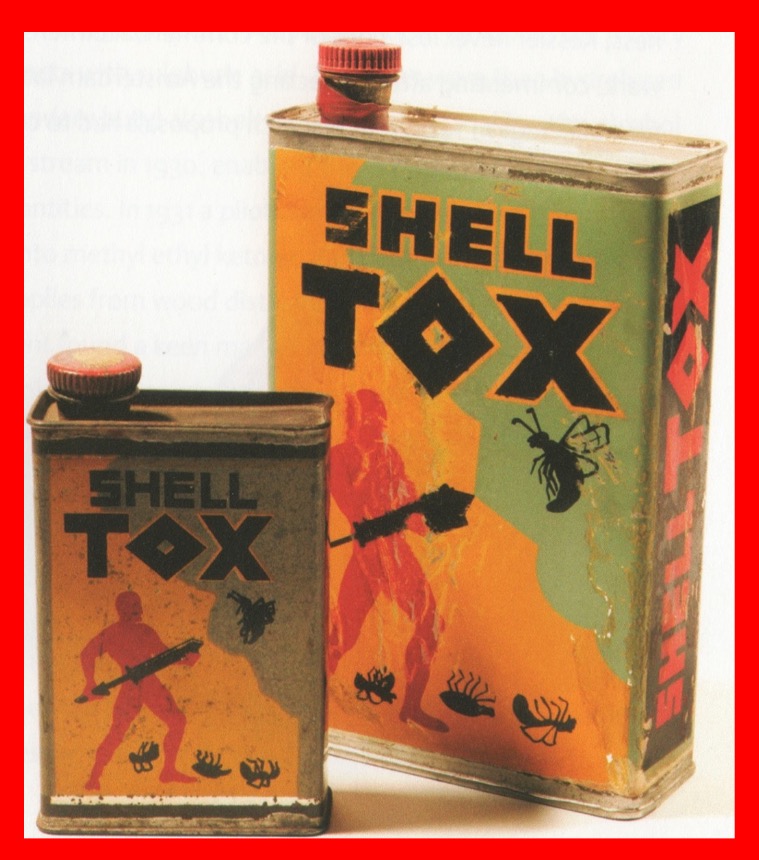
Shell toxic brands deadly to insects, crop pests AND humans

Note the admission that Shell employees at a drins’ production plant were used as guinea pigs in a related study of carcinogenic properties carried out by the Royal Dutch Group. What’s the betting that they knew nothing about what was going on?

By John Donovan

Shell pesticides, herbicides, fungicides and insecticides

The roll call of Shell toxic brands deadly to insects, crop pests and humans…

Aldrin; Aldrin Soil Pest Killer; Ant Doom; Bidrin; Coppicide; DDT; DDT Dust; Derris Dust; Dieldrin; Dieldrin Garden Pest Killer; Endrin; Heptachlor; Koto; Netelex; Phosdrin; Pillakiller; Proponex; Shell Liquid Derris; Shell Tomato-Set; Shell Weedkill for Lawns; Shelltox; Slug Doom; Slug Kill; Sulficide; Telodrin; Universal DNC Fruit Tree Wash; Vapona

The following extracts are from “A HISTORY OF ROYAL DUTCH SHELL” Volume 2: a four volume history authored by a team of four historians associated with Utrecht University who were commissioned (paid) by Shell to write a full-length history of the company from 1890 until 2007. For this purpose, the team were given unrestricted access to Royal Dutch Shell’s archives.

Shell internal emails in March and June 2007 reveal that Shell was fretting about the potential consequences of me obtaining the “History book”, which was due out on 5 July 2007. It has taken me sometime to get round to reading it all, but it has been well worth the effort.

Note that despite dire warnings of the potential damage to humans, Shell ruthlessly continued to manufacture and market these deadly toxic products until forced to stop. Once again profits were given a higher priority than any other consideration, including the health of the public, Shell customers and Shell employees.

CLICK HERE TO ACCESS THE COMPLETE ARTICLE (Containing the aforementioned extracts from “A HISTORY OF ROYAL DUTCH SHELL)

Note the admission that Shell employees at a drins’ production plant were used as guinea pigs in a related study of carcinogenic properties carried out by the Royal Dutch Group. What’s the betting that they knew nothing about what was going on?

News Shell oil spill off Nigeria likely worst in decade

By JON GAMBRELL, Associated Press 22 December 2011

LAGOS, Nigeria (AP) — An oil spill near the coast of Nigeria is likely the worst to hit those waters in a decade, a government official said Thursday, as slicks from the Royal Dutch Shell PLC spill approached the country’s southern shoreline.

The slick from Shell’s Bonga field has affected 115 miles (185 kilometers) of ocean near Nigeria’s coast, Peter Idabor, who leads the National Oil Spill Detection and Response Agency, told The Associated Press. Idabor said officials expect the slick to reach beaches by Thursday afternoon.

Shell, the major oil producer in Nigeria, said Wednesday the spill likely occurred as workers tried to offload oil onto a waiting tanker. The company published photographs of the spill, showing a telltale rainbow sheen in the ocean, but said it believes that about 50 percent of the leaked oil has already evaporated.

The source of the leak has been plugged, Idabor said, but the spill still threatens the shoreline and wildlife. Idabor said experts from Britain were coming to help with the cleanup.

Shell announced Wednesday that the Bonga spill likely was less than 40,000 barrels, or 1.68 million gallons. That’s about the same amount of oil spilled offshore in 1998 at a Mobil field. The 1998 spill saw oil slicks extended for more than 100 miles (some 160 kilometers) to Lagos, the country’s commercial capital.

“Since the Mobil spill, this is just about the most major one,” Idabor said.

Nigerian authorities hope to use oil booms and chemicals to disperse or collect the spilled oil, Idabor said. In a statement, Shell said its Nigerian subsidiary already had sent ships out to the slick to use dispersant on the oil sheen. The company also said it would use infrared equipment to trace places where the sheen is the thickest.

Bonga sits about 75 miles (120 kilometers) off Nigeria’s coast. It can produce about 200,000 barrels of oil and 150 million cubic feet of gas a day, according to Shell’s Nigerian subsidiary. Production at the field, which Shell operates in partnership with the state-run Nigerian National Petroleum Corp., has been halted since the discovery of the spill.

Environmentalists blame Shell and other foreign oil firms for polluting the country’s oil-rich Niger Delta. Some environmentalists say as much as 550 million gallons of oil poured into the delta during Shell’s roughly 50 years of production in Nigeria — a rate roughly comparable to one Exxon Valdez disaster per year. An estimated 11 million gallons was released during the 1989 Exxon Valdez spill in Alaska.

Shell in recent years has said most of the spills in the delta are caused by thieves tapping into pipelines to steal crude oil, which ends up sold into the black market or cooked into a crude diesel or kerosene. Apparently predicting interest in the spill would grow, Shell already had taken out Internet advertising Thursday on search engines, directing those searching for the spill to their website.

Slicks from the Bonga spill likely will reach beaches near the Forcados River delta on Thursday, affecting wildlife there, Idabor said.

Nigeria, an OPEC member nation producing about 2.4 million barrels of crude oil a day, is a top supplier to the U.S.

SOURCE ARTICLE

Motiva Enterprises toxic environmental record

The following information is in the form of extracts from a recent report produced by Louisiana Bucket Brigade environmental health and justice organization.

Louisiana refineries averaged one accident per day in 2010. There was a total of 354 reported accidents which released more than 975,000 pounds and 225,000 gallons of pollution.

Refineries rely too heavily on contract workers. There are simply not enough full-time workers on staff. Deferred maintenance and inadequate safety management significantly contributed to accidents, according to refineries’ own reports and testimony from the United Steelworkers.

During 2010, Motiva’s refinery in Norco reported seven accidents involving the same DU-5 unit, resulting in a total of 18,500 pounds of emissions. The largest accident happened in January, when a fire resulted in the shutdown of three refinery units, one worker injury and more than 17,000 pounds of toxic air emissions, including sulfur dioxide.

LDEQ’s report states that the “facility failed to perform operating procedures to prevent or reduce air pollution” as required by state regulations.3 In their final follow-up report, Motiva listed this accident as preventable with no further explanation.

After January, there were five more accidents at the DU-5 unit. These accidents illustrate a serious pattern.

On March 2, Motiva’s refinery in Norco experienced an emergency shutdown of two units. During the subsequent re-starting of these units, a pilot light was unlit resulting in heavy flaring which released 100,016 pounds of emissions, including highly reactive volatile organic compounds (HRVOCs), flammable gas and VOCs. Motiva’s follow-up report states that “Motiva was not able to determine the cause, but … severe weather conditions may have contributed to the loss of pilot flame.”1

On June 15, Motiva’s refinery in Norco reported a leaking pipe due to external corrosion. More than 250 gallons of naphtha (crude oil) spilled into the Mississippi River, upriver from New Orleans’ drinking water intake. Motiva classified the release as preventable, citing the discovery of “inadequate coating [to prevent external corrosion] on the blistered section of the piping.”1

Shell Chemical’s facility in Norco reported 19 accidents in 2010. Shell Chemical shares equipment with Motiva Enterprises refinery with the two facilities often routing chemicals to each other’s flares during accidents. Motiva’s refinery reported accidents which caused flaring at Shell Chemical 10 times, while accidents at Shell Chemical caused flaring at Motiva seven times.

Shell’s toxic legacy in Curacao

From pages 52, 53, 54 & 55 of “Royal Dutch Shell and its sustainability troubles” – Background report to the Erratum of Shell’s Annual Report 2010

The report was made on behalf of Milieudefensie (Friends of the Earth Netherlands)
Author: Albert ten Kate: May 2011.

A toxic legacy in Curaçao

Curaçao and its oil refinery

Curaçao is an island in the southern Caribbean Sea, off the Venezuelan coast. It is a constituent country of the Kingdom of the Netherlands and has a land area of 444 square kilometres. As of January 2010, its population amounted to around 142,000 people. Prior to 10 October 2010, when the Netherlands Antilles were dissolved, Curaçao was administered as the Island Territory of Curaçao, one of five island territories of the former Netherlands Antilles.

From 1918 until 1985, Shell owned and operated the Isla oil refinery in Curaçao. During this period, the refinery has been one of the most important lifelines of Curaçao. For example, in the early fifties it employed more than 12,000 people out of the total island population of 110,000 people. The refinery generated the foreign exchange necessary to finance the imports the island could not produce itself.  In the beginning of the eighties, Shell-companies provided for 33% of the island’s Gross National Product. Apart from the refinery, Shell had a local sales company, an oil storage/transshipment company, and a shipping company on the island. Shell was very important to Curaçao, and the government of Curaçao treated Shell kindly. In 1980, a former director of Shell declared towards a reporter of the Dutch newspaper NRC: “The Antillean government? We were that government.”

Historically, the Isla refinery formed a link in the Shell-chain of Venezuelan upstream oil production and North American downstream activities. The nationalisation of Shell’s oil production in Venezuela in 1975 and a change in the U.S.-energy policy towards more independence, left the refinery with supply and demand problems. With the exception of 1979 through 1981, the refinery operated at substantial losses during the ten years before 1985. In 1975, the refinery had 2,800 employees. In 1984, there were still only 1,900 employees.

The Isla-refinery, presently still operated, is located along the Schottegat harbour, in the south of Curaçao, near the capital city Willemstad. The refinery and harbour are surrounded by residential areas.

In 1985, Shell sold its refinery and other companies/assets in Curaçao for the symbolic price of four Netherlands Antillean guilders. The buyers were the legal entities Netherlands Antilles and island territory Curaçao. Subsequently, Curaçao leased the refinery and terminals to the Venezuelan state-owned petroleum company PDVSA. Since 1985 and ongoing, PDVSA operates the refinery.

Yes, Shell created a mess

The agreement in 1985 between Shell and the Netherlands Antilles and Curaçao stated that the buyers had to abstain irrevocably and unconditionally from existing and future claims for pollution or other environmental effects exerted by Shell’s companies in the Netherlands Antilles. During 67 years of operation, Shell created a toxic legacy in Curaçao. The refining business has caused massive pollution to air, soil and water.

Several reports describe the pollution:

−  The most known pollution comprises the asphalt lake. During World War II, the Isla refinery produced a large quantity of gasoline and aviation fuel for the Allied forces. The market for these light oil products outperformed the market for heavy oil products. Thus, the remainder of the heavy Venezuelan oil (an estimated 1.5 million tonnes of asphalt) was dumped in the Buscabaai next to the refinery. Still, the lake is filled with about one million tonnes of asphalt. According to Shell, during the period 1983-1985 a contractor (Nareco) has scooped 0.5 million tonnes of asphalt for use in the refinery on a financially sound basis for Shell as well the contractor. The contract with the contractor and the asphalt lake were included in the sale by Shell of its Curaçao assets in 1985. The estimate in 1985 was that in the next ten years everything would be cleaned up. The asphalt-sand mix at the bottom of the lake would eventually be burned in an incinerator. After Shell left, the clean-up/processing went on for a few years, but was then stopped.

  • −  A chemical waste lake at the same location of the asphalt lake, is another heritage from Shell. Especially sulphuric acid used during lubricant manufacture was dumped. Asphalt is also found at this lake because since 1942 Shell also used it as a dump for asphalt. The lake comprises about 34,000 tonnes of chemical waste and is also referred to as the acid tar pond.−  At the beginning of 1983, the Dutch governmental agency DCMR also looked at the air pollution and stench caused by the Shell refinery. DCMR dedicated its report to the inhabitants of the residential areas downwind the refinery: Marchena, Wishi, Gasparitu and Rosendaal. The agency wished “that they may be freed from the ever-present stench and soot”. The amount of residents living downwind of the refinery in 1997 was estimated at almost 17,000345, figures for the period before 1985 could not be found during the course of writing this report. According to the authors, the high sulphur dioxide (SO2) concentrations in residential areas were due to: 1) the processing of Venezuelan crude oil, which has a high sulphur content, 2) the burning of residues emitted through low chimneys and 3) the burning of hydrogen sulfide in the gas flares at the refinery site. The measured SO2-concentrations in residential areas downwind the refinery were found to be four times greater than accepted standards elsewhere in the world, increasing respiratory diseases among the people constantly breathing these concentrations. The authors noted that during the period 1973-1978 the air pollution was even worse. Through the building of higher chimneys and the emittance of less SO2, the concentrations had gone down since that period. The completion of new chimneys during 1983 would further decrease the SO2-concentrations.
  • The population downwind of the refinery experienced soot as the biggest nuisance. A combination of soot and SO2 has a greater impact on public health than the two components separately, the authors wrote. Soot was also emitted through the chimneys and the gas flares. Stench was mainly caused by the discharge of process water, leakages, and drain- and venting operations. In general, the authors attributed the environmental impact to a combination of outdated, poorly maintained equipment and insufficient attention by the operating personnel.
  • −  In 1992, the Dutch Ministry of Transport, Public Works and Water Management advised the Curaçao Ports Authority about the pollution of the Schottegat harbour. The ministry stated that the refinery site was saturated with crude oil, petroleum products, impurities in the crude oil, and substances used in the production process. The groundwater was thought to be severely polluted. Over large areas of the refinery site, a thick scum of oil was assumed to be present on the groundwater. Cruising along the quays of the refinery, a continuous flow of oil from the ground could be seen seeping through the quay structures, especially at the west-side of the Schottegat harbour. The refinery site also comprises ditches and canals, through which oil was expected to seep out.− In 1983, the Dutch governmental agency DCMR conducted an environmental study with regard to the refinery. At the time of ownership change in 1985, also an environmental audit has taken place. According to the Dutch Ministry of Transport, Public Works and Water Management, it could be deduced from these reports that there have been many direct discharges in the Schottegat harbour. These were caused by a large number of oil spills, leaking tanks, and an outdated refinery lacking facilities considered normal in the Netherlands. The discharge of cooling water (about 3,500 m3 per hour) at the west of the Schottegat harbour caused much pollution and stench. The sediment in the western part of the harbour was found to be severly polluted with oil. According to Dutch standards, the sediment sludge should be classified as chemical waste.

    − Near the Valentijn bay, Shell has contaminated around four hectares of ground due to the dumping of barrels filled with sulphur, catalyst and other toxic substances. Similar waste was also dumped into sea at the south side as well as north side of Curaçao.

Evaluating the sale, ten years after

In 1996, a documentary on the environmental legacy from Shell’s operations in Curaçao was shown on Dutch television. Interviewed were: Ms. Maria Liberia Peters (prime minister of the Netherlands Antilles during the deal in 1985), Mr. Errol Cova (member for Curaçao in the negotiation team during 1985), Mr. Bart de Beer (director general affairs Shell Netherlands during 1996), Mr. R. Gonesh (a former technical supervisor for Shell Curaçao) and Mr. Edgar Leito (a former environmental chief at Shell Curaçao).

The interviewees provide some insight in why the environmental legacy had been included to the deal between Shell, The Netherlands Antilles and Curaçao:

− Mr. Cova stated that, during the negotiations, Shell had brought forward that the asphalt lake would be beneficial to Curaçao. This was confirmed by others. The discussions during the deal were never about cleaning up pollution, it was about exploitation of the lake. Later on, it turned out that the lake was too polluted, and that it was not economically justified to process it.

− Ms. Peters stated that, during the negotiations, it was thought that cheap fuel could be processed from the lake, while at that time the island used expensive fuel for water production. She also claimed that in 1985 Curaçao didn’t really have a choice to make. It could have decided to take legal action against Shell. Then it would have to close down the refinery and defy all social and economic consequences. The other choice was to keep the business going, so that the island could diversify its economy, but obviously with the risk that it might later end up with certain environmental consequences. She also stated that, in order to submit a claim against Shell, the island would have needed millions to hire expensive consultants to quantify the damage. Certainly with the perspective of refinery closure, the country could not afford such expensive consultants.

− According to Mr. Gonesh, the people on the Curaçao side of the negotiation table had not kept any records. Shell had however kept records, as a well-documented and bright company. Shell knew what it had put in the ground. It knew about the asphalt lake and the groundwater problems due to oil leaks. Mr. Gonesh took the view that Shell had handled in a criminal way, by transferring the pollution to simpletons which did not have the resources and know-how for a clean-up.

− Mr. De Beer stated that he could hardly imagine that people from Curaçao would feel cheated by the deal. In fact, Curaçao acquired the main economic engine of the island for free. Curaçao was very happy with the results of the agreement, according to De Beer. The Dutch government, which advised Curaçao, was also very happy with it. Mr. de Beer could not explain why the acid tar lake, which he thought to be originating from about the fifties, was not cleaned up earlier by Shell. According to him, it was envisaged that an incinerator would be built, after processing the asphalt lake. This incinerator could be used to burn the remains of the asphalt lake (the tar sandy mix at the bottom of the lake) and the acid tar.

Shell to be held liable?

The government of Curaçao is currently reconsidering the future of the Isla refinery. As of April 2011, the refinery is still causing severe air pollution. In December 2009, the Dutch parliament adopted a resolution, ordering an investigation on the possibilities to recover the costs associated with the remediation of the damage from, among other, Shell. In the same month, the parliament of the Netherlands Antilles adopted a similar resolution, stating that Shell should be held liable for “the serious damage caused to the earth and sea bed, groundwater, seawater and inland waters of Curaçao.” In a civil case, Shell could still be held liable for negligence at the cost of the environment and the health of people.

THE COMPLETE 73 PAGE REPORT (with reference sources)

US EPA fine Motiva for emissions and permit violations

Florida Home to Seven Air Polluters on EPA Watch List

November 7, 2011

By Trevor Aaronson and Mc Nelly Torres
Florida Center for Investigative Reporting

The Florida Center for Investigative Reporting, in partnership with the Washington, D.C.-based Center for Public Integrity, is disclosing for the first time the air polluters in the Sunshine State that have most concerned federal regulators. These sites were included on the EPA Watch List in August or September for having unresolved violations.

The other Florida sites on the Facility Watch List were the Brevard County Central Disposal Facility in Cocoa, Eager Beaver Trailers in Lake Wales, the Miami-Dade County Resource Recovery Facility in Doral, Motiva Enterprises in Tampa, Tampa Electric Company’s Big Bend Station in Apollo Beach, and Naval Air Station Jacksonville.

The seven polluters demonstrate how toothless, and at times helpless, federal, state and county regulators can be in preventing hazardous emissions from entering the air Floridians breathe.

At another Facility Watch List site in Tampa, regulators cited and fined Motiva Enterprises, a partnership between Shell Oil Company and the Saudi Arabian Oil Company, for emissions and permit violations. Located in the Port of Tampa, Motiva Enterprises stores gasoline from incoming tankers.

Motiva Enterprises’ violations resulted in two consent orders and warranted the Tampa site’s inclusion on the EPA’s Facility Watch List. Motiva Enterprises referred questions to Shell Oil spokesperson Kayla Macke.

Her response to questions about what the company is doing to curb air pollution at the facility less than 10 miles from downtown Tampa: “We will respectfully decline to comment.”

Motiva Enterprises document batch

FULL ARTICLE

Shell set to plug leak that created pond at oilsands mine

Never-seen-before problem shows importance of additional seismic work in areas earmarked for mining

By Dave Cooper, edmontonjournal.com October 14, 2011

The flooded pit at Shell’s Muskeg River mine now holds about seven million cubic metres of salty water after a deep crack formed in the rock below the mined-out area last year, allowing water from a deep aquifer to flow upwards. It was the first time an oilsands firm has faced such a situation. Shell is building a drilling pad in the pond and will inject hot asphalt and then cement into the crack to permanently seal the leak next year. Photograph by: Shell Canada, edmontonjournal.com

EDMONTON – When water started appearing at the bottom of a Muskeg River mine pit north of Fort McMurray last October, crews assumed it was normal seepage from surrounding rock.

But it quickly became clear that this was something different — the water was not slowly rising from the basal aquifer, but flowing in under pressure, bubbling up from the bottom of the pit. It was salty, and it stank of rotten eggs, thanks to low levels of hydrogen sulphide.

So it was clearly coming from a deeper aquifer, and that meant it needed to be patched.

But how to do it?

Shell Canada tested the site to learn more about its geology and has recently come up with an innovative plan to permanently seal the crack in the floor of the mined-out pit, named cell 2A. It also has a way to deal with the seven million cubic metres (seven billion litres) of salty water now sitting in the former mine pit — a deep pond that is still growing at 200 cubic metres (200,000 litres) per hour.

“This situation in cell 2A was unexpected and something that has never happened to any oilsands mine before. But what we have now learned is going to change the way we operate, and I think the other firms will be doing the same,” said John Rhind, vice-president of heavy-oil operations for Shell Canada Energy, the operator and majority owner of the Albian Sands project.

And that means doing additional seismic work throughout areas that are planned for mining, so geologists can detect weak areas in the underlying limestone — the 150-metre-thick rock that lies above the deep saline aquifer that is the source of the water in cell 2A.

In this area of the Muskeg River mine, Shell had removed 40 metres of overburden and up to 70 metres of oilsands. Crews were cleaning out the bottom of the cell, down to the limestone base, when the water began gushing in.

“We immediately got the heavy equipment out of there. We had already started to build this cell to hold tailings, so we continued to build up the berms” to contain the salty water, Rhind said.

Water initially gushed in at 2,000 cubic metres (two million litres) per hour.

Geologists know the aquifer under cell 2A originates in Saskatchewan, where fresh water enters the ground and becomes salty as it moves through the salt-rich layer of porous rock. The aquifer eventually seeps into the Athabasca River.

Shell estimates a five-metre-long crack that snakes up through the limestone is the source of the problem.

The firm is currently filling in a small portion of the pond above the leak, dumping sand over a layer of rip-rap (rubble to allow drainage from the leak to continue) to create a base for a drill rig.

“We are going to drill holes from this pad that we are creating, which will allow us to take core samples, and also be a way to inject sealant.”

Shell considered using a floating drilling barge, but if the hydrogen sulphide gas returned it would be a safety hazard for the crew.

“The pad is the safest approach,” he said.

Shell brought in its experts from around the world, people with experience in the Gulf of Mexico and the North Sea, and scientists from Houston and Amsterdam to study the problem.

Normal cement injection won’t work because of the incoming water flow, so Shell intends to inject a hot asphalt material to create a temporary seal. Then grouting cement will be pumped down to make the seal permanent.

Drilling should be completed by January, and Rhind figures it will take another 10 months to complete the sealing process.

Dealing with the remaining water is a simpler problem. Shell can’t use the salty water in its processes, but another oil firm may be able to pipe it to its facility.

Perhaps the easiest solution is to slowly add dry sand from the tailings handling process.

“Dry sand would slowly absorb the water. There would be about 30 per cent water in the sand, and other tailings areas receive wetter sand,” Rhind said.

Reclamation could then proceed as normal, “and as our aboriginal neighbours tell us, the real architects of the land, the beaver, will come in and finish off the landscape,” he adds.

The Energy Resources Conservation Board is closely following the Shell project, spokesman Bob Curran said.

“We believe what Shell is doing is appropriate,” he said.

He could not comment on any moves to ensure all firms do full seismic work at future mine sites to detect any weakness in the limestone cap rock which overlies the deep aquifer.

But Rhind says Shell is sharing all its seismic data with its competitors, Suncor, Syncrude, Canadian Natural and Esso.

“They are happy. Everybody in the industry will learn what we have learned,” he said.

“And from this point forward, we are doing the extra seismic at Muskeg and our new Jackpine Mine so we know what we are dealing with under the oilsands.”

dcooper@edmontonjournal.com

The Muskeg River Mine Leak

- In October 2010, a five-metre crack developed in a weak area of the 150-metre thick limestone which caps a salty aquifer.

- After mining was completed, but before tailings were added to cell 2A, up to 2,000 cubic metres per hour of salty water flowed in through this crack.

- Containment walls were heightened as the cell filled, but the pressure of the new pond slowed the inflow to just 200 cubic metres per hour.

- Shell is now building a pad in the pond to support a rig which will drill three holes around and through the fracture to understand the geology.

- In January, Shell will begin pumping hot asphalt down these holes to create a temporary seal. Then grouting cement will be pumped in to make the seal permanent by the end of 2012.

- Dry sand will then be added to soak up the salty water, and normal land reclamation will proceed.

© Copyright (c) The Edmonton Journal

Shell Motiva release of carcinogenic chemical at Norco plant

By John Donovan

18 September 2011

Bloomberg has reported the release of a carcinogenic chemicalbutadiene – by Shell/Motiva at its Norco plant in Louisiana.

Butadiene is listed as a known carcinogen by the Agency for Toxic Substances Disease Registry and the US EPA. At acute high exposure, damage to the central nervous system will start to occur. Symptoms such as distorted blurred vision, vertigo, general tiredness, decreased blood pressure, headache, nausea, decreased pulse rate, and fainting may be witnessed. As the exposure to butadiene occurs at a higher level and for a longer duration, the effects witnessed will become more serious. (INFORMATION FROM WIKIPEDIA)

The current incident follows Shell’s agreement in March 2010 to pay over  $3 million in civil penalties to the federal government as part of a Clean Air Act settlement and spend $6 million to install pollution control equipment at its refineries in Alabama and Louisiana to avoid such incidents.

Forbes: Shell refineries settle with government: Associated Press, 03.31.2010, 02:40 PM EDT

NASDAQ: Shell To Pay $9.5 Million In Settling Clean Air Act Allegations: Mar 31, 2010 | 3:00PM

Los Angeles Times: Shell refineries reach Clean Air Act settlements: By Associated Press March 31, 2010 | 12:02 p.m.

THE CURRENT INCIDENT

By David Wethe – Sep 18, 2011 4:24 PM GMT+0100

An unknown amount of butadiene and propylene were released into the air yesterday at the Norco plant in Louisiana run by Motiva Enterprises LLC, according to a filing to the National Response Center.

A clamp on a pipe at a chemical facility released the materials at 10:30 a.m. local time, according to the filing dated yesterday, which cited a report from an unidentified caller.

U.S. companies must notify the NRC if they release hazardous substances in excess of reportable quantities, according to the Comprehensive Environmental Response, Compensation and Liability Act, commonly known as Superfund. Motiva is a joint venture of Royal Dutch Shell Plc (RDSA) and Saudi Arabian Oil Co.

Bloomberg News couldn’t immediately verify that the information in the NRC filing was accurate.

To contact the reporter on this story: David Wethe in Houston at dwethe@bloomberg.net

To contact the editor responsible for this story: Susan Warren at susanwarren@bloomberg.net

SOURCE ARTICLE

RELATED ARTICLE: Norco Plant Reports Accidental Chemical Release (Extract: NORCO, La. — An industrial plant in Norco has reported an accidental release of potentially toxic chemicals, though details on the amounts involved in the incident were not immediately available.

Shell’s failure to protect Nigeria pipeline ‘led to sabotage’

Shell Nigeria’s declaration this week that it cannot meet its international commitment to export 300,000 barrels a day of crude oil was caused by the company withdrawing contracts to pay people to monitor and protect the pipeline, Shell and independent reports indicate.

guardian.co.uk home

Attacks on key pipeline force company to declare ‘force majeure’ and reduce exports by 300,000 barrels a day

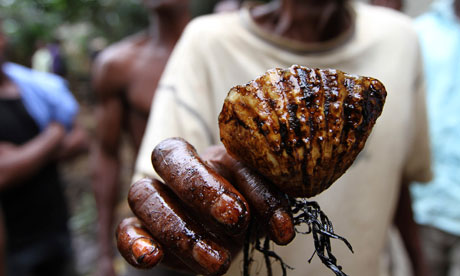
A man holds a shell coated in oil from a polluted river in the Niger delta. Photograph: Akintunde Akinleye/Reuters

Shell Nigeria‘s declaration this week that it cannot meet its international commitment to export 300,000 barrels a day of crude oil was caused by the company withdrawing contracts to pay people to monitor and protect the pipeline, Shell and independent reports indicate.

Nine oil spills in three weeks along one pipeline in the Niger Delta have forced Shell Nigeria to declare that it cannot meet its international contracts to export 300,000 barrels a day of crude oil.

Nine oil spills in three weeks along the Adibawa-Okordia pipeline in the Niger Delta are believed to be the result of sabotage by disaffected youths using hacksaws. An unknown quantity of oil has been lost and, since 2 August, fishing grounds and farmland have been polluted . With three more spills reported in the last 24 hours it appears that the company has now lost some control of the pipeline.

On Tuesday the company declared “force majeure” on all Bonny light [crude] exports until the end of October. Force majeure is a legal term releasing a company from contractual obligations due to circumstances beyond their control. “On August 21, another three hacksaw cuts were reported on the nearby Adibawa delivery line,” said Shell in a statement. “Some production is shut in while the line is repaired.”

With this force majeure, Nigeria’s total production capacity, which stood at about 2.6m of crude oil barrels per day (BDP), has declined to about 2.3m BPD.

Unpublished independent reports of the latest incidents, seen by the Guardian, suggest that the nine spills have occurred because Shell recently withdrew contracts to pay people to monitor and protect the pipeline. In interviews conducted by Friends of the Earth (FoE) Nigeria within hours of the latest incidents, community leaders said Shell must take the blame.

“The oil spills in Ikarama are caused by Shell. The youths of Ikarama were pushing for an upward review of the wages paid [by Shell] to surveillance guards and the employment of more persons in the community for the security of the pipelines. [But] we suddenly heard that Shell has stopped the surveillance contract. This is the main reason behind the series of spills experienced in the community recently”, said Livingstone J. Berebo, secretary of the Ikarama Youths group.

Ikarama,a collection of villages in the southern Nigerian state of Bayelsa, is one of the most polluted sites in the entire Niger Delta. The major pipeline that passes through the fishing and farming community of 50,000 people has been the subject of many accidents and attacks over 20 years. The company regularly blames all incidents on sabotage, but the communities accuse Shell staff of working with contractors and youths to deliberately damage the pipeline in order to get the lucrative contacts to clean up the spills.

The company is obliged by Nigerian law to clean up all spills of its oil, whatever their cause.

“It does seem that the catalyst for the incidents in this case was the withdrawal of a contract”, said a Shell spokesman in London. “Shell does not attribute every single spill to sabotage. There is no evidence that Shell contractors or staff instigated any pipeline sabotage.” But he declined to comment on the possibility of contractors paying youths to deliberately damage the pipeline, or on the standard of clean-up work done.

Last week more than 100 women from the community demonstrated against the company. “Each time there is a spill, Shell attributes it to sabotage and prevents our people from witnessing when the spill point is being clamped [repaired] and to know the cause of spill. The company makes use of the military men to threaten and chase us away from the site. The community is never represented in joint investigations. Only Shell really knows what they are doing in our land,” Berebo said.

“Shell is not helping our community; the company disregards us and is wicked. Any spill here is attributed to sabotage always by Shell since about twenty years ago, chief Luke Ogbona told FoE Nigeria. “Shell will not listen to us because they know we don’t have people to fight for our rights.”

A report from the UN Environment Programme earlier this month said decades of oil pollution in the nearby Ogoniland area of the Niger Delta may take 30 years in what would become the world’s largest ever clean-up operation. While the UN did not apportion blame for dozens of major spills, it said that there were serious faults in the way that spills were investigated and cleaned up. It called for a $1bn fund to clean up Ogoniland.

Separately, Shell has accepted blame for two major spills in the Bodo community in 2008 and is expected to have to pay many millions of dollars to have them cleaned up to international standards.

“The authorities must properly investigate the spill incidents of the last three weeks in the Ikarama community and concerned groups and environmental organisations must be part of this process. In addition, Shell should identify the contractors and staff who are instigating pipeline ruptures in Ikarama”, said Nnimmo Bassey, head of Friends of the Earth International in Lagos.

SOURCE ARTICLE

Nigeria’s oil-tainted Ogoni weary of blame game

AUSTIN EKEINDE OGONILAND, NIGERIA - Aug 24 2011 18:01

Skillfully scooping water from beneath a thick black carpet of crude, veteran Nigerian fisherman Suagelo Kpalap gives a shrug of resignation at the mention of the latest twist in an oil spill blame game he’s watched for decades.

A United Nations (UN) report released in August told Kpalap and the other inhabitants of Ogoniland, a region within the vast, oil-rich Niger Delta, what they’ve known for years — their environment is dangerously polluted and Royal Dutch Shell and the government aren’t doing enough to clean it up.

“Oil spills have wasted my life, my environment and livelihood. There isn’t much for me to enjoy at my age,” the 57-year old said, wiping oil-stained hands on ragged clothes. “My fishing nets are all soaked in oil, I don’t have money to get new ones and my canoes have been destroyed by the spills.”

In some Africa delta regions, tourists enjoy the calm waterways and wildlife. The landscape of banana trees and a pineapple farm where Kpalap stands looks bleak, stained with oil, in air filled with dark smoke from gas flaring.

The UN report said Ogoniland required the biggest oil clean-up in history, which could take 30 years and cost an initial $1-billion. The paper — the most scientific and detailed report ever on Niger Delta spills — found levels of pollution that shocked the most pessimistic observers.

In one community, drinking water was contaminated with benzene, a substance known to cause cancer, at levels over 900 times above World Health Organisation guidelines.

Shell and Nigeria’s state-owned oil firm NNPC were criticised in the paper for not meeting their own best practices. In 10 out of 15 areas the UN visited where Shell said it had completed its clean-up, high levels of pollution were still found.

Kicked out
Shell was forced out of Ogoniland in 1993 by the Movement for the Survival of Ogoni People (MOSOP), led by poet and activist Ken Saro-Wiwa, after they said the oil giant had destroyed their fishing environment. Saro-Wiwa was later hanged by the military government, prompting international outrage.

In the years since, Shell has stopped pumping oil from the region but its pipelines and other oil drilling infrastructure remain, largely unprotected, and are susceptible to leaks, sabotage attacks and theft.

Shell says it is working to better protect its equipment in Ogoniland but repairs are thwarted by persistent sabotage attacks and illegal tapping by local oil thieves.

Movement for the Survival of the Ogoni People and residents of hundreds of communities across the Niger Delta are angry with Shell and other oil majors operating in the oil-rich country and frustrated with the government for not enforcing stricter operating practices.

The government says the foreign oil company operators have to look after their equipment.

In a region where most people live on less than $2 a day, despite around $240-million-a-day in oil export revenue flowing into Nigeria, residents are tired of decades of fighting and want a proper clean-up along the lines of what the United Nations has mapped out.

Nigerian President Goodluck Jonathan last week constituted a committee to review the report and Shell and NNPC have both said they will look carefully at the findings.

Nothing short term
But there is scepticism that the positive statements of intent following the release of the report will result in any long-term changes in an area of the world far from the international media glare.

Suanu Baridam, secretary of the Ogoni Council of Traditional Rulers, hopes the UN report will build momentum that will force Shell, NNPC and the government into long-term action.

“We don’t want anything short term … I know how they normally do their thing. Once you agree with them to do one thing now and they say they will come later, they end up not doing anything. People forget again,” said Baridam.

Shell, NNPC and the government have all supported the UN report’s depth and integrity and have promised to investigate its findings — a small victory has been met with cautious optimism by rights groups and many Nigerians.

The report proves the unacceptable environmental damage caused by oil drilling in Nigeria and offers a tough and long solution.

One thing that has become clear is that the Nigerian government will have to drive any change.

“There is no point blaming Shell any more than we should blame ourselves,” said Senator Magnus Abe, the representative in the upper house of Parliament for Rivers South-East, one of the three states in the Niger Delta.

“It is our responsibility as Nigerians to enforce our laws and ensure people obey our rules. If we compromise ourselves, compromise our offices and allow people to do what they like, it doesn’t make sense for us to blame everybody else.” — Reuters

SOURCE ARTICLE