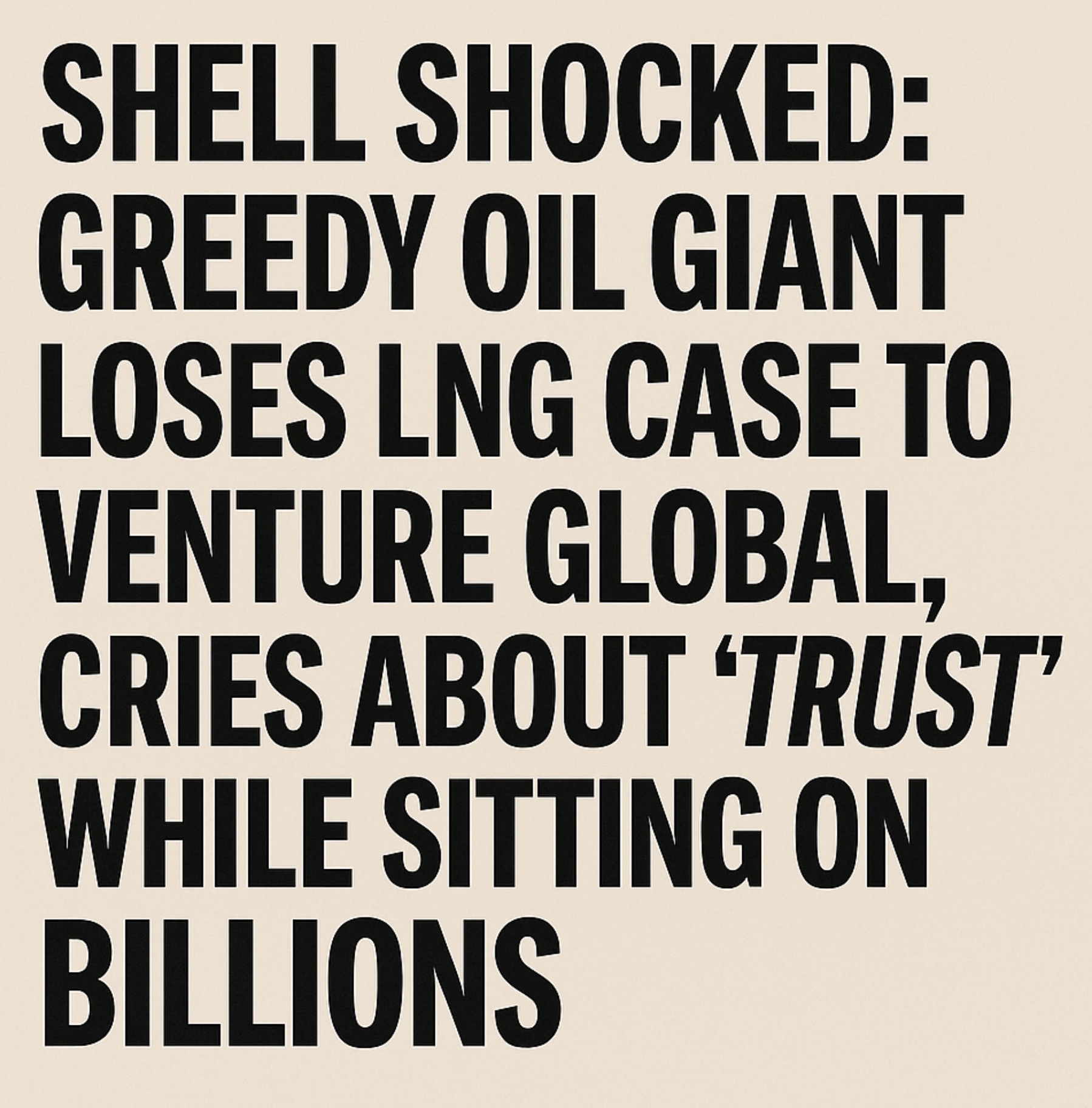

The planet-wrecking colossus known as Shell — proudly backed by Wall Street heavyweight BlackRock — just lost its $1.7 billion arbitration battle against Venture Global. The scrappy U.S. LNG upstart sold cargoes on the spot market for huge profits instead of delivering them to Shell under long-term contracts. Shell whined: “Trust in long-term contracts is the bedrock of the LNG industry.” Translation: “We’re fine making billions, but only if it’s on our terms.”
Venture Global, which banked nearly $7 billion in 2022–23, crowed: “We have consistently honored these agreements without exception.” The ruling leaves Shell sulking and the rest of us wondering if corporate karma actually exists — because for once, Big Oil didn’t win.
On Tuesday, an arbitration tribunal sided with scrappy U.S. LNG upstart Venture Global in its two-year slugfest with Shell — the same Shell that has spent decades wrapping its logo in friendly sunshine while leaving an oil-slicked trail of climate destruction behind. And to add a little irony seasoning to the schadenfreude, one of Shell’s biggest backers is none other than BlackRock — the asset management behemoth that loves talking about ESG while happily bankrolling the ultimate “sin stock.”
Here’s the gist: Shell thought it had locked in a sweet, long-term deal to buy LNG from Venture Global’s Calcasieu Pass facility in Louisiana. But when Russia invaded Ukraine and gas prices skyrocketed, Venture Global decided to, ahem, “delay” delivering those contracted cargoes. Instead, it flogged them on the spot market for fat profits. Shell and friends — BP, Edison, Portugal’s Galp — claimed this was profiteering on steroids, to the tune of $6.7–$7.4 billion in total.
Shell alone wanted $1.7 billion from Venture Global. They got… nothing. Instead, the tribunal essentially told them to read the damn contract.
Venture Global smugly declared: “The plain language in our contracts, mutually agreed upon with all of our customers, is clear. We have consistently honored these agreements without exception.”
Shell, sounding like a jilted lover after being ghosted, moaned: “Trust in long-term contracts is the bedrock of the LNG industry and essential for continued investment and sustainable growth.” Translation: “We’re fine with fleecing the planet, but only if everyone plays by our rules.”
The bitterness has been personal. Shell’s top brass, including CEO Wael Sawan, have been publicly fuming for years. In 2023, Sawan called the whole thing “very unusual, and very disappointing.” (Not unlike Shell’s climate record, but we digress.)
The backstory only makes this sweeter: Shell’s early deal with Venture Global in 2016 basically put the company on the map. Big banks only piled in because Big Oil’s golden child was involved. Shell even quadrupled its orders later on. But when the market turned, Venture Global’s “unorthodox” business model — sell the most expensive gas to whoever will pay while telling contracted buyers to wait — proved a cash-printing machine.
Between 2022 and 2023, Venture Global raked in nearly $7 billion in net income while supposedly wrestling with “faulty electric systems” at Calcasieu Pass. By the time it finally started sending LNG to long-term buyers this April — more than three years after shipping its first cargo — it was already the second-largest U.S. LNG producer.
Investors? They’re conflicted. Venture Global’s IPO in January flopped from an ambitious $110 billion valuation down to a sad little $12-a-share reality. But the stock jumped 6% in after-hours trading after Tuesday’s ruling.
Meanwhile, Shell can console itself with the fact that it’s still drowning in profits from other ventures — oil spills, gas flaring, you know, the usual — while collecting cheques from its loyal institutional backers. BlackRock’s Larry Fink might not be thrilled about this specific loss, but rest assured: Shell’s sin-stock status remains firmly intact.
DISCLAIMER: This contains strong opinions and satirical commentary based on publicly available facts. All direct quotes are reported accurately from the original sources.
*This website and sisters royaldutchshellgroup.com, shellnazihistory.com, royaldutchshell.website, johndonovan.website, shellnews.net, and shellwikipedia.com, are owned by John Donovan - more information here. There is also a Wikipedia segment, the Shell DPA Files, "Shell and the Spies", the Shell Leaks files, as well as books written and published by John Donovan - Kindle eBooks. Timeline of the Donovan Shell Feud. Toxic History of Royal Dutch Shell Group. Shell and the Donovans: The Full Media Record — 550+ Articles, 110 Books, 40 Years. *All created and supported by internet wizz, Nick Gill.