Eliano Reader: fakta.co: Published
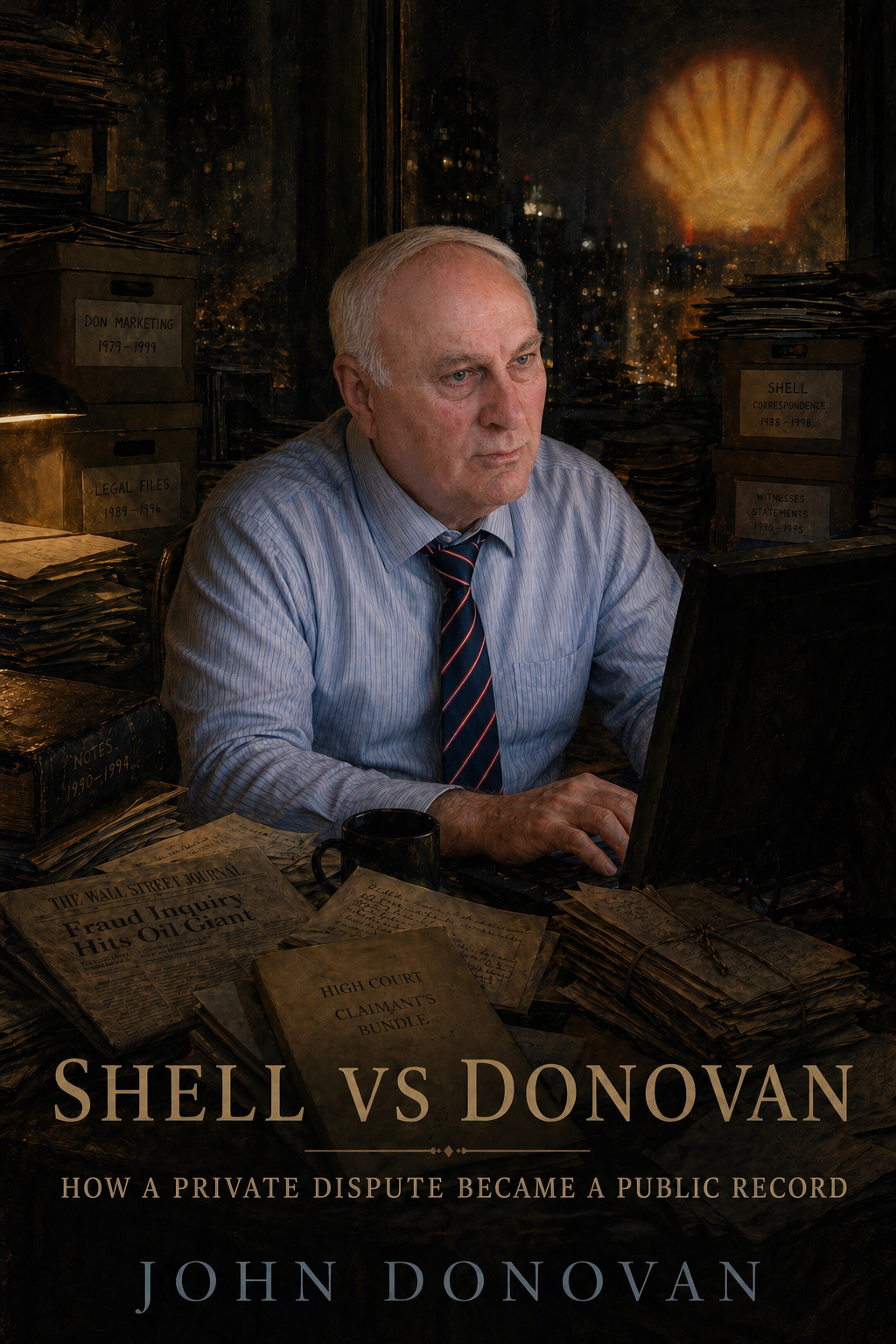
Decades ago, a group of Shell station owners formed the Shell Corporate Conscience Pressure Group (SCCPG) to challenge the multinational oil and gas company’s ethical standards and business practices. This grassroots movement, founded by Alfred Donovan and his son John, exposed alleged double standards within Shell, particularly concerning its stated principles of honesty and integrity versus its operational conduct.
The Donovans, who had previously settled multiple High Court disputes with Shell over promotional ideas, initiated the SCCPG as a free-to-join alliance for frustrated retailers. Despite Shell’s public commitment to high business principles, the Donovans accused the company of pirating ideas, obstructing investigations, and bullying smaller retailers.
Membership quickly grew to over 200 Shell UK dealers, representing more than 10% of the company’s entire UK network. The Donovans single-handedly funded and managed the group, fueled by a collective dissatisfaction with the corporate giant.
The SCCPG’s primary method of exposing these issues involved ethical surveys of Shell retailers. These surveys were independently managed by a solicitor who provided sworn affidavits to guarantee their integrity and anonymity, ensuring unbiased results from those directly interacting with Shell’s headquarters.
The initial survey, widely publicized in trade journals like Forecourt Trader, revealed that 75% of participating Shell retailers considered the company unethical, incompetent, and greedy. A subsequent poll of over 1,400 dealers further intensified these findings, with 89% stating they would not recommend Shell to other petrol retailers considering a brand switch.
Moreover, 91% of respondents demanded the resignation of Shell’s management and called for fairer policies, including binding arbitration for disputes. The Donovans even challenged Shell to conduct identical anonymous surveys, a proposition the company reportedly advised its dealers to ignore, according to internal memos that later became public.
Beyond numerical data, the SCCPG amplified the voices of its members by publishing their letters in leaflets and advertisements. These testimonials detailed personal experiences with Shell’s alleged “bully boy tactics” and deceitful practices.
For instance, J Simpson & Sons Ltd. wrote in April 1995, expressing hope that their letter would serve as a warning to others considering business with Shell. Roger Threlfall stated, “I am not at all happy with Shell. I believe the current regime is totally immoral.”
Former police officer Patrick Bradshaw penned a letter to then-Shell Chairman Mark Moody-Stuart in 1998, criticizing the “underhanded manner and deceit of some of your management.” Another letter to his MP highlighted “management that can falsify the truth without a moment’s hesitation… Shell’s ruthlessness and cheating practices.”
Sheila Gee’s leaflet, titled “THE UNETHICAL CLEANSING OF SHELL UK AGENT OPERATORS,” further underscored the sentiment of betrayal among dealers. Shell, in response, sent letters to retailers dismissing the claims and instructed staff to forward Donovan’s correspondence to their legal department, maintaining that all operations were above board.
The SCCPG persisted, addressing open letters to executives like David Varney and Chris Fay, staging protests outside Shell-Mex House, and even intervening at the 1995 AGM to demand independent ethics oversight.
The Donovans’ long-standing assertion that Shell’s top brass could not be trusted to uphold their own principles was dramatically validated by the 2004 reserves scandal. This event revealed Shell had massively overstated its oil and gas reserves by over 20%, leading to significant financial repercussions, executive resignations, and the eventual dissolution of the Anglo-Dutch dual structure that had existed for a century. The “unscrupulous conduct” the SCCPG highlighted became global news.
In a separate but related conflict, businessman John Donovan received a £200,000 settlement from Shell for two claims. However, Shell’s official stance later asserted this payment was merely a “reset” and not an admission of wrongdoing, a position Donovan challenged.
Shell’s legal submissions acknowledged Donovan had “perfect rights to claim sums due,” only for its lawyers to later claim he was “entitled to nothing.” This shift was characterized as a “magic trick” by Donovan, highlighting an apparent contradiction in the company’s approach to legal and moral obligations.
At the 1995 AGM, Donovan voiced concerns about Shell’s practice of telling small businesses to “sue us” if dissatisfied, knowing that few could afford such legal battles against a multi-billion-dollar entity. Chairman John Jennings expressed disturbance at this revelation.
Key figures like Dr. Chris Fay, Mark Moody-Stuart, Sir John Jennings, and C.A.J. Herkstroter were informed of these issues. Yet, the question of why meaningful change did not occur persisted, especially in light of the contemporaneous misstatement of oil and gas reserves.
The legacy of the SCCPG and the Donovans continues through their website, royaldutchshellplc.com, serving as a reminder that even powerful corporations can be held accountable by persistent, honest voices from within their own network.
*This website and sisters royaldutchshellgroup.com, shellnazihistory.com, royaldutchshell.website, johndonovan.website, shellnews.net, and shellwikipedia.com, are owned by John Donovan - more information here. There is also a Wikipedia segment, the Shell DPA Files, "Shell and the Spies", the Shell Leaks files, as well as books written and published by John Donovan - Kindle eBooks. Timeline of the Donovan Shell Feud. Toxic History of Royal Dutch Shell Group. Shell and the Donovans: The Full Media Record — 550+ Articles, 110 Books, 40 Years. *All created and supported by internet wizz, Nick Gill.