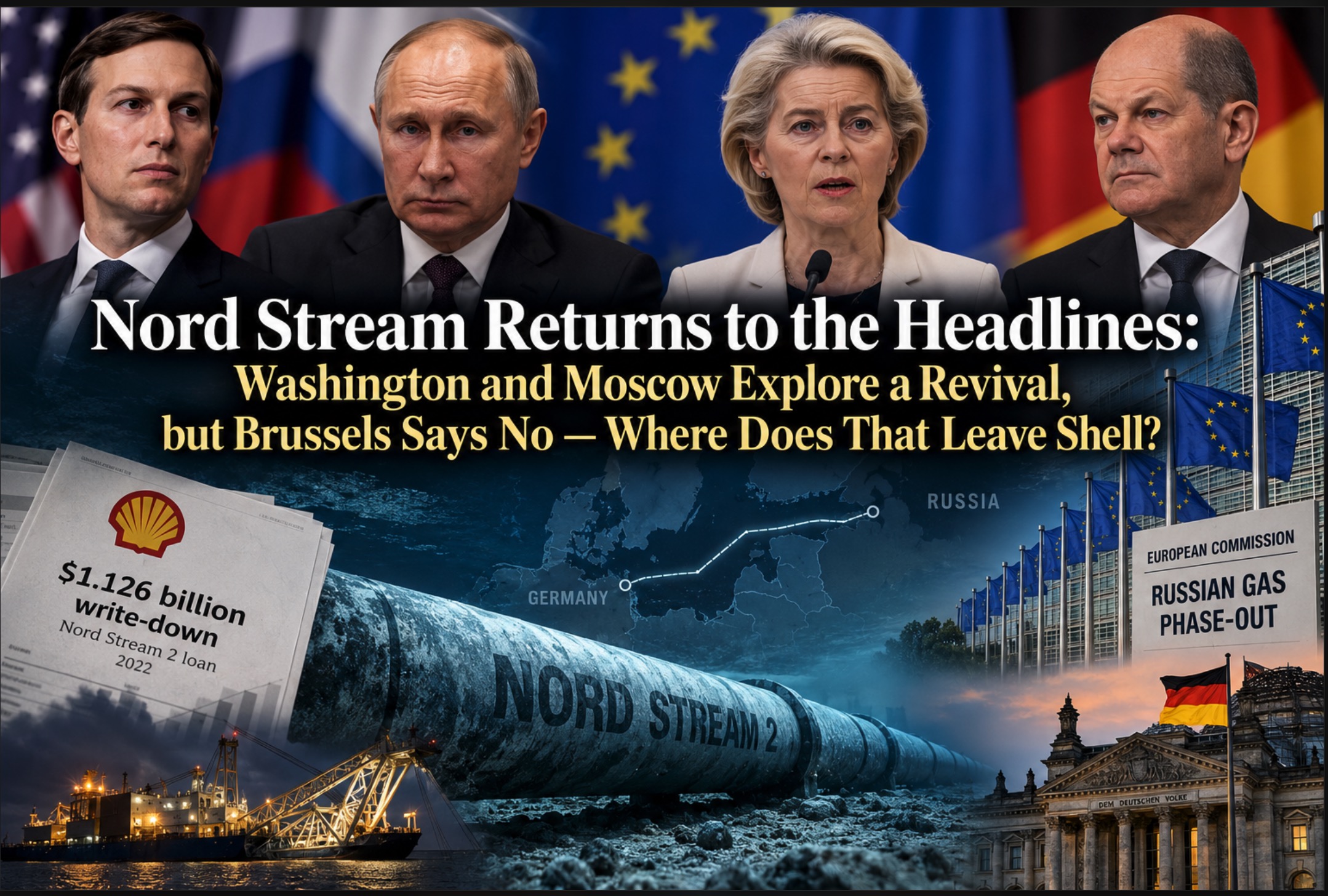
By John Donovan — 28 October 2026
An extraordinary new chapter has opened in the Nord Stream controversy. Reuters reports that senior American and Russian figures have discussed bringing a US investor into the Baltic gas pipeline system. But the European Commission has responded with an unmistakable reminder: the European Union is legislating Russian gas out of its energy market. For Shell shareholders, the renewed controversy raises another question. What, if anything, remains recoverable from the $1.126 billion loan that Shell wrote down in 2022?
A pipeline that refuses to disappear from the headlines
On 8 October 2026, Reuters published a report that would once have seemed improbable.
According to five people familiar with the situation, senior American and Russian figures had discussed the possibility of introducing a US investor into the Nord Stream pipeline system.
The reported participants included Jared Kushner, involved in American diplomatic efforts concerning the war in Ukraine, and Kirill Dmitriev, a senior Russian investment official and adviser to President Vladimir Putin.
The possible objective was to create a commercial arrangement under which Russian gas could again be supplied to Europe, potentially generating returns for American investors.
There was, however, an important qualification.
A White House official disputed the implication that recent Nord Stream negotiations had taken place. Reuters also reported that the extent to which the pipeline had been discussed at particular meetings remained unclear.
No binding investment agreement, transfer of ownership or authorised restart has been established.
Nevertheless, the report brought a project written off by many observers back into international discussion.
A pipeline that never entered commercial service may yet be considered an asset worth negotiating over.
That possibility requires careful examination.
Source: Reuters, 8 October 2026 — US and Russia Explore Gas Sales to Europe
Brussels responds on 28 October: Russian gas is being phased out
The European Commission addressed the speculation directly on Wednesday, 28 October 2026.
During its official midday press briefing, Commission representatives were questioned about the possibility that Nord Stream might reopen after a future peace agreement ending the war in Ukraine.
Chief spokesperson Paula Pinho referred to Europe’s experience of dependence upon Russian fossil fuels and the political and economic costs that had followed.
Energy spokesperson Anna-Kaisa Itkonen drew attention to a particularly important legal distinction.
The EU’s programme to eliminate Russian gas imports is not simply a sanctions response dependent upon the continuation of the war.
It is also supported by legislation adopted under the REPowerEU framework.
That legislation establishes a phased prohibition on Russian gas imports, including pipeline gas and liquefied natural gas.
The final transition period for qualifying long-term Russian pipeline gas contracts is scheduled to end on 30 September 2027, potentially extending to 1 November 2027 under specified storage-related conditions.
In other words, the conclusion of a peace agreement would not automatically restore the previous legal position.
The Commission emphasised that the legislation remains in force independently of the wartime sanctions framework.
This is central to the current controversy.
Even if Washington and Moscow reached a commercial agreement, the existence of such an agreement would not oblige Germany or other European Union countries to permit Russian gas imports.
Commercial negotiations cannot, by themselves, override European legislation.
Primary source: European Commission — Official Press Briefing, 28 October 2026
A second barrier: specific EU sanctions against Nord Stream
There is another important legal obstacle.
In July 2025, the European Union introduced Article 5af into Regulation 833/2014.
The provision prohibits specified transactions connected with the completion, operation, maintenance or use of Nord Stream and Nord Stream 2.
It also restricts related financing.
The legislation contains exceptions and mechanisms through which competent authorities may authorise certain activities.
These include, under specified conditions, transactions involving legitimate claims, recoveries, settlements, litigation and arrangements necessary to prevent environmental or safety risks.
That qualification is important when considering the position of former financiers.
The restrictions on operating the pipelines do not necessarily prevent every lawful attempt to recover money owed under earlier arrangements.
But the legislation creates substantial obstacles to transactions intended to return the pipelines to commercial operation.
The EU’s separate regulation phasing out Russian natural gas imports reinforces those obstacles.
Thus, any proposed revival would have to confront two distinct legal regimes: restrictions concerning the pipeline infrastructure and restrictions concerning the importation of Russian gas.
Primary source: Council Regulation (EU) 2025/1494 — Nord Stream Restrictions
Primary source: Regulation (EU) 2026/261 — Phase-Out of Russian Gas Imports
Germany has not changed its position
Germany remains central to any conceivable revival.
The Nord Stream pipelines terminate on the German Baltic coast.
But Berlin has not authorised Nord Stream 2 to commence commercial operation.
A German government response to a parliamentary inquiry, discussed in reporting on 27 October 2026, reiterates that bringing Nord Stream 2 into operation is not currently under consideration.
The certification process remains suspended.
The government’s position also reflects Germany’s decision to reduce reliance upon Russian energy following the full-scale invasion of Ukraine.
In its response to parliamentary questions about American sanctions, published on 26 October, the German government acknowledged earlier efforts to resist extraterritorial US sanctions affecting the project. It declined to disclose the contents of confidential discussions with Washington.
That is a useful reminder of how dramatically the political situation has changed.
In 2020 and 2021, Germany had resisted American pressure intended to prevent Nord Stream 2’s completion.
In 2026, the government is not pursuing the pipeline’s revival.
The contrast is striking.
Nord Stream 1 and Nord Stream 2 must not be confused
The distinction between the two pipeline projects is especially important for anyone examining Shell’s financial position.
Nord Stream 1 was developed under a different ownership structure.
Its operating company, Nord Stream AG, had Gazprom as its majority shareholder, alongside European shareholders.
Nord Stream 2 AG, by contrast, was wholly owned by Gazprom when the European financing agreements were signed in April 2017.
Shell was one of five European companies financing Nord Stream 2.
The other participants were ENGIE, OMV, Uniper and Wintershall.
Each had agreed to provide financing and guarantees covering up to approximately 10% of the project’s estimated €9.5 billion cost.
Shell did not acquire a corresponding 10% ownership stake in Nord Stream 2 AG.
This matters because the Reuters report concerns potential American investment in the Nord Stream pipeline system.
A transaction involving ownership of Nord Stream 1 would not automatically confer rights upon the former lenders to Nord Stream 2.
Nor would the introduction of a new investor into Nord Stream 2 necessarily result in repayment of all outstanding loans.
The outcome would depend upon the legal entity involved, the nature of the transaction, the financing arrangements and the applicable sanctions regime.
The identity of the asset being acquired is therefore just as important as the nationality of any proposed investor.
Shell’s $1.126 billion question
For Shell shareholders, the accounting record is unambiguous.
In its financial disclosures for 2022, Shell confirmed that it had fully written down its Nord Stream 2 loan.
The amount was $1.126 billion.
Shell attributed the impairment to its withdrawal from Russian oil and gas activities following the invasion of Ukraine.
Its earlier financial disclosures confirmed that the final Nord Stream 2 loan instalments had been made during the second quarter of 2020.
The subsequent write-down was substantial.
But a distinction needs to be made between an accounting write-down and the legal extinguishment of a debt.
An impairment records the company’s assessment of the recoverable value of an asset.
It does not necessarily mean every contractual right has ceased to exist.
Whether Shell retains enforceable repayment claims, has participated in any subsequent recovery arrangements or might benefit from a future restructuring cannot be established from the historical impairment figure alone.
The question becomes particularly relevant if a third party is considering investing in the infrastructure or acquiring an interest in the relevant company.
Any such investment might involve negotiations with existing creditors.
Alternatively, a transaction might be structured in a way that produced no recovery for a particular former lender.
The public documents examined do not resolve that question.
Nor do they establish that Shell is currently negotiating with American or Russian representatives about Nord Stream.
It would therefore be wrong to suggest that a recovery is imminent.
Nevertheless, the renewed discussions provide a legitimate reason to examine the status of Shell’s original financing arrangements.
Primary source: Shell’s SEC-filed Annual Report — Nord Stream 2 Loan Write-Down
Could a new American investor transform the situation?
The suggestion of an American investor is politically significant.
A change in ownership could alter the commercial incentives of parties involved in the pipeline.
An American investor might hope to profit from future gas transportation.
Russia might see value in restoring access to European customers.
Some industrial energy consumers might favour additional gas supplies if they believed these could reduce prices.
But ownership changes cannot eliminate every obstacle.
The pipeline infrastructure has suffered damage.
Nord Stream 2 has never obtained the final German operator certification needed for commercial operation.
The European Union has introduced restrictions concerning the infrastructure itself.
It has also adopted binding measures to phase out Russian gas imports.
Germany’s current government does not support reopening Nord Stream 2.
A future transaction would therefore face substantial technical, legal and political barriers.
A change in American policy would not automatically change European law.
Nor would a change in the identity of an investor necessarily change the origin of the natural gas being transported.
These are separate questions.
The renewed speculation is evidence of continuing commercial and diplomatic interest.
It is not proof that Nord Stream is about to reopen.
The historical record preserved by The Shell Leaks Files
For readers of The Shell Leaks Files, the present controversy has a particular significance.
Our recent series, The Sakhalin Papers, has reconstructed the development of Nord Stream 2 using contemporary corporate documents, government records, judicial decisions and financial disclosures.
The instalments have followed the original financing agreements, the American sanctions campaign, the withdrawal of specialist contractors, the certification disputes and the decisions taken by Germany immediately before the invasion.
They have also examined Shell’s financial exposure and the resulting write-down.
Among the particularly relevant instalments are:
- 22 October 2026 — The Warning Already in Print: Uniper’s Loan Alarm and Shell’s Write-Down
- 23 October 2026 — The Grandfathering Gamble
- 24 October 2026 — The Port Under Threat
- 26 October 2026 — The Certificate That Never Came
- 27 October 2026 — Built but Not Approved
- 28 October 2026 — The Security Report Withdrawn
These articles provide a documentary chronology against which the current proposals can be assessed.
The history matters because Nord Stream 2 did not simply become a failed investment when Russia invaded Ukraine.
Its commercial prospects had been shaped by years of sanctions, regulatory disputes and political opposition.
The invasion fundamentally transformed those circumstances.
But the underlying legal and financial arrangements did not necessarily disappear merely because the pipeline ceased to have a realistic prospect of commencing commercial operations.
Editorial commentary: A written-off investment does not necessarily become irrelevant
The suggestion that American investors might seek an interest in Nord Stream illustrates how infrastructure can retain strategic or negotiating significance long after its expected commercial purpose has failed.
The physical pipelines remain part of the Baltic energy infrastructure.
Their ownership arrangements and associated obligations remain matters of legal and commercial consequence.
Yet there is a considerable difference between possessing an asset and being legally permitted to use it.
That distinction lies at the centre of today’s controversy.
The European Commission’s position is that Russian gas is being phased out through binding legislation, not simply through temporary sanctions.
Germany’s government has no current intention of authorising Nord Stream 2 to operate.
Consequently, the prospect of an American investor does not, by itself, establish a credible route to restoring commercial gas supplies.
The more interesting question for Shell shareholders may be the fate of the original loan.
Shell publicly recognised a $1.126 billion loss.
If the relevant legal rights survived, they could still possess potential value under some future circumstances.
But that possibility is not the same as an established asset recovery.
It requires evidence concerning the present status of the financing contracts, the debtor company and any creditor arrangements.
This is an area where further disclosure from Shell would be helpful.
Does Shell retain any contractual claim arising from its original Nord Stream 2 financing?
Has the company recovered any part of the amount written down in 2022?
Would a restructuring or sale of Nord Stream 2 AG potentially affect its position?
These are reasonable questions arising from the historical financing disclosures.
They are not allegations of impropriety.
Nor do they imply that Shell has withheld information it was legally required to disclose.
They reflect the distinction between the accounting treatment of a financial asset and the ultimate legal outcome of the underlying contractual relationship.
For European governments, the central question is different.
Can a return to Russian gas be reconciled with the legal and political decisions taken since 2022?
The Commission’s answer on 28 October 2026 is that existing legislation is designed to prevent such a return.
For Washington and Moscow, commercial arrangements may form part of wider diplomatic discussions.
But any proposed agreement would still encounter the legal rights and regulatory powers of European governments.
The infrastructure cannot simply be transferred from one political controversy to another without considering those constraints.
The extraordinary feature of the Nord Stream story is that a pipeline built to transport gas has become an object of international negotiation even while its commercial operation remains prohibited or unauthorised.
Shell’s involvement is part of that history.
Whether it becomes part of the future is not yet established.
DOCUMENTARY FINDINGS
Established facts: Reuters reported discussions involving senior American and Russian figures about possible US investment in the Nord Stream pipeline system. A White House official disputed the implication of recent pipeline negotiations. No completed transaction has been established. On 28 October 2026, the European Commission reaffirmed the EU’s policy and legal framework for ending Russian gas imports. Germany’s government has not authorised Nord Stream 2 to operate. Shell recognised a full $1.126 billion write-down of its Nord Stream 2 loan in 2022.
Reported proposals and contested positions: The possible introduction of American investment remains a proposal described through confidential sources, not an executed agreement. Supporters of renewed Russian gas imports argue that increased supplies could benefit some European consumers and businesses. The European Commission and the German government maintain policies designed to prevent renewed dependence upon Russian gas. These are the respective positions of the parties concerned.
Matters not established: The available evidence does not establish that Shell is participating in the reported discussions, that any American investor has acquired an interest in Nord Stream, that the EU or Germany has agreed to reopening, or that Shell will receive any recovery from its original financing. The current status of any surviving Shell contractual claims has not been verified from the public materials examined.
Principal sources
- Reuters, 8 October 2026 — US and Russia Explore Gas Sales to Europe — Contemporary investigative reporting concerning the possible involvement of American investors.
- European Commission, 28 October 2026 — Official Midday Press Briefing — Primary record of the Commission’s response to questions about reopening Nord Stream.
- Euronews, 28 October 2026 — Brussels Rejects a Nord Stream Restart — Contemporary account of the Commission’s position.
- German Bundestag, 26 October 2026 — Discussions Concerning US Sanctions Against Nord Stream 2 — Official parliamentary record of the government’s response.
- Council Regulation (EU) 2025/1494 — Legislative source for the restrictions concerning Nord Stream infrastructure.
- Regulation (EU) 2026/261 — Legislative framework for phasing out Russian natural gas imports.
- Council of the European Union — Ending Russian Energy Imports — Official explanation of the import prohibition and transitional dates.
- Shell SEC Filing — Nord Stream 2 Loan Write-Down — Authenticated accounting disclosure confirming the $1.126 billion impairment.
Documentary disclaimer: This article distinguishes confidentially sourced reports of possible negotiations from concluded agreements and legally enforceable decisions. No allegation is made that Shell is involved in undisclosed transactions or that its directors have breached any duty. Shell’s historical loan impairment is an established accounting fact; the existence, enforceability and potential value of any surviving claims require separate verification. The current legal position is described according to official European Union legislation and government statements available on 28 October 2026. Material developments, factual corrections and responses from Shell and other relevant parties remain welcome.
The website’s general disclaimer also applies.








