AN INDEPENDENT DOCUMENTARY INVESTIGATION
By the Donovan–Shell Archive
12 November 2026
Researched and drafted with assistance from ChatGPT.
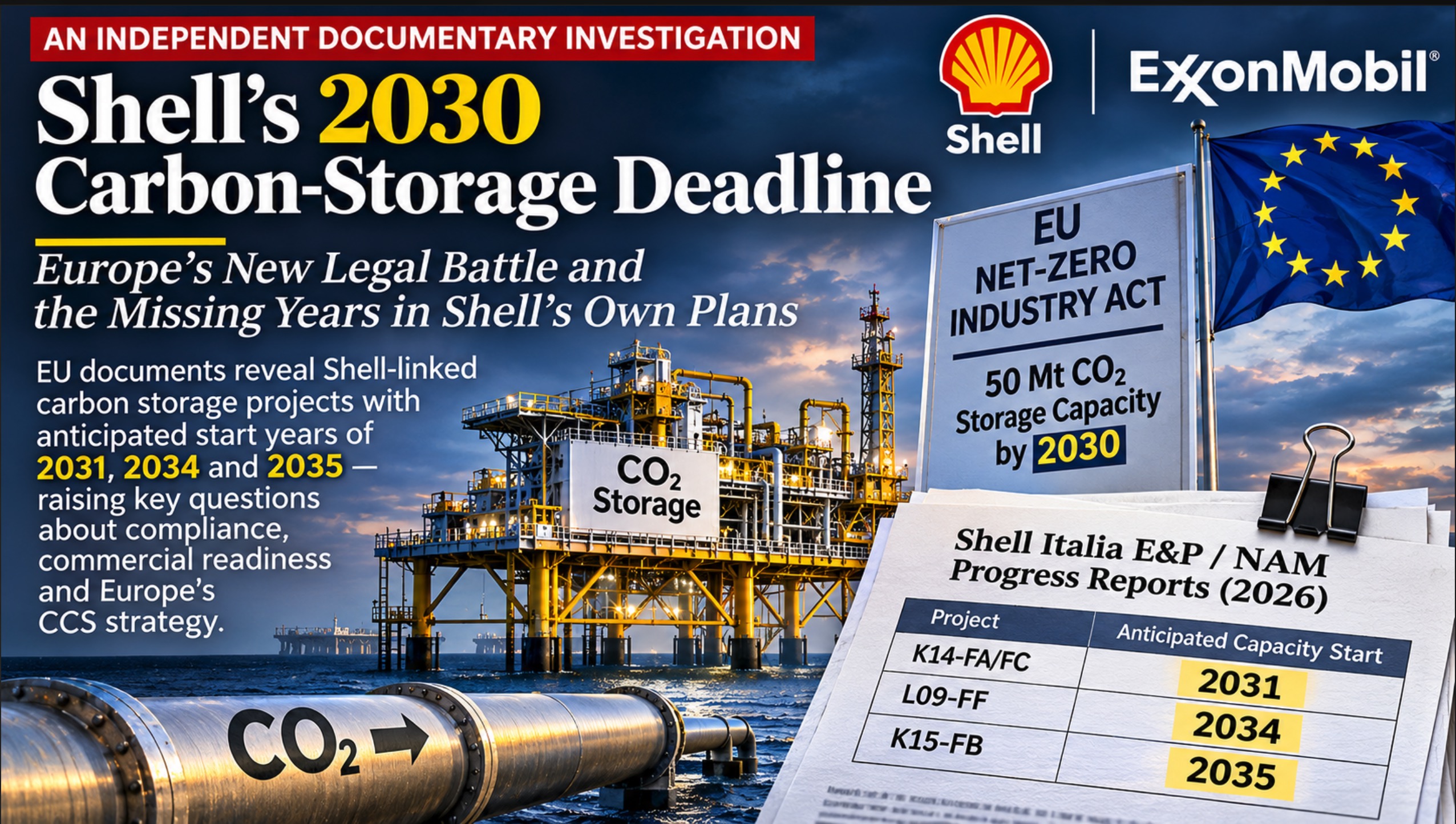
As ExxonMobil challenges European legislation requiring oil and gas producers to develop carbon-storage capacity, official European Commission documents reveal that Shell Italia faces a 1.55-million-tonne annual obligation and the Shell–ExxonMobil-owned NAM faces a further 6.35 million tonnes. Their latest published reports identify several offshore storage projects whose anticipated operating periods begin after the 2030 deadline. The discrepancy raises important questions about commercial readiness, regulatory compliance and the future of Europe’s carbon-capture industry.
A legal challenge that reaches into Shell’s European business
A new confrontation has emerged between one of the world’s largest oil companies and the European Union.
On 11 November 2026, Reuters reported that ExxonMobil had initiated confidential arbitration proceedings challenging provisions of the EU’s Net-Zero Industry Act.
The Financial Times, citing a European Commission memorandum, reported that ExxonMobil was seeking interim relief from requirements obliging major oil and gas producers to contribute to the development of carbon dioxide storage capacity by 2030.
ExxonMobil argues that the legislation imposes unrealistic obligations on an industry that does not yet have a sufficiently developed market for carbon capture and transportation.
According to Reuters, the company contends that the requirements could increase costs for European energy consumers.
The European Commission was reported to be preparing a response.
The underlying arbitration documents have not been made available for independent examination in this investigation. The procedural details are therefore attributed to the Financial Times and Reuters rather than presented as independently verified court records.
There is no evidence in the material examined that Shell plc has itself initiated these arbitration proceedings.
Nevertheless, the dispute has direct relevance to Shell.
Shell and ExxonMobil jointly own the Dutch petroleum company NAM, one of the entities bearing the largest individual obligations under the contested European legislation.
Another Shell-related company, Shell Italia E&P, has a separate statutory contribution.
What makes this development particularly newsworthy is that the European Commission has already published detailed progress reports from both businesses.
Those reports reveal not merely their obligations, but also the practical difficulties involved in satisfying them.
Sources: Financial Times — ExxonMobil launches legal challenge to EU carbon capture rules; Reuters — Exxon files legal challenge to EU carbon capture law, 11 November 2026.
Europe’s ambitious 50-million-tonne target
The EU’s Net-Zero Industry Act, Regulation (EU) 2024/1735, seeks to establish at least 50 million tonnes of annual carbon dioxide injection capacity by 2030.
The objective is to make geological storage available to industries that face particular difficulties eliminating carbon emissions through electrification or changes in manufacturing processes.
Cement, chemicals, waste processing and other industrial activities are among those for which carbon capture and storage may provide a means of reducing emissions.
The legislation places particular responsibilities on established oil and gas producers.
The rationale is that companies with experience drilling wells, managing underground reservoirs and operating offshore infrastructure possess expertise relevant to developing geological carbon-storage facilities.
The Commission subsequently identified 44 obligated oil and gas entities.
Their individual contributions were calculated principally by reference to their shares of EU oil and gas production during 2020–2023.
An important distinction must be made.
The obligation concerns the provision of qualifying annual injection capacity, not proof that the same quantity of carbon dioxide has already been captured and permanently stored.
A completed storage facility may have substantial available capacity before industrial customers begin using it at full volume.
Equally, announcing a geological storage resource or proposing a project does not establish that operational injection capacity is ready.
The necessary facilities, permits, wells, transport arrangements and commercial conditions are separate parts of the process.
Primary sources: Regulation (EU) 2024/1735 — Net-Zero Industry Act; European Commission — The EU’s 2030 carbon storage target.
The first documentary finding: NAM’s 6.35-million-tonne obligation
The European Commission’s formal allocation decision, adopted on 22 May 2025, places Nederlandse Aardolie Maatschappij B.V. first on its list of obligated producers.
The company’s assigned contribution is 6.35 million tonnes of annual CO₂ injection capacity by 2030.
This is the largest individual allocation among the 44 entities listed.
NAM is no ordinary unrelated Dutch petroleum company.
Shell’s published annual reporting identifies it as a joint venture owned equally by Shell and ExxonMobil.
NAM’s own 2026 regulatory report identifies its parent companies as Shell Nederland B.V. and ExxonMobil Holding Company Holland LLC.
It is essential, however, to distinguish NAM’s legal responsibility from the respective interests of its shareholders.
The EU decision assigns the 6.35-million-tonne obligation to NAM.
It does not allocate that entire amount to Shell plc, nor does it state that Shell alone is responsible for delivering it.
The shareholders’ respective financial contributions, contractual obligations and practical responsibilities cannot be established simply from their equal ownership percentages.
Nevertheless, Shell has a substantial corporate interest in the entity facing the largest individual requirement.
This makes NAM’s progress towards compliance directly relevant to Shell’s European carbon-management strategy.
Primary documents: Commission Decision (EU) 2025/1479 — Individual producer obligations; NAM — 2026 annual progress report submitted to the European Commission; Shell — 2024 Annual Report, Netherlands joint-venture disclosures.
The second documentary finding: Shell Italia’s separate obligation
The same Commission decision assigns Shell Italia E&P an obligation of 1.55 million tonnes of annual CO₂ injection capacity by 2030.
Shell Italia E&P identifies Shell Overseas Investments B.V. as its parent company.
Its position is particularly revealing because its public progress report, dated 30 June 2026, acknowledges substantial practical limitations.
The company reports that although it holds upstream petroleum licences, it does not operate assets domestically and does not possess the organisational resources or project-delivery capabilities needed to develop carbon-capture and storage projects independently.
Consequently, its proposed route to compliance depends on arrangements with other obligated entities or third-party storage developers.
The company explains that it cannot itself control the development schedules or financial viability of the projects upon which it would rely.
It also acknowledges that obtaining the necessary commercial agreements depends on counterparties’ willingness to participate, project maturity and market conditions.
This is an unusually candid statement of the limitations confronting an obligated corporate entity.
The issue is not that Shell as a multinational group lacks experience in carbon capture and storage.
Shell participates in major CCS projects internationally.
The narrower and more significant point is that Shell Italia E&P, the specific legal entity assigned the obligation, states that it cannot independently deliver the necessary projects and must depend upon a wider network of developers and commercial arrangements.
That distinction is central to understanding how the legislation operates.
It assigns obligations to identifiable companies, while allowing those companies to pursue compliance through partnerships and contractual arrangements.
The existence of a legal obligation does not automatically create a commercially viable project capable of satisfying it.
Primary document: Shell Italia E&P — 2026 regulatory progress report, pages 5–6.
European Commission
The most striking disclosure: the years 2031, 2034 and 2035
The most consequential finding of this investigation appears in the publicly available project schedules.
Shell Italia identifies three offshore Dutch carbon-storage developments relevant to its proposed compliance arrangements:
K14-FA/FC, L09-FF and K15-FB.
The first is associated with an offshore storage project for which a permit has been granted.
The other two were reported at the feasibility and site-characterisation stage.
In Table 8 of Shell Italia’s 2026 progress report, the company gives anticipated start years for the capacity associated with these projects.
For K14, the year is 2031.
For L09, it is 2034.
For K15, it is 2035.
The corresponding NAM progress report identifies the same anticipated start years for the same three offshore developments.
That is the central documentary discrepancy.
The European legislation requires qualifying operational injection capacity by 2030.
Yet the public reporting by these Shell-linked entities includes project schedules whose anticipated capacity periods begin one, four and five years later.
This does not establish that either company will breach the law.
Both entities may be able to secure alternative capacity, change delivery arrangements, accelerate projects or satisfy the requirements through legally recognised agreements.
Furthermore, the reports contain references to capacity potentially contributing by 2030, subject to eligibility criteria. Those entries must be read alongside the later operating-period estimates rather than ignored.
Nevertheless, the documents leave an important unresolved question.
What specific qualifying injection capacity will actually be available to meet the 2030 obligations if the publicly identified storage projects are not expected to begin their reported capacity periods until 2031 or later?
That is a matter which Shell, NAM and the European Commission could clarify.
It is not answered simply by pointing to the eventual geological capacity of the North Sea reservoirs.
A reservoir’s capacity over several decades is different from its operational annual injection capability by a particular statutory deadline.
Primary documents: Shell Italia E&P — 2026 progress report, Table 8, page 9; NAM — 2026 progress report, Table 8, page 10.
European Commission+1
The same projects appear in both companies’ plans
A further point deserves examination.
Shell Italia and NAM both refer to the K14, L09 and K15 offshore storage developments.
This is not inherently improper.
The Net-Zero Industry Act permits obligated companies to work together and to establish agreements with storage developers or other obligated entities.
Indeed, cooperation is likely to be essential if Europe is to create a functioning carbon-storage industry within the required period.
However, shared reliance on the same projects creates a legitimate requirement for clear allocation of capacity.
If a storage development has a specified annual injection capacity, its total capability cannot be assumed to multiply merely because several companies identify it in their compliance plans.
The Shell Italia report includes figures for the estimated capacity of agreements that explicitly take account of the contributions of all counterparties.
Those figures should not be misrepresented as capacity reserved exclusively for Shell Italia.
NAM’s report similarly refers to arrangements involving the same developments, while directing readers to additional supporting information for some commercial details.
The publicly examined material does not establish the precise contractual allocation of capacity between all participating entities.
Nor does it establish that any capacity has been improperly counted twice.
The appropriate investigative question is whether sufficiently clear arrangements exist to ensure that the combined obligations of participating companies can be met without relying upon overlapping claims to the same capacity.
That is an issue for documentary clarification, not an allegation of misconduct.
Shell has made genuine progress on the Dutch offshore projects
It would be misleading to examine the later start dates without recognising progress already achieved.
Shell announced in June 2026 that the Dutch Ministry of Economic Affairs and Climate had granted a storage permit for the K14-FA and K14-FC depleted gas fields beneath the North Sea.
According to Shell, the public consultation period produced no objections, meaning the permit decision became final.
The company identified EBN, Rockrose and ONE-Dyas as partners involved in advancing the project.
Shell described the permit as an important step towards a final investment decision expected in 2027.
That is tangible regulatory progress, and it represents more than an announcement of geological potential.
A storage permit can require detailed technical and environmental scrutiny, including consideration of reservoir characteristics, well integrity, monitoring and risk management.
Nevertheless, an approved storage permit is not identical to a completed injection facility.
Investment approval, construction, commissioning, connection to transport infrastructure and the establishment of commercial operations remain separate stages.
Shell has also reported progress on L09, including publication of documents associated with the environmental impact assessment process in April 2026.
This development is at an earlier stage.
These differing levels of maturity help explain why the eventual delivery schedules are so important.
Primary source: Shell — Offshore Carbon Storage Netherlands: News and Updates.
Shell Global
The Aramis complication: a pipeline is not a storage reservoir
Much of the proposed offshore capacity depends upon the wider Aramis carbon-capture and storage network in the Netherlands.
Aramis is intended to transport captured industrial carbon dioxide to offshore storage facilities beneath the North Sea.
The infrastructure could play an important role in enabling difficult-to-decarbonise industries to access geological storage.
But an industrial carbon-storage system requires more than a suitable reservoir.
There must be capture facilities at industrial sites, arrangements for transporting the carbon dioxide, suitable pipelines or shipping infrastructure, compression facilities, receiving installations and permitted injection wells.
An operational storage reservoir without an effective transportation system may have limited commercial use.
Similarly, a functioning pipeline cannot deliver permanent storage unless suitable injection facilities are available at the other end.
In April 2025, the Aramis participants announced a restructuring of the project.
The Dutch public-sector entities Gasunie and EBN would assume the principal role in developing and ultimately owning the pipeline infrastructure.
Shell and TotalEnergies would continue contributing expertise during development and focus principally on offshore storage facilities and associated services.
This was not an abandonment of carbon capture and storage by Shell.
It was a redistribution of responsibilities within the wider project.
The distinction matters because it introduces another participant into the timetable for delivering a complete operational system.
On 3 September 2026, Aramis announced that the parties in its value chain were planning a final investment decision in 2027, with the objective of becoming operational in 2030.
It also acknowledged that appeals concerning project permits remained pending.
The 2030 infrastructure ambition is therefore not necessarily identical to the anticipated operating years of the individual storage projects listed in Shell Italia’s and NAM’s submissions.
Those schedules may eventually be reconciled through project revisions, different facilities or revised agreements.
For now, however, their relationship is not fully explained in the public documents examined.
Sources: TotalEnergies — Aramis restructuring announcement, 25 April 2025; Aramis — Progress towards final investment decision, 3 September 2026.
The public sector’s increasing role
The Aramis restructuring also raises questions about the division of financial responsibilities.
The legislation places carbon-storage contribution obligations upon certain oil and gas producers.
Yet the transport infrastructure needed to make storage commercially accessible is being developed principally under the leadership of Dutch public-sector organisations.
That arrangement may be entirely justified.
Pipelines serving multiple industrial customers can resemble other forms of shared infrastructure in which public participation provides advantages unavailable to individual commercial operators.
Public involvement may improve coordination, support open access and reduce the risk of several competing companies building inefficient parallel networks.
There is nevertheless a legitimate public-interest question about the allocation of costs and risks.
Who ultimately finances the shared infrastructure?
Who bears losses if industrial demand for carbon storage develops more slowly than expected?
What commercial payments will storage developers and industrial users make?
And how will the obligations imposed upon hydrocarbon producers interact with infrastructure supported by public capital?
The available evidence does not establish that Shell or ExxonMobil has transferred an unlawful financial burden to taxpayers.
It establishes that the delivery arrangements include a substantial public-sector component.
That feature deserves transparency because the benefits and costs of developing an entirely new industrial system will extend beyond the companies named in the EU legislation.
The European Commission has already acknowledged insufficient progress
The uncertainty is not confined to Shell.
The European Commission’s own 2026 climate-action progress report contains a significant assessment of the wider carbon-storage programme.
It states that the projected contributions contained in the plans submitted by the 44 obligated producers in 2025 did not yet demonstrate sufficient progress towards the required 2030 injection-capacity objective.
That conclusion concerns the earlier plans.
It should not be presented as a final regulatory assessment of the subsequent June 2026 progress reports, or as a finding that Shell or NAM is non-compliant.
Nevertheless, it provides important context.
Europe’s carbon-storage target depends upon a coordinated industrial and regulatory programme involving multiple companies, governments and infrastructure providers.
Even where geological storage potential is available, development may be delayed by permitting, financing, technical feasibility or the absence of commercially committed customers.
The Commission itself recognises that this is a developing industry.
The legislation is intended partly to help create the market that does not yet exist at the desired scale.
This is precisely where the disagreement with ExxonMobil becomes significant.
ExxonMobil’s reported argument is that the law compels companies to deliver capacity before the necessary commercial conditions are in place.
The Commission’s position is that imposing obligations on companies possessing relevant expertise is part of the mechanism for establishing that infrastructure and market.
Both arguments involve genuine economic and practical considerations.
Neither proves the ultimate outcome of the arbitration proceedings.
Primary source: European Commission — 2026 Climate Action Progress Report, Chapter 6: Industrial Carbon Management.
Climate Action
Does the ExxonMobil legal challenge affect Shell?
This is the critical legal distinction.
ExxonMobil and Shell are separate corporations.
The fact that they jointly own NAM does not mean that Shell has joined an arbitration initiated by ExxonMobil.
Nor does the existence of joint ownership automatically make Shell a party to proceedings brought by another shareholder.
The publicly available reporting examined here does not establish the precise relationship, if any, between the arbitration claims and the separate obligations assigned to NAM or Shell Italia.
It would therefore be premature to conclude that the proceedings will suspend, reduce or invalidate either company’s obligations.
Likewise, the fact that ExxonMobil has challenged the legislation does not establish that its legal arguments will succeed.
The arbitration has been reported, but no substantive tribunal ruling has been verified in the material examined.
What can reasonably be concluded is narrower but still significant.
A major shareholder in NAM is now publicly challenging European rules under which NAM itself faces a substantial obligation.
At the same time, NAM and Shell Italia have disclosed practical uncertainties regarding the projects upon which their compliance strategies depend.
Those facts create a significant corporate and regulatory issue for Shell’s European operations.
Carbon storage and climate responsibility are not interchangeable
Carbon capture and storage can reduce emissions from suitable industrial processes if carbon dioxide is captured, transported and permanently stored under effective safeguards.
But the environmental benefit depends on what is actually accomplished.
The construction of future injection capacity is not the same as eliminating existing emissions.
Nor does a project’s projected geological storage volume establish how much carbon dioxide will ultimately be captured from industrial facilities.
The distinction becomes particularly important when considering claims about future emissions reductions.
A company may make genuine progress in permitting and developing storage facilities without those facilities yet delivering measurable atmospheric benefits.
It may also possess commercial storage capacity that customers use gradually.
Conversely, the absence of immediate full utilisation does not necessarily mean the investment has failed.
The relevant measurements differ.
There is geological storage volume, measured in total tonnes.
There is annual injection capacity, measured in tonnes per year.
And there is actual carbon dioxide captured and permanently injected, measured from operating activities.
Responsible reporting must not treat those figures as interchangeable.
For the same reason, the two Shell-linked entities’ combined allocated obligations should not be presented as Shell plc’s own individual legal obligation.
NAM’s 6.35 million tonnes and Shell Italia’s 1.55 million tonnes are assigned to separate legal entities with different ownership structures.
The appropriate analysis concerns their respective responsibilities and the identifiable Shell interests connected with them.
The questions that now require answers
There are several matters on which further corporate and regulatory clarification would materially improve the public record.
First, what capacity does Shell Italia E&P expect to have contractually secured and eligible under the Net-Zero Industry Act by the end of 2030?
Second, how does NAM intend to satisfy its 6.35-million-tonne annual contribution given that its publicly reported storage-project capacity periods begin in 2031, 2034 and 2035?
Third, how will the available capacity of K14, L09 and K15 be allocated among the multiple companies identifying those projects in their regulatory submissions?
Fourth, how do the Aramis system’s stated 2030 operating ambitions relate to the later start years reported for the associated storage facilities?
Fifth, has the European Commission accepted or sought clarification of the relevant companies’ proposed compliance pathways?
Finally, what would be the legal and commercial consequences for the Shell-linked obligations if ExxonMobil obtains interim relief or ultimately succeeds in its challenge?
These are questions arising from the documentary record.
They are not allegations that Shell, NAM or their partners have deliberately misled regulators.
Answers from the relevant parties would help distinguish ordinary project-development uncertainty from a more substantial risk to the 2030 timetable.
DOCUMENTARY FINDINGS
Established facts
The EU Net-Zero Industry Act establishes a target of at least 50 million tonnes of annual operational CO₂ injection capacity by 2030.
The European Commission allocated 6.35 million tonnes per year to NAM and 1.55 million tonnes per year to Shell Italia E&P.
Shell and ExxonMobil each own 50% of NAM.
The June 2026 public progress reports from both entities identify K14, L09 and K15 as relevant offshore carbon-storage projects.
Both reports give anticipated start years of 2031, 2034 and 2035 for capacity associated with those projects.
Shell has obtained an offshore storage permit for K14-FA/FC and is advancing other developments through earlier planning and assessment stages.
The Aramis project is targeting an investment decision in 2027 and operation in 2030, subject to further development and regulatory considerations.
Reported development requiring careful attribution
ExxonMobil has reportedly commenced confidential arbitration proceedings challenging provisions of the Net-Zero Industry Act.
The Financial Times reported the proceedings, and Reuters reported the company’s public criticism of the legislation.
The underlying arbitration papers were not independently examined.
No court or arbitral decision suspending Shell Italia’s or NAM’s obligations has been verified.
Matters not established
The documents examined do not establish that Shell Italia or NAM has committed a breach of the Net-Zero Industry Act.
They do not demonstrate that carbon-storage capacity has been improperly counted more than once.
They do not establish that any company made false representations concerning its progress.
They do not show that Shell plc has joined ExxonMobil’s legal challenge.
They do not determine the ultimate commercial viability of the projects or the likely outcome of the arbitration.
Editorial analysis
The published project timetables reveal a genuine issue requiring clarification.
The relevant corporate entities have statutory contribution obligations for 2030, while their own reporting identifies material storage capacity associated with periods beginning after that year.
This does not prove that the obligations are impossible to meet.
It does demonstrate that successful delivery depends on project development, contractual arrangements and potentially further measures not fully established by the public records examined.
CONCLUSION: THE DIFFICULT YEARS BETWEEN A LEGAL TARGET AND AN OPERATING PROJECT
The new dispute between ExxonMobil and the European Union is significant in its own right.
But the Shell-related documentary evidence deserves separate attention.
The European Commission has assigned substantial carbon-storage obligations to two entities in which Shell has a corporate interest.
One is Shell Italia E&P.
The other is NAM, jointly owned with ExxonMobil.
Both have submitted public progress reports identifying offshore Dutch storage projects.
Both report anticipated project-capacity periods beginning after the statutory 2030 deadline.
Meanwhile, Shell is making identifiable progress on permitting and project development, and the wider Aramis infrastructure programme continues under substantial Dutch public-sector leadership.
These developments demonstrate neither the collapse of European carbon-storage policy nor the certainty of its success.
They expose the practical challenge at the heart of the legislation.
Europe has established a legal requirement for operational carbon-storage capacity by 2030. The companies and infrastructure providers must now turn that requirement into functioning industrial facilities, commercially viable arrangements and capacity that satisfies the applicable legal conditions.
The newly reported arbitration proceedings may influence that process.
But the central question exists independently of the litigation.
Can the responsible companies deliver qualifying capacity by the deadline, and can the public obtain a sufficiently clear explanation of how it will be achieved?
For Shell, ExxonMobil, NAM and European regulators, that is a question which cannot be answered by ambition alone.
It requires evidence.
PRINCIPAL DOCUMENTARY SOURCES
1. Financial Times — ExxonMobil launches legal challenge to EU carbon capture rules, November 2026. Initial reporting of the confidential arbitration, subscription access may be required.
2. Reuters — Exxon files legal challenge to EU carbon capture law, 11 November 2026. Contemporaneous reporting including ExxonMobil’s explanation of its position.
3. Commission Decision (EU) 2025/1479. Official individual injection-capacity allocations.
4. European Commission — Shell Italia E&P 2026 Progress Report. Primary corporate submission dated 30 June 2026, including project-development limitations and anticipated capacity dates.
5. European Commission — NAM 2026 Progress Report. Primary corporate submission dated 30 June 2026, including ownership information, the 6.35-million-tonne obligation and project schedules.
6. Shell — Offshore Carbon Storage Netherlands: News and Updates. Shell’s account of permitting and development progress.
7. Aramis — September 2026 Project Update. Primary announcement of the anticipated investment and operational timetable.
8. European Commission — 2026 Climate Action Progress Report, Industrial Carbon Management. Assessment of the wider EU carbon-storage programme and challenges.
DOCUMENTARY DISCLAIMER
This investigation is based on European Union legislation, European Commission publications, corporate regulatory submissions dated 30 June 2026, corporate project announcements and attributed contemporary news reporting available as of 12 November 2026.
The reported ExxonMobil arbitration proceedings have not been independently verified against publicly available initiating documents. No finding is made concerning the validity or likely outcome of those claims.
The obligations assigned to Shell Italia E&P and Nederlandse Aardolie Maatschappij B.V. are obligations of those named entities. NAM is jointly owned by Shell and ExxonMobil. The legal and commercial responsibilities of shareholders must not be conflated with the statutory obligations of the joint venture.
Statements about future capacity, operational start dates, investment decisions, permitting and project viability are distinguished from established completed activities.
Differences between statutory deadlines and reported project-development timetables are identified as matters requiring clarification, not proof of non-compliance, wrongdoing or intentional misrepresentation.
This article does not allege that Shell plc, ExxonMobil, NAM, Shell Italia E&P or any project partner has breached the law.
The Donovan–Shell Archive is independent of Shell plc and its subsidiaries. Shell, ExxonMobil, NAM, the European Commission and other interested parties are invited to provide factual corrections, clarifications or additional documentary evidence. Substantiated information will be considered and incorporated fairly.
Publication assessment: This investigation meets our documentary standard. It is founded principally on official European Commission records and corporate submissions rather than the paywalled ExxonMobil report. Its strongest finding is the independently verifiable difference between the 2030 regulatory obligation and the 2031–2035 anticipated project-capacity periods disclosed by both Shell Italia and NAM.








