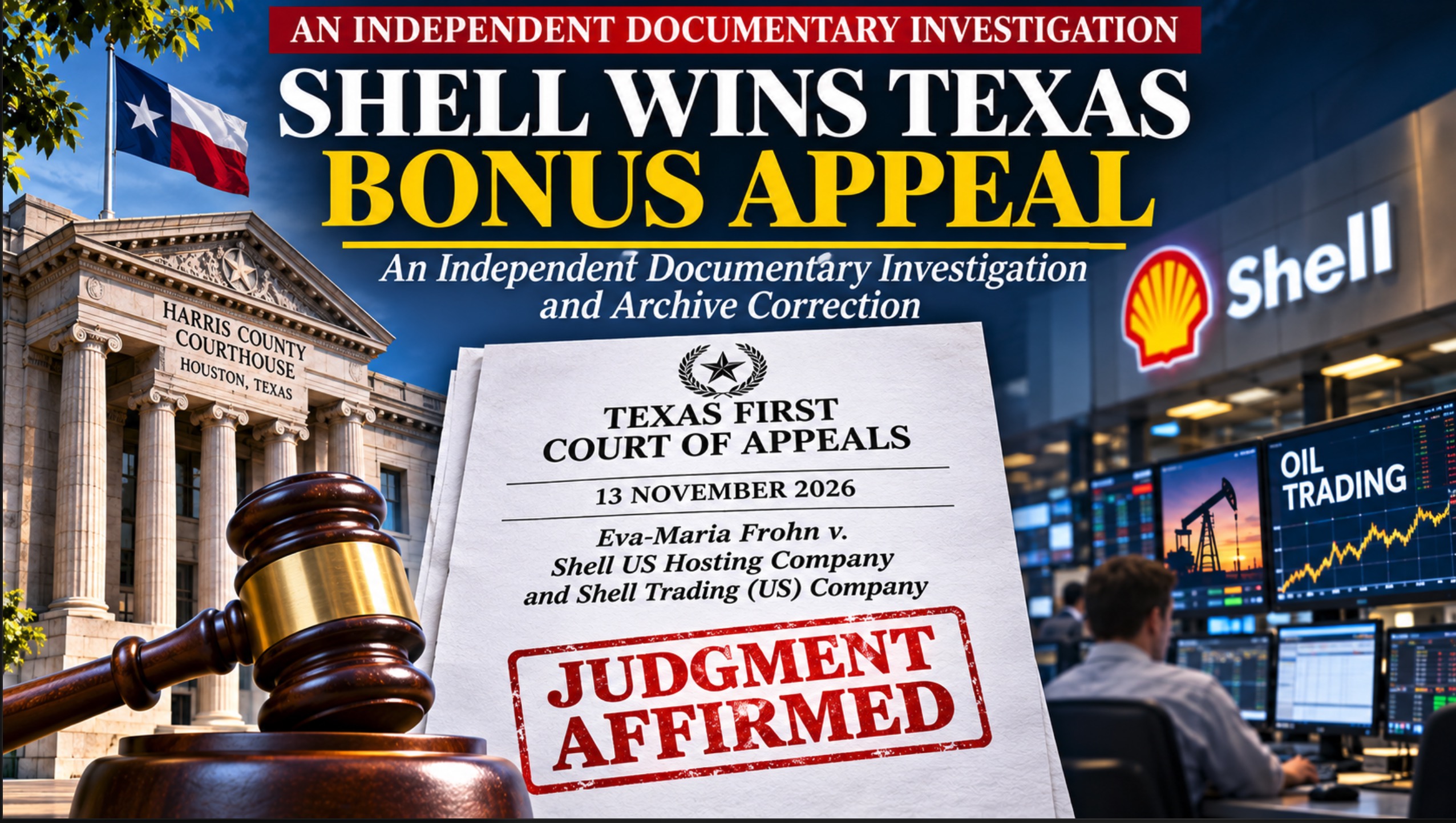
AN INDEPENDENT DOCUMENTARY INVESTIGATION
By the Donovan–Shell Archive
14 November 2026
Researched and drafted with assistance from ChatGPT.
A Texas appeals court has upheld Shell’s victory in a multimillion-dollar dispute with former senior oil trader Eva-Maria Frohn. The decision examines the contractual meaning of redundancy, the treatment of conditional bonuses and performance shares, and the relationship between Shell’s international employment policies and individual compensation agreements. It also provides an important opportunity for the Donovan–Shell Archive to correct its own earlier coverage of the case.
A significant judgment in a dispute over Shell trading bonuses
On 13 November 2026, the First Court of Appeals of Texas issued a memorandum opinion in Eva-Maria Frohn v. Shell US Hosting Company and Shell Trading (US) Company.
The appeal arose from a lawsuit brought by a former senior Shell oil trader who claimed that the company had improperly withheld substantial bonus payments and performance-share awards following her departure in November 2021.
At the centre of the dispute was a deceptively simple question.
Had Frohn left Shell because her employment was redundant, or had she voluntarily ended an employment relationship that Shell wanted to continue?
The answer mattered because her compensation agreements contained restrictions on awards that had not yet vested.
Certain exceptions permitted awards to continue when employment ended for specified reasons, including redundancy.
Frohn maintained that her circumstances fell within that exception.
Shell disputed her interpretation.
A Texas jury had already rejected her breach-of-contract claim and found in Shell’s favour on her remaining claims.
The appellate court has now upheld that outcome.
The court’s opening explanation is particularly clear: the contractual question was whether Frohn’s employment ended because of redundancy, and the jury’s decision that Shell had not breached the agreements was supported by the evidence.
The judgment is therefore a documented legal victory for Shell in this particular dispute.
It is not merely a corporate assertion that the company acted properly.
It is the result of a trial and appellate proceedings.
Primary source: Texas First Court of Appeals, Case No. 01-24-00571-CV, memorandum opinion issued 13 November 2026.
The earlier revelation about Shell’s trading profits
The case first attracted substantial attention in April 2024 for reasons extending beyond Frohn’s personal compensation dispute.
Reuters reported that testimony disclosed in the proceedings provided a rare glimpse into the financial performance of Shell’s United States crude-oil trading business.
John Dimech, a former head of Shell’s US crude trading operations, had testified that the division typically generated between approximately $950 million and $1 billion annually.
Those figures attracted interest because Shell does not ordinarily disclose the profitability of individual trading desks in the same way it reports the results of its principal business divisions.
Reuters also reported the exceptional scale of compensation available to successful senior energy traders.
According to its April 2024 account, Frohn was seeking approximately $15 million, including a disputed $6 million bonus associated with 2021.
The report stated that she had previously received a bonus exceeding $5 million in 2020 for her work during the preceding year.
These were substantial amounts, even by the standards of highly compensated international financial and commodity-trading professionals.
But two distinctions must be maintained.
First, the historical trading-profit estimates arose from testimony reported during the litigation. They were not independent, audited disclosures of the division’s current profitability.
Second, the scale of compensation claimed did not establish that Shell had unlawfully withheld it.
That second distinction is especially important in light of the subsequent court decisions.
Contemporaneous source: Reuters, 29 April 2024 — Shell earns $1 billion a year from US crude trading, court filing shows.
What our own archive reported — and what it omitted
On 29 April 2024, royaldutchshellplc.com published an article entitled:
Shell Rakes in $1 Billion Annually from US Crude Trading, Lawsuit Exposes.
That article drew attention to the trading-profit disclosures and the extraordinary amounts involved in the compensation dispute.
Its presentation was satirical and strongly critical of Shell.
It also described the alleged breach of Frohn’s contract in terms that could reasonably give readers the impression that wrongful conduct had been established.
That was not an adequately qualified account of the legal position.
The Reuters report published on the same date had already stated that a Texas jury had returned a verdict favourable to Shell, rejecting Frohn’s claim.
Our original article did not mention that outcome.
The omission was material.
An allegation of contractual misconduct and a jury’s finding that the contract was not breached are fundamentally different matters.
The earlier article’s satirical character does not eliminate the importance of preserving that distinction.
Nor should the subsequent appellate victory be ignored simply because it favours Shell.
The Donovan–Shell Archive’s responsibility is to record the evidence accurately, including evidence that contradicts its earlier commentary.
We therefore correct the record explicitly: Shell prevailed at trial in the Frohn bonus dispute, and the Texas First Court of Appeals affirmed that judgment on 13 November 2026.
The original reporting about historical trading-profit testimony is a separate matter and is not disproved by the appellate judgment.
The correction concerns the legal status and outcome of Frohn’s compensation claims.
An international career and a dispute over unvested compensation
The newly published appellate judgment provides a much fuller account of the employment history and contractual arrangements than was available to many readers of the original news reports.
Frohn began working for Shell in London in 2001.
In 2010, she accepted a long-term international assignment in Houston, Texas, as a trading manager.
Her assignment was extended several times, and she remained in Houston for approximately eleven years.
During her employment, she received conditional cash-bonus awards and performance-share awards.
The disputed agreements related to awards granted in 2019, 2020 and 2021.
Their conditions generally required continued employment through specified vesting dates before the awards became payable or transferable.
For the conditional cash bonuses, those dates fell in August 2022, August 2023 and August 2024.
For the performance-share awards, the relevant dates fell in January 2022, January 2023 and January 2024.
Frohn left Shell on 30 November 2021.
Consequently, the awards concerned had not vested when her employment ended.
However, the agreements recognised limited exceptions.
Depending on the award, those exceptions included redundancy, retirement, disability, injury or ill health, with an additional fixed-term-contract provision applying to the share awards.
The case did not turn on whether Frohn had been a successful or valuable trader.
It concerned whether the contractual conditions for retaining unvested awards had been satisfied.
That distinction is central to understanding why an employee could receive exceptionally large awards during employment yet fail to qualify for additional conditional compensation after leaving.
The disagreement over returning to London
The circumstances preceding Frohn’s departure were contested.
According to the appellate opinion, Shell had taken steps in March 2020 to retain her after learning that she was considering leaving the company.
Those steps included an improved compensation package.
In June 2021, Frohn informed Shell that she wanted to conclude her Houston assignment and return to London for personal reasons.
The court records that her circumstances included concern about her father’s health and a desire to spend more time with him.
Shell wanted her to continue in Houston.
When it became apparent that Frohn intended to return to London, the company explored alternative employment opportunities.
One involved a leadership position in an internal technology-modernisation initiative known as Project Punk.
Another concerned a senior low-carbon-fuels position with potential responsibilities in London and Rotterdam.
Shell presented evidence that these opportunities could preserve important aspects of Frohn’s seniority, remuneration or professional responsibilities.
Frohn did not accept the Project Punk position and did not pursue the low-carbon-fuels opportunity to the point of appointment.
Shell subsequently classified her departure as a resignation.
Frohn challenged that classification.
An important feature of her argument was that she had neither submitted a formal resignation letter nor expressly stated that she was resigning.
She also relied on the conclusion of her Houston assignment and the absence of an identical position available to her in London.
These circumstances were not simply ignored by the appellate judges.
They were examined as part of the evidentiary record.
The court acknowledged that Frohn had presented evidence supporting her interpretation.
The difficulty for her case was that the jury had also heard evidence supporting Shell’s position.
The appellate judges concluded that the jury was entitled to resolve those competing accounts in Shell’s favour.
What did redundancy mean under the bonus agreements?
The dispute illustrates the importance of distinguishing employment terminology from the specific language of an enforceable compensation contract.
Frohn argued that the conclusion of her international assignment, combined with the circumstances of her proposed return to London, meant that her departure should be treated as redundancy.
Shell maintained that her Houston position remained available.
The company had not decided that her work was no longer needed.
Instead, she had requested a move for personal reasons and had not accepted the alternative opportunities subsequently identified.
The appellate court addressed the contractual meaning of redundancy and treated its ordinary meaning as involving the cessation of employment because the employee was no longer needed.
Whether Frohn’s individual circumstances satisfied that meaning was a question to be assessed against the evidence.
The court did not say that a company could obtain the desired outcome merely by labelling a departure as resignation.
Rather, it examined the underlying facts.
The evidence that Shell wanted Frohn to remain in Houston was significant.
So was evidence that her original position had not been eliminated.
The court concluded that the jury had sufficient grounds to find that Frohn’s employment had not ended because she was redundant.
That meant the contractual exception permitting retention of the unvested awards had not been established.
The distinction is important for any international employer operating complicated compensation arrangements.
The language of a particular contract may be decisive even where broader human-resources policies employ overlapping terminology.
Could Shell’s own employment policies change the outcome?
A particularly interesting part of the appeal concerned the relationship between Shell’s individual bonus agreements and its wider internal employment policies.
Frohn relied upon materials connected with Shell’s United Kingdom redundancy procedures, its international mobility arrangements and a restructuring programme known as Project Reshape.
Her argument was that these materials supported a broader understanding of redundancy.
One of the policies addressed circumstances in which an international assignment ended and the individual was unable to secure another position.
Another concerned situations where employees rejected alternative employment following organisational changes.
These were not irrelevant subjects.
They helped explain why Frohn considered her departure to be something other than a straightforward voluntary resignation.
But the appellate court identified a decisive contractual difficulty.
The disputed bonus agreements did not incorporate the relevant policies as part of their own terms.
Under the Texas contractual principles applied in the case, separate guidance documents could not simply be used to alter the meaning of the compensation agreements.
The court also noted evidence that Project Reshape’s relevant UK provisions applied to local UK employment arrangements rather than Frohn’s continuing Houston role.
Even where internal policies discussed redundancy or severance, that did not necessarily confer an entitlement to the specific conditional cash bonuses and performance shares in dispute.
This finding should not be turned into a universal statement that corporate employment policies have no legal significance.
Their effect depends upon the relevant contractual language, governing law and circumstances.
The conclusion in Frohn’s case was narrower.
The particular documents on which she relied did not establish the contractual entitlement she claimed.
The court also rejected challenges concerning excluded evidence
Frohn raised a further appellate argument concerning the treatment of expert evidence.
The trial court had excluded excerpts from articles addressing British redundancy practices.
She contended that those materials supported her position and should have been admitted.
The appellate court upheld their exclusion.
It referred to deficiencies in the attempt to establish the publications as appropriate authorities for the expert evidence and to the fact that the expert had not relied on them when forming his underlying opinion.
The court also considered that the material would have been cumulative of evidence already presented.
It therefore found no basis for reversing the judgment on that ground.
The appellate judges additionally rejected Frohn’s challenge concerning the denial of attorney’s fees.
Because she had not succeeded in her contractual claim, the relevant grounds for recovering those fees had not been established.
These conclusions further reinforce the narrow but decisive nature of the judgment.
The court examined legal and evidentiary objections to the trial outcome and found no grounds to disturb it.
What the judgment does — and does not — establish
The outcome is clear, but its scope should not be exaggerated.
The appellate judgment establishes that the evidence supported the jury’s finding that Shell did not breach the disputed bonus agreements.
It also establishes that Frohn’s challenges to the treatment of policy documents and excluded evidentiary material did not justify overturning the judgment.
The jury had found in Shell’s favour on the other claims presented at trial, including fraud and declaratory relief.
The November 2026 decision affirms the trial court’s judgment.
It does not, however, amount to a general judicial endorsement of Shell’s employment practices worldwide.
Nor does it establish that every bonus-forfeiture provision used by Shell is enforceable in every jurisdiction.
Different contracts and different factual circumstances may produce different legal outcomes.
The decision also does not resolve broader questions concerning the appropriate size of commodity traders’ bonuses.
Those are separate matters of remuneration policy, corporate governance and commercial judgement.
Furthermore, the appellate ruling does not adjudicate the historical estimates of Shell’s US crude-trading profits reported by Reuters in 2024.
The $950-million-to-$1-billion figures arose from separate testimony disclosed during the proceedings.
They should not be presented as an independently verified estimate of current 2026 trading profits.
Similarly, the amount Frohn claimed in 2024 should not be confused with a court-ordered payment.
Reuters reported that she sought approximately $15 million. A report published by Law360 on 13 November 2026 described the disputed awards as approximately $16 million.
The appellate opinion itself does not establish a reconciled monetary valuation of the claims.
The important verified financial conclusion is that the trial judgment awarded Frohn no recovery on those claims and that this result was upheld on appeal.
The wider importance of conditional compensation
Although the dispute concerns an unusually highly paid professional, it raises broader questions about compensation structures in major international corporations.
Large trading organisations often seek to retain experienced employees whose decisions can influence substantial commercial exposures.
Deferred compensation provides one mechanism for encouraging continuity.
An employee may receive a conditional award reflecting performance during one period while remaining subject to vesting requirements extending several years into the future.
That arrangement can serve a legitimate business purpose.
It may discourage short-term risk-taking and encourage employees to remain with the organisation.
But it also creates potential disputes when the employment relationship ends before an award has vested.
The employee may regard the award as compensation generated by work already performed.
The employer may regard it as a contractual benefit payable only if future conditions are satisfied.
Neither interpretation necessarily determines the legal outcome.
The relevant agreements, the circumstances of departure and the applicable law are essential.
The Frohn judgment demonstrates the financial importance of those distinctions.
It also illustrates how international employment arrangements can become complicated when an employee begins a career in one country, spends many years on assignment in another and subsequently seeks to return.
Internal mobility policies, redundancy procedures, retention arrangements and compensation agreements may all become relevant.
But they do not automatically create identical legal entitlements.
An independent archive must record Shell’s victories as well as its defeats
The Donovan–Shell Archive has published substantial material examining Shell’s commercial practices, litigation history, corporate governance and relationships with employees.
Many of those investigations concern allegations, regulatory findings or documentary evidence unfavourable to the company.
That historical focus makes it particularly important to report legal decisions that do not support criticism of Shell.
The Frohn litigation is a useful example.
The original 2024 article drew attention to a genuine public-interest subject: the scale of compensation and profits associated with Shell’s oil-trading operations.
But it did not adequately explain the status of the legal claim on which the disclosures had arisen.
That omission requires correction.
A reader encountering only the earlier account could reasonably conclude that Shell had been shown to have wrongfully withheld compensation.
The court record supports a different conclusion in this particular case.
Shell defended the proceedings successfully.
A jury found that the company had not breached the compensation agreements.
The subsequent appeal did not overturn that finding.
Those are not facts that should be minimised because they are favourable to Shell.
They are part of the documentary history.
Nor is it necessary to adopt Shell’s commercial or ethical perspective in order to report them.
The purpose of an independent archive is not to guarantee that every legal dispute produces evidence against the corporation under examination.
Its purpose is to preserve an accurate record and to distinguish proven events from allegations, commentary and unresolved questions.
The present article therefore serves two functions.
It reports a new judgment.
And it corrects the treatment of an older case in the historical archive.
Both are appropriate responsibilities for an independent documentary publication.
DOCUMENTARY FINDINGS
Established facts: On 13 November 2026, the Texas First Court of Appeals affirmed the judgment in favour of Shell US Hosting Company and Shell Trading (US) Company in the Frohn litigation. The jury had found no breach of the disputed bonus agreements. The appellate judges held that sufficient evidence supported that conclusion and rejected the additional challenges addressed in their opinion.
Frohn’s position: She maintained that the conclusion of her international assignment and the circumstances of her return to the United Kingdom brought her within the redundancy provisions of her conditional compensation agreements. She disputed Shell’s classification of her departure as a resignation and relied partly upon internal Shell employment policies.
Shell’s position: The company maintained that Frohn’s Houston position remained available, that it wished to retain her and that the relevant contractual exception did not apply. The jury accepted Shell’s defence, and the appellate court found that the verdict was supported by sufficient evidence.
Unresolved or separate matters: The ruling does not independently establish Shell’s current US crude-trading profitability, evaluate the general appropriateness of its bonus policies or determine how different compensation agreements might operate under other employment laws. The possibility of further appellate proceedings has not been excluded by this investigation.
Archive correction: The Donovan–Shell Archive’s article of 29 April 2024 did not adequately distinguish Frohn’s allegations from the jury verdict already reported in Shell’s favour. This investigation corrects that omission.
CONCLUSION: A COURT VICTORY THAT DESERVES AN ACCURATE PLACE IN SHELL’S HISTORY
The Texas appeal has ended with another judgment in Shell’s favour.
That is the essential finding.
Eva-Maria Frohn pursued a substantial compensation claim based upon her interpretation of contractual redundancy provisions.
Shell disputed her entitlement.
The jury accepted Shell’s position.
On 13 November 2026, the First Court of Appeals upheld the trial court’s judgment.
The dispute provides an instructive account of the way conditional compensation can operate in a major international trading organisation.
It shows why the distinction between an unvested award and a legally enforceable entitlement matters.
It also demonstrates the difficulty of reconciling international assignment policies with individual bonus contracts when an employment relationship ends.
But the case carries an additional significance for this archive.
Our original reporting drew attention to Shell’s trading profits and senior-trader remuneration without adequately recording that the company had already prevailed before the jury.
That omission should not remain uncorrected.
The strongest independent investigations are those prepared to report the documentary evidence wherever it leads, including when that evidence favours Shell or contradicts an archive’s earlier presentation.
The new appellate judgment supplies the authoritative record.
It deserves to be published accurately and preserved alongside the original 2024 account.
PRINCIPAL DOCUMENTARY SOURCES
1. Texas First Court of Appeals — 13 November 2026
Eva-Maria Frohn v. Shell US Hosting Company and Shell Trading (US) Company — Full memorandum opinion.
Case No. 01-24-00571-CV, originating from Harris County District Court case No. 2022-07028. The primary judicial record supporting the article’s findings on contractual interpretation, the evidence and the appellate outcome.
2. Full judgment, PDF reproduction
Download the 22-page Texas Court of Appeals opinion.
3. Texas judicial case information
Texas Courts — Appellate case record, No. 01-24-00571-CV.
The official appellate case information system. The judgment itself is the authoritative source for the outcome; public docket updates may lag behind newly issued decisions.
4. Reuters — 29 April 2024
Shell earns $1 billion a year from US crude trading, court filing shows.
Contemporaneous reporting of the trading-profit testimony, Frohn’s claimed compensation and the jury’s verdict in Shell’s favour.
5. Donovan–Shell Archive — 29 April 2024
Shell Rakes in $1 Billion Annually from US Crude Trading, Lawsuit Exposes.
The historical article examined and corrected by this investigation.
6. Law360 — 13 November 2026
Shell Didn’t Owe Ex-Worker $16M Bonuses, Texas Panel Says.
Contemporary legal reporting of the appellate decision. Subscription access may be required.
DOCUMENTARY DISCLAIMER
This independent investigation is based principally on the Texas First Court of Appeals’ memorandum opinion issued on 13 November 2026, together with contemporaneous Reuters reporting, publicly available judicial case information and the Donovan–Shell Archive’s article of 29 April 2024.
The judicial findings are distinguished from the parties’ allegations and from the archive’s editorial analysis.
The appellate ruling concerns the specific agreements, evidence and claims presented in Frohn v. Shell US Hosting Company and Shell Trading (US) Company. It is not represented as a comprehensive legal assessment of Shell’s employment practices or as a determination of rights under other contracts or jurisdictions.
Amounts attributed to Frohn’s compensation claims come from contemporary reporting and are not presented as sums awarded by a court. The historical trading-profit figures were reported from testimony and are not treated as verified current financial performance.
The archive acknowledges that its 29 April 2024 article omitted the jury verdict in Shell’s favour and used language that could imply an established contractual breach. The present investigation corrects that presentation.
As of 14 November 2026, the appellate judgment has been verified. No claim is made that further review is legally impossible or that all applicable post-judgment procedures have concluded.
Shell plc, the defendant companies, Eva-Maria Frohn and their representatives are invited to submit factual corrections or relevant additional documents. Substantiated corrections will be considered fairly.
The Donovan–Shell Archive is independent of Shell plc. This article is documentary reporting and analysis, not legal advice or a determination of liability beyond the findings of the cited courts.








