Royal Dutch Shell plc .com Rotating Header Image

Posts Tagged ‘Sakhalin Energy’

Blog costs Shell US$15 Billion

Article by Glen Frost, Editor, The PR Report

Yes, 15 billion. This is the claim of John Donovan, a UK blogger who campaigns against  the global oil producing giant Shell (full name Royal Dutch Shell) using his blog www.royaldutchshellplc.com .

Arguably the most powerful blog in the world dedicated to covering one company; and intrigued as to how the site developed such influence, Glen Frost met with the blog’s founders, John and Alfred Donovan, to get the full story.

EXTRACTS

The blog is now so popular, and trusted, the site appears on the front page of major newspapers (see pictures), and has ex‐employees from Shell contributing regular articles

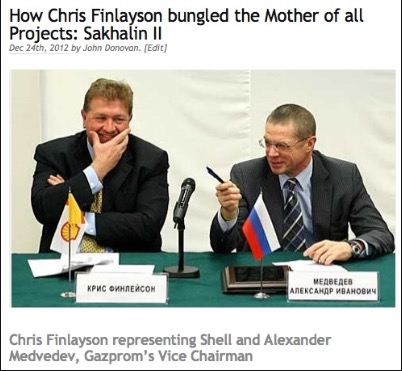
The Russian connection: the scoop that made the  Donovan’s blog famous

The Donovans had been collecting and publishing information online about Shell’s activities since 2001; this information dates back to the mid 1980’s and their former business relationship with Shell. Over the years, more and more people in the oil industry discovered the website, and the Donovan’ s have been swamped with information about Shell from both suppliers, contractors, insiders and former employees.

Some of this information concerned Shell’s activities in Russia from 1996. A Shell‐led consortium (called Sakhalin Energy) and the Russian Government entered into a production sharing agreement. It was information on alleged environmental abuses by the consortium from the Donovan’ s that killed the deal. John Donovan said he suspected his information was the trigger but didn’t know for sure until Oleg Mitvol, a senior figure in the Russian Government, stated so in a media interview.

Asked by a journalist from PetroleumArgus, a trade magazine, who his sources were for the environmental abuse charges that Mitvol laid against the Sakhalin Energy consortium, Mitvol, then deputy head of Russia’s environmental watchdog Rosprirodnadzor, said he had “email correspondence between executives in Sakhalin Energy management from 2002.”

The compromising material had come from Donovan, owner and blogger of the anti‐Shell website www.royaldutchshellplc.com, Mitvol said.

Donovan estimates the value lost to Shell is US$15 billion.

The Donovan’s website is a full frontal attack on Shell’s management and ethics. Shell has tried to shut the site down on the grounds that it uses the company name. However, the site www.royaldutchshellplc.com  makes no money, and, crucially, is registered in the USA, where laws on websites are weighted in favour of the domain owner.

“Our site receives up to 2.2 million hits a month; we want it to become a magnet for people who have a problem with the
company,” says Donovan.  “Many of the people using the site are Shell employees.

Blog publishes market sensitive information

Donovan publishes market sensitive information on the site, and he, and the website, are now quoted by esteemed news organisations like Reuters and The Financial Times. For example, Donovan  published information questioning the level of Shell’s reserves, in which the company was found to have inflated its oil and gas reserves by some 20% in 2003‐04, which led to negative media headlines.

The picture (right; The Daily mail, UK 8th Sept 2009) shows how Donovan’s blog published details of staff cuts before Shell had announced them to the markets and the media.

Because of the blog, and the Donovan’s insistence on publishing all information he can verify about Shell, good and bad, John Donovan’s influence with the media is now global, instant and at a senior level – John lists the names of all the UK, US and global media outlets, their Editors or senior correspondents covering corporate news or the oil sector as his contacts.

Shell’s external PR advisors

A post on the Donovan’s website links to an article in a recently published book on corporate reputation and the rise of blog sites that attack, or expose, poor corporate ethics and illegal or dubious corporate activity, and what CEOs should do about such sites; http://www.shellnews.net/images/CorporateReputationAED.pdf ‐ the book is written by Dr Leslie Gaines‐Ross, who, incidentally, was previously CMO of Burson‐Marsteller USA, who manage Shell’s public relations.

FULL ARTICLE (FREE SUBSCRIPTION)
Previous PR Report issues here: http://thepublicinterest.ning.com
PR Report Facebook page: http://tinyurl.com/ykg6p7j
PR Report YouTube channel: www.youtube.com/theprreport

EXTRACT FROM BOOK REFERRED TO ABOVE: “REPUTATION LOSS – 12 Steps to safeguarding and Recovering Reputation”

One such empowered activist is arch Shell critic Alfred Donovan. No one was more surprised than Royal Dutch Shell PLC to learn that this 88-year-old British army veteran had purchased the Internet domain name www.royaldutchshellplc.com. The gadfly Donovan was a well-known, though underestimated, critic of the company. By acquiring the domain name, Donovan obtained the perfect platform to voice his criticisms of the oil giant. Who would have thought a decade ago that such an unlikely individual could stand up to a corporate powerhouse, waging a war of words against one of the world’s largest companies?

Gazprom raking it in at the expense of Shell

Below an extract from a Wall Street Journal article published today reporting on the profits of Gazprom and Sakhalin Energy, the company in which Shell was forced to surrender its majority stake.

THE WALL STREET JOURNAL

FEBRUARY 1, 2010

Foreign-Exchange Gains Boost Gazprom’s Net

By JACOB GRONHOLT-PEDERSEN

Sakhalin Energy, a Gazprom joint venture with Royal Dutch Shell PLC and Japan’s Mitsui Co. Ltd. and Mitsubishi Corp., posted earnings of 10.65 billion rubles in the third quarter. Sakhalin Energy opened Russia’s first plant for liquefied natural gas last February and shipped 5.5 million tons of LNG in its first year.

COMPLETE ARTICLE

John Donovan Russian intervention cost billions – no denial by Shell

Documents released by Royal Dutch Shell Plc under the Data Protection Act to John Donovan, a prominent critic of the world’s largest oil company, show that Shell does not deny that his intervention in the Sakhalin2 project in Russia cost Shell billions – according to the Sunday Times – $22 billion.

Shell internal correspondence from December 2006 to March 2007 reveal that Shell was concerned that:

“…the Sunday Times has picked up the Sakhalin/drilling leaked e-mail story from Donovan’s website, They are responding with agree Os and As that have been used previously with the Guardian, but are first trying to kill the story by pointing out that is old news – slim chance that this will work.”

The story said that insider information supplied by John Donovan to the Russian government official Oleg Mitvol, known as the “Kremlin attack dog”, had cost Shell $22 billion, according to calculations made by the newspaper based on information from Shell annual accounts.

The article also featured an interview with Mitvol in which he indicated his surprise at the lack of a fight put up by Shell before it surrendered its majority stakeholding in the project. The interview with him was mentioned in a Shell internal email dated Saturday 3 February 2007. Later that same day, just hours before planned publication on Sunday 4 February, the article, which was so embarrassing to Shell senior management, was killed.

A Shell internal email dated 22 March 2007 headed “Subject: RE: News Management Grid”, reported our speculation that Shell had managed to suppress the article. There was no confirmation, nor any denial.

A Shell internal email dated 20 July 2009 discussed a Sunday Times article that was published on 19 July 2009, two years after the aborted article. The new article, which had been scrutinized by Shell, contained the following reference to the same subject:

In 2005, when the Kremlin was building a case against Shell over the Sakhalin gas project, the Donovans provided confidential documents regarding alleged environmental infractions directly to Oleg Mitvol, the minister who led the case. Shell was ultimately forced to sell a stake to the Russians, leading to billions in lost revenue. Mitvol publicly acknowledged the help provided by the Donovans in building his case.

The Shell email took issue with a reference in the article to the outcome of the most recent High Court action John Donovan brought against Shell. The person who authored the email was apparently misled by the Shell press statement issued at the time, which was a classic example of Shell Media spin (outright deception).There was however, no challenge to the veracity of the statement about Shell Sakhalin losses.

An extract from a recent Guardian article covering the same issue:

Four years ago Shell was embroiled in a bitter dispute with Russia’s environmental regulator over drilling for gas at Sakhalin Island. It was eventually forced to relinquish its majority stake in the project, costing Shell billions in lost revenue. Later, the regulator, Oleg Mitvol, publicly acknowledged the Donovans’ help in getting information about alleged claims of environmental abuses by Shell.

It is notable that in none of the Shell internal communications has Shell ever taken issue with the claim that the involvement of John Donovan and his website royaldutchshellplc.com in Sakhalin2, did indeed cost Shell billions. It also resulted in the resignation of the Project Director and Deputy Chairman of Sakhalin Energy Investment Company, David Greer. But that is another story (scandal).

Related extracts…

Prospect Magazine: Rise of the gripe site: 25 February 2007

…it is the home of www.royaldutchshellplc.com, a website which can claim to have cost Shell billions of dollars—and helped Vladimir Putin score another victory over western energy interests.

one world trust Accountability in Action Newsletter July 2007:

Royaldutchshellplc.com – The power of a website:

The site has not only cost Shell billions of dollars in Russia, but Prospect Magazine reports that the Ogoni tribe of Nigeria also use the website to spread information about Shell’s activities in the Niger Delta, and that even Shell insiders unhappy with the company use it.

Sakhalin Energy CEO To Head Embattled Shell Africa Unit

THE WALL STREET JOURNAL

JUNE 19, 2009, 10:53 A.M. ET

LONDON (Dow Jones)–Sakhalin Energy’s chief executive, Ian Craig, is to head Royal Dutch Shell PLC’s (RDSB.LN) embattled Africa unit, with the incumbent moving to the firm’s Australian business, according to an email Friday, as the oil major’s corporate shakeup continues.

In comments sent to Dow Jones Newswires via the Shell press office, Ann Pickard, Shell’s current vice president for exploration and production in Africa, said: “Major changes take place in Shell’s leadership, and after four exciting years running our upstream business in Africa, I will look after our gas and oil production in Australia.”

“My successor, Ian Craig, is the absolutely best choice I could think of to continue moving the challenging and important business in Africa forward,” Pickard added.

The statement confirms a news item published earlier Friday by Dow Jones Newswires.

No detailed timeframe has been disclosed, but a Sakhalin Energy spokesman previously said there are “still months to go before Ian moves on.”

As head of Sakhalin Energy, Craig presided over Shell’s single largest and most challenging oil and gas project before OAO Gazprom (GAZP.LN) took control in 2007.

Now he will be tasked with solving the problems of Shell’s Nigerian operation, the bulk of Shell’s Africa business and now its most problematic unit.

Years of attacks by militants and government underfunding have hindered the Nigerian’s operation potential. In the first quarter of this year, Shell lost 90,000 barrels of its share of Nigerian production from unrest and oil theft.

The move is part of a wide-ranging revamp initiated by incoming chief executive Peter Voser, before formally taking over from Jeroen van der Veer July 1.

The corporate restructuring may have already contributed to at least one high-profile departure. Linda Cook, the head of Shell’s gas business, once seen as a contender for the chief executive job, resigned abruptly late May. The move came just before a merger of the gas unit with the exploration and production business was announced.

Shell appointed Craig, a former Enterprise Oil executive, at the helm of Sakhalin Energy in 2004, before the company unveiled delays and a doubling of the Russian venture’s project costs to $20 billion. The initial budget had been designed prior to Craig’s arrival and he has said the changes were tied to insufficient and overly optimistic planning by previous managers.

The problems were seized upon by Russia, with Gazprom ultimately taking control of the project with Shell as a minority partner and Craig remaining chief executive.

As for Pickard, the Australian appointment will also be rich in prospects, as Shell has already said it was open to consolidation opportunities in this market.

Pickard said in the statement: “I indeed look forward to taking on these challenges, and my target is to develop Shell’s business in Australia further.”

-By Benoit Faucon, Dow Jones Newswires; +44-20-7842-9266; benoit.faucon@dowjones.com

WSJ ARTICLE

Sakhalin Energy CEO Ian Craig key player in Shell Executive reshuffle

Ian Craig, CEO, Sakhalin Energy

Ian Craig, CEO, Sakhalin Energy

THE WALL STREET JOURNAL

Shell Mulls Sakhalin JV CEO To Head Africa Op – Source

JUNE 19, 2009, 5:28 A.M. ET

LONDON (Dow Jones)–Royal Dutch Shell PLC (RDBS.LN) is considering Sakhalin Energy Chief Executive Ian Craig to head its embattled West Africa operation, a person familiar with the matter said this week, as Shell’s incoming chief executive, Peter Voser, extends its corporate shakeup.

As head of Sakhalin Energy Investment Co. Ltd., Craig presided over Shell’s single largest and most challenging oil and gas project before OAO Gazprom (GAZP.LN) took control in 2007.

If the appointment is confirmed, he will be tasked with restructuring the Nigerian operation, the bulk of Shell’s West Africa business and now its most problematic unit.

The reshuffle – if its goes forward – would be effective later this year. The person said that Ann Pickard, who currently heads Shell’s West Africa operation, may move to a vice-president position that would cover Australia.

A Shell spokesman declined to comment.

A Sakhalin Energy spokesman confirmed Craig’s appointment to a Shell position but referred to the Anglo-Dutch major for further comments. The move “is according to what has been planned and announced before – and still months to go before Ian moves on,” the Sakahlin Energy spokesman said.

Pickard didn’t comment on the personnel changes when contacted and Craig didn’t return a request for comment.

The move would be part of a wide-ranging revamp initiated by incoming chief executive Voser before formally taking over from Jeroen van der Veer July 1.

The corporate restructuring may have already contributed to at least one high-profile departure. Linda Cook, the head of Shell’s gas business, once seen as a contender for the chief executive job, resigned abruptly late May. The move came just before a merger of the gas unit with the exploration and production business was announced.

Shell appointed Craig, a former Enterprise Oil executive, at the helm of Sakhalin Energy in 2004, before the company unveiled delays and a doubling of the Russian venture’s project costs to $20 billion. The initial budget had been designed prior to Craig’s arrival and he has said the changes were tied to insufficient and overly optimistic planning by previous managers.

The problems were seized upon by Russia, with Gazprom ultimately taking control of the project with Shell as a minority partner and Craig remaining chief executive.

The Nigeria operation he would take over would bring new challenges for the executive, after years of attacks by militants and government underfunding hindered its potential. In the first quarter of this year, Shell lost 90,000 barrels of its share of Nigerian production from unrest and oil theft.

As for Pickard, an Australian appointment could also be rich in prospects as Shell has already said it was open to consolidation opportunities in this market.

-By Benoit Faucon, Dow Jones Newswires; +44-20-7842-9266; benoit.faucon@dowjones.com

WSJ Article

royaldutchshellplc.com headline by John Donovan

Japan joins Russian push for Pacific gas projects

The first cargo of liquefied natural gas (LNG) from the Gazprom-led Sakhalin-2 project arrived in Japan last month. The next wave of projects could include a gas processing plant near Vladivostok, Miller said.

Click to continue reading “Japan joins Russian push for Pacific gas projects”

Sakhalin Energy Halts 09 Seismic Work To Protect Whales – WWF

CNNMoney.com

Dow JonesApril 24, 2009: 11:50 AM ET

LONDON -(Dow Jones)- Sakhalin Energy, which recently started a large liquefied natural gas plant in Russia’s far east, has canceled all planned 2009 seismic surveys following pressure from environmental groups and scientists seeking to protect the habitat of the Western Gray Whale, the Russian branch of the World Wildlife Fund said in a statement Friday.

The WWF Russia called on other companies operating in the area -BP PLC (BP), ExxonMobil Corp. (XOM) and OAO Rosneft (ROSN.RS) – to take similar action.

The decision of Sakhalin Energy, a joint venture between OAO Gazprom (GAZP.RS) , Royal Dutch Shell PLC (RSDB.LN), Mitsui & Co. Ltd. (8031.TO) and Mitsubishi Corp. (8058.TO), followed new research showing a significant decline in sightings, and behavior changes of the whales in their primary feeding area near Piltun Bay, the statement said.

Oil and gas exploration activities in the area appear to have displaced the whales to deeper areas offshore, making it more difficult for whale calves to feed, the WWF said.

“WWF lauds the responsible and forward looking approach taken by Sakhalin Energy in heeding this call from the panel,” said Aleksey Knizhnikov, oil and gas environmental policy officer for WWF-Russia.

Sakhalin Energy wasn’t immediately available for comment.

Company Web site: www.wwf.ruwww.sakhalinenergy.com

-By James Herron, Dow Jones Newswires; +44 (0)20 7842 9317; james.herron@ dowjones.com

(END) Dow Jones Newswires 04-24-09 1150ET Copyright (c) 2009 Dow Jones & Company, Inc.

SOURCE ARTICLE

Shell, Gazprom sign LNG, pipeline supply agreements

Miller and Shell chief executive Jeroen Van der Veer also discussed further collaboration in LNG projects in Russia when they met Wednesday to sign the agreements, the statement said.

Click to continue reading “Shell, Gazprom sign LNG, pipeline supply agreements”

Unexpected friends

When a consortium called Sakhalin Energy, led by Royal Dutch Shell, announced plans to build an oil platform and lay pipelines in the only bay where the whales were known to congregate, these protests proliferated.

Click to continue reading “Unexpected friends”

Russia ships first Sakhalin LNG to Japan

MOSCOW, March 29 (Reuters) – Russia sent its first cargo of liquefied natural gas (LNG) to Japan on Sunday from a Pacific island project that will allow the Kremlin to extend its reach in world energy markets from Europe into Asia and North America

Click to continue reading “Russia ships first Sakhalin LNG to Japan”