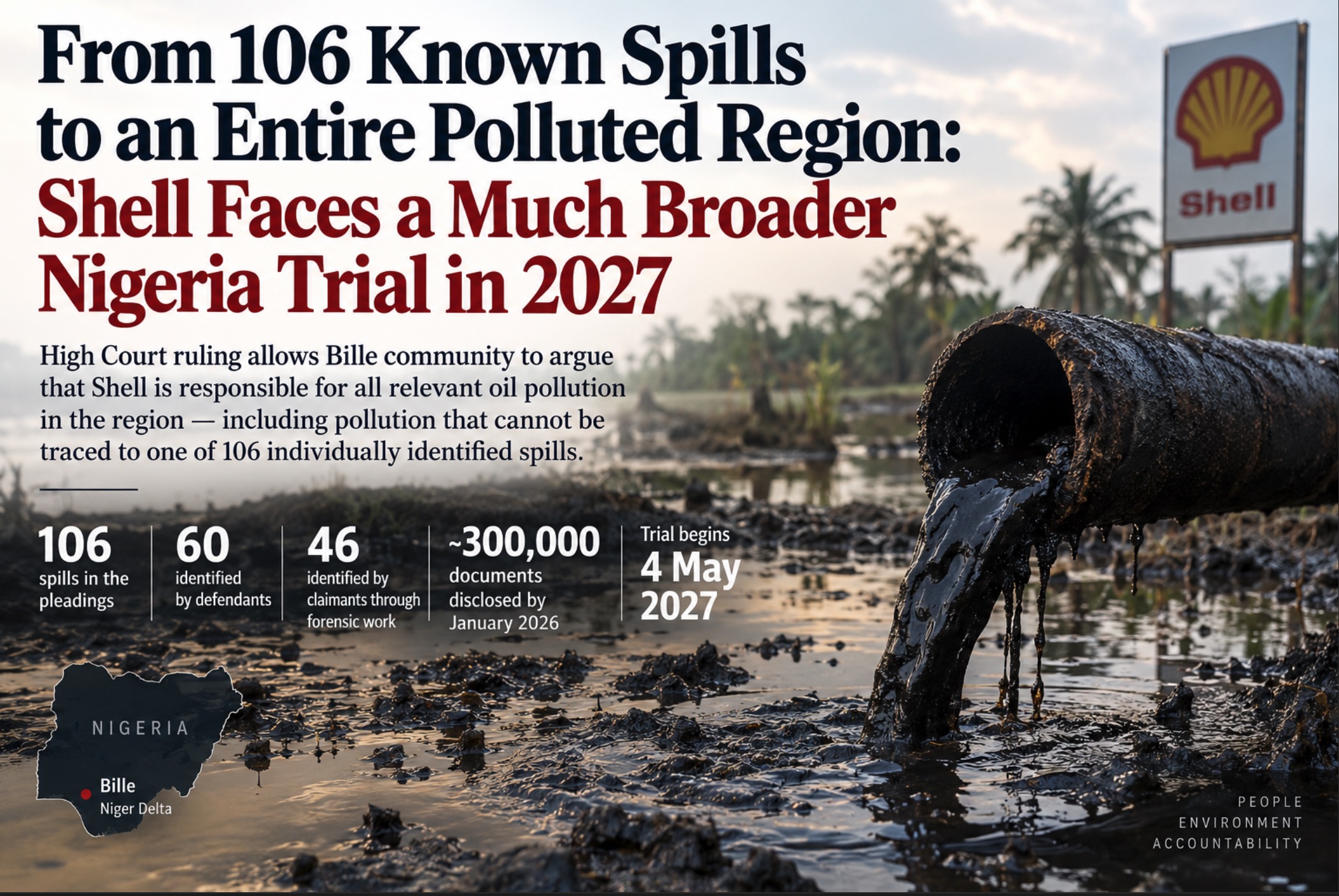
High Court ruling allows Bille community to argue that Shell is responsible for all relevant oil pollution in the region — including pollution that cannot be traced to one of 106 individually identified spills
A major new dimension has emerged in the long-running litigation over Shell-related oil pollution in Nigeria’s Niger Delta.
On 10 September 2026, Mrs Justice Lambert handed down judgment in Alame & Ors v Shell Plc & Anor [2026] EWHC 2332 (KB).
Much attention has understandably focused on another part of the ruling: allegations that Shell witnesses knowingly relied upon false or misleading factual assertions during the company’s earlier jurisdiction challenge are now to be dealt with as the litigation moves towards trial.
That development was examined in our earlier article, “Shell Nigeria Case Takes a Dramatic Turn: High Court Allows Allegations of Misleading Evidence to Be Tried.”
But the same judgment contains another ruling which may ultimately prove just as significant.
The High Court has rejected Shell’s attempt to prevent the Bille community from advancing what the judgment describes as its “primary” or “all-spills” case.
In simple terms, the claimants will be permitted to argue at the 2027 trial that Shell and its former Nigerian subsidiary are responsible not merely for pollution attributable to 106 specifically identified spills, but for all relevant oil pollution in the Bille region during the period covered by the claims.
That does not mean that the court has decided that Shell is responsible for all such pollution.
It emphatically has not.
What the court has decided is that the claimants are entitled to try to prove that case.
That distinction is crucial.
The case has moved far beyond 106 spills
The Bille litigation concerns oil pollution associated with pipelines, wellheads and other infrastructure in the Niger Delta between 2011 and 2013.
Following earlier procedural battles, the claimants were required to particularise their case in much greater detail.
The resulting pleadings identify 106 individual spills.
But there is a striking detail in the judgment.
Of those 106 spills, 60 had been identified by the defendants and given incident numbers.
A further 46 spills had not been identified by the defendants and were instead identified by the claimants during the forensic process.
Mrs Justice Lambert recorded that the claimants had produced individual annexes dealing with each of the 106 spills and setting out the systemic failures alleged to have caused or contributed to them.
Those alleged failures include matters concerning:
- pipeline and infrastructure integrity;
- leak detection;
- maintenance and repair;
- protection against third-party interference and illegal bunkering;
- spill containment;
- remediation and clean-up.
These remain allegations which Shell is entitled to contest at trial.
But the claimants’ case does not stop with the 106 spills.
The “all-spills” argument
The claimants contend that evidence concerning those identified spills may permit the court to draw wider inferences about pollution in Bille that cannot be attributed to any individually identified incident.
In other words, if contamination is found in an area and cannot be traced to one of the 106 specifically pleaded spills, the claimants want to be able to argue that it nevertheless resulted from another unidentified spill for which the defendants were responsible.
Shell opposed that approach.
The defendants argued that the claimants should be confined to the 106 identified spills and to damage which could be traced back to those specific events.
Had Shell succeeded, pollution that could not be connected to an individually identified spill would potentially have fallen outside the claimants’ case.
Mrs Justice Lambert rejected that restriction.
The claimants are therefore entitled to advance their broader case.
Doughty Street Chambers, whose Joshua Jackson acts for the claimants, summarised the effect of the ruling on 14 September:
the Bille community may argue that Shell is responsible for all oil pollution in the relevant region even where residents cannot identify every individual spill which produced that pollution.
That is a substantial development.
What the judge did — and did not — decide
The ruling should not be misunderstood.
Mrs Justice Lambert has not found that Shell caused every spill in Bille.
She has not found that every area of pollution came from Shell-operated infrastructure.
She has not decided whether sabotage, theft, illegal refining or other third-party activities caused particular spills.
Those are matters for evidence and trial.
The judgment instead deals with whether the claimants are legally and procedurally entitled to put their broader causation case before the court.
The judge concluded that they are.
Her reasoning illustrates why the eventual evidence will matter so much.
If, hypothetically, the evidence relating to the 106 identified spills showed that the defendants were responsible for virtually all of them and there were no credible competing sources for the remaining pollution, that evidence could potentially support an inference concerning unidentified spills.
If, on the other hand, the evidence presented a substantially mixed picture involving different causes and different responsible parties, drawing such a broad inference could become much more difficult.
The claimants therefore have permission to make the argument.
They still have to prove it.
Almost 300,000 documents
There is another important part of the chronology.
According to Doughty Street Chambers, an earlier High Court disclosure order resulted in Shell providing the claimants with almost 300,000 documents by January 2026.
After that disclosure exercise, the claimants were required to provide detailed particulars concerning parent-company liability, fault and causation.
Their expanded pleadings followed.
That sequence matters.
This is no longer a case being argued principally from general assertions about pollution in the Niger Delta.
The approaching trial will take place after a very large disclosure exercise and after years of forensic examination of the underlying events.
The identification by the claimants of 46 additional spills which had apparently not previously been given incident numbers by the defendants provides one indication of what that forensic process has produced.
A second explosive issue sits alongside the pollution case
The same September judgment also dealt with the claimants’ application concerning aggravated damages.
The claimants allege, among other matters, that Shell knowingly relied upon false or misleading factual assertions from witnesses during the jurisdiction proceedings that occupied the English courts between 2016 and 2021.
Shell had been arguing during those proceedings that its Nigerian subsidiary operated independently of the London-based parent company.
The jurisdiction dispute ultimately reached the UK Supreme Court, which in 2021 allowed the Nigerian communities’ claims against Royal Dutch Shell plc — now Shell plc — to proceed in England.
The current claimants now allege that evidence presented during that jurisdiction battle was false or misleading.
They also make allegations concerning the deletion or destruction of relevant evidence.
Again, these are allegations.
There has been no judicial finding that Shell, any Shell witness, or any lawyer deliberately misled a court or improperly destroyed evidence.
Shell contests the allegations.
But Mrs Justice Lambert rejecte
This website and sisters royaldutchshellgroup.com, shellnazihistory.com, royaldutchshell.website, johndonovan.website, shellnews.net, and shellwikipedia.com, are owned by John Donovan - more information here. There is also a Wikipedia segment, the Shell DPA Files, "Shell and the Spies", the Shell Leaks files, as well as books written and published by John Donovan - Kindle eBooks. Timeline of the Donovan Shell Feud. Toxic History of Royal Dutch Shell Group. Shell and the Donovans: The Full Media Record — 550+ Articles, 110 Books, 40 Years.