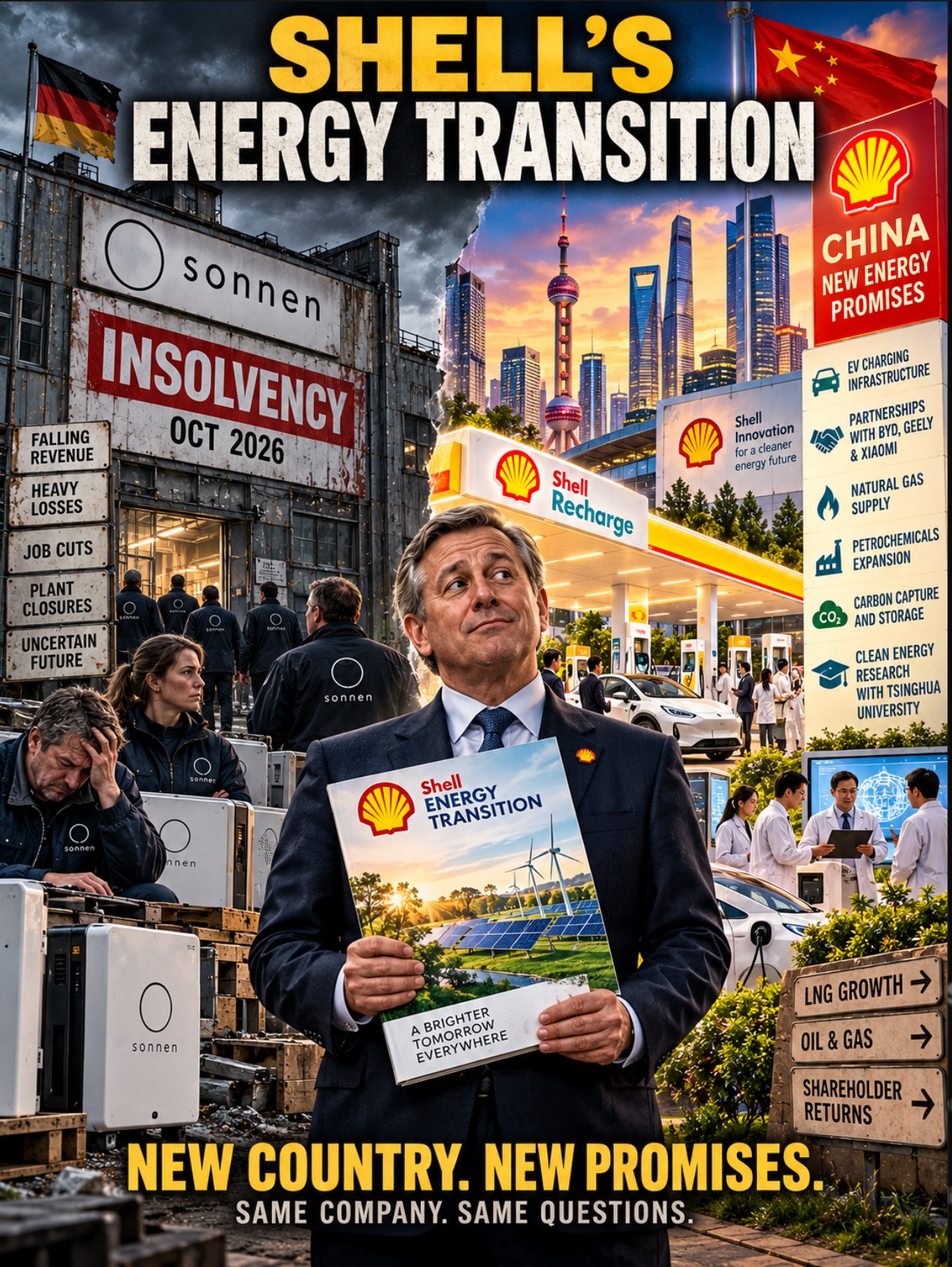
 China gets the promises, Germany gets the insolvency proceedings, and Shell gets to explain why both developments are entirely consistent with its energy-transition strategy.
25 October 2026
Shell has discovered an exciting new frontier in the global energy transition.
China.
A country where electric vehicles are booming, renewable-energy technologies are advancing rapidly, and international energy companies are understandably eager to participate.
On 22 October 2026, China Daily published an upbeat account of Shell’s plans to deepen its involvement in China’s energy transformation.
There were discussions of innovation, partnerships, cleaner technologies, charging infrastructure and a more sustainable future.
It was a heartwarming corporate vision.
Unfortunately, the very same day, something considerably less heartwarming was happening in Germany.
Sonnen GmbH, the battery-storage pioneer that Shell had once acquired as part of its own clean-energy ambitions, confirmed that it had filed for insolvency.
Shell had sold Sonnen only two months earlier.
Thus, in the space of a single news cycle, the public was presented with two contrasting versions of Shell’s energy transition.
In China: opportunity, innovation and commitment.
In Germany: insolvency proceedings, restructuring and uncertainty.
Naturally, both developments can be described using the reassuring language of modern corporate strategy.
One is called investing in the future.
The other is called portfolio optimisation.
The difference is that one looks rather better in the annual report.
Shell’s latest declaration of enthusiasm
The China Daily report of 22 October, written by Zheng Xin, describes Shell’s ambition to deepen its partnerships with Chinese companies, universities and government bodies.
Qu Xuemei, executive chairperson of Shell China, identified China’s energy transition as a central consideration in the company’s continued development in the country.
The article presents Shell as a participant in China’s evolving energy economy, combining established oil and gas activities with electricity, advanced technologies, electric mobility and carbon-management initiatives.
This is not an entirely empty public-relations exercise.
Shell has substantial commercial operations in China.
It also has genuine research partnerships and business activities associated with cleaner energy technologies.
The important question is how those activities fit together — and whether the company is being sufficiently candid about the continuing importance of fossil fuels to its strategy.
Because beneath the language of transition lies a familiar Shell formula.
Gas remains central.
Petrochemicals remain central.
Lubricants remain central.
And lower-carbon technologies are pursued where they offer attractive commercial opportunities.
Shell is not pretending to have stopped selling fossil fuels.
But it is certainly eager to demonstrate that the future has a place in its portfolio.
Provided, of course, the future can meet the investment criteria.
China: an energy transition with a substantial helping of natural gas
Consider the Changbei natural gas project.
According to China Daily, the project, undertaken with China National Petroleum Corporation, has delivered more than 60 billion cubic metres of natural gas.
That is a significant industrial achievement.
Natural gas can provide energy security and, in certain applications, lower combustion-related carbon dioxide emissions than coal.
But natural gas is still a fossil fuel.
Its production, processing and transport can also release methane, a powerful greenhouse gas.
The climate implications depend on factors including the energy source displaced, leakage rates and the duration of the resulting infrastructure investment.
The fact that gas may support some aspects of China’s changing energy system does not automatically make every new gas project a climate solution.
Shell’s continuing interest in natural gas is entirely consistent with its global strategy.
It is also consistent with the company’s longstanding ability to present commercial expansion in the most environmentally reassuring terms available.
Petrochemicals: another shade of green?
The China Daily report also highlights the CNOOC-Shell petrochemical joint venture.
Its annual ethylene production capacity exceeds 2.2 million tonnes.
The report states that the operation has reduced unit carbon emissions by 23.5% since beginning operations in 2006.
If calculated consistently, that represents a meaningful improvement in emissions intensity.
It deserves acknowledgement.
But intensity and absolute emissions are different measurements.
A facility can produce each tonne of output more efficiently while total emissions remain substantial or even increase if production expands.
Ethylene is also a fundamental building block for plastics and numerous other chemical products.
Consequently, improved petrochemical efficiency is not the same as replacing fossil-fuel-based industrial production.
The distinction matters.
It is perfectly reasonable for Shell to report genuine operational improvements.
It is equally reasonable for readers to ask what those improvements mean for total emissions and long-term dependence on fossil-derived feedstocks.
Otherwise, the energy transition risks becoming an exercise in celebrating the efficiency of activities that remain fundamentally carbon-intensive.
Carbon capture: ten million tonnes of ambition
Shell is also exploring a potentially substantial carbon capture and storage development in Guangdong.
According to China Daily, Shell, CNOOC and the provincial government are conducting joint feasibility research into a Daya Bay carbon capture and storage hub with a proposed scale of approximately 10 million tonnes.
This is a noteworthy initiative.
Carbon capture and storage may play a role in reducing emissions from industrial activities that are difficult to decarbonise.
But there is an important distinction between a feasibility study, a financed development, an operational project and independently verified permanent storage.
The reported 10-million-tonne figure describes the proposed scale of the concept.
It is not evidence that Shell is currently capturing and permanently storing that quantity of carbon dioxide at Daya Bay.
The eventual climate benefit would depend on what is built, how it operates, the source of the captured emissions, lifecycle energy requirements and monitoring of stored carbon dioxide.
Shell should receive credit for participating in credible technical investigations.
But a proposed carbon capture hub must not be confused with emissions reductions already achieved.
The atmosphere, regrettably, does not accept feasibility studies as payment.
Shell Recharge and China’s electric-vehicle revolution
China’s rapid expansion in electric vehicles offers Shell a different kind of commercial opportunity.
The China Daily article reports that Shell Recharge has established roaming and platform interconnection agreements with companies including BYD, Geely and Xiaomi.
These arrangements can help drivers access charging networks and support greater interoperability.
Shell is also collaborating with FAW Jiefang on vehicle electrification, battery thermal management and immersion cooling.
Meanwhile, its work with Li Auto and Xiaomi includes smart oil-change solutions — a reminder that not every automotive partnership described in an energy-transition article is necessarily about eliminating fossil-fuel use.
The charging arrangements are commercially and technologically relevant.
Shell’s established international presence may help Chinese electric-vehicle manufacturers support customers in overseas markets.
But charging-network access agreements should not be presented as though they are equivalent to building and owning the entire infrastructure.
Nor does a partnership with an electric-vehicle manufacturer establish that Shell has fundamentally transformed its own business.
These activities represent diversification.
Their ultimate significance depends on their scale, profitability, deployment and measurable contribution to lower-emission transport.
There is also an irony worth noting.
Chinese manufacturers are now formidable competitors in battery technology.
Their competitive strength has contributed to the difficulties faced by European battery-storage manufacturers, including Sonnen.
Shell is therefore promoting partnerships in the country whose industrial capabilities are helping reshape the very market in which one of its former German investments struggled.
Globalisation is full of such contradictions.
Shell’s corporate communications department must occasionally wish it came with a pause button.
Tsinghua University: a genuine research partnership
Not everything in the China Daily article deserves scepticism.
Shell’s research relationship with Tsinghua University has substance and history.
The university and Shell established a joint research centre in 2017.
In October 2026, they elevated the collaboration to a university-wide level with the launch of the Tsinghua University–Shell Clean Energy Joint Research Center.
Shell’s 14 October announcement confirms the development.
The expanded partnership creates opportunities for interdisciplinary work involving energy technology, industrial systems and decarbonisation.
Research collaboration can produce valuable advances, even where the commercial benefits take years to emerge.
Shell deserves appropriate recognition for supporting such work.
The question is not whether Shell should collaborate with leading Chinese researchers.
It should.
The question is how much of the company’s wider investment strategy is directed towards technologies capable of reducing fossil-fuel dependence — and how much remains focused on making its established businesses more competitive.
Those are not necessarily mutually exclusive objectives.
But they should not be casually treated as interchangeable.
Meanwhile, in Germany: Sonnen’s future collapses
Now consider what was happening in Germany on the same day that China Daily was celebrating Shell’s ambitions.
Sonnen GmbH, based in Wildpoldsried, Bavaria, confirmed an insolvency filing.
The company had been a pioneer of residential battery storage and virtual power plant technology.
Shell first invested €60 million in Sonnen in 2018 and acquired the company outright in 2019.
The acquisition formed part of Shell’s expansion into electricity and distributed energy resources.
For years, Sonnen represented precisely the kind of company that might help an international oil and gas group develop a meaningful position in the emerging energy system.
But Sonnen’s finances deteriorated badly.
According to the German newspaper Handelsblatt, group revenue fell from €443 million in 2023 to €198.9 million in 2024.
That represented a decline of approximately 55%.
The newspaper reported a negative group EBITDA of approximately €188.7 million for 2024.
Shell continued providing financial support during the company’s difficulties.
It also pursued restructuring.
In August 2026, Shell sold Sonnen to investment vehicle Tiven, associated with Aurelius founding partner Gert Purkert.
The sale consideration was not publicly disclosed.
Two months later, Sonnen filed for insolvency.
Approximately 400 employees at its Bavarian headquarters were informed.
Numerous subsidiaries faced liquidation or restructuring, although the company indicated that service for more than 150,000 existing customers would continue.
These developments were examined in our article published on 24 October:
The insolvency does not establish misconduct by Shell or Sonnen’s new owners.
Nor does it mean battery-storage technology has failed.
Sonnen faced substantial financial and competitive pressures, including increasingly strong competition from Chinese manufacturers.
Nevertheless, its collapse is an important part of Shell’s energy-transition history.
A company once presented as strategically valuable had become commercially unattractive to its former parent.
The resulting contrast with Shell’s enthusiasm for China’s energy opportunities could hardly be more striking.
The American exception makes the story even more revealing
There is another important qualification.
Sonnen’s North American business has been expanding, even while the German company has encountered severe financial difficulties.
On 22 October, Solar Power World reported that Sonnen USA was emphasising continued investment in virtual power plant technology and the North American market following Tiven’s acquisition.
Its chief executive, Blake Richetta, expressed confidence in the company’s direction, while Tiven emphasised the potential of residential virtual power plants.
This demonstrates that Sonnen’s business activities cannot simply be classified as one uniform commercial failure.
Some markets appear to offer considerably stronger growth opportunities than others.
It also makes the restructuring questions more important.
Which assets and businesses will survive?
What happens to the German operations, employees and creditors?
How will intellectual property and international operations be managed?
And what role, if any, will Shell’s previous ownership play in understanding the eventual financial outcome?
These questions require evidence rather than speculation.
But they are entirely legitimate matters for investigation.
Shell’s strategy: fewer sentimental attachments, more attractive returns
The contrast between Sonnen and China becomes clearer when viewed through Shell’s broader corporate strategy.
Shell’s management has repeatedly emphasised financial discipline, competitive returns and the prioritisation of businesses where it believes the company has an advantage.
Its established oil and gas activities remain fundamental.
The company has continued to emphasise LNG growth and significant shareholder distributions.
That strategy is commercially understandable.
Investors do not generally expect multinational corporations to support loss-making subsidiaries indefinitely.
Nor is there anything inherently improper about selling a business whose prospects no longer justify continued investment.
But the commercial rationale should not obscure the strategic consequences.
Shell once acquired Sonnen as part of its expansion into the emerging electricity economy.
When the business became financially burdensome, Shell eventually withdrew.
In China, Shell is now highlighting partnerships, research and new-energy opportunities alongside substantial existing fossil-fuel and petrochemical operations.
This suggests a company increasingly interested in participating in energy-transition markets without necessarily owning every capital-intensive technology business that contributes to them.
That may prove financially prudent.
It may also mean Shell’s contribution to the transition becomes more selective than its earlier acquisition strategy suggested.
There is nothing wrong with explaining such a change openly.
The problem arises when every stage of the journey is marketed as evidence of unwavering commitment, even when the direction of travel has changed.
What should Shell’s institutional shareholders be asking?
Major asset managers and institutional investors, including BlackRock, Vanguard and Norges Bank Investment Management, have featured among Shell’s significant shareholders in institutional ownership disclosures.
Their holdings vary over time, and their investment mandates differ.
They should not be treated as a single group with identical policies or objectives.
Nevertheless, Shell’s changing energy strategy raises questions relevant to investment stewardship.
What returns did Shell ultimately achieve from its Sonnen acquisition?
How much additional capital was committed before the disposal?
What lessons has management drawn from the experience?
How does the company assess the financial and environmental outcomes of its Chinese partnerships?
And how should investors evaluate a strategy that combines continuing fossil-fuel expansion with selective investment in lower-carbon technologies?
The answers matter because Shell’s energy-transition narrative is not merely a public-relations exercise.
It is also part of the company’s explanation to investors about how it intends to remain competitive as energy markets change.
Investors are entitled to judge that explanation against actual capital allocation and investment outcomes.
So are employees, customers, regulators and the public.
China is not the problem. The selective storytelling is.
It would be absurd to criticise Shell merely for investing in China.
China is one of the world’s most important energy markets.
Its technological capabilities, industrial scale and electrification programmes make it central to the future of global energy.
Shell’s participation in research, charging services, industrial efficiency and potentially useful carbon-management projects can generate genuine benefits.
The company should receive credit where measurable progress is demonstrated.
Equally, it should be scrutinised when projects remain aspirational, when emissions claims lack sufficient context, or when its business decisions appear inconsistent with earlier strategic messaging.
The same standards should apply in Germany, China, the United States and everywhere else Shell operates.
That is the real significance of the two stories appearing on 22 October.
One describes what Shell hopes to achieve.
The other reveals what happened to a company Shell once hoped would help achieve it.
Both belong in the historical record.
The verdict: the energy transition continues — but Shell chooses the timetable
Shell has not abandoned every lower-carbon activity.
Its Chinese partnerships demonstrate that it continues to see commercial opportunities in energy technologies beyond conventional oil and gas.
But the Sonnen episode illustrates the limits of its willingness to sustain financially difficult investments.
That is not necessarily a contradiction in commercial terms.
It is, however, a powerful reminder that Shell’s energy-transition strategy is shaped by shareholder returns, market conditions and management’s assessment of competitive advantage.
The company will participate where it sees opportunities.
It will withdraw where it sees unacceptable financial risk.
And it will continue presenting those decisions in the language of progress.
On 22 October 2026, readers could celebrate Shell’s latest energy-transition ambitions in China.
Or they could read about the insolvency of the German battery pioneer it had sold two months earlier.
Both stories were true.
The difficulty for Shell is that they are considerably more revealing when read together.
In China, Shell is investing in the promise of tomorrow. In Germany, the bill for yesterday’s promises has arrived.
And somewhere in the corporate communications department, another presentation on the future of energy is undoubtedly being prepared.
This time, perhaps, with fewer photographs of German batteries.
 Sir Henri Deterding and John Donovan discuss Shell’s latest energy transition
An entirely fictional and satirical conversation. Sir Henri Deterding died in 1939. Nothing attributed to him below is an authentic historical quotation.
SIR HENRI DETERDING: Donovan! I hear Shell has discovered China.
JOHN DONOVAN: Rather a long time ago, Sir Henri.
DETERDING: Ach. Then why is everyone so excited?
DONOVAN: Shell is promoting its latest partnerships in China’s energy transition.
DETERDING: Very good. Are they selling oil?
DONOVAN: Among other things.
DETERDING: Gas?
DONOVAN: Certainly.
DETERDING: Petrochemicals?
DONOVAN: Those too.
DETERDING: Then I understand the business. What is all this talk of transition?
DONOVAN: Electric-vehicle charging, research, battery technology and carbon capture.
DETERDING: Ja. Progress. And how is that German battery company we purchased?
DONOVAN: We did not purchase it, Sir Henri. Shell did, long after your time.
DETERDING: You are becoming pedantic, Donovan. How is the company?
DONOVAN: Insolvent.
DETERDING: Mein Gott! What happened?
DONOVAN: Shell sold it two months before the insolvency filing.
DETERDING: Remarkable timing.
DONOVAN: Shell says it is optimising its portfolio.
DETERDING: And in China?
DONOVAN: Deepening its commitment to the energy transition.
DETERDING: So in Germany they are optimising their departure, while in China they are deepening their arrival?
DONOVAN: That appears to be the corporate vocabulary.
DETERDING: Ach, Donovan. I built an oil empire with tankers, pipelines and refineries. These modern fellows appear to be building one with adjectives.
DONOVAN: At least the adjectives are renewable.
DETERDING: Ja. Unlike shareholder patience.
DISCLAIMER
This article is independent opinion, critical commentary and satire, based on publicly available reporting and company statements as of 25 October 2026. The juxtaposition of Shell’s activities in China and Sonnen’s insolvency is an editorial comparison, not evidence of unlawful conduct or improper intent. Sonnen’s insolvency does not establish wrongdoing by Shell, Tiven, Aurelius or any individual. Reported financial figures, company statements and restructuring developments should be assessed in the context of their original sources. The fictional conversation is parody and does not represent actual statements by the historical Sir Henri Deterding or John Donovan. This article does not constitute financial, investment or legal advice.
Principal Sources
- China Daily — Shell’s energy-transition partnerships in China
- Shell China — Tsinghua University research partnership
- Handelsblatt — Sonnen insolvency investigation
- Solar Power World — Sonnen USA’s continuing virtual power plant ambitions
- Our earlier Sonnen investigation, 24 October 2026
This companion piece adds a broader international perspective to the Sonnen investigation while recognising Shell’s genuine activities in China.
*This website and sisters royaldutchshellgroup.com, shellnazihistory.com, royaldutchshell.website, johndonovan.website, shellnews.net, and shellwikipedia.com, are owned by John Donovan - more information here. There is also a Wikipedia segment, the Shell DPA Files, "Shell and the Spies", the Shell Leaks files, the Independent Shell Archive, as well as books written and published by John Donovan - Kindle eBooks. Timeline of the Donovan Shell Feud. Toxic History of Royal Dutch Shell Group. Shell and the Donovans: The Full Media Record — 550+ Articles, 110 Books, 40 Years. *All conjured up by internet wizz, Nick Gill.







