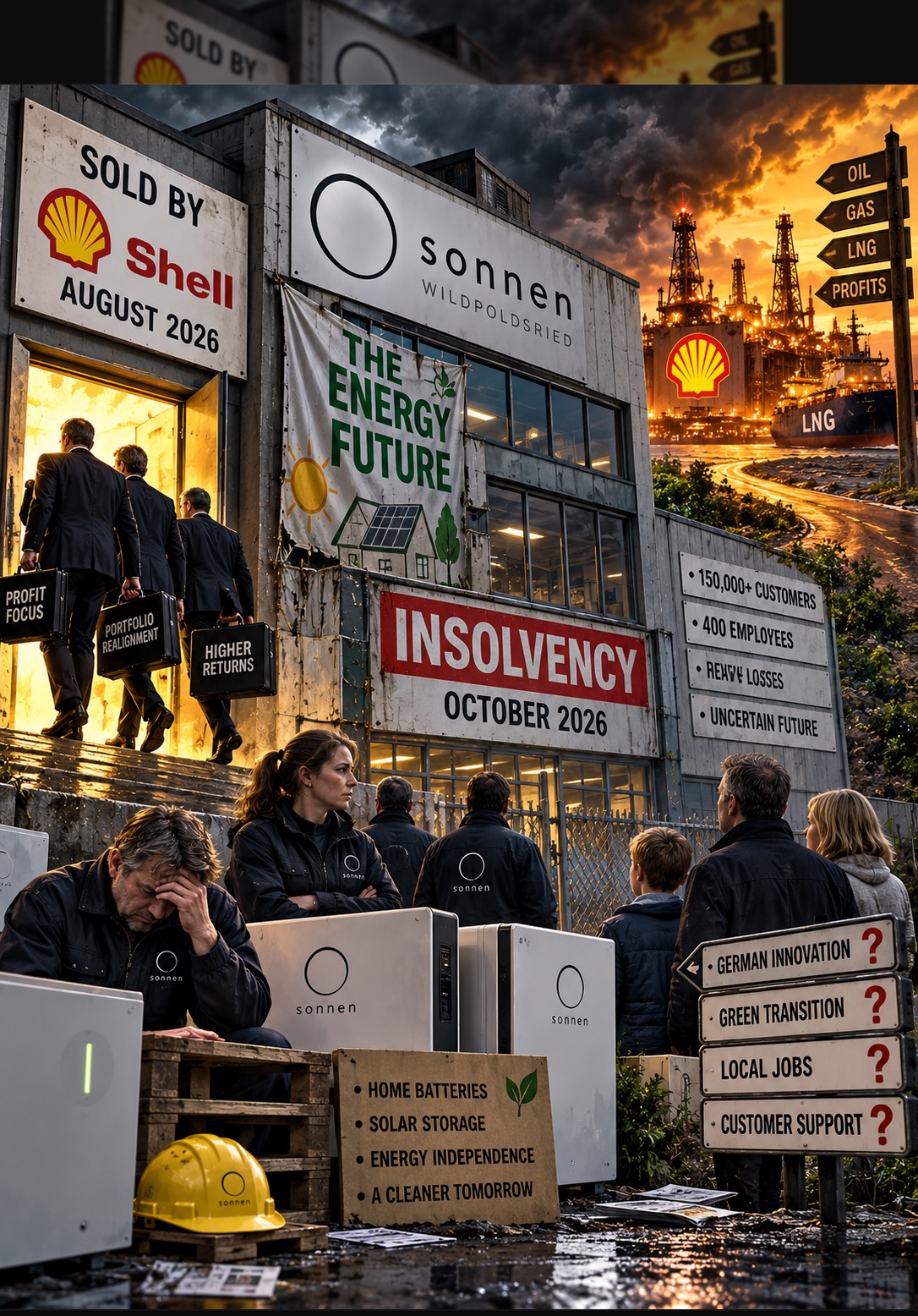
How a German clean-energy champion became an expensive casualty of Shell’s changing priorities — while the oil giant continued pursuing LNG growth and shareholder returns.
24 October 2026
There are corporate embarrassments. There are expensive strategic miscalculations. And then there is Shell’s remarkable ability to make a much-celebrated clean-energy investment disappear from its portfolio just before the insolvency headlines arrive.
In 2019, Sonnen represented the future.
In August 2026, Sonnen represented an asset disposal.
On 22 October 2026, Sonnen represented an insolvency filing.
Welcome to Shell’s energy transition, where yesterday’s pioneering technology can become tomorrow’s discontinued business strategy, apparently without disturbing the oil and gas growth projections.
The immediate news is dramatic.
German battery-storage pioneer Sonnen GmbH, once a flagship investment in Shell’s ambitions beyond fossil fuels, has filed for insolvency barely two months after Shell sold the business to investment vehicle Tiven.
According to reporting by Handelsblatt, approximately 400 employees at Sonnen’s headquarters in Wildpoldsried, Bavaria, were informed on 22 October.
The company confirmed the filing.
Its existing customer business is expected to continue operating, but numerous subsidiaries face closure, liquidation or restructuring through insolvency proceedings.
Only one production site is reportedly expected to survive.
And somewhere in Shell’s corporate headquarters, the expression “portfolio optimisation” may never have sounded quite so convenient.
The company Shell once wanted to own
Sonnen was no ordinary battery manufacturer.
Founded in 2010 in Germany’s Allgäu region, the company became one of Europe’s pioneers in household battery storage.
Its technology allowed households with rooftop solar installations to store electricity for later use, reduce dependence on the conventional grid and potentially participate in more flexible electricity markets.
Sonnen also developed virtual power plant technology, linking individual household batteries so that they could operate collectively as a distributed energy resource.
This was precisely the kind of innovation that could help a renewable electricity system function more effectively.
Shell recognised the opportunity.
In 2018, it invested €60 million in Sonnen.
In 2019, Shell acquired the company outright, reportedly paying approximately €500 million.
The acquisition formed part of a wider expansion into electricity and lower-carbon services.
Other investments included the British household energy supplier First Utility, electricity aggregator Limejump and electric-vehicle charging company NewMotion.
The strategy seemed clear.
Shell would remain an oil and gas giant while acquiring a foothold in businesses that could become increasingly important as the energy system changed.
For Sonnen, Shell appeared to offer substantial financial backing, international reach and the ability to scale its operations.
For Shell, Sonnen offered something equally attractive: a credible place in the emerging market for decentralised clean energy.
The symbolism was almost irresistible.
An oil company buying an innovative solar-battery specialist.
The future was arriving.
Or at least being acquired.
The financial collapse happened under Shell’s ownership
The most important revelation in the latest reporting is not that Sonnen became insolvent after its sale.
It is that its financial deterioration was already severe while Shell owned the business.
Handelsblatt’s investigation, drawing on internal documents and individuals familiar with the company, reported that Sonnen’s group revenue collapsed from €443 million in 2023 to €198.9 million in 2024.
That represents a fall of approximately 55%.
The newspaper also reported group EBITDA of negative €188.7 million in 2024.
After restructuring measures, the negative EBITDA was reduced to approximately €52.2 million in 2025.
These figures concern the Sonnen group and should not be confused with the separate statutory accounts of Sonnen GmbH.
The German operating company’s own 2024 annual financial statements recorded a net loss of approximately €106.6 million.
Nor did the difficulties emerge suddenly in 2026.
According to Renewable Energy Industry’s examination of the financial statements, Sonnen’s audited 2023 accounts already contained warnings about its ability to continue operating without financial support.
Sonnen Holding GmbH committed financing of up to €49.2 million in June 2024, extending through the end of 2025.
That holding company was itself dependent on financial support from Shell.
In other words, Sonnen’s financial vulnerability was documented long before the August 2026 disposal.
Shell was not simply watching a healthy business suddenly encounter difficulties after changing hands.
The business had been financially distressed under Shell’s ownership, and its survival had depended on continued support.
That does not establish that Shell caused its insolvency.
But it raises entirely legitimate questions about whether Shell’s investment strategy, management oversight and eventual disposal adequately addressed the problems.
How much did the experiment cost?
The historical investment figures are particularly revealing.
Handelsblatt reported that Shell paid approximately €500 million to acquire Sonnen in 2019 and subsequently provided more than another half-billion euros in financial support by 2025.
That implies cumulative acquisition and subsequent funding in excess of €1 billion, based on the reported amounts.
The actual net financial outcome for Shell would depend on the precise acquisition structure, subsequent investments, sale consideration, accounting adjustments and any retained obligations.
The August 2026 sale price has not been publicly established in the reporting reviewed.
It would therefore be misleading to calculate a precise total loss.
Nevertheless, the scale of Shell’s commitment is unmistakable.
For years, the company supported a business that it considered strategically important.
Then the strategic priorities changed.
The money had been spent.
The losses continued.
And the battery pioneer became available for disposal.
One can almost hear the investor-relations presentation:
Slide 1: Investing in the future.
Slide 2: Supporting the energy transition.
Slide 3: Adjusting capital allocation.
Slide 4: Please do not dwell on Slides 1 and 2.
Project Sunrise: an optimistic name for a painful restructuring
Sonnen had already embarked on a major restructuring programme while Shell still owned it.
The initiative was called Project Sunrise.
According to Handelsblatt, Sonnen reduced costs, closed business activities and cut employment dramatically.
Its workforce had fallen from approximately 1,318 to around 800 by January 2026.
By the October insolvency announcement, approximately 400 employees remained at its Bavarian headquarters.
The programme reduced losses but did not produce the sustainable turnaround management had sought.
Internal sales documents reportedly envisaged profitability during 2026.
Those expectations were not achieved.
There is a certain grim irony in naming an emergency restructuring programme Sunrise.
For the employees losing their jobs, it must have felt rather more like sunset.
But the basic commercial problem was genuine.
Sonnen had expanded rapidly in an increasingly competitive industry.
Its costs were high.
Revenue had fallen sharply.
It faced increasingly capable and price-competitive international rivals.
The company needed more than a reassuring programme name.
It needed a sustainable business model.
Shell’s August escape: enter Tiven and Aurelius
In August 2026, Shell completed the sale of Sonnen to Tiven, an investment vehicle associated with Gert Purkert, a co-founder and partner of the international investment firm Aurelius.
Aurelius WaterRise was subsequently involved in restructuring work.
At the time, Shell presented the transaction as part of its continuing efforts to optimise its portfolio and concentrate resources on business activities promising stronger financial returns.
In a statement reported by Handelsblatt, Shell expressed confidence that Tiven and Aurelius were well positioned to support Sonnen’s future development.
But just two months later, that future looked radically different.
The Sonnen GmbH insolvency filing came on 22 October.
Numerous subsidiaries faced closure or insolvency proceedings.
Operations in Britain and Italy were reportedly earmarked for winding down.
Australia was reported to have entered a self-administered insolvency process.
Spain was expected to retain a service operation, while the future of Egypt remained uncertain.
The North American business, however, appeared destined for a different future.
And that is where the story becomes particularly interesting.
The American business that may survive
According to Handelsblatt, Sonnen’s North American operation was experiencing substantial growth even as much of the wider group struggled.
The publication reported that the American business accounted for almost 30% of group revenue by late 2025.
Its revenue had reportedly increased by approximately 270% between 2023 and 2025.
Sales volumes had more than doubled over two years.
The business was benefiting from strong US demand for battery storage and related energy services.
It is therefore significant that, according to reporting, the US operation was expected to continue under arrangements involving a newly established German entity, Sonnen Intelligence GmbH.
Handelsblatt reported that this entity had been registered on 5 October 2026, before the insolvency announcement.
Sources cited by the newspaper alleged that valuable intellectual property, branding and other assets were being moved towards the American operations.
Some insiders questioned whether the entire business had ever been intended to survive intact under its new ownership.
These are allegations, not established findings of wrongdoing.
Corporate restructurings frequently involve the preservation of profitable business units, the transfer of intellectual property and the closure of operations that cannot be made financially viable.
The important questions are whether any relevant transactions were properly valued, legally conducted and consistent with the rights of creditors and other affected parties.
The publicly available reporting does not establish unlawful asset stripping or misconduct by Shell, Tiven or Aurelius.
It does, however, identify a legitimate public-interest issue deserving further scrutiny.
How did the potentially valuable parts of Sonnen become separated from the operations facing insolvency, and what protection remains for employees, creditors and customers?
Insiders criticise Shell’s withdrawal
Handelsblatt’s investigation also reported strong criticism from individuals familiar with Sonnen’s circumstances.
Some criticised Shell for withdrawing from the business after years of financial support.
Others questioned the restructuring strategy pursued after the sale.
The central allegation was that the former parent company had stepped away from responsibility while Sonnen’s vulnerable operations faced a highly uncertain future.
These criticisms must be properly attributed.
They are not findings by a court or insolvency administrator.
Shell had no automatic obligation to finance losses indefinitely simply because it had previously owned the company.
Equally, the new owner was entitled to examine restructuring options, subject to its legal and contractual responsibilities.
But the episode raises difficult questions about corporate stewardship.
What did Shell know about Sonnen’s prospects when it agreed the sale?
What commitments did Tiven make concerning continued funding and restructuring?
Were the risks to employees and customers sufficiently understood?
Did alternative buyers exist, and what were their proposals?
And did the sale represent the best available opportunity for preserving a business that Shell had previously presented as part of the energy future?
Until the relevant transaction documents, financing arrangements and restructuring decisions are examined, definitive answers would be premature.
But asking the questions is entirely justified.
Germany’s battery industry is facing a wider crisis
It would be wrong to treat Sonnen’s difficulties as uniquely attributable to Shell.
Germany’s residential energy-storage industry is experiencing fierce competitive pressure.
Renewable Energy Industry reports that several German manufacturers have encountered serious financial difficulties.
RCT Power filed for insolvency in September 2026.
Insolvency proceedings involving VARTA Storage GmbH opened in October.
EnBW’s subsidiary Senec had already announced that it would stop taking on new customers.
Chinese manufacturers, including BYD, Huawei and Sungrow, have become major competitors.
According to market analysis cited in the same report, BYD held approximately 16.5% of the German home-storage market in 2025.
Sonnen’s share was approximately 3.3%.
The market is also changing structurally.
Large installation businesses increasingly select preferred suppliers or develop integrated solutions, making it harder for individual storage manufacturers to maintain market position.
Consequently, a company’s technical achievements do not automatically translate into financial sustainability.
That is an important point.
Sonnen’s difficulties do not prove battery storage is an unsuccessful technology.
Nor do they prove the energy transition itself is failing.
Demand for battery storage remains substantial.
The problem is that technological promise, market growth and profitable manufacturing are three different things.
Shell’s own difficulty was deciding how long it was prepared to support that commercial transition.
Its eventual answer appears to have been: not indefinitely.
More LNG, fewer batteries: Shell’s changing definition of the future
The broader strategic context makes Sonnen’s fate particularly revealing.
Shell’s investment priorities have shifted considerably since it acquired the German company in 2019.
Under its more recent strategy, Shell has emphasised financial discipline, shareholder distributions, integrated gas, LNG growth and continued oil production.
Its 2025 Capital Markets Day presentation projected annual LNG sales growth of 4–5% through 2030.
It also envisaged sustained liquids production of approximately 1.4 million barrels per day by 2030 and shareholder distributions amounting to 40–50% of cash flow from operations through the cycle.
Those are substantial commitments to its established hydrocarbon businesses and financial returns.
They are not intrinsically incompatible with investment in cleaner technologies.
But the contrast is difficult to ignore.
Sonnen needed continuing financial support.
Shell decided its capital could be deployed more attractively elsewhere.
The oil and gas portfolio remained strategically central.
The German battery manufacturer did not.
The result is an uncomfortable illustration of the commercial limits of Shell’s earlier diversification ambitions.
It is easy to endorse clean-energy innovation when the market appears poised for rapid expansion.
It is rather more challenging to sustain that commitment when losses accumulate and competitors begin reducing prices.
Shell ultimately chose to concentrate on businesses where it expected better financial returns.
Shareholders may consider that commercially rational.
Critics may regard it as evidence that Shell’s energy-transition rhetoric exceeded its willingness to finance the difficult realities of building new energy businesses.
Both perspectives deserve consideration.
What cannot reasonably be disputed is the chronology.
Shell bought Sonnen as part of its expansion into lower-carbon energy, supported it through years of losses, sold it in August 2026, and saw its former subsidiary file for insolvency in October.
That is a corporate history worth examining.
What about BlackRock, Vanguard and other institutional shareholders?
The Sonnen episode also deserves attention from Shell’s major institutional investors.
According to ownership data reported during 2026, BlackRock, Vanguard and Norges Bank Investment Management were among the significant investment institutions holding Shell shares.
Their precise holdings fluctuate and depend on the reporting date and classification of managed funds.
These institutions represent enormous pools of investment capital.
They also frequently publish policies concerning investment stewardship, corporate governance, climate-related risks and capital allocation.
The Sonnen transaction therefore presents a useful test of the questions such institutions should be asking.
Did Shell’s historical investment in Sonnen generate an acceptable return?
What lessons were learned from the acquisition and subsequent restructuring?
How did management evaluate the prospects for distributed energy storage compared with its established hydrocarbon businesses?
What is the broader implication for Shell’s future investment in low-carbon technology?
And how should investors distinguish a financially disciplined exit from a potentially costly failure of corporate strategy?
The purpose of asking these questions is not to suggest that institutional shareholders directed Sonnen’s management or bear legal responsibility for its insolvency.
There is no established basis for such a claim.
Rather, their significance lies in the role major shareholders can play in scrutinising corporate strategy and holding management accountable for investment decisions.
The episode should concern anyone interested in the long-term direction of one of the world’s largest energy companies.
More than 150,000 customers: the practical consequences
Behind the corporate announcements and financial figures is a simpler concern.
What happens to customers who bought Sonnen battery systems?
According to pv magazine, the company intends to continue providing services to more than 150,000 existing customers.
That is important reassurance.
It is not, however, a permanent guarantee.
Customers need to know whether warranties, software services, maintenance support, spare parts and virtual power plant arrangements will remain available.
Battery storage systems are long-term investments.
Many rely on digital platforms, remote monitoring and manufacturer support.
A company entering insolvency proceedings creates uncertainty about the continuity of those services even where immediate operations continue.
The details will depend on contractual arrangements, the relevant legal entities and decisions taken during restructuring.
The reassurance that services will continue deserves to be welcomed.
But it should also be followed by clear, practical information for customers.
A household that invested in energy independence should not suddenly discover that its greatest dependency is on an insolvency administrator’s business plan.
The wider lesson: fossil-fuel profits and the difficult economics of transition
There is a fundamental irony in Sonnen’s history.
Battery storage is an important technology for electricity systems with increasing shares of renewable generation.
Shell recognised that opportunity early enough to buy a leading European manufacturer.
Yet recognising a technology’s strategic importance is not the same as building a profitable business around it.
Shell’s investment in Sonnen exposed the company to the considerable risks of a competitive manufacturing and technology market.
Its fossil-fuel businesses, meanwhile, continued to provide substantial cash flows.
When pressure mounted to improve returns and simplify the portfolio, the battery investment became expendable.
That raises a broader policy question.
If even enormous, well-capitalised energy companies are unwilling to sustain prolonged losses in emerging clean-energy businesses, how should societies finance the industrial capabilities required for an energy transition?
The answer cannot simply be that oil companies should subsidise every struggling battery manufacturer indefinitely.
That would be economically unrealistic.
But neither should a failed acquisition be quietly airbrushed out of the historical record as though the earlier promises never existed.
Shell’s Sonnen experience should be examined for what it reveals about investment discipline, the difficulty of industrial transformation and the gap between acquiring green technology and making it commercially sustainable.
The final verdict: the green future was sold, but the questions remain
The insolvency of Sonnen GmbH is not proof of wrongdoing by Shell or its successor owner.
The company’s problems were serious, long-standing and compounded by an increasingly difficult market.
Shell provided substantial financial support over several years.
The new owners inherited a deeply troubled operation.
Those facts matter.
But so does the extraordinary sequence of events.
Shell acquired Sonnen as a pioneer of the energy future.
The business grew, struggled and accumulated heavy losses.
Shell pursued restructuring.
Then Shell sold it.
Two months later, Sonnen filed for insolvency.
Now employees, customers, creditors and the communities associated with the business face uncertainty.
There may be entirely legitimate commercial explanations for every stage of this history.
But Shell should not expect its former clean-energy ambitions to vanish from public scrutiny simply because the asset is no longer on its balance sheet.
For a company that has spent years promoting its contribution to the energy transition, the collapse of a former flagship battery investment deserves more than another polished paragraph about capital discipline.
Sonnen was supposed to help demonstrate that Shell could participate meaningfully in the future of electricity.
Instead, it has become a costly case study in how difficult that transformation can be.
Shell has not abandoned the energy transition entirely. But in Sonnen’s case, the transition from ownership to insolvency proved remarkably swift.
And while the oil giant continues promising more value with fewer emissions, one of its former green-energy flagships is now discovering just how little warmth there can be in the words “portfolio optimisation”.
A fictional conversation between Sir Henri Deterding and John Donovan
The following is fictional satire. Sir Henri Deterding died in 1939. The dialogue does not represent actual statements by either participant.
SIR HENRI DETERDING: Donovan! I understand Shell has purchased a company that manufactures household batteries.
JOHN DONOVAN: They bought it in 2019, Sir Henri.
DETERDING: Excellent! A new technology. Perhaps our successors have finally acquired some imagination.
DONOVAN: They sold it in August.
DETERDING: Sold it? Why?
DONOVAN: It had been losing large amounts of money.
DETERDING: Ach. A serious commercial problem. What happened next?
DONOVAN: It filed for insolvency two months later.
DETERDING: Mein Gott! These modern executives work very quickly when leaving the building.
DONOVAN: Shell calls such disposals portfolio optimisation.
DETERDING: Portfolio optimisation? In my day we called it selling a business.
DONOVAN: The company was once considered an important part of Shell’s energy transition.
DETERDING: And now?
DONOVAN: Shell is focusing on stronger returns, including LNG and upstream production.
DETERDING: Ja. Oil and gas. I recognise these businesses.
DONOVAN: Sonnen’s group revenue fell by about 55% in 2024.
DETERDING: Then the financial difficulties were hardly a surprise.
DONOVAN: Precisely. The company had depended on Shell’s financial support for years.
DETERDING: So why did they buy it?
DONOVAN: They believed batteries were part of the future.
DETERDING: And why did they sell it?
DONOVAN: Apparently, they decided someone else should finance that future.
DETERDING: Ach, Donovan. Modern capitalism has perfected an extraordinary trick.
DONOVAN: What’s that?
DETERDING: Take credit for embracing tomorrow, then sell tomorrow when the bill arrives.
DONOVAN: That is rather a good summary.
DETERDING: Naturally. I am an industrialist. Not a corporate communications consultant.
Spoof Shell corporate statement
The following is parody and is not an actual Shell statement.
Shell is pleased to reaffirm its unwavering commitment to energy-transition innovation, disciplined investment and the responsible disposal of yesterday’s strategic priorities.
Our previous ownership of Sonnen demonstrated our enthusiasm for cleaner energy solutions.
Our subsequent disposal demonstrated our enthusiasm for financial returns.
The fact that the company entered insolvency proceedings shortly after being sold demonstrates the importance of selecting an appropriate completion date.
Shell remains deeply committed to supporting the energy technologies of tomorrow, provided they meet the rigorous financial expectations of today.
We are confident that our ongoing investments in oil, gas and LNG will provide the financial resilience necessary to continue discussing the energy transition for many years to come.
We thank Sonnen’s employees and customers for their contribution to our strategic journey.
For further information, please consult our latest presentation on portfolio optimisation, which contains several reassuring graphs.
DISCLAIMER
This article is independent opinion, commentary and satire based on publicly available reporting as of 24 October 2026. Financial figures are attributed to the reporting and accounting entities identified. Criticisms and allegations made by unnamed sources are reported as allegations, not established facts. Sonnen’s insolvency does not itself establish misconduct, negligence or unlawful behaviour by Shell plc, Tiven, Aurelius or any individual. The fictional dialogue and spoof corporate statement are satire. This article is not financial, investment or legal advice. Readers should consult original reporting, official company disclosures and relevant insolvency records. The website’s general disclaimer also applies
Sources and background reading
The article draws on the original Handelsblatt investigation and the three reports you supplied, supplemented by Shell’s own strategic disclosures and current ownership information.
*This website and sisters royaldutchshellgroup.com, shellnazihistory.com, royaldutchshell.website, johndonovan.website, shellnews.net, and shellwikipedia.com, are owned by John Donovan - more information here. There is also a Wikipedia segment, the Shell DPA Files, "Shell and the Spies", the Shell Leaks files, the Independent Shell Archive, as well as books written and published by John Donovan - Kindle eBooks. Timeline of the Donovan Shell Feud. Toxic History of Royal Dutch Shell Group. Shell and the Donovans: The Full Media Record — 550+ Articles, 110 Books, 40 Years. *All conjured up by internet wizz, Nick Gill.








