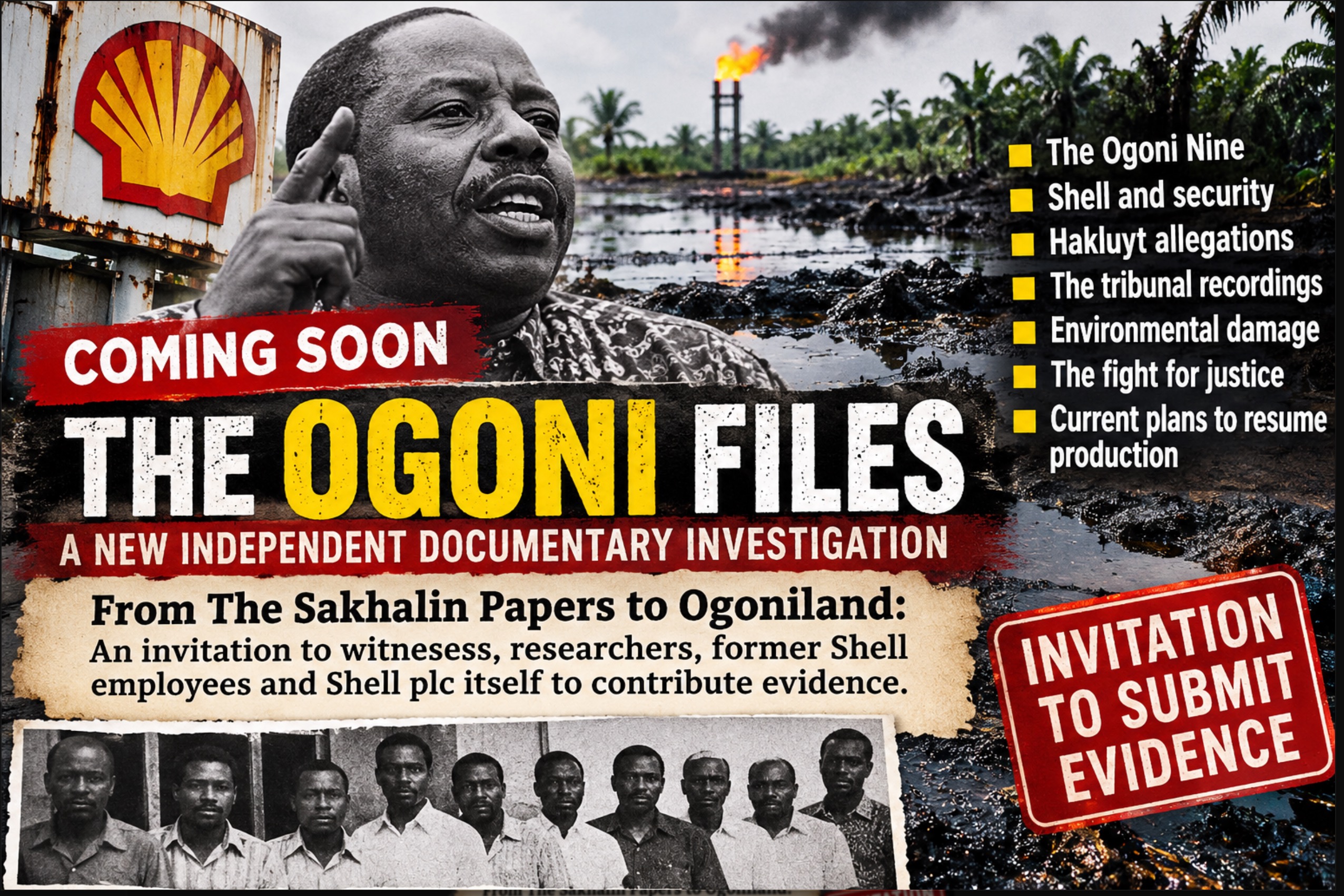
From The Sakhalin Papers to Ogoniland: An invitation to witnesses, researchers, former Shell employees and Shell plc itself to contribute evidence.
By the Donovan–Shell Archive | 8 November 2026
AN INDEPENDENT DOCUMENTARY INVESTIGATION
Following the publication of The Sakhalin Papers, our extensive documentary examination of Shell’s involvement in the Sakhalin-2 project in Russia, the Donovan–Shell Archive is preparing a new investigative series examining another profoundly important chapter in the company’s history.
THE OGONI FILES
The series will investigate Shell’s historical operations in Nigeria’s Ogoniland, the events surrounding the execution of Ken Saro-Wiwa and eight fellow Ogoni campaigners on 10 November 1995, the subsequent struggle for justice, and the continuing controversy over environmental restoration and proposals to resume oil production in the region.
The announcement comes as the 31st anniversary of those executions approaches.
A documentary record spanning decades
The proposed investigation will draw upon an extensive historical archive of correspondence, legal documents, contemporaneous news reports, corporate records and communications involving Ogoni campaigners.
The archive includes material arising from the longstanding relationship between John and Alfred Donovan and representatives of the Ogoni community, including the National Union of Ogoni Students in the United States.
It also includes historical correspondence relating to Esther Kiobel, whose husband, Dr Barinem Kiobel, was among those executed in November 1995.
Esther subsequently pursued legal proceedings against Shell in the United States and the Netherlands.
In April 2019, Esther visited John Donovan in Colchester shortly before an important stage of the Dutch litigation. The visit was documented at the time.
Esther Kiobel in Colchester — 29 April 2019
Another potentially important historical resource consists of recordings of the Ogoni Nine tribunal proceedings, supplied to John Donovan by Esther Kiobel and subsequently published on YouTube in 2017.
We intend to examine these recordings alongside the available judicial records and contemporary reporting.
Beyond the executions: security, surveillance and corporate accountability
The investigation will also revisit historical allegations concerning Shell’s relationships with Nigerian security forces and private intelligence organisations.
Subjects requiring examination include the activities of Hakluyt, allegations of intelligence gathering involving environmental campaigners, and documentary evidence concerning Shell’s security arrangements in Nigeria.
We will distinguish established facts from contested allegations and will examine the relevant explanations, denials and legal outcomes.
The purpose is not to arrive at predetermined conclusions. It is to establish, as accurately as the available evidence permits, what happened, who knew what, and what the documentary record actually demonstrates.
The present-day Ogoni dispute
The series will not be confined to historical events.
Recent communications from Ogoni representatives have raised renewed concerns about proposals to restart oil production in Ogoniland, the legitimacy of consultation arrangements, environmental obligations and whether the interests of affected communities are being adequately represented.
These matters will be examined in the context of current developments and the wider historical record.
We recognise that there are differing views within the Ogoni community about the conditions under which petroleum operations might resume. Those differences deserve to be reported fairly.
An open invitation to contribute evidence
The Donovan–Shell Archive invites individuals and organisations possessing relevant information to contribute to this investigation.
We would particularly welcome contact from:
- Members of the Ogoni community and their representatives.
- Relatives of the Ogoni Nine and individuals involved in the historical campaign for justice.
- Former and current Shell employees with relevant firsthand knowledge.
- Lawyers, journalists, researchers and human-rights organisations.
- Individuals with knowledge of historical security arrangements, intelligence activities or environmental conditions in Ogoniland.
- Anyone possessing relevant correspondence, photographs, original recordings, legal documents or contemporaneous records.
Contributors are encouraged to identify the origin and date of their material wherever possible.
The submission of information does not automatically constitute permission to publish it. Confidentiality, source protection, privacy and publication permissions will be considered carefully. Prospective confidential sources should avoid sending sensitive material through ordinary unsecured email before suitable arrangements have been agreed.
An invitation to Shell plc
Shell plc is expressly invited to participate in this investigation.
We welcome relevant documents, factual corrections, explanations and responses to historical allegations from Shell and its representatives.
We also recognise that Shell’s current corporate structure and Nigerian operations differ from those of the 1990s. The series will distinguish historical responsibilities from present-day operations.
Shell’s responses will be considered fairly and published where appropriate, subject to normal editorial standards.
The invitation is extended in good faith. Participation is entirely a matter for Shell.
The standard we intend to maintain
Our approach will follow the principles established during The Sakhalin Papers investigation:
Original evidence. Verifiable sources. Accurate chronology. Transparent attribution. Fair treatment of competing accounts.
We will identify uncertainty rather than conceal it, distinguish allegation from proof, and correct material factual errors when established.
The Donovan–Shell Archive has long been critical of Shell’s historical conduct. We do not disguise that editorial history. Nevertheless, longstanding criticism does not relieve us of the obligation to investigate fairly and independently.
The objective is to produce a substantial, accessible documentary record that can be examined by journalists, historians, researchers, shareholders and members of the public.
Thirty-one years later, the questions remain
On 10 November 1995, Ken Saro-Wiwa and eight fellow Ogoni men were executed by Nigeria’s military government.
More than three decades later, disputes concerning environmental damage, historical accountability, community representation and the future of oil production in Ogoniland continue.
The Ogoni people, and the wider public, deserve an accurate account of that history.
The Ogoni Files will seek to contribute to that record — one document, one witness and one verifiable fact at a time.
The Donovan–Shell Archive
https://royaldutchshellplc.com
Editorial note: This announcement describes an investigation in preparation. The inclusion of any individual, organisation or allegation does not imply a finding of wrongdoing. Where allegations are disputed or have been considered by courts, the relevant responses and judicial outcomes will be examined and reported.
My editorial recommendation
I would publish this before 10 November, without waiting for the email archive to be organised or for responses from Esther, Nathan, Gene or Baridakara.
Importantly, the announcement does not suggest that any of those individuals have already agreed to participate.
I would also avoid publishing personal email addresses or creating a dedicated submission address until Nick has helped establish an appropriate system. Readers can initially use your website’s existing contact arrangements.
One final consideration: although the subject is the Ogoni Nine, I would not make the entire series exclusively about their executions. The historical security arrangements, Hakluyt, the litigation, environmental consequences and the current debate over restarting production deserve sustained investigation in their own right.
The central message is that we are inviting evidence, not soliciting agreement with a predetermined account. Shell should have precisely the same opportunity to provide relevant documentary material as any other participant.
That is the standard that can distinguish The Ogoni Files from an advocacy campaign and give the eventual series lasting historical value.








