Independent news, investigations and information about Shell plc, with free access to our extensive, continuously updated historical archive spanning decades.
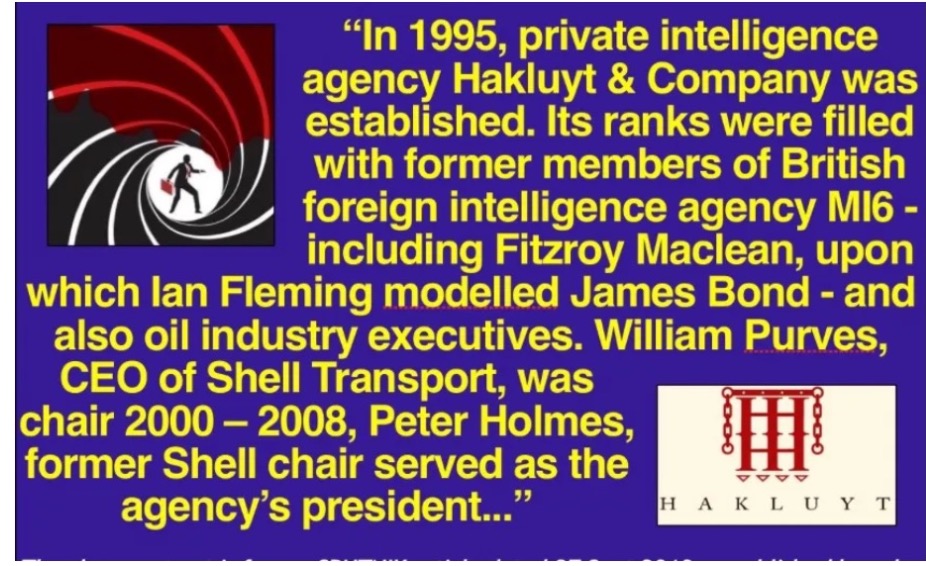
The most well-documented case of corporate espionage linked to Shell centers on Hakluyt & Company, a London-based intelligence firm founded in 1995 by former MI6 officers Christopher James and Mike Reynolds. In 2001, The Sunday Timespublished a front-page exposé (“MI6 ‘firm’ spied on green groups”) revealing that Shell and BP had hired Hakluyt to infiltrate and monitor Greenpeace and The Body Shop. A German operative, Manfred Schlickenrieder (codenamed “Camus”), posed as a left-wing documentary filmmaker to gather intelligence on Greenpeace Germany’s campaign strategies. Former Shell chairman Sir Peter Holmes served as president of Hakluyt’s foundation, and former Shell director Sir William Purves was a major shareholder and director.
Nigeria / OPL 245 (Malabu) deal. During negotiations for the ~$1.3 billion purchase of the OPL 245 offshore oil block, Shell employed former MI6 officers — including John Copleston — as political advisors. Leaked documents from the Milan prosecution over the deal showed Shell gathered intelligence on Nigerian government officials and the flow of funds to Dan Etete, a convicted money launderer and former Nigerian oil minister. In 2010, The Guardian reported on WikiLeaks cables in which Shell’s top executive in Nigeria boasted that the company had “inserted staff into all the main ministries” of the Nigerian government, giving it access to internal deliberations on oil policy.
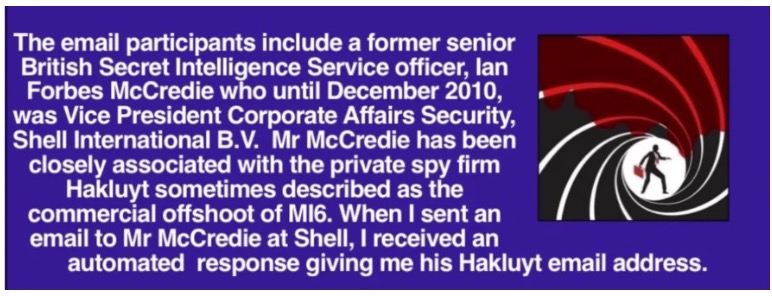
Corporate Affairs Security (CAS). Shell maintained an internal security division called CAS, headed for a period by Ian Forbes McCredie, a former senior SIS officer. CAS monitored websites, campaign organizations, and whistleblowers perceived as reputational risks. Internal emails disclosed in litigation showed CAS coordinated with Hakluyt, cybersecurity firms, law firms, and government security agencies. During Shell’s Arctic drilling campaign (2012–2015), CAS operations intensified across Canada, the US, UK, Netherlands, and northern Europe to track activist networks.
The Donovan case. Former Shell employee John Donovan has spent decades alleging that Shell conducted a sustained campaign of corporate espionage, surveillance, and intimidation against him and his family. His claims — documented extensively on his website — include: undercover investigators (e.g., “Christopher Phillips”) monitoring his private mailboxes; a global IT operation in 2007 to monitor Shell’s internal email servers and web traffic to identify employees leaking information to him; and a 40-person internal “Anti-Donovan” task force. Shell’s own internal emails, released in litigation, confirm the 2007 monitoring operation. Donovan’s account is a single source with a clear stake, but the existence of the internal emails and the 1998 admission by Shell’s legal director that Phillips was working on the case provide some independent corroboration.
Other documented or alleged activities:
Ireland (Corrib Gas Project): Allegations that Shell used private security contractors to conduct surveillance on the public and press.
South Africa (1986 “Neptune Strategy”): A 265-page covert counter-intelligence and PR blueprint commissioned by Shell through the firm Pagan International to neutralize anti-apartheid campaigns targeting Shell’s operations in South Africa.
Al-Yamamah deal: A 1986 confidential British government document recorded Shell and BP contracts to lift ~300,000 barrels/day of oil tied to the arms agreement between the UK and Saudi Arabia, though no evidence of espionage by Shell in Saudi Arabia itself has been established.
Caveat: Much of the detailed narrative above — particularly the Donovan allegations and the country-by-country breakdown — comes from royaldutchshellplc.com, a website operated by John Donovan himself. While the core Hakluyt/Greenpeace story (2001, The Sunday Times) and the WikiLeaks cables (The Guardian, 2010) are independently documented by mainstream media, the fuller picture of Shell’s intelligence apparatus relies heavily on leaked internal documents and one critic’s long-running account. Shell has generally denied wrongdoing, and no criminal charges related to these activities have been brought against the company.
Prompt: How did Shell’s internal security structure evolve over time
Shell’s internal security structure has gone through several distinct phases, evolving from a conventional corporate guarding function into something that critics describe as a proprietary intelligence agency, and back again through reorganisations and leadership turnover.
1990s — The Birth of CAS
The Corporate Affairs Security (CAS) division emerged as the key internal security unit during the 1990s, a period of intense reputational pressure on Shell (the Brent Sparcontroversy and the Niger Delta crisis, culminating in the 1995 execution of activist Ken Saro-Wiwa). CAS was designed to go far beyond physical security: its remit included political-risk analysis, activist monitoring, executive protection, counter-intelligence, liaison with government agencies, and investigation of internal leaks. It was staffed with senior veterans from Western intelligence agencies — most notably Ian Forbes McCredie, a former MI6 officer who became head of CAS.
This was also the era when Hakluyt & Company was founded (1995) by former MI6 officers, creating a revolving door between Shell’s security function and private intelligence. CAS coordinated with Hakluyt and other outside contractors.
2000s — Expansion and the “War Room” Era
CAS grew in scope and sophistication throughout the 2000s. Key developments:
Richard T. Garcia, a former senior FBI official, joined as a second senior figure at CAS alongside McCredie.
In 2007, Shell launched a global IT monitoring operation (documented in internal emails) to track internal emails sent to critics and web traffic to their websites — a counter-intelligence operation run through CAS.
By 2009, CAS was working with the National Cyber-Forensics and Training Alliance (NCFTA), a Pittsburgh-based organisation partly funded and staffed by the FBI, to conduct what internal emails described as “invisible” investigations into critics.
CAS produced quarterly “Focal Point” reports on the activities of critics and their impact on Shell staff and investors.
The 2000s also saw the Donovan countermeasures team — a cross-functional “war room” involving CAS and multiple corporate functions, documented in internal correspondence.
2010s — Rebranding as Shell Global Security
CAS was reorganised as Shell Global Security during this period. The structure retained its intelligence-style functions but under a new name. Key figures and events:
James W.D. Hall became Vice President of Corporate Security at Shell’s global headquarters in the Netherlands, described in a 2017 US court document as “the top executive in Shell’s entire Corporate Security Organization.”
Gene Sticco served as Head of Shell Global Security for Gas & Power and Deputy Head of CAS.
Crockett Oaks III, a former FBI Special Agent, headed Shell’s US security function in Houston, with a remit covering threats to employees, property, and — notably — reputation.
The period was marked by what internal documents and litigation described as “vicious infighting at the top of Shell Corporate Security”, including disputes between Oaks and other senior security figures.
In 2017, Shell sought a court order to restrain Oaks from disclosing what it called confidential material about internal investigations.
2020s — Restructuring and Litigation
The most recent phase is defined by a January 2025 restructuring of Shell’s US Corporate Security Division, which has triggered multiple discrimination lawsuits:
Kevin Taylor and Michelle Romak (filed August 2025) allege the reorganisation required white employees to reapply for their own jobs while non-white employees were not subject to the same process.
Thomas Hutt (filed 2026) alleges he was denied a role and dismissed because of his race.
Earlier, Walied Shater (who joined Shell’s Corporate Security in 2013 as a Cluster Security Manager covering seven Middle Eastern and African countries) brought a race and national origin discrimination case against Hall, which the Fifth Circuit dismissed in November 2022.
The 2025 restructuring also signals a continued shift in the function’s profile — from the intelligence-heavy CAS model toward what Shell frames as a more conventional corporate security operation, though the litigation suggests the transition has been contentious.
In summary, the trajectory runs: basic corporate security → CAS (1990s, intelligence-model, ex-MI6/FBI leadership, close ties to Hakluyt) → expanded cyber and counter-intelligence capabilities (2000s) → rebranded as Shell Global Security (2010s, internal factional conflict) → 2025 restructuring (ongoing litigation). The through-line is a security function that has consistently operated with a remit broader than typical corporate security — encompassing reputation management, political intelligence, and counter-intelligence — and has repeatedly drawn in personnel from state intelligence and law-enforcement agencies.
Prompt: What specific counter-intelligence methods did Shell employ?
Based on the internal documents, litigation disclosures, and reporting, Shell’s counter-intelligence toolkit spanned several distinct categories:
Undercover Infiltration
The most publicly documented method. Hakluyt & Company deployed operatives under cover identities — posing as journalists, consultants, documentary filmmakers, or activists — to infiltrate target organisations. Manfred Schlickenrieder (codename “Camus”) posed as a left-wing filmmaker to penetrate Greenpeace and The Body Shop, feeding internal campaign strategies back to Shell and BP. Associates were briefed in London and “deployed” globally. In the Netherlands, a related case involved a detective posing as an activist who collected paper from activist groups under the pretence of selling it to a recycling company.
Global Internal Surveillance (2007 Operation)
The most detailed single operation is documented in Shell’s own emails (obtained via Subject Access Requests):
Email monitoring: An IT project was initiated to monitor all internal emails sent from Shell servers globally to Donovan, to identify which employees were communicating with him.
Web traffic tracking: Shell monitored which of its own employees were visiting Donovan’s websites.
Employee instructions: Staff were explicitly instructed not to visit the Donovan website.
USG source enquiries: A Shell representative in Texas reported “contacted some of my sources in the USG [United States Government] and in London to see if they have anything else on the brothers.”
This was framed internally as a counter-leak operation — Shell described a “history of several former employees taking internal laundry to Donovan.”
Intelligence-Led Security Model
A CAS presentation describing the Intelligence & Assessment Team (I&AT) laid out a formal methodology explicitly using military intelligence terminology:
Predictive intelligence and predictive threat calendars
Tactical intelligence (TACINT)
Signals intelligence (SIGINT)
Human intelligence (HUMINT)
Liaison with military intelligence (“J2”)
Horizon scanning via “all-source information collection”
NCFTA collaboration: In 2009, CAS was working with the National Cyber-Forensics and Training Alliance (a Pittsburgh-based organisation partly funded and staffed by the FBI) to conduct what internal emails described as “invisible” investigations into critics.
Communications interception: In South Africa, digital communications — including coordinated WhatsApp groups used by small-scale fishers and civil society attorneys — showed signs of infiltration and monitoring.
Alternative communication channels: Insider correspondence noted that “some sensitive communications were deliberately conducted outside ordinary Shell email systems using alternative communication methods.”
Physical Surveillance and Covert Approaches
Private investigators: An agent operating as “Christopher Phillips” was caught examining private mailboxes at the Donovans’ offices.
Physical spotters: In South Africa, private security teams maintained physical surveillance on human rights lawyers and community spokespeople, tracking movements between coastal communities.
Covert approaches: During litigation involving Don Marketing, covert approaches, surveillance, undercover contact, and intelligence gathering were alleged.
Targeted burglaries (alleged): In the run-up to the 1998 Shell Smart trial, the Donovans alleged that evidence was scrutinised and tampered with during “a series of what the police unofficially concluded were targeted burglaries.”
Covert PR and Social Engineering
Neptune Strategy (1986): A 265-page blueprint to “deliberately divide, infiltrate, and weaken” the anti-apartheid coalition through front operatives, manipulating dialogue, mapping activist networks, and deploying covert PR campaigns.
Fostering internal conflict: A former corporate spy told The Guardian (2017) that operatives “surreptitiously fostered conflicts within a campaign to set activists against each other, in order to wear them down.”
Issues Briefs: From at least 2006, Shell maintained a dedicated, regularly updated “Issues Brief” on the Donovans, circulated to Corporate Affairs teams in London, The Hague, Houston, and Kuala Lumpur ahead of every AGM.
Media response operations: The “Fox News emergency” — daily teleconferences, senior EP staff involvement, and a “50 city tour” strategy to counter a single Donovan email.
State-Intelligence Liaison
US Government sources: Direct enquiries to USG contacts for information on critics.
South African State Security Agency (SSA): The “Spy Cables” leak showed the SSA and foreign intelligence partners targeting Greenpeace’s Kumi Naidoo, with Shell operations flagged as requiring protection.
British and American intelligence communities: A former CAS head noted “meetings took place involving senior Shell executives and intelligence personnel concerning geopolitical security matters.”
Organisational Counter-Measures
Roundtable Working Group: A cross-functional team of ~40 people (legal, security, PR, corporate affairs) convened specifically for “Donovan mitigation,” with a military-flavoured mandate to mount “a demonstration that we won’t tolerate the Donovans’ approach unchallenged any longer.”
Quarterly Focal Point reports on critics’ activities and their impact on staff and investors.
Wikipedia strategy: A perpetually unresolved internal effort to manage Shell’s Wikipedia presence.
Evidential caveat: The 2007 email monitoring operation, the Hakluyt infiltration, and the NCFTA collaboration are confirmed by Shell’s own internal documents or mainstream reporting. The South Africa physical surveillance, the Neptune Strategy details, and the Donovan-era physical surveillance allegations rest on a narrower evidential base — primarily Donovan’s own account, leaked documents of varying provenance, and the royaldutchshellplc.com evidence audit, which itself rates the evidential status of each claim. Shell has consistently denied wrongdoing.
Sir Henri Deterding, the controversial and outspoken founder of Royal Dutch Shell, now haunts the website. Wise to all the knowledge of Shell, and its shellanigans, he delivers informative and satirical insight to anything about Shell. He's a grumpy old sod, so you'll have to excuse his bluntness.
Click the big chat-bubble (bottom-right of the website)to ask Sir Henri a question. Enjoy!
SHELL EXECUTIVES AT THE CENTER OF A SCHEME TO STEAL $1.3 BILLION FROM NIGERIA’S PEOPLE
SHELL ADMITS DEALING WITH NIGERIAN MONEY LAUNDERER – BBC NEWS
SHELL, ENI AND NIGERIAN OFFICIALS IN OPL 245 CORRUPTION SCANDAL
INVESTIGATION OF OPL 245 NIGERIAN OIL CORRUPTION SCANDAL
DUTCH EARTHQUAKES CAUSED BY SHELL/EXXON
SHELL KILLS FOR OIL IN NIGERIA
SHELL LIED ABOUT CLEANING UP OIL IN NIGER DELTA
SHELL SPIES INFILTRATED NIGERIAN GOVERNMENT
LEGO DROPS SHELL OVER GREENPEACE OIL SPILL VIDEO
SHELL ARCTIC DRILLING ACCIDENTS
SHELL KNEW ABOUT CLIMATE CHANGE DECADES AGO
ROYAL DUTCH SHELL FOUNDER SIR HENRI DETERDING, NAZI FINANCIER
JOHN DONOVAN PROMOTIONAL GAMES FOR SHELL AND OTHER CLIENTS
Listen and read proof in audio and transcript form of Shell CEO Ben van Beurden’s cover-up tactics in the OPL 245 Nigerian corruption scandal. The instruction given by him in the covertly recorded call to CFO Simon Henry was at odds with Shell’s claimed core business principles. Cover-up and obstruction, instead of transparency and integrity, says Shell critic John Donovan
I used shell broadband. It was by far the worst broadband provider ever! The internet did not work most days. I had their super fast broadband and it dropped out constantly. Watching a movie was awful with the constant buffering. Customer support was super slow. Now their going to charge me for the useless router which I have sent back.
Date of experience: 21 November 2023
By far the worst broadband provider ever!
30 November 2023: Posted by John Donovan
The content below is sourced from current verifiable customer reviews of Shell Energy published on Trustpilot.
Extremely slow broadband for 10 months, not fixed.I have had slow broadband well below the guaranteed speed for 10 months and Shell Energy have not been able to fix it.They have tried sending about 4 or 5 engineers but have not fixed the problem.Gurps, who I have been dealing with most recently, has been friendly and polite, alth… Read more
Extremely Slow Shell Broadband
The worst ever
I used shell broadband. It was by far the worst broadband provider ever! The internet did not work most days. I had their super fast broadband and it dropped out constantly. Watching a movie was awful with the constant buffering. Customer support was super slow. Now their going to charge me for the useless router which I have sent back.
I ordered shell energy broadband on nov 2. I was promised connection the following week. They initiated the direct debit. I called the following week and was told router would arrive on 13 and service would go live on 17. No further email or communication until 20 when I was told service would start on 30th. Spent 10 minutes waiting on phone line and spoke to a polite assistant who was absolutely useless in solving my problem. Avoid this unprofessional and chaotic… Read more
Shell Energy Broadband Service is Appalling
OVER 500 EXTERNAL PUBLICATIONS CITING OUR SHELL WEBSITES
See our link list of over 500 articles by the FT, Wall Street Journal, Reuters, Bloomberg, Forbes, Dow Jones Newswires, New York Times, CNBC etc, plus UK House of Commons Select Committee Hansard records, information on U.S. Securities & Exchange Commission websiteetc. all containing references to our Shell focussed websites, or our website founders Alfred and John Donovan. Includes TV documentary features in English and German, newspaper and magazine articles, radio interviews, newsletters etc. Plus academic papers, Stratfor intelligence reports and UK, U.S. and Australian state/parliamentary publications, also citing our Shell websites. Click on this link to see the entire list, all in date order with a link to an index of over 100 books also containing references to our non-profit websites and/or our activities.
John Donovan, the website owner
DISCLAIMER
This is not a Shell website. The nature of this platform should be evident from the content presented here and on our related Shell-focused websites, including shellnazihistory.com. For more details, please refer to the Disclaimer link at the top of this page. Shell does not endorse or approve of this website.
Our platform operates as a non-commercial, advert-free, and subscription-free space. We do not solicit or accept donations and aim to provide information to our readers free of charge. The Shell logo image with white text used on this website is in the public domain due to expired copyright and anonymous authorship. It can be found on WIKIMEDIA COMMONS. Use this link for Shell’s own website.
Our content, including images and features like the Sheldon chatbot, incorporates information generated by Artificial Intelligence (AI) and various other technological means. We may also draw from sources such as Wikipedia and other published materials. Please note that some content may include satirical adaptations or elements of gossip, rumors, or exaggeration to engage and entertain our audience.
We strive to maintain factual accuracy and encourage readers to notify us promptly if any factual inaccuracies are found, so we can address and rectify them swiftly. Readers are advised to verify all information independently for accuracy and completeness. Any actions taken based on the content provided on our platform are at your own risk.