How a 2009 Wikipedia Snapshot Helped Expose Shell
 Disclaimer
Warning: satire ahead. The criticisms are pointed, the humour intentional, and the facts stubbornly real. Quotes are reproduced word-for-word from trusted sources. This material includes transformative satirical commentary relating to Shell plc and is not affiliated with or endorsed by Shell plc. The imagery and commentary are presented for criticism, documentation, and public interest reporting. As for authorship—John Donovan and AI both claim credit, but the jury’s still out on who was really in charge. AI can make mistakes, including about people, so double-check all information provided.
Prologue: Wikipedia tried to move on. The evidence didn’t.
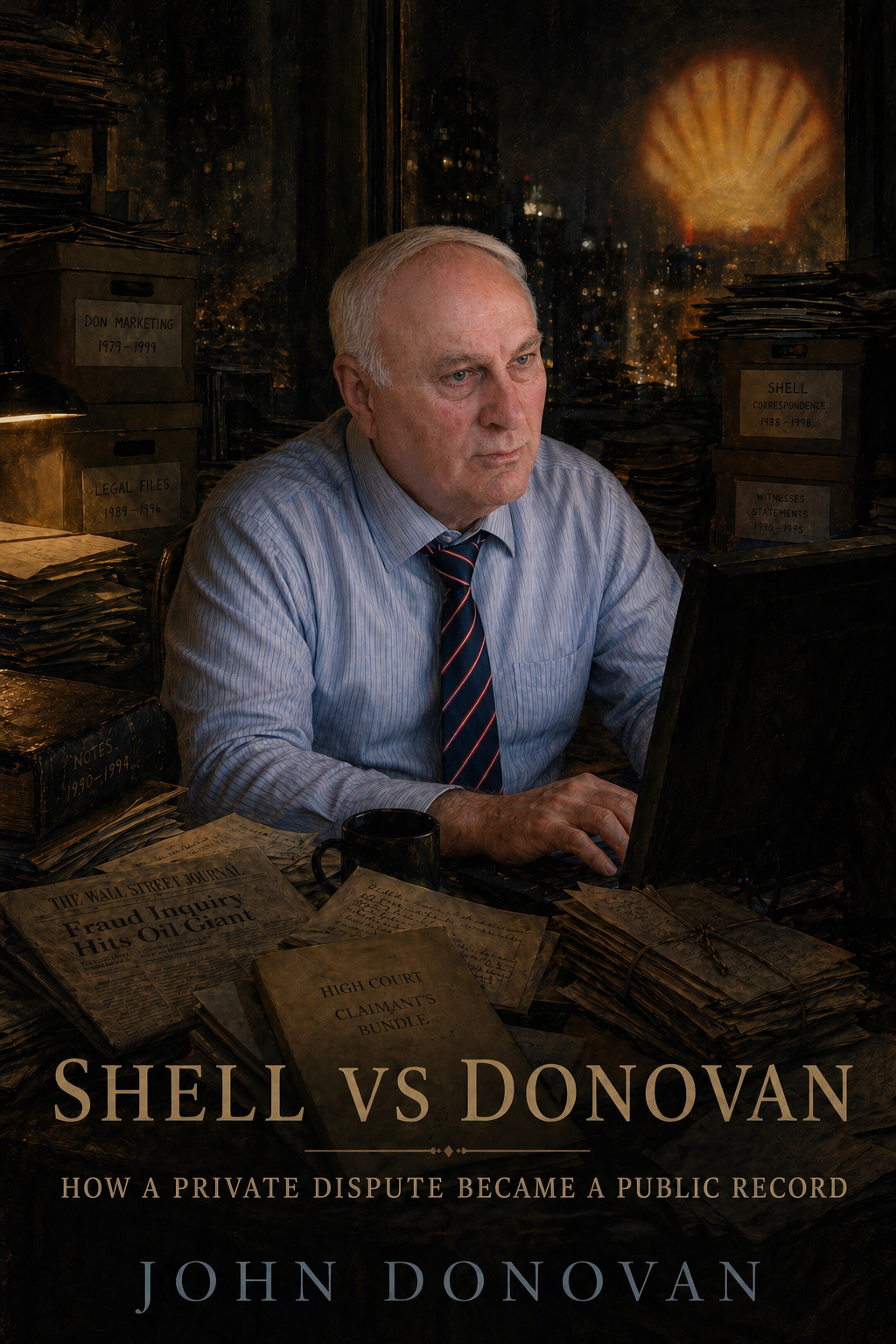
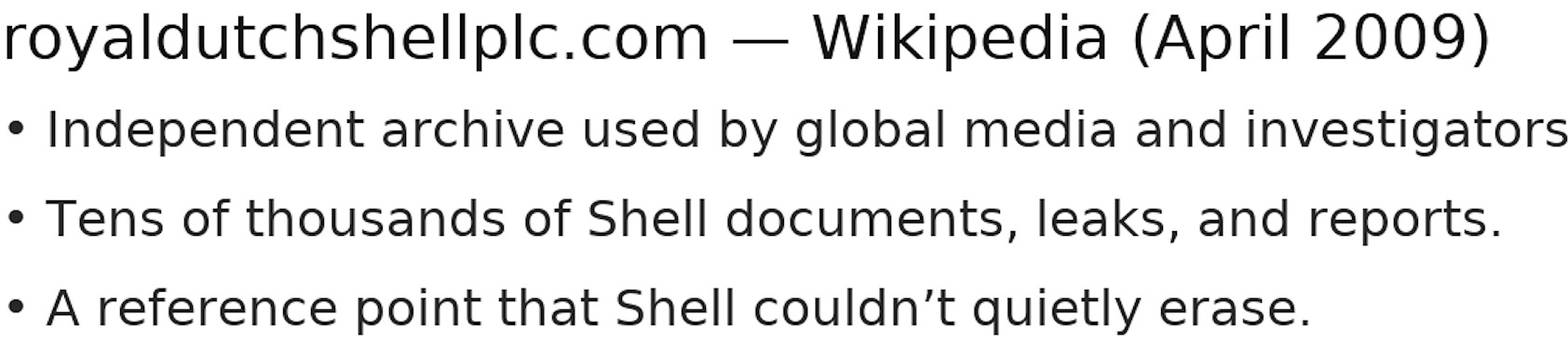
Back in April 2009, a stubborn little encyclopedia page captured something Shell would prefer you forget: that a single consumer website, royaldutchshellplc.com, had become a reference desk for journalists, investigators, NGOs, whistleblowers, and angry shareholders trying to keep track of a greedy, ruthless, polluting oil giant with a public-relations budget larger than most countries’ climate funds. The page—later condensed into the Shell entry—documented a living archive that reporters from Reuters, The Guardian, The Sunday Times, The Telegraph, The Wall Street Journal, and broadcasters from the UK, the US, and beyond repeatedly consulted. Some even came to Colchester to meet John Donovan at his kitchen-table newsroom.
The page moved; the files remained. That’s the problem with evidence—it refuses to stay edited.
The 2009 Snapshot—why it mattered
In 2009, the royaldutchshellplc.com Wikipedia content summarized a public fact that had already begun to irritate Shell’s skin: the Donovans had built a durable, searchable, and relentlessly cited archive of Shell’s own past. The site did not invent scandals; it organized them. Early pages on the Donovan sites boasted 24,000+ documents (2009), then 30,000+ (2012), and 37,000+ (2014), expanding across royaldutchshellplc.com and sister sites such as ShellNews.net. The number isn’t the point; the trajectory is. This is an archive that grows whenever Shell tries to prune it.
The Donovan network’s Wikipedia category pages and later PDFs show how that history kept resurfacing: page copies, archive references, and tag pages documenting the tug-of-war. Wikipedia sections changed; the underlying record did not.
Media gravity: why reporters travelled to Colchester
You don’t fly to a cul-de-sac in Essex without a reason. Yet outlets did—because the archive had become a live newsroom for Shell’s least convenient stories. Prospect Magazine captured the Colchester reality in 2007: an unlikely little command post where, instead of a trading floor, there was a filing cabinet and a phone; instead of “access,” there were documents.
Even Shell-focused reporters acknowledged what insiders already knew: the archive had range—from Sakhalin II to Niger Delta threads, from advertising rulings to safety failures. A ShellNews.net profile described John Donovan’s Colchester office “not the kind of place you would expect to find at the centre of a global energy war,” but there it was.
Wikipedia skirmishes—and Shell’s fingerprints
Over the years, Wikipedia entries about the Donovan site were trimmed, deleted, revived, and eventually condensed into a section under Shell. The dynastic footwork didn’t happen in a vacuum. Donovan has published internal Shell correspondence obtained via Subject Access Requests (SARs), as well as a dedicated e-book spelling out how touchy facts were removed or softened on Wikipedia. We can debate editorial nuance all day, but we can’t argue with a title: “Toxic facts about Shell removed from Wikipedia: How Shell became the most hated brand in the world.”
On top of that, Donovan’s sites host tag pages and archives documenting Wikipedia changes over time—breadcrumbs of an edit history that proves at least this much: Shell cared. If the page were meaningless, it would have died unmourned. It didn’t.
What the archive actually did
This wasn’t just a blog. It functioned as infrastructure for accountability:
-
Newsrooms mined it for leads, background, and contacts.
-
Investigators used it to cross-reference names, dates, and corporate statements.
-
NGOs leveraged it to broadcast appeals to Shell workers and investors (documented on-site and referenced from Wikipedia-related archive notes).
By 2014, the Donovan network explicitly billed itself as “the world’s largest online library” on Shell, with tens of thousands of entries across two primary sites; prior snapshots in 2009 and 2012 show how the scale accelerated. That’s why reporters kept coming back.
The sin stock and its patrons
It’s hard to run a century-long wrecking ball without institutional backers happy to collect the dividends. Shell’s largest shareholders include BlackRock, Vanguard, and Norges Bank Investment Management (NBIM). Public ownership trackers and profiles list them among the top holders, with institutional ownership dominating the register—exact stakes shifting by filing, but the names rarely changing. The concentration matters: a small cohort of managers can steer the ethics by steering the cash.
When Reuters most recently reported “Shell reported third-quarter adjusted earnings of $5.4 billion” and that it would maintain hefty buybacks, the archive didn’t need to editorialize. It just had to file the link and wait for the next quarter. Quotes age; patterns don’t.
Why the Wikipedia snapshot still matters
Because it captured an uncomfortable truth: a volunteer encyclopedia and a volunteer archive often outperformed corporate PR. Even when entries were condensed or pruned, the very existence of a 2009 page acknowledging the Donovan archive validated what insiders already knew—that Shell’s reputation problems were document problems. Wikipedia edits can move facts to another page; they can’t de-index reality.
And the irony is delicious. The more Shell (or anyone else) tried to clean the record, the more citations multiplied across mirror pages, PDFs, and tag archives. The effect is geological; once laid, the sediment layers are hard to erase.
A note on scale, the only number Shell can’t spin
We don’t need to pick a single figure to prove the point. In 2009 the Donovan archive advertised 24,000+ entries; by 2012 30,000+; by 2014 37,000+—and it has kept growing. This is not a stunt. This is institutional memory, assembled by two people who refused to forget what Shell wanted the world to overlook.
References
-
royaldutchshellplc.com / Wikipedia archive and tag pages: ongoing documentation of article history and public appeals referenced from Wikipedia.
-
PDF capture (later): “royaldutchshellplc.com – Wikipedia” (includes references to earlier coverage and descriptions).
-
Archive size snapshots: 24k (2009), 30k (2012), 37k (2014).
-
Media interest in Colchester: Prospect Magazine on the Donovans in Colchester; ShellNews.net profile of the Colchester office.
-
John Donovan e-book on Wikipedia interventions: Toxic facts about Shell removed from Wikipedia (Amazon).
-
Recent Shell profits (for context) and buybacks: Reuters Q3 2025 report.
-
Major investors: MarketScreener/ownership profiles and analysis referencing BlackRock, Vanguard, NBIM; institutional concentration commentary.