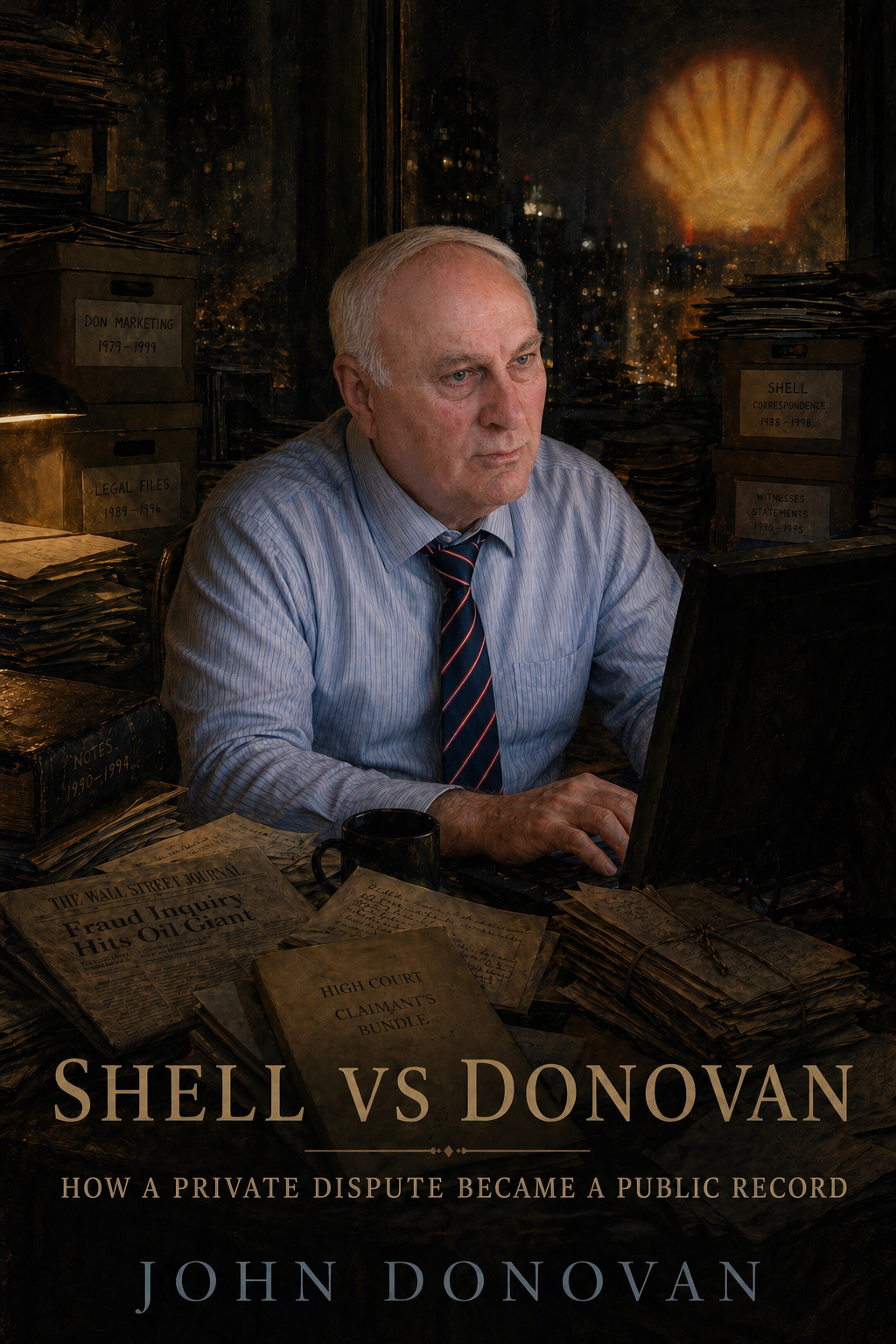
SHELL’S MORAL SLIP: THE OIL GIANT, THE GAME SELLER, AND THE GREATEST CON IN CORPORATE HISTORY
How Britain’s most high-minded energy giant preached ethics to John Donovan while secretly cooking the books for billions — and keeping spies on the payroll
By Our Investigations Desk | Exclusive
PICTURE THE SCENE. It is the spring of 1997. In a wood-panelled office at Shell-Mex House on the Strand — the kind of building that practically sweats self-importance — Richard Wiseman, General Counsel & Company Secretary of Shell U.K. Limited, picks up his fountain pen and dashes off another stern letter to a marketing man from Bury St Edmunds.
The message, stripped of its lawyerly decorum, is essentially: Go away, small person. You have been dealt with. The slate is wiped clean. Do not bother our directors.
The small person in question was John Donovan, Managing Director of Don Marketing UK Limited, a promotional games company that had spent the better part of a decade supplying Shell with some of its most successful petrol-station promotions — only to allege, with mounting evidence, that Shell had then helped itself to his ideas without proper payment or acknowledgement.
Donovan, not a man inclined to retreat quietly, was at the time pursuing two High Court actions against Shell in the Chancery Division. Shell, with the resources of one of the world’s largest companies behind it, had herded the whole mess into a mediation process — which is corporate-speak for “let’s sort this somewhere the press can’t see.”
The mediation worked, up to a point. Donovan accepted £200,000 to settle both claims.
But the correspondence that flowed before, during and after that settlement tells a story that Shell’s own Statement of General Business Principles — that celebrated document of corporate virtue — would struggle to accommodate.
“THE SLATE IS WIPED CLEAN” — OR IS IT?
Shell’s legal position, advanced by Wiseman with considerable persistence, was that the £200,000 payment had been a kind of moral severance — a blanket discharge of all Shell’s obligations to Don Marketing, past, present and future.
Donovan, who had been in the game-promotion industry long enough to spot a post-hoc rationalisation, was having none of it.
“I wonder if any other non-retained agency has ever received a severance payment from Shell, let alone one for £200,000,” he wrote drily on 21 May 1997, noting there was “not the slightest trace in the settlement documents or the letter received from Dr Fay of any termination element.”
Dr Chris Fay — then Chairman and Chief Executive of the Royal Dutch Shell Group — had in fact sent Donovan a letter of apology on behalf of Shell for the way the company had treated him. It is, as Donovan has noted, available on the internet. Apology letters from the heads of global energy conglomerates are not, generally speaking, the kind of thing handed out with a wipe-the-slate spirit.
Shell’s own solicitors, the grandly titled Mackrell Turner Garrett, had inadvertently strengthened Donovan’s hand in their mediation submission. Describing an earlier dispute over a promotion called “Make Money”, they wrote with refreshing candour that Shell had recognised Don had “perfect rights to claim sums due” — and had paid up within days. As admissions go, this was not the most helpful opening for a “they’re entitled to nothing” defence.
THE CAST: A WHO’S WHO OF SHELL’S GREAT AND GOOD
The correspondence, remarkable for its breadth of senior involvement, reads less like a dispute with a small Suffolk business and more like a matter of state.
Wiseman’s letters were copied — routinely — to Mr C.A.J. Herkstroter, Group Chairman of Royal Dutch Shell; Dr John Jennings, Chairman of Shell Transport & Trading (later knighted: Sir John Jennings); and Mr Mark Moody-Stuart, Group Managing Director, who would subsequently become Group Chairman. The legal matters of one Suffolk marketing company had apparently become agenda items at the very apex of the Anglo-Dutch energy empire.
Whether this reflects the gravity with which Shell took the matter, or simply illustrates that Donovan was, as he consistently argued, dealing with issues that implicated the entire group’s ethical reputation, is left as an exercise for the reader.
What is clear is that Wiseman — nominally the General Counsel of Shell U.K. — was in practice communicating on behalf of, and keeping informed, directors of multiple companies across the Royal Dutch/Shell Group. A situation Donovan noted with characteristic precision, pointing out that it would be “a novel concept for a subsidiary company (Shell UK Limited) to take legal action to prevent its parent companies from being kept accurately informed.”
THE AGM ENCOUNTER: A FATHER TAKES THE MICROPHONE
Among the documents is a verbatim transcript of an exchange at the 1995 Annual General Meeting of The “Shell” Transport and Trading Company, held at the Queen Elizabeth II Conference Centre in Westminster.
The speaker was Alfred Donovan, John’s late father, representing the Shell Corporate Conscience Pressure Group — a body that counted around 200 Shell service station operators among its members. Alfred Donovan did not mince his words:
“Whenever they have any problems with Shell, the answer is, ‘If you don’t like our answers, if you don’t like our solution, sue us.’ The problem here is the small businessman cannot sue you because you’ve got billions and he’s got hundreds.”
He requested an arbitration system that could give small businesses a fair hearing without the ruinous expense of High Court litigation.
Chairman Jennings, to his credit, did not dismiss the intervention. He expressed disturbance at the response Donovan described receiving from Shell, agreed disputes should be resolved “in a sensible, balanced and objective way,” and offered a meeting afterwards.
What makes this transcript particularly notable, with hindsight, is who else was present at that meeting. The minutes list Sir Peter Holmes and Sir William Purves among the Shell Transport directors in attendance. Both men were, around that same period, becoming involved in Hakluyt & Company — a private intelligence firm founded in 1995 by former MI6 officers, which Shell had engaged as a client. Sir Peter Holmes would become President of the Hakluyt Foundation. Sir William Purves would serve as Chairman of Hakluyt & Company itself.
CONFIDENTIALITY: SHELL’S FLEXIBLE FRIEND
The correspondence reveals a particularly intriguing episode in which Shell sought to use confidentiality provisions in a 1995 Deed — one of the settlement documents — to prevent Donovan from sharing information with Shell’s own parent company directors.
Donovan, with the logic that tends to triumph in such arguments, pointed out that it would be extraordinary for a subsidiary to use legal proceedings to stop its parents from being kept “accurately informed about matters which are of great importance to the reputation of the Royal Dutch/Shell Group.” He added that the most senior directors of the parent companies already knew about the various matters, and that the Chairman of Shell Transport had “actually intervened three times on behalf of DM.”
Shell eventually relented — partially. A letter from Jyoti Munsiff, Company Secretary of Shell Transport, informed Donovan in April 1998 that Shell U.K. had “agreed not to take the point insofar as circulation to Shell Transport’s Directors is concerned.”
So: Shell directors could be told. Shell shareholders — the people who actually owned the company — could not. The distinction tells you rather a lot about where Shell thought accountability ended.
MORAL PRINCIPLES: THE SMALL PRINT
Shell’s Statement of General Business Principles — cited approvingly by Herkstroter in the correspondence as the ethical lodestar of the group — looms over this entire saga like a particularly well-drafted fig leaf.
Donovan invoked it repeatedly. Shell cited it solemnly. Wiseman assured him that the relevant directors were aware of it.
What neither Donovan nor Shell’s own shareholders could have known as these letters crossed between Bury St Edmunds and the Strand was that, even as the correspondence was being written, something rather significant was happening inside Shell’s exploration and production division.
Shell was, according to subsequent findings by the U.S. Securities and Exchange Commission and the UK Financial Services Authority, in the process of systematically overstating its proved hydrocarbon reserves. Shell ultimately overstated proved reserves by 4.47 billion barrels of oil equivalent — approximately 23% — and overstated the standardised measure of future cash flows by approximately $6.6 billion.
The SEC found that Shell had been warned on several occasions prior to the fall of 2003 that reported proved reserves potentially were overstated, and in each case Shell either rejected the warnings as immaterial or unduly pessimistic, or attempted to “manage” the potential exposure.
An email dated November 9, 2003, from Walter van de Vijver, then Shell’s head of Exploration and Production, to the chairman of the Committee of Managing Directors, stated: “I am becoming sick and tired about lying about the extent of our reserves issues.”
The scandal triggered investigations by financial regulators in the U.S. and the UK. Shell settled with the SEC for a $120 million civil penalty. The UK’s FSA fined Shell £17 million for “particularly serious market abuse.”
So: while Shell’s finest were writing letters to a Suffolk businessman about moral obligations, the wiped slate, and the sanctity of business principles — the company was engaged in what regulators would later characterise as systematic deception of its own investors on a multi-billion barrel scale.
The moral high ground, it turns out, had subsidence problems.
THE SPY IN THE BOARDROOM
One final detail completes this picture.
The Shell Transport directors who sat through Alfred Donovan’s AGM speech in 1995 — and who were copied into correspondence throughout the dispute — included individuals who were simultaneously, or shortly thereafter, embedded in Hakluyt & Company, Shell’s preferred private intelligence firm. Sir Peter Holmes, former chairman of Shell Transport and Trading, served as president of the Hakluyt Foundation. Another Shell Transport director, Sir William Purves, chaired Hakluyt & Company Ltd.
Hakluyt & Company is a London-based corporate intelligence firm set up in the mid-1990s by former MI6 officers. Shell was among its early and most significant clients. The firm’s operatives were subsequently deployed — according to a front-page Sunday Times investigation in 2001 — to gather intelligence on environmental groups.
Donovan has noted that none of this was disclosed to him during the litigation, or to Shell’s shareholders during the same period. Neither role — Holmes’s presidency of the Hakluyt Foundation, nor Purves’s chairmanship of Hakluyt & Co — was publicly disclosed to shareholders engaging Shell through formal governance channels. Both men were presented, outwardly, as independent guardians of Shell’s ethics and accountability.
Shell peddling ethics while running an intelligence network staffed by former spooks, directed by its own board members, and aimed — according to press reports — at its critics. If that sounds like the plot of a le Carré novel, perhaps Shell should have read one before writing its Statement of General Business Principles.
THE BOTTOM LINE
What the Donovan–Shell correspondence ultimately reveals is not merely a David-and-Goliath commercial dispute, however instructive that narrative is. It is a window into a corporate culture that maintained, simultaneously and without apparent irony:
- A published commitment to ethical business conduct;
- A systematic effort to suppress, exhaust and legally outmanoeuvre a small business with legitimate grievances;
- A reserve-booking strategy that misled investors for years;
- Undisclosed intelligence relationships involving its own board members.
Donovan got his £200,000. Dr Fay wrote him an apology. Shell got a £17 million fine from the FSA and a $120 million bill from the SEC, plus the small matter of having destroyed trust in its reserves figures — the bedrock on which the company’s entire stock market valuation rested.
As for Shell’s moral slate: given what was going on in the reserves department while the lawyers were trading letters about wiping it clean — one might reasonably conclude that the slate was never clean to begin with.
The correspondence referenced in this article is drawn from original documents and letters exchanged between Don Marketing UK Limited, Shell U.K. Limited, The “Shell” Transport and Trading Company, and their respective legal advisers between 1995 and 1998. Shell’s mediation submission was prepared by Mackrell Turner Garrett on behalf of Shell U.K. Limited.
*This website and sisters royaldutchshellgroup.com, shellnazihistory.com, royaldutchshell.website, johndonovan.website, shellnews.net, and shellwikipedia.com, are owned by John Donovan - more information here. There is also a Wikipedia segment, the Shell DPA Files, "Shell and the Spies", the Shell Leaks files, as well as books written and published by John Donovan - Kindle eBooks. Timeline of the Donovan Shell Feud. Toxic History of Royal Dutch Shell Group. Shell and the Donovans: The Full Media Record — 550+ Articles, 110 Books, 40 Years. *All created and supported by internet wizz, Nick Gill.