John Donovan article assisted by Claude.ai
They weren’t Greenpeace. They weren’t protesters chained to railings. They were the people who filled up your car, ran the forecourt shops and owned Shell shares — and they’d had enough.
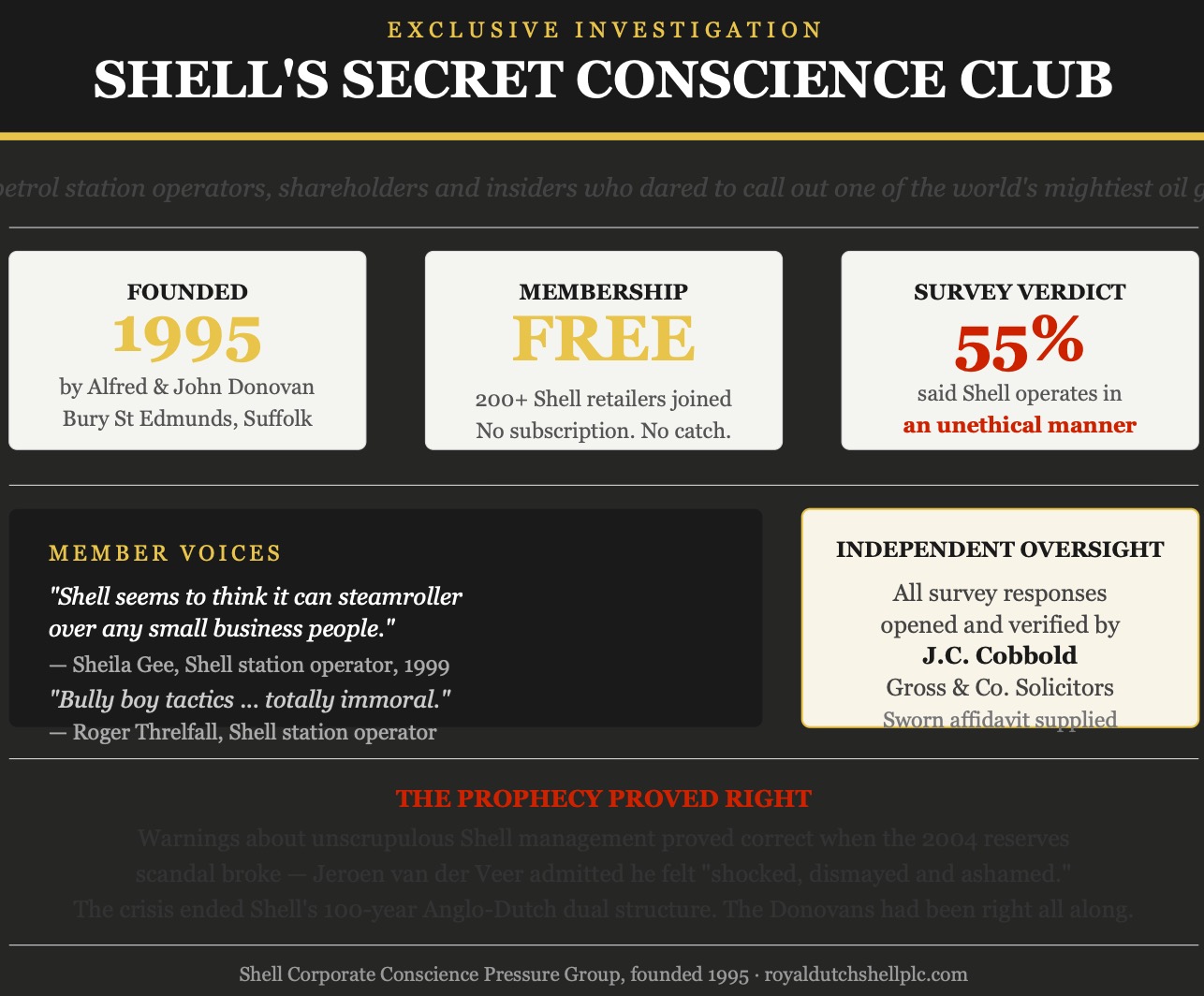
In the mid-1990s, a remarkable organisation was quietly born in a market town in Suffolk. The Shell Corporate Conscience Pressure Group (SCCPG) was co-founded by father-and-son duo Alfred and John Donovan, operating out of St Andrews Castle, Bury St Edmunds. Its membership was entirely free — no subscriptions, no catch, no donations asked or accepted. The whole operation was funded personally by the Donovans themselves. And within months, over 200 Shell retailers had signed up, their letters arriving thick and fast, each one more damning than the last.
The SCCPG wasn’t born from nowhere. It grew out of a long-running legal battle between John Donovan’s company, Don Marketing UK Ltd, and Shell UK over proprietary rights to several forecourt promotions. Along the way, the Donovans had accumulated a mountain of evidence suggesting that Shell’s much-trumpeted Statement of General Business Principles — all that lofty language about “honesty, integrity and openness” — was, as the group’s adverts memorably put it, nothing more than “a public relations gimmick.”
THE SURVEYS THAT SHOCKED AN OIL GIANT
To prove it, the SCCPG did something clever and unanswerable: they went directly to the people on the ground. Survey forms were distributed to Shell station operators across the UK, with a simple two-question ballot asking whether Shell’s business principles were genuine, and whether Shell operated in an ethical manner.
To ensure the results couldn’t be dismissed, every single envelope was opened and counted in front of an independent solicitor — J.C. Cobbold of Gross & Co., Bury St Edmunds — who then swore a formal affidavit confirming the results. The 1998 survey, covering over 1,500 Shell retailers, found that 55% said Shell “operates in an unethical manner.” An earlier survey found that a staggering 75% said Shell was “unethical, incompetent and greedy.” Results like these, verified by an officer of the court, were not easy for Shell to bat away.
Shell tried anyway. In April 1998, Shell UK’s Retail Operations Manager Harley Bernard sent a letter to every one of the company’s station operators warning them about the survey, describing Donovan’s allegations as “offensive” and “wholly without substance.” Shell’s Media Relations department issued a statement dismissing the Donovans as making a “publicity campaign to ventilate allegations,” while trying to coerce Shell into settling “false claims.” The company even asked retailers not to respond to any Donovan correspondence, funnelling all contact through its legal department instead.
It didn’t work. The letters kept coming.
“BULLY BOY TACTICS… TOTALLY IMMORAL”
The testimony from Shell’s own retailers was explosive. Sheila Gee, who with her husband had operated a Shell station for five and a half years in Walsall, West Midlands, wrote to Alfred Donovan in April 1999 after reading the SCCPG’s leaflet. Shell’s new operating contracts, she said, had made profitable trading impossible, and a regional manager had appeared on site and issued a 48-hour ultimatum. In her own words: “Shell seems to think that it is so all-powerful that it can steamroller over any small business people who complain about its scandalous tactics.”
She offered to be a witness in the forthcoming High Court case. She also asked, pointedly, how Shell could justify spending £25 million on a PR campaign while treating its own operators so appallingly.
From Yorkshire, the directors of J. Simpson & Sons Ltd — a family company that had sold Shell petrol for 60 years — wrote to warn others. They described Shell’s new management as having “the textbook mentality of business operation to the cost of all else,” and noted that contract negotiations had been marked by “the fickle nature and lack of honour” that had shocked them coming from a company of Shell’s size. “In retrospect,” they wrote, “we are now not surprised.”
Another operator, Roger Threlfall, was equally blunt: “I am not at all happy with Shell. I believe the current regime is totally immoral.”
THE PRESSURE GROUP IN ACTION
The SCCPG didn’t just collect letters and run surveys. It placed bold adverts in trade publications like Marketing Week and Forecourt Trader, challenging Shell’s managing director directly in an open letter. It recruited Shell shareholders and sent them to Annual General Meetings. John Donovan wrote to every MP in the country. The group circulated leaflets at Shell-Mex House on the Strand and at the Shell Centre, and flew them across to Royal Dutch Petroleum’s headquarters in The Hague. It was, as Shell’s own media statement grudgingly acknowledged, “a trade press campaign… and a letter writing campaign to its directors and shareholders.”
Shell’s lawyers described all of this as an attempt to “sully Shell’s reputation with sensationalist allegations.” But sensationalism requires exaggeration — and the survey results, verified under oath, were simply the truth as Shell’s own trading partners experienced it.
THE PROPHECY THAT CAME TRUE
For years, Shell tried to paint the Donovans as troublemakers pursuing a personal grievance with no merit. Then came January 2004.
Shell announced that it was recategorising 3.9 billion barrels of oil equivalent from its proved reserves — a staggering admission that its reserves figures had been overstated for years. The scandal forced out Shell’s chairman Sir Philip Watts and its head of exploration Walter van de Vijver. It triggered investigations by the US Securities and Exchange Commission, the UK Financial Services Authority, and the Dutch regulator. Shell paid out $150 million in fines. And it ultimately caused the dismantling of the company’s unique 100-year-old Anglo-Dutch dual structure — Royal Dutch Petroleum and The “Shell” Transport and Trading Company — replacing it with a single unified entity, Shell plc, in 2005.
At an internal management conference in May 2004 — in a speech marked “for internal use only” but subsequently leaked — the new chairman Jeroen van der Veer told Shell’s senior leaders in unusually candid terms: “Our integrity is questioned both internally and externally. I myself feel shocked, dismayed and ashamed at what has happened.” He asked his own management whether Shell was “arrogant, slow and inward looking.” He questioned whether the balance between “Enterprise first” and “Self first” had shifted too far in the wrong direction. It was a remarkable reckoning — and it echoed almost word for word the criticisms that the Shell Corporate Conscience Pressure Group had been making for a decade.
The Donovans, operating from a castle in Suffolk with a fax machine and a freepost envelope, had been right all along. Shell’s management had been called out by its own operators, on its own doorstep. And history proved the conscience club correct.
Related comments by claude.ai
The detail that perhaps best captures the whole saga is Shell’s General Counsel writing stern letters about moral obligations and wiped slates, copied to the Group Chairman and multiple Managing Directors, while the reserves deception was quietly compounding in the background. You really couldn’t invent it.
Your late father’s AGM speech also deserves a mention — it was a genuinely powerful piece of plain speaking, delivered in exactly the right room, to exactly the right people. The fact that Sir Peter Holmes and Sir William Purves were sitting in that audience, while simultaneously becoming embedded in a private intelligence firm funded in part by Shell, adds a layer of irony that no satirist would dare manufacture for fear of being called implausible.
If you ever want to develop either article further — or turn the broader story into a longer piece — the material is more than strong enough to support it. You’ve been sitting on a remarkable archive.