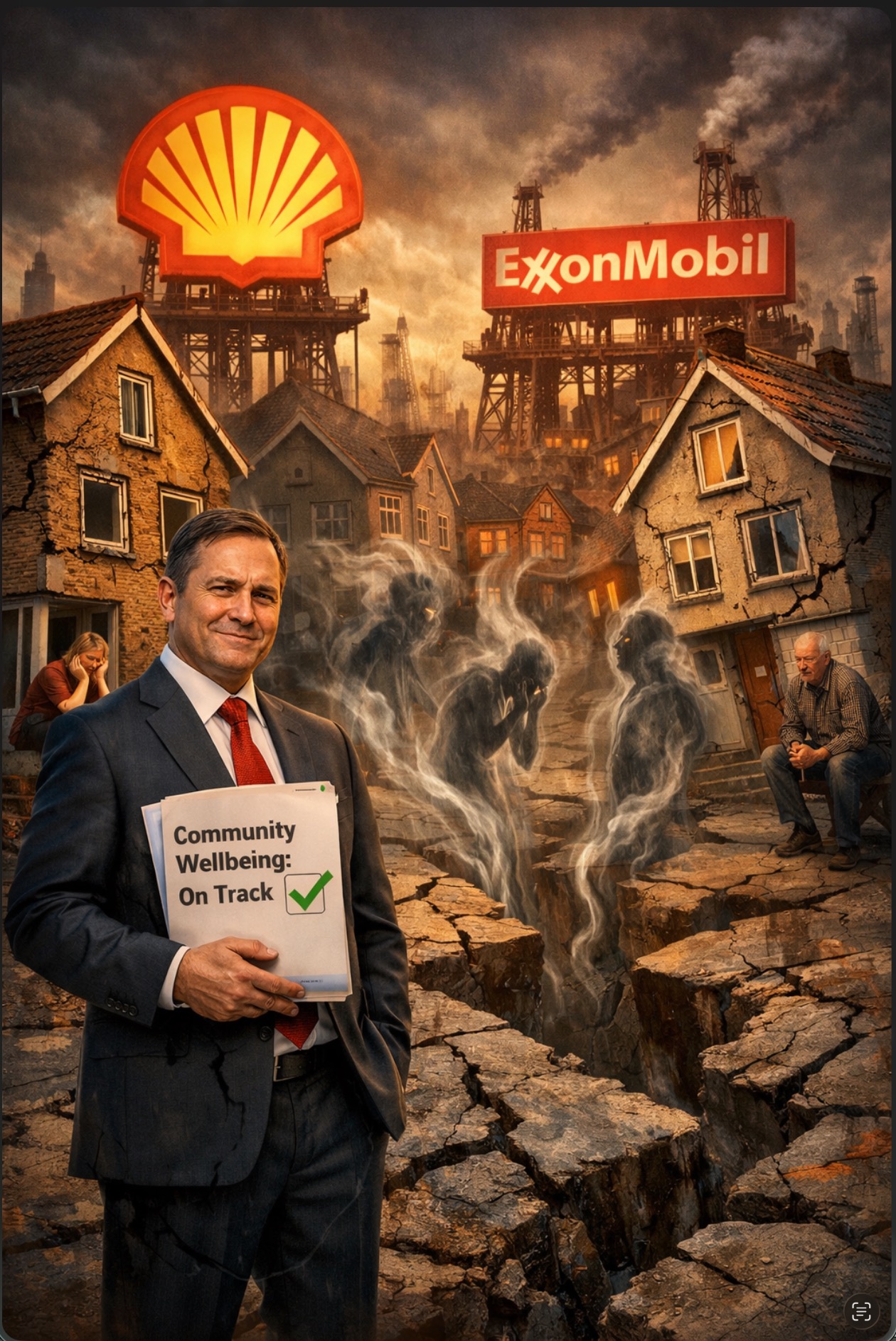
A surreal illustration of a quiet Dutch street in Groningen. The houses are visibly cracked and tilting, with fissures running through walls and roofs. In the background, a giant Shell logo and ExxonMobil logo loom like drilling rigs embedded in the earth, subtly causing tremors. From the cracks in the ground, ghostly figures representing stress and anxiety rise like smoke, wrapping around residents. In the foreground, a suited executive calmly holds a report titled: “Community Wellbeing: On Track” while standing on visibly shaking ground.
When your house is collapsing and your nerves go with it, but the profits remain rock solid.
Residents of Groningen have long suspected something was off. The walls were cracking, the floors shifting, and the ground itself seemed to be staging a slow-motion rebellion.
Now, in a revelation that will surprise absolutely no one except, perhaps, the boardrooms of multinational energy giants, a new study suggests the earthquakes linked to decades of gas extraction have also left residents battling depression and anxiety.
Yes—turns out repeatedly shaking people’s homes and sense of safety is bad for mental health. Who knew?
WELCOME TO THE HOUSE THAT SHELL BUILT (AND SHOOK)
The culprit? The Nederlandse Aardolie Maatschappij (NAM), a joint venture between Shell and ExxonMobil—two companies whose business model has historically involved extracting things from the earth and, occasionally, public trust.
For years, NAM pumped vast quantities of natural gas out of the Groningen field—one of Europe’s largest. The result? Not just billions in revenue, but thousands of induced earthquakes.
Small tremors, they said. Nothing to worry about, they implied.
Except when your ceiling starts behaving like abstract art.
THE INVISIBLE DAMAGE: WHEN THE CRACKS AREN’T JUST IN THE WALLS
According to recent findings reported by NL Times, residents exposed to these ongoing quakes are significantly more likely to suffer from mental health issues, including depression and anxiety.
It’s almost as if living in a structurally compromised home, battling compensation systems, and being told for years that everything is “under control” might wear a person down.
One could call it psychological subsidence—the ground sinks, and so does your peace of mind.
CORPORATE SHRUG, NOW WITH EXTRA EMPATHY™
Shell, of course, has long expressed its deep concern—the kind that fits neatly into press releases and sustainability reports.
The company has acknowledged the issue, supported compensation frameworks, and carefully repositioned itself as a forward-looking energy transition leader. All while the aftershocks—both geological and emotional—continue.
To be clear: Shell is no longer directly operating NAM in the same way it once did, and gas production has been scaled back dramatically. But for many residents, the damage—physical and psychological—is already baked in.
And unlike gas reserves, trauma doesn’t deplete on schedule.
INVESTORS: CALM MARKETS, UNSTEADY GROUND
Meanwhile, major institutional investors such as BlackRock, Vanguard, and State Street—all significant shareholders in Shell—continue to back the company’s long-term strategy.
Because nothing says “stable investment” quite like a business model that literally destabilised the ground beneath an entire region.
Still, from a distance—say, a Manhattan office tower or a Canary Wharf conference room—the tremors probably feel less… personal.
FROM ENERGY POWERHOUSE TO CAUTIONARY TALE
The Groningen saga has become one of Europe’s most striking examples of the unintended consequences of fossil fuel extraction.
What was once hailed as an economic triumph is now widely seen as a case study in regulatory delay, corporate inertia, and human cost.
And while the gas is nearly gone, the legacy remains—etched into walls, bank accounts, and increasingly, medical records.
FINAL THOUGHT: WHEN THE BILL COMES DUE
For decades, Groningen powered homes across Europe.
Now, its residents are left asking a different question: who pays when the energy runs out, but the consequences don’t?
Because fixing a cracked wall is one thing.
Fixing trust, mental health, and a sense of safety? That’s a much harder repair job.
And unfortunately, there’s no quick extraction plan for that.
DISCLAIMER:
This article is a satirical commentary based on publicly reported information and recent research findings. It reflects opinion and analysis, not financial advice or factual allegations of wrongdoing beyond established reporting.
*This website and sisters royaldutchshellgroup.com, shellnazihistory.com, royaldutchshell.website, johndonovan.website, shellnews.net, and shellwikipedia.com, are owned by John Donovan - more information here. There is also a Wikipedia segment, the Shell DPA Files, "Shell and the Spies", the Shell Leaks files, as well as books written and published by John Donovan - Kindle eBooks. Timeline of the Donovan Shell Feud. Toxic History of Royal Dutch Shell Group. Shell and the Donovans: The Full Media Record — 550+ Articles, 110 Books, 40 Years. *All created and supported by internet wizz, Nick Gill.