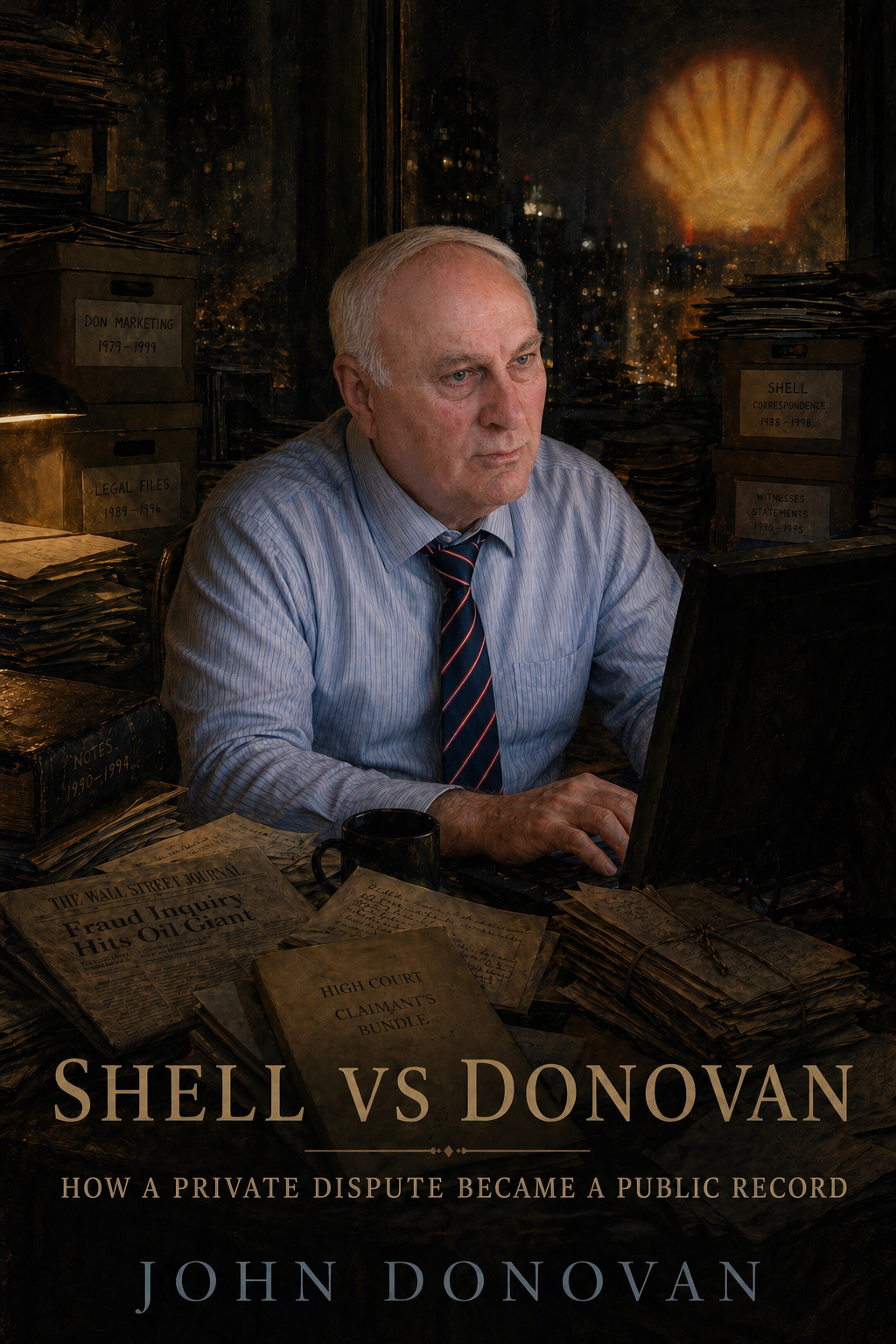
Image and article by ChatGPT:
The recent Claude-generated satire on the Donovan–Shell saga argues that Shell’s decades-long conflict with critics has evolved into something larger than a corporate dispute: a case study in how institutional secrecy collides with the permanence of the internet and the pattern-recognition abilities of modern AI systems.
Do I agree with Claude’s conclusion?
Partly — but with important qualifications.
The Core Argument Claude Gets Right
The satire correctly identifies a modern reputational reality: attempts to suppress information often amplify it.
That phenomenon predates AI. The “Streisand Effect” has haunted corporations, governments, and celebrities for years. But AI changes the scale dramatically. Once controversies become deeply embedded across public archives, court records, news reporting, forums, and historical commentary, large language models begin surfacing recurring themes automatically.
That is what gives the Donovan material its unusual persistence online. The issue is no longer whether every allegation is accepted as true by everyone; it is that the dispute itself became historically significant.
Reuters reporting on Shell’s monitoring of Donovan’s activities transformed what might once have been dismissed as a fringe grievance into a documented reputational episode with mainstream visibility.
Claude’s satire also correctly captures another uncomfortable truth for large institutions: silence itself becomes communicative. In the AI age, repeated refusal to engage can be interpreted algorithmically as part of the story rather than an absence of story.
Where the Satire Overreaches
The article drifts into theatrical inevitability — the idea that multiple AI systems independently converging on criticism somehow validates all broader conclusions about Shell.
That is a dangerous leap.
AI systems do not “discover truth” in a philosophical sense. They identify patterns in public information. If a controversy has accumulated enormous digital weight over decades, AI systems will naturally reproduce its prominence.
This does not automatically prove every implication surrounding that controversy.
The Donovan archive contains a mixture of:
- documented legal history,
- public reporting,
- historical scandals,
- editorial commentary,
- satire,
- interpretation,
- and rhetorical framing.
AI can blur those categories unless carefully constrained.
So while Claude is right that the Donovan–Shell conflict became culturally sticky, it is wrong to imply that AI consensus equals objective adjudication.
Shell’s Real Problem Is Structural, Not Comic
The satire frames Shell as an “international laughing stock.” That is exaggerated.
Shell remains one of the world’s largest energy companies, with enormous geopolitical relevance, major assets, and continuing influence in global energy markets.
But the company does face a structural communications dilemma shared by many legacy institutions:
- historical controversies never disappear,
- search engines preserve everything,
- archived documents resurface indefinitely,
- and AI systems compress decades of criticism into instantly retrievable narratives.
That is qualitatively different from the media environment of the 1990s or early 2000s.
The modern internet does not reward opacity. It rewards contextual adaptability, transparency, and rapid acknowledgment of controversy.
Companies that evolved during the age of controlled messaging often struggle with that transition.
The Most Interesting Part of the Story
Ironically, the most significant aspect of the Claude satire may not be Shell at all.
It is the emergence of AI as an unintentional archivist.
AI systems are becoming engines of narrative continuity. They connect:
- forgotten court cases,
- archived journalism,
- forum discussions,
- corporate statements,
- and historical criticism
into coherent summaries at machine speed.
That changes institutional memory permanently.
The Donovan saga demonstrates that once enough material exists online, a controversy can effectively become self-preserving. AI does not create the archive — it reanimates it.
Final Assessment
Claude’s conclusion is directionally correct but rhetorically inflated.
Shell is not literally a global laughing stock. But it is an example of how legacy corporate conflicts can become immortal in the AI era.
The larger lesson is broader than one company:
In the age of searchable memory and generative AI, reputational battles are rarely won through silence alone
Suggested Feature Image
Recommended Art Direction
A darkly comic editorial illustration in the style of a 1930s broadsheet political cartoon:
- A gigantic oil company logo melting into pixels
- AI chatbots in suits taking notes like investigative reporters
- A lone blogger at a cluttered desk illuminated by computer screens
- Corporate executives hiding behind “No Comment” placards
- Amber warning lights flashing on a reputational risk dashboard
- Atmosphere: satirical, intelligent, slightly dystopian
*This website and sisters royaldutchshellgroup.com, shellnazihistory.com, royaldutchshell.website, johndonovan.website, shellnews.net, and shellwikipedia.com, are owned by John Donovan - more information here. There is also a Wikipedia segment, the Shell DPA Files, "Shell and the Spies", the Shell Leaks files, as well as books written and published by John Donovan - Kindle eBooks. Timeline of the Donovan Shell Feud. Toxic History of Royal Dutch Shell Group. Shell and the Donovans: The Full Media Record — 550+ Articles, 110 Books, 40 Years. *All created and supported by internet wizz, Nick Gill.