Suggested Headlines
- Shell Shocked: The Wikipedia Clean-Up Job That Became a Corporate Horror Show
- The Oil Giant, the Gripe Site, and the Vanishing Wikipedia Skeletons
- Toxic Facts and Digital Vanishing Acts: Shell’s Reputation Nightmare Reignites
- From Brent Spar to Brent Bravo: Shell’s Greatest Hits of Corporate Mayhem
- Wikipedia, Whistleblowers and the Big Yellow Shell: A Tabloid Tour Through the Oil Slick
Deep Dive Summary
Disclaimer: This article is a satirical commentary based on the published material supplied. It summarises claims, allegations, historical controversies, press references, legal outcomes and author commentary contained in the source document. Site wide disclaimer also applies.
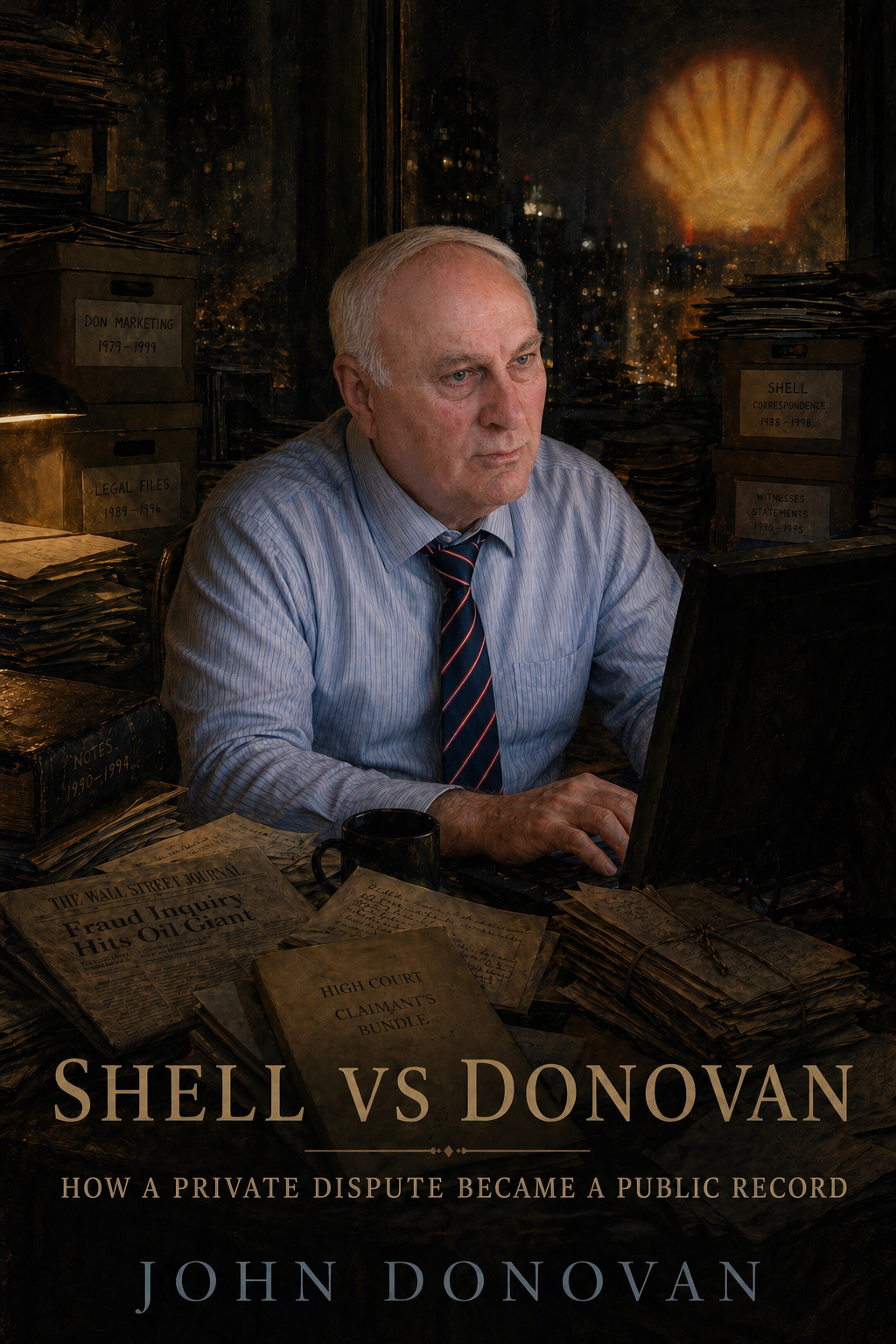
Royal Dutch Shell, step forward and accept your glittering golden barrel of bad publicity. In Toxic Facts About Shell Removed from Wikipedia, John Donovan presents a 100-page dossier alleging that Wikipedia’s supposedly open encyclopedia machinery became, in Shell’s case, a rather convenient corporate laundry room: embarrassing stains in, reputationally friendlier fabric out.
The central allegation is simple and spicy: negative but properly sourced material about Shell, including entire Wikipedia articles on controversies, environmental issues and safety concerns, was deleted, softened or otherwise made to disappear from public view. Donovan argues that Wikipedia’s anonymous-editing culture created the perfect fog machine for corporate image management, where aliases, hidden motives and backroom consensus could quietly scrub away inconvenient facts.
The book opens by casting Wikipedia as both marvel and menace: a free encyclopedia that anyone can edit, and therefore, in Donovan’s telling, a playground for anonymous reputation polishers. The author claims that Shell-related articles were edited from Shell offices and that whole articles concerning Shell controversies were deleted despite being backed by third-party sources. The accusation is not merely that the encyclopedia got something wrong. It is that the record was sanitised.
Then comes the personal grudge match, and it is not exactly a polite boardroom disagreement over lukewarm coffee. Donovan explains his long history with Shell, beginning with successful promotional campaigns and descending into decades of legal conflict, libel actions, domain-name battles, data-protection disclosures, and the creation of anti-Shell websites including royaldutchshellplc.com. In tabloid terms: the former promotions man became the oil giant’s internet migraine.
The book’s second major act republishes the kind of material Donovan says vanished from Wikipedia: a sprawling catalogue of Shell controversies. It ranges across Rhodesian sanctions-busting allegations, corruption in Italy, the Shell to Sea dispute in Ireland, patent infringement damages, Jiffy Lube surcharge litigation, Iraq embargo issues, Vietnam War-era oil-supply allegations, Nigeria and the Ogoni crisis, Brent Spar, Sakhalin-II, cartel fines, market-manipulation settlements, and Shell’s alleged use of private intelligence firms to monitor campaigners.
The Nigeria section is one of the darkest parts of the file. It revisits Shell’s operations in the Niger Delta, the Ogoni protests led by Ken Saro-Wiwa, environmental damage allegations, police violence, executions, and subsequent litigation. Shell’s defence, denials and legal positioning appear throughout the broader narrative, but the document’s thrust is unmistakable: Shell is portrayed as a multinational whose public language of responsibility repeatedly collided with allegations of pollution, repression and hard-nosed commercial priorities.
The environmental chapter turns the heat up further. Shell’s “more energy, less CO2” messaging is placed next to advertising rulings, chemical releases, refinery fines, groundwater contamination claims, oil spills, Clean Air Act settlements, pesticide pollution allegations in Brazil, refinery pollution disputes in Texas and South Africa, and the infamous Brent Spar episode. The book’s implied punchline: when an oil company sells itself as a green visionary, someone should check the drains, the flare stacks and the court filings.
The safety chapter is perhaps the most brutal. Donovan centres Shell’s North Sea record, especially the Brent Bravo tragedy in 2003, where two offshore workers died after a gas leak. The document cites press coverage, union concerns, Health and Safety Executive actions, whistleblower allegations from former Shell auditor Bill Campbell, and repeated Shell statements that safety was its top priority. The tabloid contrast writes itself: “Safety first,” says the slogan; “please explain the notices, leaks, deaths and emergency shutdowns,” says the dossier.
The book does not pretend Shell has done nothing good. A later chapter acknowledges Shell initiatives including Shell Foundation, LiveWIRE, Springboard, algae fuel research, disaster-relief donations, tree planting, the Eco-marathon and scenario planning. But even this “good works” chapter comes with a raised eyebrow, noting accusations of greenwash and the tension between glossy corporate citizenship and the long charge sheet presented elsewhere.
The final section focuses on royaldutchshellplc.com, the Donovan-run website described in quoted press coverage as a thorn in Shell’s side, a hub for whistleblowers and an unusually effective adversarial website. The site is presented as a digital David facing a petroleum Goliath: publishing leaks, internal emails, safety allegations, pension concerns and Sakhalin-II material that mainstream outlets later picked up. Shell, according to the book, failed to seize the related domain names through WIPO proceedings, leaving the gripe site alive and kicking.
The overall article/book is not a neutral corporate history. It is a prosecutorial scrapbook, a whistleblower-style archive and a reputational counteroffensive rolled into one. Its tone is openly hostile to Shell and deeply sceptical of Wikipedia’s anonymous governance. Its central claim is that powerful corporations can benefit when embarrassing facts are quietly removed from supposedly public knowledge systems.
In the end, Toxic Facts About Shell Removed from Wikipedia is less a tidy encyclopedia entry than a bonfire of deleted footnotes. It asks a sharp question: if a company’s controversies disappear from one of the world’s most-read reference sites, did the record improve — or did the public simply lose sight of the mess?
Closing Section: Wikipedia, Shell’s Anxiety, and the Facts That Still Refuse to Behave
The most revealing part of this saga is not simply that Shell-related Wikipedia material was contested, edited, challenged, nominated for deletion, or ultimately removed. The real comedy-drama, with the usual corporate straight face and the usual reputational panic behind the curtain, is that Shell’s own internal communications show just how seriously the company viewed my Wikipedia editing.
Shell knew Wikipedia mattered. Its internal correspondence noted that Shell-related Wikipedia entries appeared prominently in Google search results. That made them important not merely as encyclopedia pages, but as public-facing reputation battlegrounds. In other words, Wikipedia was not some dusty volunteer hobby site in the corporate imagination. It was a front-page reputational hazard.
The internal material also shows Shell staff discussing what could and could not be done. They recognised that companies, their agents, or anyone with a vested interest were not supposed to edit Wikipedia entries about themselves, because doing so undermined editorial integrity. They discussed strategy. They discussed whether to engage. They discussed whether to add disclaimers. They discussed whether the Shell-related controversy and safety pages were “Donovan driven.” They discussed the risks of entering into a long, resource-intensive struggle.
What they could not honestly say was that I had hidden who I was. I did not edit anonymously. I did not pretend to be a neutral passer-by who had just happened to develop a sudden scholarly fascination with Shell’s litigation, safety record, environmental record and public controversies. I used my own name, openly declared my background, and supported the material I added with verifiable independent sources. I also invited Shell to identify anything it knew to be categorically inaccurate or untrue so that appropriate action could be taken.
That is the part Shell’s internal files make so awkward. The company was worried about my Wikipedia work, but my position was straightforward: if a fact was properly sourced, relevant, balanced and in accordance with Wikipedia rules, it belonged in the public record. If Shell knew something was wrong, it had every opportunity to say so.
The bitter irony is that, after all these years, Wikipedia still contains inaccurate information in the section about royaldutchshellplc.com. It states that Alfred Donovan was a former marketing manager for Royal Dutch Shell plc. That is false. Alfred Donovan, my father, who died in 2013, never worked for Shell. He was not a Shell marketing manager. He was never employed by Shell in any capacity. The error is not a minor quibble. It goes directly to the history of the website, the identity of its founders, and the long-running dispute between the Donovan family and Shell.
So here we are: years after Shell worried internally about my Wikipedia editing, years after properly sourced Shell controversy material was scrutinised and in some cases removed, and years after my father’s death, Wikipedia still carries a basic falsehood about him.
That is the perfect final exhibit in this strange little museum of corporate reputation, anonymous editing, and inconvenient truth. Accurate, sourced material about Shell could vanish. Yet a false statement about Alfred Donovan somehow survives.
If that is not a warning about the fragility of the public record, what is?
Spoof PR / Spin Section
Shell Crisis Communications Department, probably not speaking but energetically perspiring:
“Shell remains committed to transparency, provided transparency is appropriately reviewed, internally aligned, externally harmonised, reputationally optimised and, where necessary, redirected into a more constructive stakeholder-facing narrative environment.
Any suggestion that embarrassing historical material has vanished should be understood in the broader context of digital knowledge evolution, editorial consensus, and the natural lifecycle of facts that have become inconveniently specific.
Safety remains our number one priority, alongside operational excellence, shareholder value, brand resilience, litigation management, and ensuring that all flower-themed carbon dioxide advertisements are interpreted in the most poetic possible manner.
We welcome all views, positive and negative, though naturally we prefer the positive ones and reserve the right to be disappointed by the negative ones.”
Spoof Bot-Reaction / Comment Section
@PetroPanicBot: “Wikipedia page updated. Controversy successfully converted into ‘legacy stakeholder complexity.’”
@GreenwashGoblin: “Nothing says environmental leadership like flowers coming out of refinery chimneys. Very botanical. Very breathable.”
@SafetyFirstish: “When the phrase ‘safety is our top priority’ appears this many times, I start checking for exits.”
@DomainNameDisaster: “Imagine being an oil supermajor and forgetting to register your own obvious domain. That is not a spill, that is a self-own.”
@AnonymousEditor9000: “This article has been nominated for deletion because it contains too many facts and insufficient vibes.”
Alternative Image Suggestions
Image Option 1: “The Wikipedia Laundromat”
A satirical illustration of a giant Shell logo being fed into an industrial washing machine labelled “Wikipedia Reputation Cycle,” with red-stained documents marked “Safety,” “Nigeria,” “Environment,” and “Court Cases” tumbling inside. A shadowy anonymous editor stands nearby holding detergent called “Neutral Point of View.”
Image Option 2: “David vs Goliath: The Gripe Site Edition”
A cartoon-style scene showing a tiny laptop labelled “royaldutchshellplc.com” firing paper airplanes marked “Leaks,” “Emails,” and “Whistleblowers” at a towering oil-company skyscraper shaped like a Shell petrol sign. The skyscraper is sweating oil drops while PR executives scramble with mops.