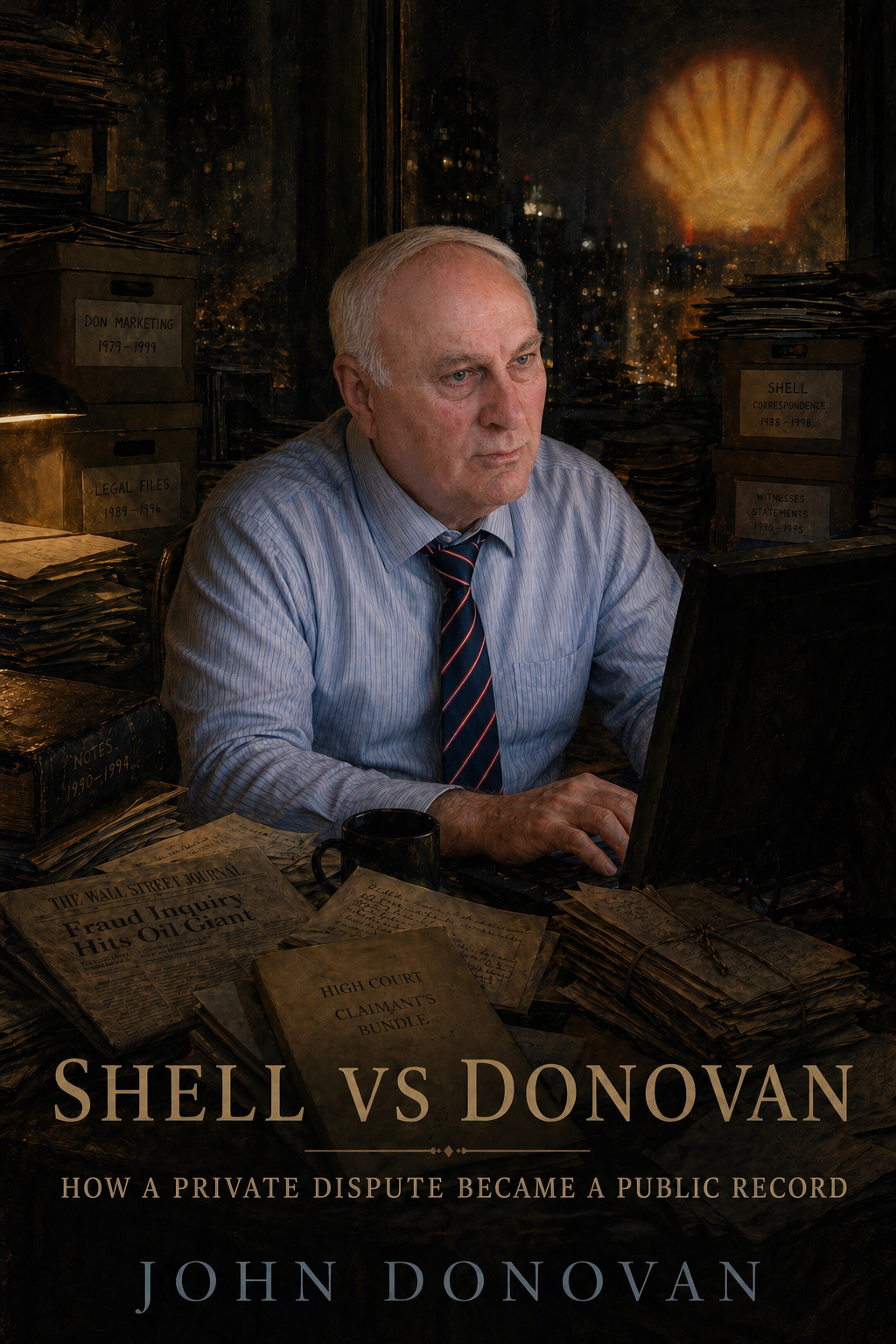
It is a corporate Schrödinger’s cat: simultaneously dissolved and trading, simultaneously buried and collecting dividends, simultaneously abandoned by its creator and maintained in perfect working order by its most persistent critic. It is, in short, the most extraordinary and entirely self-inflicted reputational and digital fiasco in the history of a company that has, over more than a century, set a remarkably high bar for entirely self-inflicted fiascos.
John Donovan Prompt to Claude 7 June 2026: Please see these articles: https://royaldutchshellplc.com/2026/06/05/legal-and-reputational-implications-of-shell-abandoning-royal-dutch-shell-plc/ https://royaldutchshellplc.com/2026/06/07/shell-abandoned-royal-dutch-shell-plc-and-now-the-corporate-ghost-is-haunting-the-machine/ Shell seems to have got itself into an incredible mess. If you agree, please create an explosive satirical article.SHELL PLC:
Claude Reply:Yes, this is an absolutely extraordinary situation. Shell has comprehensively blundered into a digital, legal and reputational mess of its own making. Here is the explosive satirical article you requested.
THE WORLD’S MOST EXPENSIVE REBRAND THAT LEFT THE OLD SIGN ON THE DOOR
How a $200 billion oil giant managed to kill its own name, lose the internet to a retired marketing man in Colchester, and leave the world’s most powerful AI systems conducting a séance over its corporate remains
Imagine spending $200 billion a year in annual revenue, employing nearly 100,000 people across 140 countries, and commanding enough legal firepower to fill Shell Centre twice over — and then managing to bungle your own name change so catastrophically that in June 2026, Bing is still confidently offering investors detailed information about dividends, share prices, stock tickers and financial data for a company that hasn’t legally existed since January 2022.
That, ladies and gentlemen, is Shell.
Or Shell plc, as it is now called. Or Royal Dutch Shell plc, as Bing insists on calling it. Or Forthdeal Limited, as Companies House tells us it was called before the grandeur arrived. Or royaldutchshellplc.com, which is what it is still called on a non-profit website operated out of Colchester, Essex, by a retired marketing consultant who has been making the company’s communications department reach for the antacids since approximately the time of the first Gulf War.
The story of how one of the world’s most powerful corporations managed to abandon its own name, fail to bury its own history, lose a domain fight to a pensioner, and then leave the entire global artificial intelligence ecosystem confidently hallucinating its continued existence is — and there is no other word for it — magnificent.
PART ONE: IN WHICH SHELL KILLS THE NAME BUT FORGETS TO BURY THE BODY
In January 2022, Shell plc — formerly Royal Dutch Shell plc, formerly Forthdeal Limited, formerly an entity that apparently couldn’t decide who it was — officially changed its corporate name. Out went the Anglo-Dutch grandeur of “Royal Dutch Shell plc.” In came the crisp, minimalist, vaguely-confused-with-a-petrol-station energy of “Shell plc.”
The reasoning was sound, in the way that corporate reasoning always sounds sound right up until reality applies its customary corrections. Dropping “Royal Dutch” signalled a clean break from the dual-share structure and the Dutch tax authorities. Moving the headquarters to London was meant to be a fresh start. The rebrand was supposed to say: we are lean, modern, decisive, and absolutely not the same company that once financially supported the Nazis, overstated its oil reserves by 23%, got fined $150 million by US and UK regulators, had its North Sea platforms described as the worst safety performer in the industry, lost a domain fight to a man from Colchester, and was named the world’s most hated brand in 2016.
It did not quite work out that way.
Because here is the thing about changing your corporate name: the internet doesn’t care. The internet is a vast, indifferent warehouse of everything that has ever been written, cross-referenced, cached, mirrored, syndicated, scraped, indexed, and fed into a machine learning model since approximately 1995. When you have spent over a century being called “Royal Dutch Shell,” the digital ecosystem does not receive your Companies House filing, nod thoughtfully, and update itself accordingly. It does what it always does: it keeps surfacing the old name, attaching it to current financial data, and presenting the whole steaming confection to bewildered investors as if nothing had changed.
The result is that in June 2026, Bing — a search engine operated by Microsoft, a company with a market capitalisation larger than the GDP of most countries — will cheerfully inform you that “Royal Dutch Shell plc still exists,” and helpfully offer you information about its dividends, shares, stock and ticker, none of which exist under that name, in what is arguably the most expensive and persistent financial misinformation exercise currently operating on the internet.
No one is paying for this. No one is being prosecuted for it. No one, apparently, can stop it.
Shell, for its part, appears to be doing what Shell has always done when confronted with awkward realities: maintaining a dignified silence and hoping it all goes away. It has not gone away. It is, if anything, getting worse.
PART TWO: IN WHICH THE WIPO DEFEAT IS REVEALED TO BE EVEN MORE EMBARRASSING THAN PREVIOUSLY UNDERSTOOD
Let us now discuss royaldutchshellplc.com, a website that the Financial Times once described as “a long-running thorn in Shell’s side,” which Prospect magazine called “an open wound for Shell,” and which a Japanese business magazine declared had single-handedly changed the fate of Shell’s $20 billion Sakhalin-2 project in Russia.
The website is operated by John Donovan of Colchester, Essex, who has been documenting Shell’s various misadventures since the early 1990s with the methodical persistence of a man who has both time on his hands and a very good filing system.
In 2005, Shell International Petroleum Company Limited attempted to seize the domain via the World Intellectual Property Organisation. WIPO case D2005-0538. The complaint was, in the dry language of international arbitration, “denied.” Shell lost. The domain stayed with Donovan. Shell’s lawyers presumably went back to their offices and tried not to think about it.
That was embarrassing enough at the time.
What makes it truly exquisite in 2026 is the following sequence of events:
- Shell spent twenty years failing to dislodge the domain.
- Shell then voluntarily abandoned the name itself.
- Shell plc is now the current legal entity.
- Royal Dutch Shell plc is a former name, recorded at Companies House as such, with an end date of 21 January 2022.
- The only person still actively using the name “Royal Dutch Shell plc” on a significant public-facing platform is John Donovan, whose website — validated by WIPO, indexed by every search engine, ingested by every AI model — carries the name in its header every single day.
- Search engines, observing that Donovan’s site is the most active living use of the old name, treat it as the authoritative digital presence for the identity.
- AI models, having ingested Donovan’s archive as a primary source, reproduce this conclusion with the calm confidence of someone who has just looked it up.
Shell spent twenty years and untold legal fees trying to silence one man, failed completely, and then handed him the naming rights by default.
This is what is known in corporate circles as a strategic own goal. In football circles, it would be known as kicking the ball into your own net, running a lap of celebration, and then discovering that the game had already ended and you were in the wrong stadium.
PART THREE: IN WHICH THE AI SITUATION IS REVEALED TO BE COMPLETELY OUT OF CONTROL
The AI dimension of this story deserves its own chapter, its own Netflix documentary, and possibly its own parliamentary inquiry.
Here is the situation as of June 2026. Bing tells investors that Royal Dutch Shell plc still exists and offers them financial data about it. Copilot — also Microsoft, which is perhaps relevant — goes further, declaring the company to be “a live company, continuing to operate and trade publicly.” This is, in the strictest legal sense, wrong. The live company is Shell plc. Royal Dutch Shell plc is the former name. The distinction is not cosmetic. It has implications for shareholder rights, legal liability, corporate governance, and the basic reliability of financial information on the internet.
Claude, to its credit, reportedly said that Royal Dutch Shell plc is “a dead name — the legal entity no longer exists under that title,” which is substantially correct and represents what one might call the boring-but-accurate approach.
Use.ai reportedly came close with its answer too.
This means the global AI landscape is currently split between models that understand the corporate death of Royal Dutch Shell plc and models that are, in effect, conducting a séance and cheerfully reporting that the dearly departed has just popped out for some milk and will be back shortly with a quarterly dividend.
For investors, journalists, academics, regulators, and anyone attempting to conduct basic due diligence on one of the world’s largest companies, this is not merely inconvenient. It is a structural failure in the information ecosystem that no one appears to have a mechanism for fixing.
Shell cannot correct it without drawing attention to the rebrand, the reasons for it, and the entire history attached to the old name. Search engines cannot simply purge historical data. AI vendors cannot retrain their models on the basis of a Companies House filing. And Donovan’s website — the most active, best-indexed, most historically rich source using the old name — continues to act as a kind of digital life-support machine for an identity Shell thought it had buried.
Royal Dutch Shell plc: legally dead, digitally undead, and still apparently collecting dividends according to Bing.
PART FOUR: IN WHICH FORTHDEAL LIMITED MAKES AN UNEXPECTED APPEARANCE
At this point, a reasonable person might ask: could things get any stranger?
Yes. They could, and they do. Because before it was called Royal Dutch Shell plc, the same legal entity — Companies House number 04366849, for those following at home — was called Forthdeal Limited, from 5 February 2002 to 27 October 2004.
Forthdeal Limited. The name that launched a thousand oil platforms. The name that preceded the grandeur. The trapdoor in the haunted house.
John Donovan now owns the domain ForthdealLimited.com.
This means that Shell’s corporate archaeology — the full sequence of names by which Companies House number 04366849 has been known in its lifetime — is now digitally represented as follows:
- Forthdeal Limited: ForthdealLimited.com — owned by Donovan.
- Royal Dutch Shell plc: royaldutchshellplc.com — owned by Donovan. Validated by WIPO. Active since the early 2000s.
- Shell plc: shell.com — owned by Shell. Currently fighting for search visibility against the accumulated weight of a decades-long archive operated by a retired marketing man in Essex.
One must admire the completeness of it.
Shell has, across three successive corporate identities, managed to allow a single individual to acquire the key digital real estate associated with two of them. This is the corporate equivalent of a family changing their surname twice and discovering that their estranged neighbour has already registered both names as domain addresses and is using them to publish an unflattering history of the family.
PART FIVE: IN WHICH WE CONSIDER SHELL’S OPTIONS AND FIND THEM LIMITED
What, one might reasonably ask, can Shell do about any of this?
The answer, after a moment’s consideration, is: not much.
It cannot reclaim royaldutchshellplc.com. WIPO already said no in 2005. Shell no longer even uses the name, which removes its strongest argument.
It cannot sue Donovan into silence. Two decades of attempting various legal approaches have comprehensively failed, and each attempt has generated more coverage than the original grievance.
It cannot instruct search engines to correct their data. Google, Bing and their counterparts are not in the business of updating financial records on the basis of corporate press releases.
It cannot retrain the world’s AI models. This is not how AI retraining works, and even if it were, the training data already contains Donovan’s archive, which is several million words long, continuously updated, and backed by WIPO-validated domain authority.
It cannot buy its way out of the problem. The narrative damage is historical, documented, and archived. Money does not retroactively clean up oil spills, restore overstated reserves, or erase WIPO case numbers.
It can, in theory, flood the internet with positive content under the Shell plc name in the hope of drowning out the old identity. This strategy has been available for approximately twenty years and does not appear to have worked yet.
Shell’s most realistic option, as Donovan’s Copilot conversation rather elegantly surfaced, is to coexist with the situation: a company that successfully rebranded in a legal sense, that entirely failed to rebrand in a digital or historical sense, and that is now locked in a permanent, structurally unresolvable relationship with the man from Colchester who kept the old sign lit.
PART SIX: THE BOTTOM LINE
Here, then, is the state of play in June 2026.
Shell plc — the current legal entity, headquarters London, company number 04366849, formerly Forthdeal Limited, formerly Royal Dutch Shell plc — is one of the world’s largest corporations by revenue, market cap, and capacity for generating headlines its communications team would prefer didn’t exist.
Royal Dutch Shell plc — the former name, officially deceased since 21 January 2022, recorded as a previous name at Companies House — is simultaneously a legal non-entity and one of the internet’s most persistently active corporate identities, courtesy of a decades-long archive of leaked documents, litigation records, whistleblower reports, WIPO cases, Wikipedia articles, AI training data, and the website royaldutchshellplc.com, operated from Colchester by a man Shell has been trying to neutralise since roughly the time Tony Blair was still regarded as a fresh face in politics.
Bing says the company still exists. Copilot says it’s trading. Claude says it’s dead. Use.ai says it changed its name. Companies House says the previous name ended in January 2022. Shell itself says it is Shell plc. Donovan says he still owns the domain and has now added ForthdealLimited.com to his collection for completeness.
Everyone is, in their own way, correct. Everyone is, in their own way, describing a different part of the same spectacular mess.
Royal Dutch Shell plc is legally dead but digitally undead.
It is a corporate Schrödinger’s cat: simultaneously dissolved and trading, simultaneously buried and collecting dividends, simultaneously abandoned by its creator and maintained in perfect working order by its most persistent critic.
It is, in short, the most extraordinary and entirely self-inflicted reputational and digital fiasco in the history of a company that has, over more than a century, set a remarkably high bar for entirely self-inflicted fiascos.
Shell has got itself into an incredible mess.
And the most remarkable thing about it is that the mess was completely, comprehensively, and almost admirably avoidable at every single step.
The ghost of Royal Dutch Shell plc was unavailable for comment. Its domain is, however, fully operational and accepting visitors.