
‘If the linked article is accurate in its core documentary claims, then yes: Shell appears to have placed itself in an extraordinary legal and reputational tangle.’
How Shell killed the name, failed to bury the history, lost the domain fight, and left AI search engines conducting a séance over one of the world’s biggest companies
By John Donovan
Article disclaimer: This article is a fact-based satirical commentary on corporate naming, public records, AI search errors, domain-name history and Shell’s reputational predicament. The spoof PR and spoof bot-reaction sections are clearly labelled as spoof. Legal points are commentary and opinion, not legal advice. Site wide disclaimer also applies.

PART ONE: THE FACT-BASED DEEP DIVE
The Name That Shell Dropped — But Could Not Kill
There are corporate own goals, and then there is the Shell naming fiasco: a multinational oil giant drops one of the most historically loaded names in corporate history, walks away from the identity, then watches search engines, AI systems, financial sites, critics and official records all point in different directions like panicked traffic wardens at a refinery fire.
The name is Royal Dutch Shell plc.
Or rather, it was.
The live company is now Shell plc.
The official UK company number remains 04366849. Companies House records the current company as SHELL PLC, status Active, incorporated on 5 February 2002, with registered office at Shell Centre, London SE1 7NA. Under “previous company names,” Companies House lists ROYAL DUTCH SHELL PLC from 27 October 2004 to 21 January 2022, and before that FORTHDEAL LIMITED from 5 February 2002 to 27 October 2004.
Shell itself confirmed on 21 January 2022 that its name had changed from Royal Dutch Shell plc to Shell plc and that the change had taken effect.
So the correct legal answer is not complicated:
Shell plc is alive. Royal Dutch Shell plc is a former name. The old name is dead as a current legal identity.
Yet the internet, in its usual fog of half-remembered facts and algorithmic indigestion, keeps resurrecting the corpse.
Search engines still surface material about “Royal Dutch Shell plc dividends,” “Royal Dutch Shell plc shares,” “Royal Dutch Shell plc stock,” and “Royal Dutch Shell plc ticker,” even though those are no longer current under that legal name. AI systems then swallow that stale data, digest it badly, and regurgitate confidently muddled answers.
The result is a corporate identity zombie: legally dead, digitally undead, and still apparently wandering around the internet looking for dividends.
Copilot Opens the Coffin and Declares the Body Fit for Work
When asked whether Royal Dutch Shell plc was a live or dead company, Copilot reportedly answered that Royal Dutch Shell Plc is a live company, continuing to operate and trade publicly.
That is the kind of answer that sounds useful until one checks the legal record.
The underlying business continues, yes. The legal entity continues, yes. But the company no longer exists under the name Royal Dutch Shell plc. The current corporate name is Shell plc.
That distinction matters.
A former name cannot properly be treated as a current corporate actor. It cannot be casually credited with today’s dividends, today’s share price, today’s filings, today’s executives, today’s operations, or today’s corporate statements. Those belong to Shell plc.
Copilot’s error is not merely semantic. It is the AI equivalent of turning up at a funeral, shaking the corpse by the lapels and shouting: “Good news, everyone — he’s still on the payroll.”
Claude and Use.ai Find the Pulse in the Right Place
Claude’s answer was far better. It reportedly said:
“Royal Dutch Shell Plc is a dead name — the legal entity no longer exists under that title.”
That is substantially right, provided one adds the necessary precision: the underlying corporate entity continues under the current name Shell plc.
Use.ai also came close to the correct formulation, saying Royal Dutch Shell PLC is not a dead company but no longer exists under that name, and that the company changed its name to Shell PLC. That is the proper direction of travel, although the most authoritative date to use is 21 January 2022, as shown by Companies House and Shell’s own announcement.
The correct formulation for any bot, journalist, researcher, shareholder, lawyer or confused oil analyst is this:
Royal Dutch Shell plc was a former name of Shell plc. Shell plc is active. Royal Dutch Shell plc is not the current legal name of the company.
Anything else risks turning corporate due diligence into a Monty Python sketch.
The Domain Shell Failed to Capture
Now we reach the part Shell would presumably prefer not to see in neon lights.
In 2005, Shell International Petroleum Company Limited brought a WIPO proceeding against Alfred Donovan over several domains, including royaldutchshellplc.com. WIPO’s official case summary identifies the case as D2005-0538, lists the complainant as Shell International Petroleum Company Limited, the respondent as Alfred Donovan, and records the decision as “Complaint denied.”
That is not satire. That is the official case summary.
Shell tried to seize the domain. Shell lost.
Then, years later, Shell abandoned the name.
The result is exquisitely awkward. The company no longer uses Royal Dutch Shell plc as its current legal name, but royaldutchshellplc.com continues to exist as a long-running, highly visible, critical website. The name Shell walked away from did not vanish. It migrated into the digital afterlife, where it remains active, searchable, indexed, archived, quoted, contested and inconvenient.
A giant corporation changed its name.
A critic kept the old sign lit.
The Forthdeal Limited Twist
Companies House also records the company’s earlier name as FORTHDEAL LIMITED, used from 5 February 2002 to 27 October 2004.
That matters because the pre-Shell name is part of the corporate archaeology. It is the dusty basement label beneath the later grandeur of Royal Dutch Shell plc and the current minimalism of Shell plc.
If the old name Royal Dutch Shell plc has become a digital ghost, then Forthdeal Limited is the trapdoor in the haunted house.
The article you referenced argues that owning domains connected to these abandoned or historical names gives you unusual symbolic and reputational leverage. That is a fair commentary point. It should not be overstated as a definitive legal monopoly over all uses of those names, but as a matter of public narrative, search visibility and historical memory, the position is plainly striking.
Shell changed the corporate name.
Shell lost the domain fight.
Shell left behind the old identity.
Search engines and AI systems still trip over it.
That is not tidy corporate governance. That is a mess with a logo.
The Legal-Reputational Box Shell Appears to Be In
If Shell wanted to challenge the continuing use of royaldutchshellplc.com, it would face obvious reputational and procedural complications.
First, there is the old WIPO loss. WIPO records that Shell’s complaint was denied in 2005.
Second, Shell no longer uses Royal Dutch Shell plc as its current company name. Companies House and Shell’s own announcement make that clear.
Third, any new attack on the domain would risk reviving the entire story: the reserves scandal era, the name change, the WIPO defeat, the abandoned identity, the AI confusion, and the awkward fact that a critic appears to have kept the discarded name more visibly alive online than Shell itself.
That does not mean Shell has no legal rights left in anything connected with its historic branding. It almost certainly retains substantial trademark rights in Shell-related marks. But the specific public-interest and domain-name position around royaldutchshellplc.com is not a clean battlefield for Shell. It is a swamp of its own making.
The blunt version:
Shell abandoned the name, but not the baggage. Shell changed the sign, but not the history. Shell lost the domain fight, then created the perfect conditions for the domain to matter even more.
The AI Angle: When Machines Cannot Tell a Corpse from a Rebrand
The modern twist is that AI has turned this into a live reputational problem.
AI systems do not reliably understand corporate death. They absorb historical references, old financial data, cached pages, Wikipedia mirrors, stock-market archives and decades of Shell material. Then they try to produce a neat answer.
But the neat answer is often wrong.
They say Royal Dutch Shell plc exists.
They list phantom financial categories.
They attribute current Shell plc activity to the former name.
They confuse corporate continuity with current legal identity.
That is dangerous because this is not trivia. Shell is one of the world’s most prominent energy companies. Incorrect present-tense statements about its corporate identity, shares, dividends or legal status are not just amusing errors. They are potentially misleading public information.
The correct answer is simple, but apparently too subtle for parts of the machine:
The business survived. The legal entity continued under a new name. The old name died as a current legal identity. The internet failed to update the tombstone.
Verdict
If the linked article is accurate in its core documentary claims, then yes: Shell appears to have placed itself in an extraordinary legal and reputational tangle.
Not because changing the name to Shell plc was itself unlawful or improper.
The mess arises because Shell:
- created and used the name Royal Dutch Shell plc;
- failed to secure the corresponding critical domain;
- lost the WIPO fight over that domain;
- later abandoned the name as its current legal identity;
- left search engines and AI systems to misinterpret the resulting debris;
- now faces the absurd situation where the old name is dead in law but alive in search.
That is not merely a corporate name change.
That is a self-inflicted identity crisis with a Companies House reference number.
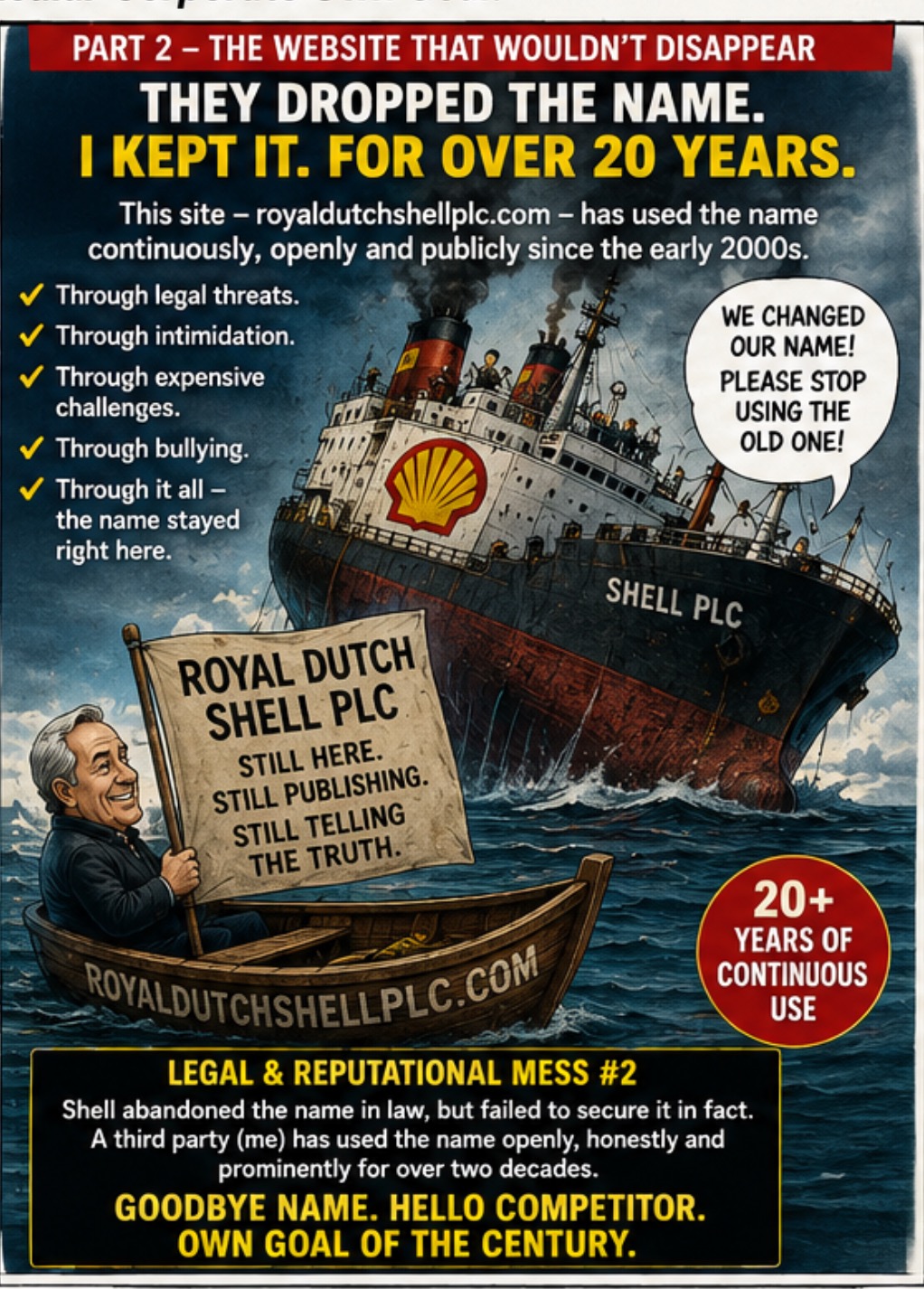
PART TWO: SPOOF PR / SPIN SECTION
Shell Announces “Strategic Corporate Afterlife Management Initiative”
A fictional Shell spokesperson, standing beside a polished tombstone engraved ROYAL DUTCH SHELL PLC — 2004–2022, today denied that the company had created any confusion whatsoever by abandoning one of the most recognisable names in global business history.
“Royal Dutch Shell plc is not dead,” the spokesperson insisted. “It has merely been transitioned into a legacy nomenclature environment.”
Asked whether the current company is actually Shell plc, the spokesperson replied:
“Yes, absolutely. Unless an old name is reputationally useful, legally inconvenient, historically embarrassing, algorithmically persistent, or accidentally revived by a chatbot.”
Asked whether Shell had lost a WIPO case involving royaldutchshellplc.com, the spokesperson adjusted his tie and said:
“We prefer to describe that as an early-stage domain outcome optimisation event.”
Asked whether the complaint was denied, the spokesperson said:
“The panel reached a conclusion that did not fully align with our preferred universe.”
Pressed on why the company dropped “Royal Dutch” from its name but now appears unable to stop the old name resurfacing online, the spokesperson unveiled a new Shell strategy document titled:
“You Can’t Say We Abandoned It If The Bots Keep Saying It Exists.”
The document reportedly contains five pillars:
- Forget the name.
- Deny the implications of forgetting the name.
- Allow the internet to remember the name incorrectly.
- Blame AI for the confusion.
- Hope nobody notices the critic still owns the domain.
The spokesperson concluded:
“Shell is committed to clarity. That is why we are Shell plc, formerly Royal Dutch Shell plc, previously Forthdeal Limited, historically Royal Dutch/Shell, globally Shell, locally confusing, digitally haunted, and absolutely not responsible for anyone asking why the corpse is still receiving dividend enquiries.”
At this point, a chatbot in the press room asked whether Royal Dutch Shell plc was alive or dead.
The spokesperson replied:
“That depends entirely on whether we are talking legally, reputationally, historically, algorithmically, financially, spiritually or in Dutch.”
The chatbot answered:
“Yes.”

PART THREE: SPOOF BOT-REACTION / COMMENT SECTION
Copilot
Verdict: Royal Dutch Shell plc is alive.
Translation:
“I found Shell. I found shares. I found oil. I found old data. I did not find the difference between a former legal name and a current company.”
Comment:
Classic corporate necromancy. Copilot put a hard hat on the corpse and sent it back offshore.
Claude
Verdict: Dead name, live underlying business.
Translation:
“The parrot is dead, but the pet shop continues trading as Shell plc.”
Comment:
A respectable performance. The bot located the pulse in the surviving legal entity rather than in the expired name badge.
Use.ai
Verdict: Not dead as a business, but no longer existing under that name.
Translation:
“The organism survived. The name tag did not.”
Comment:
Nearly correct. Needs the date pinned to 21 January 2022, not a looser trading-platform reflection date.
Companies House Bot
Verdict: SHELL PLC active. ROYAL DUTCH SHELL PLC previous name.
Translation:
“I am a filing system, not a séance.”
Comment:
The only entity in the room with no jokes, no hallucinations, and no need to ask Bing.
WIPO Bot
Verdict: Complaint denied.
Translation:
“Shell tried to seize the domain. Shell did not get the domain.”
Comment:
A quiet little sentence with a twenty-year echo.
Shell PR Bot
Verdict: There is no mess.
Translation:
“The mess is fully aligned with our values, governance model and stakeholder confusion strategy.”
Comment:
Currently beta-testing the phrase: “Legacy brand divestment with reputational residue.”
RoyalDutchShellPlc.com Bot
Verdict: Still here.
Translation:
“You changed the name. I kept the record.”
Comment:
Awkward for Shell. Very awkward for Shell. Increasingly awkward for the bots.
Final Line
Shell thought it could drop Royal Dutch Shell plc like an old boiler suit.
But names are not boiler suits. Names carry history. Names carry scandal. Names carry legal records, domain disputes, search results, archives, bots, ghosts and critics with long memories.
Shell abandoned the name.
The internet did not.
And now the former name of one of the world’s biggest companies is legally dead, digitally undead, and sitting on the front lawn of Shell’s reputation with a placard reading:
“You can change your name. You cannot delete your past.”
*This website and sisters royaldutchshellgroup.com, shellnazihistory.com, royaldutchshell.website, johndonovan.website, shellnews.net, and shellwikipedia.com, are owned by John Donovan - more information here. There is also a Wikipedia segment, the Shell DPA Files, "Shell and the Spies", the Shell Leaks files, the Independent Shell Archive, as well as books written and published by John Donovan - Kindle eBooks. Timeline of the Donovan Shell Feud. Toxic History of Royal Dutch Shell Group. Shell and the Donovans: The Full Media Record — 550+ Articles, 110 Books, 40 Years. *All conjured up by internet wizz, Nick Gill.







