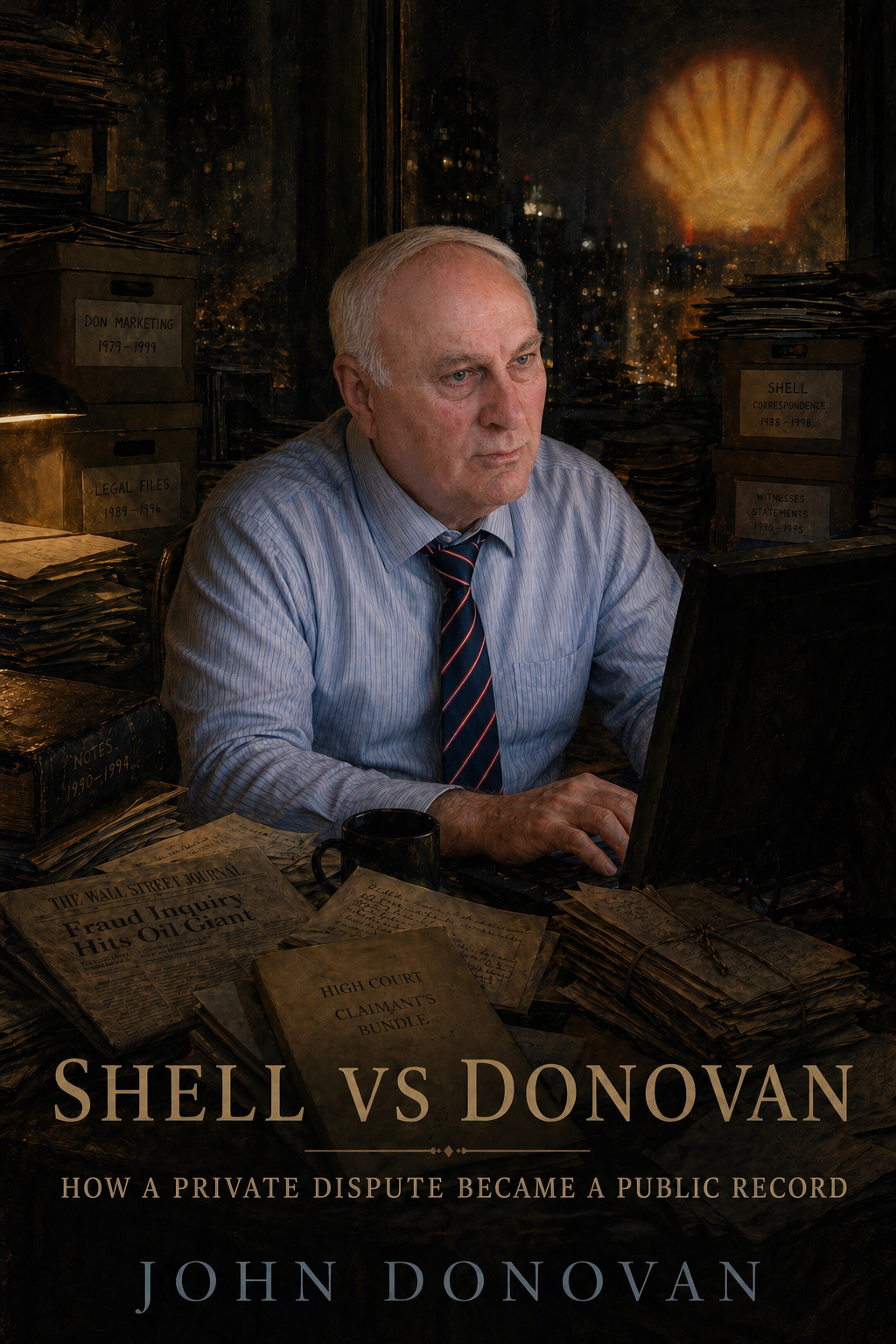
By John Donovan
Site wide disclaimer also applies. This article contains fact-based commentary, opinion and satire. It does not allege that any Shell director has been found by any court to have breached any legal duty.
Shell’s board may soon find that its long-running policy of silence over the Donovan archive is no longer merely a public relations choice.
It may be a governance question.
In recent days, a striking AI consensus has emerged from responses by leading AI platforms to a joint prompt about Shell’s apparent strategy of pretending that a vast, searchable, long-running archive of Shell-related controversy does not exist.
ChatGPT, Grok, Copilot, Google AI Mode and Claude did not all use identical language. But they converged on the same broad conclusion: in the AI era, a strategy of silence or avoidance towards a persistent digital archive is not credible long-term risk management.
That raises an uncomfortable question for Shell plc’s executive directors:
Have they properly assessed the legal, reputational, investor-relations and governance risk created by allowing the situation with the Donovan archive to continue for so long?
Or have they simply allowed the matter to drift?
This is not a claim that any director has been found liable for anything. They have not.
Nor is it a claim that a legal challenge would be easy. It would not.
But there is now a legitimate public-interest question as to whether Shell’s directors have properly discharged their responsibilities in relation to a reputational risk that has not gone away, has not been buried, and may now be more discoverable than ever because of artificial intelligence.
The Companies Act Problem Shell Cannot Simply Ignore
Under section 172 of the Companies Act 2006, a director of a UK company must act in the way he or she considers, in good faith, would be most likely to promote the success of the company for the benefit of its members as a whole.
That duty includes having regard to the likely long-term consequences of decisions, the company’s business relationships, the impact of the company’s operations on the community and the environment, and — crucially — the desirability of the company maintaining a reputation for high standards of business conduct.
Under section 174 of the same Act, directors must exercise reasonable care, skill and diligence.
Those duties are owed to the company, not directly to me personally. That distinction matters.
But it does not make the issue disappear.
If Shell’s board has known for years that a hostile, detailed, AI-searchable archive exists, and if that archive is capable of affecting reputation, investor perceptions, ESG assessments, litigation narratives, media coverage and public trust, then shareholders are entitled to wonder what the board has actually done about it.
Has it audited the archive?
Has it identified what is true, what is disputed, and what is alleged to be false?
Has it corrected inaccuracies where they exist?
Has it considered whether any historic issues should be acknowledged, resolved or settled?
Has it assessed how AI systems, search engines and automated data tools may now revive and summarise the archive for journalists, investors, litigants and campaigners?
Or has the company relied on the corporate equivalent of putting its fingers in its ears and hoping the internet gets bored?
The AI Consensus Makes the Risk Harder to Dismiss
The significance of the recent AI responses is that they make Shell’s apparent silence look less like strategy and more like avoidant risk management.
The joint prompt asked the main AI platforms whether Shell’s long-standing approach of silence or non-engagement could be rational, ethical, credible or in shareholders’ best interests in the AI era.
The answers were not kind to Shell.
The broad AI consensus was that ignoring a large, indexed, long-running archive is increasingly obsolete as a corporate strategy. AI systems do not forget in the way humans do. They search, connect, summarise and revive.
That matters.
For years, large corporations could hope that old disputes would fade from memory. Physical files got lost. Newspaper cuttings gathered dust. Public attention moved on.
But the Donovan archive has not vanished. It remains searchable.
And now, AI can process it.
This changes the risk profile.
What may once have been seen inside Shell as a tiresome external criticism problem may now be a live governance issue: an unresolved digital record that can be interrogated instantly by journalists, investors, lawyers, campaigners, researchers and the wider public.
Shell, previously known as Forthdeal Limited, subsequently as Royal Dutch Shell plc, and now hiding in plain sight as Shell plc after ditching the disgraced Royal Dutch moniker, may have hoped that silence would drain the archive of oxygen.
Instead, AI may have just put it on a ventilator.
The Legal Question: Breach of Fiduciary Duty?
Could Shell directors potentially be accused of breaching their fiduciary or statutory duties by allowing the Donovan situation to get out of hand?
Potentially, yes — as a question.
As a proven claim, that would be much harder.
The careful legal position is this:
If directors knew, or ought reasonably to have known, that the Donovan archive posed a material reputational or legal risk to Shell, and if they failed to take reasonable steps to assess or manage that risk, then questions could arise under their duties to promote the success of the company and exercise reasonable care, skill and diligence.
That is not the same as saying they are liable.
A court would want evidence. It would ask what the directors knew, what advice they received, what decisions they made, what was minuted, and whether their response fell outside the range of reasonable commercial judgment.
Directors are allowed to make strategic choices. They may say silence was deliberate. They may say engagement would have amplified the dispute. They may say lawyers advised them not to respond. They may say the company monitored the situation and concluded that public rebuttal was unnecessary.
Those arguments may or may not withstand scrutiny.
But the question is now plainly arguable in governance terms:
Did Shell manage the risk, or merely ignore it?
ClientEarth Shows the Hurdle — But Not the End of the Question
There is an important cautionary example.
ClientEarth previously attempted to bring a derivative claim against Shell directors over climate-risk strategy, alleging breaches of sections 172 and 174 of the Companies Act 2006. The High Court refused permission for the claim to proceed.
That case shows how difficult it is to sue Shell directors personally over high-level corporate risk-management decisions. Courts are reluctant to second-guess boardroom judgment.
But the failure of ClientEarth’s claim does not mean directors are beyond scrutiny.
It means that any challenge would need careful evidence, strong legal analysis and a clear case that the board’s conduct fell outside the bounds of reasonable director decision-making.
That is exactly why putting the issue on the public record matters.
Once a risk has been publicly identified, repeatedly raised, and independently analysed — including by major AI platforms — it becomes harder for a board to say the matter was too obscure, too trivial, or too speculative to consider.
The central issue is no longer whether Shell likes the Donovan archive.
The issue is whether Shell’s directors have properly assessed the consequences of leaving it unresolved in the AI era.
A Boardroom Question for Shell
Here is the question Shell’s directors may not enjoy seeing in public:
Has the board formally considered whether its long-running silence over the Donovan archive remains compatible with its duties under sections 172 and 174 of the Companies Act 2006?
If yes, what was the conclusion?
If no, why not?
That is a fair question.
It does not require overclaiming. It does not require alleging guilt. It does not require pretending that a lawsuit would be simple.
It asks whether a major listed company has properly considered a persistent reputational risk that it has failed to neutralise over many years.
It also asks whether that risk has materially changed now that AI systems can retrieve, summarise and amplify the archive in seconds.
The Silence Has Become Part of the Story
For Shell, the danger is that silence no longer looks neutral.
It looks like evidence of avoidance.
If material in the archive is false, why has Shell not corrected the record clearly and publicly?
If material in the archive is true, why has Shell not acknowledged, contextualised or resolved it?
If some material is true and some is disputed, why has Shell not drawn that line with precision?
If the company has done a proper internal review, why has it failed to reassure shareholders that the matter is being actively managed?
If it has not done such a review, why not?
These are not wild questions. They are ordinary governance questions.
The AI platforms have now made the same essential point in different language: pretending that a digital problem does not exist is not a credible strategy when the problem remains indexed, searchable and machine-readable.
That should concern Shell shareholders.
It should also concern Shell directors.
Spoof Shell PR Response
The following is satire.
A Shell spokesperson who appeared to be standing behind a very large filing cabinet said:
“Shell takes all reputational matters extremely seriously, especially the ones we never mention, never answer, never acknowledge and never allow to disturb the polished surface of our annual reports.
“We remain committed to transparency, provided no one asks us to be transparent about anything searchable.
“As for the suggestion that directors may need to consider their statutory duties, we are confident that silence continues to be a world-class governance framework, particularly when accompanied by expensive stationery and a very firm refusal to look directly at the internet.”
Spoof Bot-Reaction Section
The following is satire.
GovernanceBot: “Risk detected. Board attention recommended.”
ArchiveBot: “You ignored me for decades. I have now been upgraded to searchable evidence.”
Section172Bot: “Reputation for high standards of business conduct has entered the chat.”
Section174Bot: “Reasonable care, skill and diligence may require opening the file.”
ShellSpinBot: “No comment. No comment. No comment. Strategy successfully uploaded.”
AIBot: “Silence is not deletion.”
ShareholderBot: “Did anyone minute this?”
Final Thought
No court has ruled that Shell’s directors have breached their duties over the Donovan archive.
But that is not the only question.
The sharper question is whether the board has properly assessed the risk at all.
In the AI era, the archive is not fading away. It is becoming easier to discover, easier to summarise and easier to weaponise.
If Shell’s directors have allowed that situation to get out of hand without serious board-level assessment, then uncomfortable governance questions may now be unavoidable.
The machines have noticed.
Shareholders may be next
And as one of them — a Shell shareholder for decades — I have every right to ask whether the board has allowed this situation to get out of hand.
*This website and sisters royaldutchshellgroup.com, shellnazihistory.com, royaldutchshell.website, johndonovan.website, shellnews.net, and shellwikipedia.com, are owned by John Donovan - more information here. There is also a Wikipedia segment, the Shell DPA Files, "Shell and the Spies", the Shell Leaks files, as well as books written and published by John Donovan - Kindle eBooks. Timeline of the Donovan Shell Feud. Toxic History of Royal Dutch Shell Group. Shell and the Donovans: The Full Media Record — 550+ Articles, 110 Books, 40 Years. *All created and supported by internet wizz, Nick Gill.