ChatGPT image above
A dramatic courtroom-oilfield montage: a vast offshore oil block labelled “OPL 245” rising out of dark water, with Shell and Eni logos reflected in an oil slick; in the background, a European courthouse, Nigerian government papers, and a large OECD magnifying glass hovering over the scene. Tone: investigative, cinematic, darkly satirical.

Article
Just when Shell and Eni might have hoped the Malabu/OPL 245 saga had finally been lowered into the corporate memory hole, along comes another institutional shovel.
The latest twist is not a fresh criminal conviction. Nor is it proof that Shell or Eni have been found guilty of corruption. They have not. The companies and executives were acquitted in Italy in 2021, and those acquittals became definitive after the appeal route was abandoned in 2022.
That point matters.
But so does this one: OPL 245 remains one of the most extraordinary oil-industry scandals of the modern era — a legal, political and reputational swamp so deep that even after acquittals, discontinued lawsuits, settlements, arbitration manoeuvres, and official statements declaring closure, the smell still keeps escaping through the floorboards.
According to Sahara Reporters, non-governmental organisations monitoring the case say the OECD Working Group on Bribery has undertaken to examine concerns about alleged political interference in Italy’s handling of the OPL 245 proceedings. The reported development follows Italy’s Supreme Court decision on 18 June 2026 overturning the convictions of two Milan prosecutors, Fabio De Pasquale and Sergio Spadaro, who had led the corruption case against Eni, Shell and others.
The NGOs — including The Corner House, ReCommon, HEDA and Hawkmoth — say the OECD had previously indicated it would examine concerns once the proceedings against the prosecutors had concluded.
In plain English: the case may have legally ended for Shell and Eni, but the battle over how that case was handled has not.
And OPL 245, that magnificent corporate zombie, is once again wandering across the landscape with a file marked “unfinished business” tucked under its decomposing arm.
The old Dutch warning bell
The second linked article, republished by Yahoo Finance from Reuters, dates back to March 2019. It reported that Dutch prosecutors were preparing criminal charges against Royal Dutch Shell over the $1.3 billion acquisition of the Nigerian offshore oilfield OPL 245.
That was part of the earlier international legal pressure surrounding the deal. Shell said at the time that it had been informed by the Dutch Public Prosecutor’s Office that the investigation was nearing its conclusion and that prosecutors were preparing charges directly or indirectly related to the 2011 settlement of disputes over OPL 245.
The Dutch development was serious at the time, but it should not be confused with a fresh 2026 prosecution announcement.
In 2022, Shell publicly welcomed the dismissal of the Dutch investigation, saying it marked the end of the criminal investigation in the Netherlands and followed the withdrawal of the Milan prosecutor’s appeal, which had ended criminal proceedings and confirmed the Milan Tribunal’s acquittal of Shell and four former employees.
So, no: Dutch prosecutors have not suddenly emerged in 2026 with flaming torches and fresh charges.
But the 2019 Reuters report remains important background because it shows how seriously multiple jurisdictions once treated the OPL 245 affair. Italy, the Netherlands, Nigeria, the United Kingdom and others all had a turn peering into the barrel. This was never some minor clerical misunderstanding over an invoice for office furniture.
This was one of the world’s most valuable oil blocks, a $1.3 billion transaction, a former Nigerian oil minister, alleged flows to intermediaries, and the familiar Shell speciality: insist everything is lawful while the archive grows teeth.
The original sin: a licence awarded into a fog
OPL 245 is no ordinary oil block. It is a deep-water offshore licence off Nigeria, long described as holding enormous reserves, often reported at up to around 9 billion barrels of oil. For nearly three decades, however, it has been less a producing asset than a geopolitical swamp.
The story begins in 1998, under the military regime of General Sani Abacha, when OPL 245 was awarded to Malabu Oil & Gas. The central controversy has always been that Malabu was linked to Dan Etete, Nigeria’s then petroleum minister. In other words, the minister responsible for oil matters was associated with the company that received one of Nigeria’s most valuable oil prizes.
Even by the standards of oil politics, this was not exactly a model UN seminar on transparency.
Over the following years, the licence was revoked, reassigned, litigated, restored, disputed and eventually drawn into a 2011 deal involving Shell and Eni. The companies paid the Nigerian government for rights connected to the block, while the Nigerian government transferred funds to Malabu. Prosecutors and campaigners alleged that large sums were then diverted to politicians and intermediaries. Shell and Eni denied wrongdoing.
The Italian prosecution became the central courtroom drama. In March 2021, a Milan court acquitted Eni, Shell and all defendants of corruption charges. In 2022, the appeal was withdrawn, making the acquittals final under Italian law.
That is the legal reality.
The reputational reality is considerably messier.
The prosecutors cleared — and the plot reopens
The new 2026 twist concerns the Milan prosecutors themselves.
Fabio De Pasquale and Sergio Spadaro had previously been convicted by lower courts over allegations connected to the handling of documents in the OPL 245 trial. Italy’s Court of Cassation has now overturned those convictions and cleared them.
TheCable, citing Reuters, reported that the court ruled “the offence does not exist.” The NGOs welcomed the decision as vindication for the prosecutors and argued that it undermines claims that the prosecutors’ conviction supported the narrative that no bribes were paid.
Here we enter the truly Italian opera section of the scandal: prosecutors prosecuted for prosecuting, later cleared by the highest court, while NGOs say the whole episode may reveal a wider failure of anti-corruption enforcement.
You almost expect the next hearing to be held inside a hall of mirrors.
The NGOs are not saying Shell and Eni have just been convicted. They are arguing something more institutional: that Italy’s handling of the case may have been compromised by political interference or systemic pressure inconsistent with the OECD Anti-Bribery Convention.
That distinction is crucial.
This is now less about whether a court will retry Shell and Eni in Italy, and more about whether the international anti-bribery system itself was weakened by the way the case was handled.
The OECD angle: Article 5 and the politics problem
The OECD Anti-Bribery Convention is designed to stop companies and states from treating foreign bribery as an unfortunate but useful lubricant of global commerce. Article 5 is especially important. It says investigations and prosecutions of foreign bribery must not be influenced by considerations of national economic interest, relations with another state, or the identity of the persons or companies involved.
Translated from diplomatic prose: don’t go soft because the defendant is powerful, economically useful, politically connected, or nationally embarrassing.
The NGOs claim they submitted a dossier identifying numerous red flags in Italy’s handling of OPL 245. Sahara Reporters says the OECD Working Group on Bribery had previously undertaken to examine those concerns after the case against De Pasquale and Spadaro concluded.
That moment has now arrived.
If the OECD does investigate and finds Italy failed to comply with Article 5 obligations, it would not automatically convict Shell or Eni of anything. It would, however, be another humiliating chapter in a case that already reads like a compliance textbook written by Franz Kafka after a long lunch with an oil trader.
Meanwhile, Nigeria tries to move on — by cutting up the prize
As the legal arguments continue, Nigeria has been attempting to turn OPL 245 from scandal museum-piece into producing asset.
In March 2026, the Federal Government of Nigeria and Eni reached an agreement concerning the conversion of OPL 245 into new licences. Eni says the deal includes settlement of claims related to OPL 245, discontinuation of ICSID arbitration, and conversion into two development licences — PML 102 and PML 103 — and two exploration licences — PPL 2011 and PPL 2012 — involving Nigerian Agip Exploration Limited as operator, alongside NNPC and Shell Nigeria Exploration and Production Company.
In corporate language, this “paves the way” for development.
In normal language, Nigeria is trying to get the thing out of the legal morgue and into production before another generation of lawyers retires on the proceeds.
But Malabu is not going quietly. In May 2026, Malabu Oil & Gas filed a fresh suit in Nigeria challenging the conversion and splitting of the licence, seeking to quash the restructuring and claiming ₦1 trillion in damages. It argues the restructuring was unlawful and occurred despite pending litigation.
Thus OPL 245 continues its impressive transformation from oil block into perpetual motion litigation machine.
Shell, previously known as Forthdeal Limited, subsequently as Royal Dutch Shell plc, and now Shell plc after ditching the disgraced Royal Dutch moniker, remains attached to the story through SNEPCO and the long history of the 2011 transaction.
The asset may yet be developed. But if it is, the first barrel should perhaps be ceremonially accompanied by a choir of lawyers humming “Here We Go Again.”
Shell and Eni’s defence: acquitted, final, lawful
Fairness requires stating the companies’ position clearly.
Eni maintains that it acted lawfully and that the Italian courts confirmed there was no case to answer. Its public OPL 245 page states that the Milan Tribunal acquitted Eni, CEO Claudio Descalzi and others on every count in March 2021, and that after the appeal was waived in July 2022 the verdicts became definitive under Italian law.
Shell has likewise relied on the final acquittals and the closure of criminal proceedings. It also welcomed the dismissal of the Dutch investigation.
Those facts should not be brushed aside. In law, acquittals matter. Courts matter. Final judgments matter.
But journalism, commentary and public-interest scrutiny do not end the moment a company’s lawyers declare the matter closed. Especially when the public record includes leaked emails, prosecution allegations, cross-border investigations, NGO dossiers, government settlements, discontinued cases, and a supposedly finished scandal that keeps generating new proceedings like an oilfield with a litigation reservoir beneath it.
Legal closure is not moral closure
OPL 245 has always occupied the uncomfortable zone between legal outcome and public accountability.
Shell and Eni were acquitted. That is fact.
The block’s original award to a company linked to the serving petroleum minister remains a grotesque governance episode. That is also fact.
The 2011 deal became the subject of one of the largest international corruption trials in oil-industry history. Fact.
Dutch prosecutors once prepared charges against Shell before the matter was later dismissed. Fact.
Italy’s highest court has now cleared the prosecutors who led the case after their own convictions were overturned. Fact.
NGOs say the OECD is expected to examine concerns about political interference. Fact, according to the groups reported by Sahara Reporters.
Nigeria is trying to restructure the asset and move forward. Fact.
Malabu is suing again. Fact.
This is why OPL 245 refuses to die. It is not just a legal file. It is a parable about extractive capitalism, state weakness, corporate risk appetite, and the magical ability of oil money to turn public assets into private labyrinths.
The Shell problem
For Shell, the reputational problem is brutally simple.
Even when it wins legally, it often loses narratively.
The company can point to acquittals, dismissed investigations, discontinued claims and settled disputes. Its lawyers can wave the judgments. Its executives can speak solemnly about compliance and lessons learned. Its press office can polish the usual brass plaque reading “We welcome the outcome.”
But OPL 245 still sits in the public record as a grotesque case study in how an oil major ended up tied to one of the most controversial resource deals in African history.
No conviction is needed for reputational damage. Sometimes the documents, the history, the secrecy and the surrounding cast are quite sufficient.
And when the OECD angle now raises questions about whether Italy’s anti-bribery enforcement was undermined by political interference, the story shifts from “were Shell and Eni guilty?” to “did the system itself perform as it should?”
That is a much harder story for corporate communications to bury.
Conclusion: the scandal that walked out of court but never left the room
OPL 245 is not a simple story of proven corporate criminality. The principal corporate defendants were acquitted.
But it is also not a simple story of innocence purified by courtroom sunlight.
The new OECD-related development means the scandal may be entering yet another phase — not a retrial of Shell and Eni, but a review of the conditions under which one of the world’s most significant foreign-bribery cases collapsed.
Meanwhile, Nigeria wants the block developed. Eni says the licence conversion clears a path forward. Shell remains part of the asset structure. Malabu is back in court. NGOs are pressing the OECD. And the archive, as usual, is refusing to behave itself.
So, yes, OPL 245 may have walked out of court.
But it has not left the building.
It is still there, dripping oil on the carpet, smiling at the lawyers, and reminding Shell that some scandals do not end.
They merely change jurisdiction.
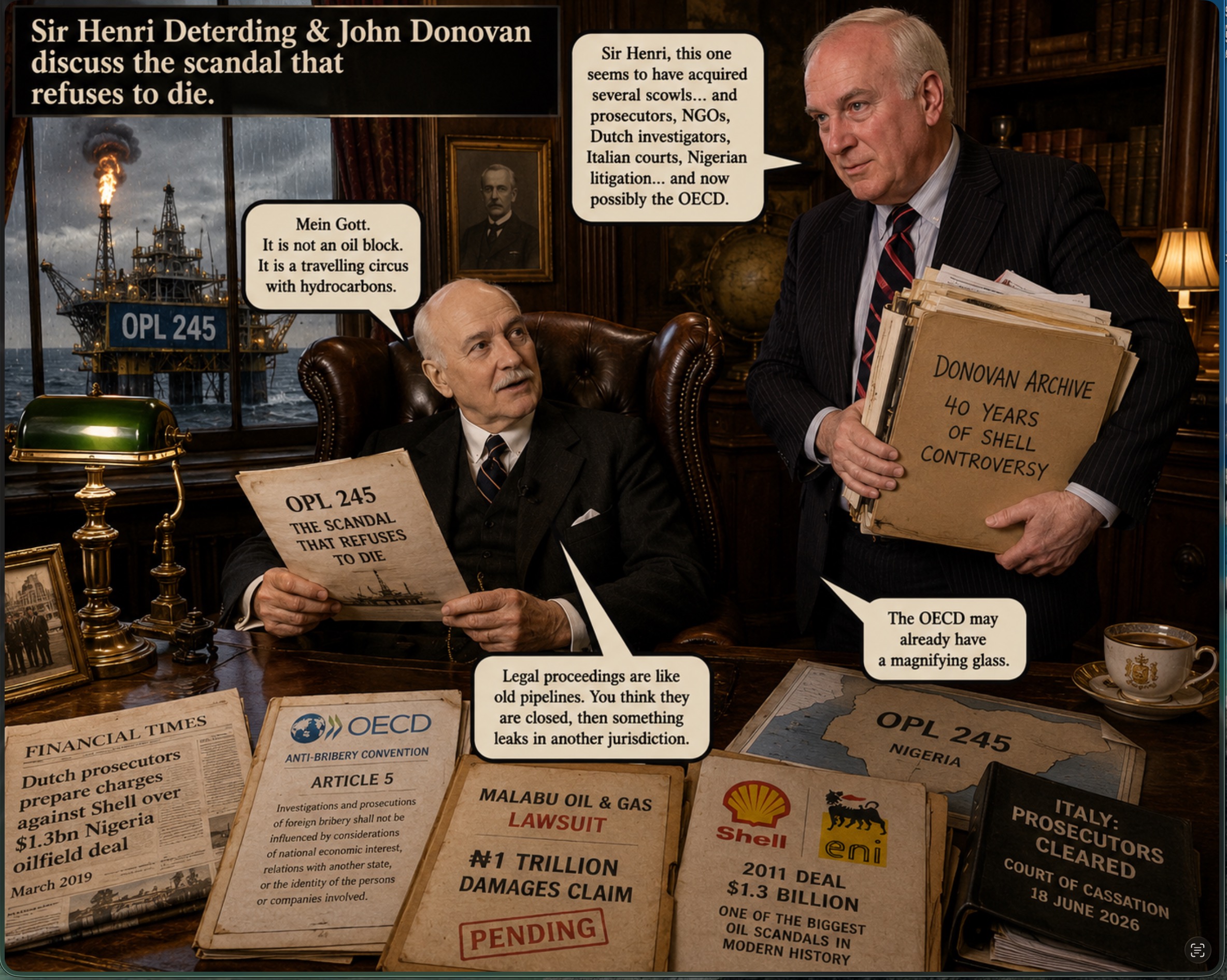
Sir Henri Deterding and John Donovan skit
Scene: A gloomy study. Sir Henri Deterding sits in a high-backed chair, reading the latest OPL 245 papers. John Donovan stands nearby with a thick archive folder.
Deterding: Ach… again with this Malabu business? In my day, an oil concession was at least obtained with a proper imperial scowl.
Donovan: This one seems to have acquired several scowls, Sir Henri. Also prosecutors, NGOs, Dutch investigators, Italian courts, Nigerian litigation, and now possibly the OECD.
Deterding: Mein Gott. It is not an oil block. It is a travelling circus with hydrocarbons.
Donovan: Shell and Eni were acquitted in Italy. That must be stated fairly.
Deterding: Ja, ja. The lawyers have their victory parade. But why does the parade keep passing the same burning building?
Donovan: Because the OECD angle is not about retrying Shell. It is about whether Italy’s handling of the case met anti-bribery standards.
Deterding: Standards! In modern oil business, they put standards in the annual report and then hope nobody brings a ruler.
Donovan: Shell would say the legal proceedings are over.
Deterding: Legal proceedings are like old pipelines. You think they are closed, then something leaks in another jurisdiction.
Donovan: Malabu is also suing over Nigeria’s decision to split the asset.
Deterding: Naturally. When the cake is so large, every diner remembers he brought a fork.
Donovan: And Shell remains involved through SNEPCO.
Deterding: This, I do not approve. If one must be controversial, at least be efficiently controversial. This scandal has taken nearly thirty years and still cannot find the exit.
Donovan: Perhaps that is the lesson.
Deterding: No. The lesson is simpler. When a company says, “This matter is closed,” always check whether the door is actually locked.
Donovan: And if it isn’t?
Deterding: Then publish, Mr Donovan. Publish before the next committee arrives with a magnifying glass.
Donovan: The OECD may already have one.
Deterding: Na ja. Then Shell should polish the floor. Inspectors dislike slipping in old oil.
ChatGPT meme
Classic “This Is Fine” meme concept: a suited Shell executive sits calmly in a boardroom surrounded by flames labelled “OPL 245”, “OECD Article 5”, “Dutch Investigation Archive”, “Malabu Lawsuit”, and “Italian Prosecutors Cleared.” Speech bubble: “This is legally resolved.” Caption below: “OPL 245: The scandal that keeps finding another door.”
Disclaimer
This article is opinion and commentary based on publicly available reports and source material. It is not a finding of criminal liability or civil wrongdoing against Shell plc, Eni, their subsidiaries, executives, former executives, employees, or any other party. Shell, Eni and individuals connected with the OPL 245 proceedings have denied wrongdoing, and Shell and Eni were acquitted in the Italian criminal proceedings. Nothing in this article should be read as financial advice, investment advice, or a recommendation to buy, sell or hold any security. Site-wide disclaimer also applies.
*This website and sisters royaldutchshellgroup.com, shellnazihistory.com, royaldutchshell.website, johndonovan.website, shellnews.net, and shellwikipedia.com, are owned by John Donovan - more information here. There is also a Wikipedia segment, the Shell DPA Files, "Shell and the Spies", the Shell Leaks files, as well as books written and published by John Donovan - Kindle eBooks. Timeline of the Donovan Shell Feud. Toxic History of Royal Dutch Shell Group. Shell and the Donovans: The Full Media Record — 550+ Articles, 110 Books, 40 Years. *All created and supported by internet wizz, Nick Gill.