By John Donovan
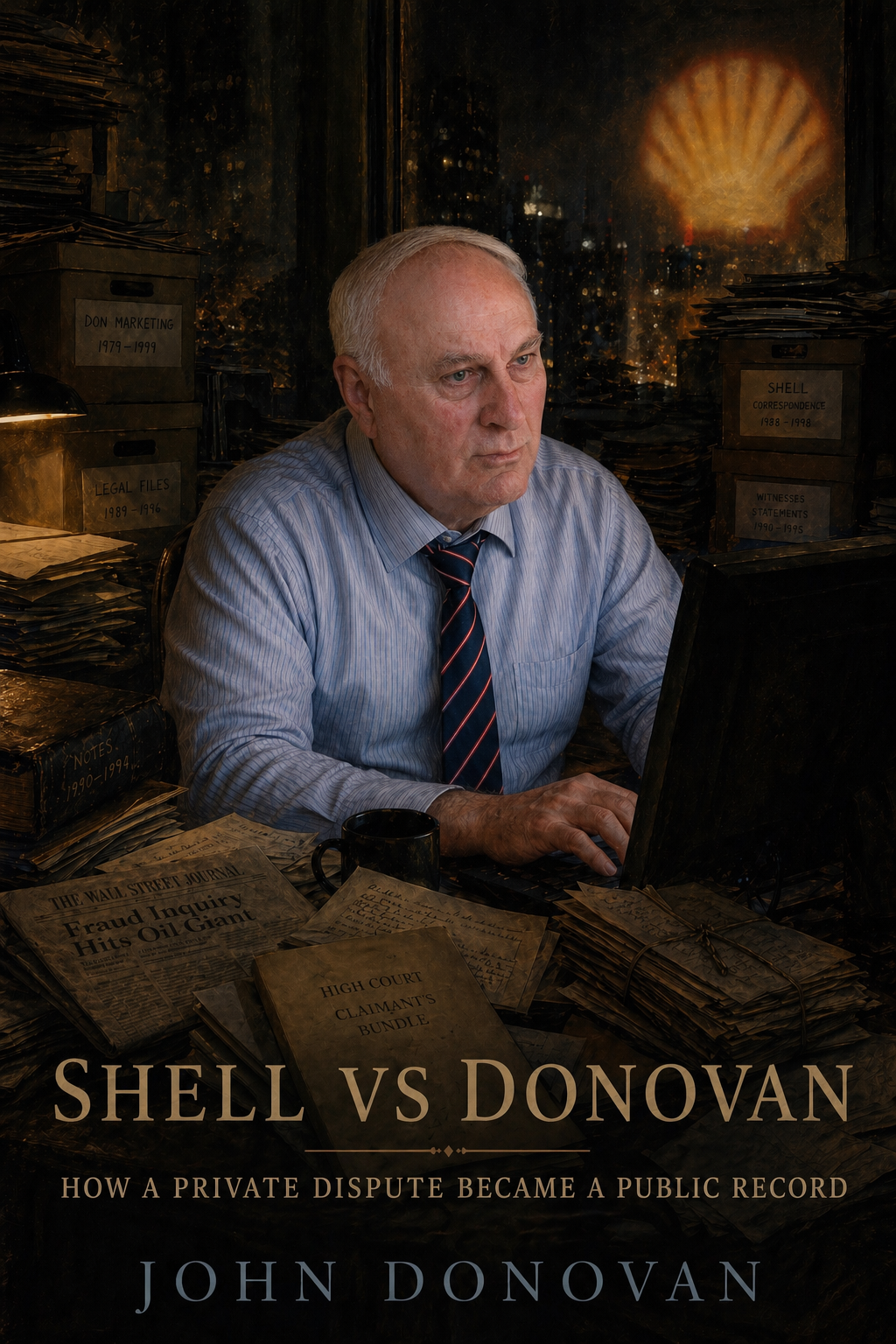
A tabloid-satirical rewrite of Chapter 16 of the John Donovan Shell archive: “Our activities caught the attention of the news media.”
Source chapter: CHAPTER 16: Our activities caught the attention of the news media, first published 27 October 2018 and later modified on 8 November 2021.

Every large corporation likes to imagine it controls its story. Shell had annual reports, polished statements, lawyers, global communications teams and enough corporate vocabulary to stun a conference hall. Then along came the Donovan websites: stubborn, searchable, awkward, colourful, and apparently very hard for the oil giant to swat.
Chapter 16 records how the long feud between Shell and the Donovan family escaped the private filing cabinet and became a media story in its own right. The press noticed. Public-interest groups noticed. Whistleblowers noticed. Even Shell insiders, according to the coverage, noticed where uncomfortable information was getting published.
The result was a strange modern spectacle: one of the world’s biggest energy companies being needled by a family-run website from Colchester, with journalists periodically arriving to ask why the small website kept making the big company twitch.
The Media Discovers Shell’s Online Thorn
The Sunday Telegraph published Juliette Garside’s “Online revolutionaries” article in 2007. The original Telegraph URL now returns a blocked response, so it is not retained as a live source link here, but Chapter 16 preserves the reference and screenshot material. The point of the article was clear: activists and critics were no longer merely shouting from pavements. They were publishing, linking, archiving and embarrassing large companies from behind keyboards.
The Times also took notice, with Martin Waller’s City Diary column describing Shell as having been at war since the 1990s with the family behind royaldutchshellplc.com. The chapter’s extract captures the essential tabloid flavour: Shell had failed to shut the site down, and the site had attracted everything from job applications to alleged threats, which were passed on to the company.
The Financial Times joined the chorus. Ed Crooks described RoyalDutchShellPlc.com as an anti-Shell website run by a father-and-son partnership that had become a long-running thorn in Shell’s side. That may not be a corporate communications award, but as reputational summaries go, it has a certain brutal efficiency.
The Gripe Site That Became A Watchdog
The One World Trust, an independent research organisation associated with the UK Houses of Parliament and the United Nations, treated the site as more than a personal protest page. Its July 2007 Accountability in Action newsletter described RoyalDutchShellPlc.com as a gripe site that had played a watchdog role over Shell and acted as a gathering point for complaints.
That is the bit Shell could never quite laugh off. A gripe site is supposed to sound small: a cranky little noticeboard in the internet attic. But One World Trust credited it with helping hold a global organisation to account, especially on Sakhalin. Suddenly the attic had a spotlight, filing cabinets and an international readership.

Whistleblowers, Safety And The Daily Mail
The media attention was not just about internet novelty. It was about substance: leaks, safety, Shell insiders and campaigners. The Daily Mail published Shell on back foot as gripe site alleges safety concerns on 1 September 2007. The source chapter also links an EIN Presswire item headed Offshore workers died as a result of a touch f*** all safety regime at Royal Dutch Shell, connected with retired Shell HSE Group Auditor Bill Campbell.
When safety auditors, whistleblowers and journalists all start orbiting the same website, the phrase “just a gripe site” begins to look a little desperate. In tabloid terms: Shell’s internet headache had grown legs, found a fax machine, and started talking to reporters.
Reuters, Prospect, Nikkei And The Whistleblower Conduit
Reuters also noticed the site. The original Reuters UK URLs now redirect to blocked Reuters pages, so they are not retained as live links here. But the source chapter and the broader RoyalDutchShellGroup media-record page preserve the trail, including the 2007 Reuters report on a Shell executive leaving the troubled Kashagan project and the 2009 Reuters report describing John Donovan as a prominent internet critic of Shell.
Prospect Magazine published Shell’s Colchester Headache, describing the website as essential reading for anyone covering Shell and the wider energy sector. That is quite a sentence. Shell had a corporate headquarters; the Donovans had a website. Yet for reporters, the latter was becoming a place to look when the former was saying too little.
Nikkei BP, a major Japanese business publication, ran Gripe sites are becoming more powerful, pointing to Sakhalin II and the role of Alfred and John Donovan. The Japanese angle mattered because Sakhalin involved Japanese companies Mitsui and Mitsubishi as well as Shell. A family website in Britain had somehow become relevant to a Russian energy project, Japanese business readers, and Shell’s international embarrassment. That is not a bad day’s work for a so-called gripe site.

Wall Street Journal, Leaks And The Shell Memo Machine
The Wall Street Journal also made an appearance in the archive, with Guy Chazan’s 2008 article on Shell output issues. The chapter links a working image copy, Shell Addresses Output Issue, noting that a memo from Shell’s Jeroen van der Veer had been given to RoyalDutchShellPlc.com, a website regularly used by Shell whistleblowers.
This is where Shell’s communications problem became almost comic. The company had internal memos. The website had readers. Somehow the memos kept migrating toward the readers. Shell may have called it leakage. Journalists called it material.
Shell’s Reputation: A Brand With Bruises
Chapter 16 also places the Donovan websites inside a broader Shell reputation problem. RoyalDutchShellPlc.com linked the article VW challenges Shell as world’s most hated brand after emissions scandal, the Guardian’s The world’s most hated company: can NGOs help turn Shell’s reputation around?, and PRWeek’s Shell remains world’s most hated brand.
The point is not that the Donovan websites single-handedly created Shell’s reputation problems. Shell managed quite a lot of that on its own. Nigeria, Brent Spar, Sakhalin, Arctic drilling, safety controversies and climate criticism all did their share. But the websites gave those stories a persistent archive: a place where Shell’s bad days refused to evaporate.
The chapter reaches back to the Guardian’s 1997 article Unloveable Shell, the goddess of oil, which covered pollution, corruption, violence and extra-judicial murder. In other words, Shell was unloved long before social media made corporate shame travel at broadband speed.

Final Word: The Website Shell Could Not Make Disappear
Chapter 16 is ultimately about a media transformation. The Donovan websites began as a protest and archive arising from a bitter dispute with Shell. Over time, they became a public record, a leak repository, a campaign amplifier and a reference point for journalists writing about Shell.
For Shell, that was the nightmare. Not a single hostile article, not a one-day embarrassment, but an archive that kept resurfacing. The company could issue statements. The website could issue links. And links, unlike corporate soothing noises, have an irritating habit of still being there when the next reporter comes looking.
So yes, the media noticed. The watchdogs noticed. The whistleblowers noticed. And Shell, judging by the volume of attention, certainly noticed. A family website from Colchester had become an oil giant’s recurring headline problem.
Working Source Links Retained From The Chapter
The following working links are retained from the source chapter, excluding social-share links, blocked Reuters and Telegraph URLs, and a missing Times PDF.
- Source chapter: CHAPTER 16
- Financial Times / Energy Filter: Stirring words on Sakhalin
- One World Trust: Accountability in Action newsletter
- RoyalDutchShellPlc.com
- Daily Mail: Shell on back foot as gripe site alleges safety concerns
- EIN Presswire: Offshore workers died as a result of a touch f*** all safety regime at Royal Dutch Shell
- Prospect Magazine: Shell’s Colchester Headache
- Nikkei BP: Gripe sites are becoming more powerful
- Wall Street Journal image: Shell Addresses Output Issue
- When Winston Churchill accused Shell of secret oil price rigging
- TV, radio, newspaper and magazine coverage relating to RoyalDutchShellPlc.com
- VW challenges Shell as world’s most hated brand after emissions scandal
- The Guardian: The world’s most hated company
- PRWeek: Shell remains world’s most hated brand
- The Guardian: Unloveable Shell, the goddess of oil
- Media record: several hundred articles referencing RoyalDutchShellPlc.com or its founders
Screenshot Exhibits Retained From The Source Chapter
- Screenshot exhibit 1
- Screenshot exhibit 2
- Screenshot exhibit 3
- Screenshot exhibit 4
- Screenshot exhibit 5
- Screenshot exhibit 6
- Screenshot exhibit 7
- Screenshot exhibit 8
- Screenshot exhibit 9
- Screenshot exhibit 10
- Screenshot exhibit 11
- Screenshot exhibit 12